



Harvest Moon Farm, located in southern Indiana, is a small operation. 34 years ago my husband and I bought 5 acres, half of which are wooded. When we started farming this acreage 24 years ago, it seemed we had all the land we could desire for future expansion. By our 10th year of market farming, I wasn’t quite so certain. With no present options for buying adjoining land, we adopted a “small is beautiful” philosophy and began to brainstorm ways we could grow our farm’s profits without growing its size. We discovered that DIVERSITY was at least part of the answer to our dilemma.
This diversity solution was not something we actually decided to do, but rather was something we were drawn towards one step at a time with no clear vision as to where it would take us. It was driven primarily by an intense passion for agricultural “experiments’” and an enthusiastic quest to learn how to grow first this and then that, followed by an exploration of where we could sell the results of our efforts.
We’ve discovered that growing and selling a multitude of products and having various marketing venues has given us “profit insurance:” If a farmers market is stormy one week, our other selling sites not affected by the weather help keep our farm running in the black. If a certain product is not suitable for one marketing outlet, it’s often desired in another.
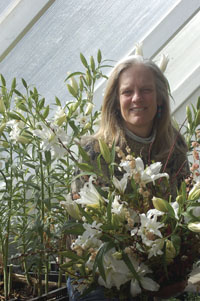
In retrospect, we were already diversifying from the beginning, growing over 75 species of flowers in our fields (and later, hoophouses), having discovered that this variety gave our arranged bouquets distinct textural and eye-catching appeal for our market and bridal customers. Every year we add new varieties of flowers and woody bushes, trial testing whether they add more synergy and interest to the stalwart standards we’ve grown year after year.
When we first started farming, farmers markets were not all that common or popular yet. We were lucky that our local college town had a small but well-attended market. It was a good small arena for us to cut our teeth on our new trade and slowly learn our skills. Then, some 15 years ago, markets started springing up in many populated areas and we were ready to ramp up our production for more markets. For years now in the warm months we have participated in three weekly markets, selling primarily our flowers. One market is in a college town, one is in a downtown urban setting and the other is in an upscale urban neighborhood. Each market is distinctly different and we have learned that what might not be very popular at one market is sought after at another.
Though it creates a major space crunch in March and early April, we have always grown extra bedding plants beyond what we need for our operation in the spring. This part of our business has grown over the years as our facilities grew and ready-to-plant garden plants got more popular with farmers market folks. Recently we built two short little cold frames that hold about 400 1-gallon potted perennials over the winter and these have really boosted our sales. It’s an intense amount of labor, nurturing hundreds of plant trays and pots when fields need to be prepared, planted and mulched, but bedding plants plug us right in economically at our April, May and early June markets.
Because we put a lot of effort into the aesthetics of our farm overall, we decided eight years ago to also have plant sales on the farm on Sunday and Monday afternoons in May. A number of people want to see our place, so this is one way we can offer that and still get paid for our time. We’re currently thinking up other ways folks can visit, particularly during July and August when the place is in high season. The trick is, it has to pay and it has to demand very little from us…picnic dinners have been a thought. Visitors bring all the plates/food and take the clean-up home; we offer a well-set table with flowers and privacy (!) and charge a per head fee…we just might try it this year.
Some 10 years ago, the ‘chef-to-farmer’ movement caught on in our local community. A new creative chef in our town solicited several of us to grow for him and a new agricultural palette opened up for us. How about micro-greens? Arugula, mustard, radish, and chard…little green nutritious sprouts ready for harvest in 1-2 weeks. What used to be empty greenhouse space is now filled with trays of fast-maturing crops and a steady income. We then started growing beautiful culinary herbs in quantity: rosemary, thyme, sage, cilantro, parsley, chervil, as well as all the summer annuals. We grow them in the fields and in the hoophouses and harvest some of them 12 months out of the year for our chefs and winter markets. The income from our restaurants has enabled us to put up four medium sized hoop houses and provided an opportunity to expand our 6-month growing season to a 12-month one. Now with hoophouse-grown winter and early spring flowers, salad mix grown in the cool months when it tastes best, and our other fall/winter produce, our profit margins have gained some substance and offer year-round income.
As time has passed, winter markets have become more and more common as well. We have found that this is where our micro-green production is most appreciated by consumers. Given that the local winter produce is more limited in variety and quantity, people pay a bit more attention to the smaller, more delicate items. We also sell our winter flowers, herbs and greens at our winter markets.
The winter markets have been particularly lucrative for our farm in the months of November and December. We have been selling fresh evergreen wreaths with dried flower/pods/cones accents for two decades now via special order or at local craft shows. Now, having weekly Saturday farmers markets during the holiday season has been keeping us profitably busy in a season that used to see more money flowing out than in. We’ve expanded into selling loads of centerpieces, holiday bouquets, flowering narcissus, rosemary ‘trees’ and many assorted types of wreaths besides the traditional evergreen wreaths.
Another market we have tapped into is wedding flowers. When I first started some 15 years ago, I bumbled along not really knowing how to do a wedding — the how–to of arranging, pricing, and how to inspire confidence in brides. But, after trial and error, this part of our farm trade currently brings us 30-40 weddings a year. In truth, this is where floral artistry can really create added value to flowers. There’s more stress and more organization required in managing wedding work than in doing the market/farm work, but for some temperaments it can be very rewarding artistically and financially. We generally enjoy it.
Last year we took a big leap and hosted a wedding for 270 people on the farm. Being new to this end of the business, in retrospect I didn’t charge enough (I’m not sure there is an “enough”), but it really worked out beautifully with our farm geography and it looks like we’ll be doing it again this year for another couple — 75 people this time; piece of cake!
When Lynn first asked several experienced growers to write articles for GFM on “What made our particular farms successful?” my first internal response was “WORKAHOLISM!” While this is true, it’s really the diversity of product, markets and even farm infrastructure that makes our 2.5-acre farm a well-known and successful little entity. Perhaps there’s nothing particularly unique about a farm that grows and sells flowers, plants, vegetables, micro-greens, herbs, wreaths, holiday items and does a little agri-tourism, but I believe that if we had only focused on two or three of these products in one or two marketing venues during one or two seasons of the year, given the small size of our farm, we might have had to get outside jobs to pay some of the bills.
All of these endeavors are still challenging and keep us learning how to grow better and better products every year as well as keeping us aware of the latest cultural trends, styles and value-added ideas that might work for us. As noted before, all this labor and artistry is driven by a love for agriculture, the lifestyle it offers and the wonderful people we collaborate with, sell to and become friends with. There’s a LOT of labor in running a diverse farm (even a small one), a LOT of skills to acquire and a LOT of grown materials to keep track of, but, with a LOT of energy (!), you can take a small growing operation and maximize its profit margins beyond the norms.
We’ve had a great time doing so.
Linda Chapman owns and operates Harvest Moon Flower Farm with her husband and daughter. She can be contacted through www.harvestmoonflowerfarm.com.
Copyright Growing For Market Magazine.
All rights reserved. No portion of this article may be copied
in any manner for use other than by the subscriber without
permission from the publisher.