










The 2024 season was our eighth season of farming in the high desert of Colorado’s western slope. By far, it was our hardest. By May, the grasshoppers started in our hoophouses as nymphs, and by early summer there was an infestation in our field, too. Due to climate change the baseline level of grasshoppers is increasing. What was a bad grasshopper year in 2023, coupled with a mild winter, turned into a plague in 2024 as eggs overwintered in the ground.
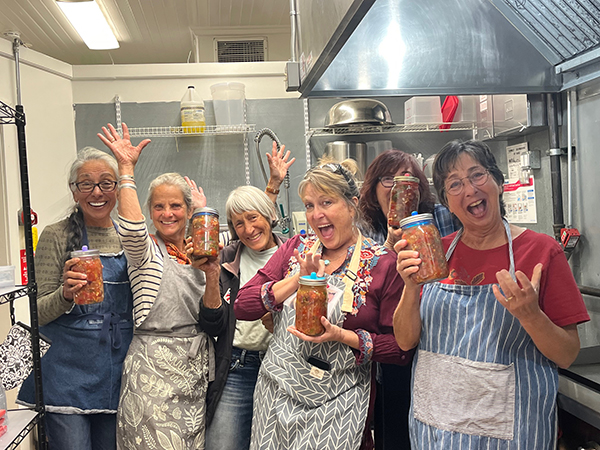
Happy participants showing off their quarts of fermented salsa to take home following a workshop. Ingredients were all sourced from the farm and provided a value-added outlet for surplus tomatoes. Class sizes were limited and a hands-on demonstration was provided.
Then in mid-June and again in mid-August, our farm was hit by devastating hail storms. The farm is located in an area that is considered a “banana belt” of sorts for growing in the state of Colorado. Our geographic location in the Surface Creek Valley enjoys warm summers, but never too hot. A gentle southwesterly slope off of Grand Mesa and the inversion effect, mean that the coldest air drifts down to the valley floor some ten plus miles south of us so that we have a later first freeze date than communities that sit 2,000 elevation feet below us. And, hail, well, it historically is an extremely rare occurrence here, hence why the area has historically been known for its orchards and fruit growing.
Our farm suffered great loss as a result of these events. Grasshoppers whittled newly transplanted plugs down to the ground, and newly seeded beds were nibbled to nothing almost as soon as they germinated (even under insect barrier). Whole crops were lost, successive plantings as the season progressed vanished overnight, and our plan for the season seemed to change with each new day as we navigated new twists and turns of the grasshopper saga.
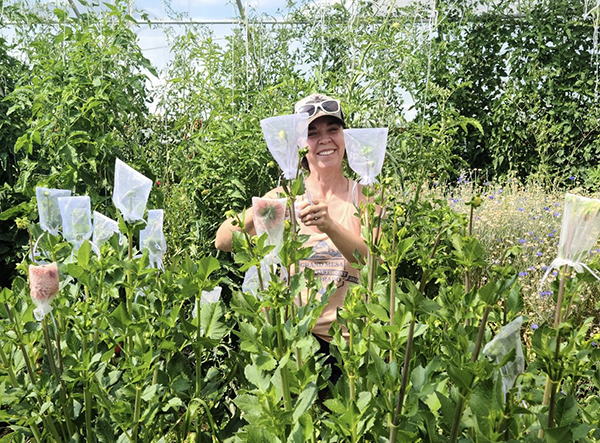
The author working in one of her hoophouses in the summer of 2024 placing organza bags on the dahlia buds as protection from grasshoppers.
We learned more about grasshopper lifecycle and management (or more accurately the challenges of doing this organically) than we ever thought imaginable (but this is the subject of a different article). The hail bruised, dented and shredded newly established starts and early crops such as sugar snap peas in the June storm. Then in August, it not only put divots in any exposed fruits and stems, but it also knocked blossoms off all flowering plants (such as peppers and eggplant) and shredded the leaves of vining plants enough so that most of them never recovered.
But, what doesn’t kill you makes you stronger, and we certainly put this to the test last summer. In an effort to make up for lost revenue, we were forced to get creative. To do this, we diversified our offerings at our farm. While, yes, many crops were lost, others didn’t just survive, they thrived. Fortunately for us, some of these crops were cash crops such as cabbages, which were out of the field before the grasshopper population developed wings and truly took over; tomatoes, most of which were growing in the hoophouse and out of hail’s harmful way; and dahlias, which had organza bags covering the buds. We capitalized on these crops and spun them off into other projects and offerings.
Plan B
It was evident by June that things were not going to plan for the season. At this time, we started to develop our Plan B. Ideas that we had tossed around from season to season in daydreaming sessions or that we had listed on our five-year goal list, we decided to execute. We were forced to take risks and make investments that we might otherwise have waited on, simply as a strategic means for our farm’s survival.
So, what did this Plan B entail, you’re wondering? Our diversified list of offerings included workshops, an additional CSA, a few value-added products, farm-branded merchandise, a dahlia tuber sale, and new in the 2025 season, a spring flower program.
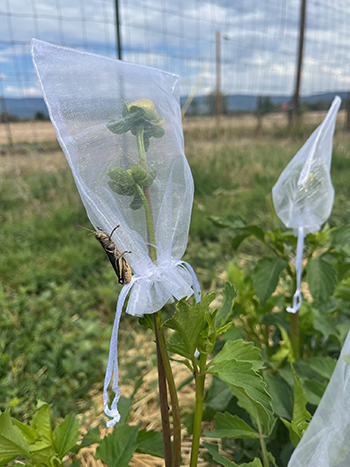
A grasshopper showing why the organza bags were necessary. All photos courtesy of the author.
We started with workshops. With a background in nutritional sciences and a keen interest in gut health, we first scheduled a series of fermentation workshops. To use another proverbial phrase, when life gave us lemons we made lemonade; however, in our case when life gave us abundant cabbage, we made kimchi and sauerkraut. Then, during the latter part of the summer, with a bumper crop of tomatoes, we made fermented salsa.
In our small town of 2,500, we found a commercial kitchen space that could be rented out by the half-day with the added benefit of cross-promotion from the business owner of the rental space. Classes were kept small, six students, plus myself and a helper. For $55, we provided the ingredients to produce one quart of fermented product, instructional materials, rental fee for the space, and a home fermentation kit.
Attendees brought all of their own kitchen supplies from home. The interactive, two-hour workshops were advertised through our newsletter and through free social media channels, and they sold out. We then scheduled a fall dahlia workshop on dividing and storing tubers.
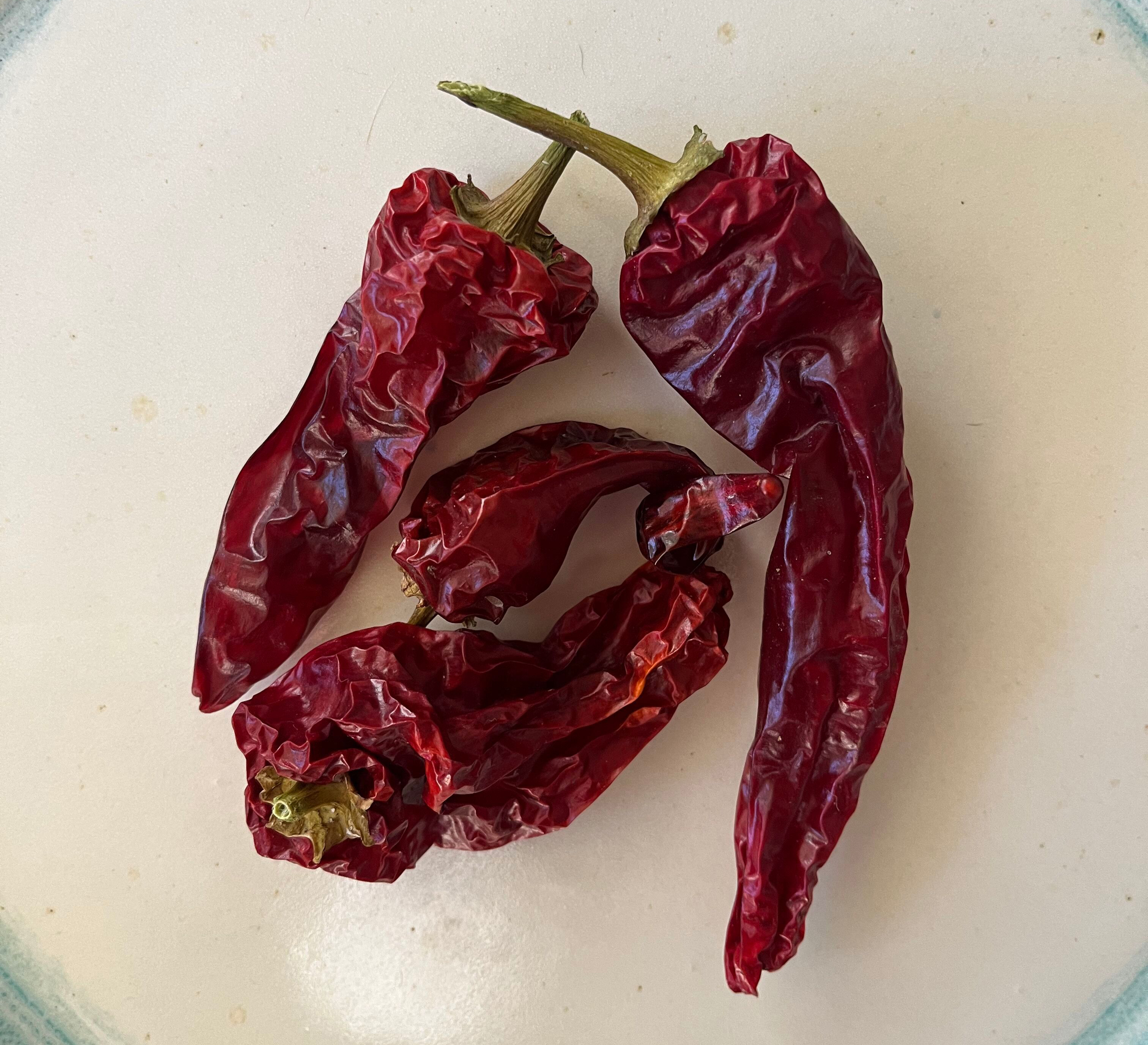
Pictured here are dehydrated Chimayo chilies, a specialty pepper that hails from northern New Mexico and is sought out for culinary purposes.
We found our customer base enjoyed these experiential offerings, and we also attracted new customers. This type of offering is great for farmers who enjoy teaching and interacting with the public, public speaking and leading hands-on instruction, and graphic design.
In our case, I developed educational materials using our graphic design go-to tool, Canva. For those who possess this subset of interests, it is a good way to create a revenue opportunity on a day or night of the week when no markets are happening and when it is advantageous to harvest and have an outlet for surplus product.
The workshops were such a hit that this year, in addition to the already established offerings, we will be hosting bouquet-making workshops as well as a spring dahlia workshop to coincide with our annual dahlia tuber sale. For the 2025 season, we also created an additional CSA benefit of discounted workshops as a perk and (hopefully) attraction to gain and retain CSA members.
Our second new offering of last season was a fall dahlia CSA. This was one of those things that we had plans to begin in our three-year plan, but as luck would have it, our dahlias were superb once we discovered organza bags to protect their buds from the grasshoppers. We rolled our dahlia CSA out in July and first offered it to our summer flower CSA members.
Without really planning it, we found this was a good way to create demand for this CSA, relying on the principle of scarcity. In an effort to be conservative in our first year, we offered just a three-week subscription. It was a good way to get our feet wet, and this year we will be offering a five-week dahlia CSA program. Furthermore, this was an opportunity to cultivate a following of dahlia lovers eager to participate in our other (new) dahlia offerings, our dahlia tuber sale and our dahlia workshops.
As the season progressed we also decided to offer dried goods including dehydrated San Marzano tomatoes and dried Chimayo chilies. In 2012, the Colorado legislature enacted the Colorado Cottage Foods Act, allowing limited types of food products that are non-potentially hazardous (do not require refrigeration for safety) to be sold directly to consumers without licensing or inspections. The producer must complete a food safety training course, and there are specific rules and regulations on the labeling, packaging, and sales of these products. But on a small scale, such as what we were doing, this law allowed us to sell these homegrown products at farmers markets and late-season festivals.
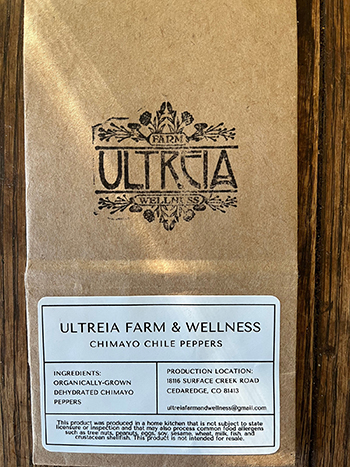
This photo shows our packaging for this product and the labeling requirements under the Cottage Foods Act, including our production facility address, email address (or phone number) of the producer, and the disclaimer stating that this was produced in a home kitchen not subject to licensure or inspection.
I created the labels using Canva and had them printed through an online service. To dehydrate our products we used a commercial size Excalibur Food Dehydrator. Furthermore, these products were additional items to sell on our online store through the holidays after the freeze when no fresh produce is available.
At this same time we also added farm-branded merchandise, starting with trucker hats and tote bags. These two items are a fairly low investment to get started as one size fits all. We found a local company to do our hats, and again, with the help of Canva, I designed our bags and had them printed on recycled cotton totes. There’s not a huge mark-up on these products, but we see two-fold benefits. Not only are we making a bit of additional revenue, but, more importantly, it is free advertising for our brand. Essentially, the person wearing that hat or using that tote is saying, ‘this is a cool company to support,’ the greatest kind of testimonial.
Our dahlia tuber sale was planned (and not the result of adverse circumstances), however, it is worth mentioning as it contributed so much to our business in what is typically a time when expenses are high and revenue is low. Last year was our first year to offer what will now be an annual sale. As is the trend with us, we started small. We offered the sale in the spring and found this to be a good time as folks are so excited to be thinking about growing and gardening.
The sale required a fair amount of educating our customers on dahlias through our newsletter and on social media, but the results have been well worth the time. Our customers now love dahlias (almost) as much as we do. The tuber sale requires strong organizational skills (which many farmers possess anyway) and was a great addition to our regular annual spring plant sale.
Our Squarespace-hosted website is quite easy to manage and learn, and we did the work to build the online tuber store ourselves so there was no additional cost. To prepare and streamline this process, we took photos of the flowering dahlias last summer and stored these in Dropbox along with a spreadsheet of notes regarding the production and growth of each of the dahlias in our sale. This made writing descriptions and listing the items online a fairly straightforward process.
Hard, but valuable lessons were learned in 2024. As climate change continues to make our seasons more unpredictable and varied, we decided to implement another substantial new offering in the 2025 season. This year we started a spring flower program entailing 1) a spring bulb CSA (anemones, ranunculus, tulips, and fragrant narcissus); 2) forced winter tulip bunches available at tulip pop-up markets; 3) spring plant cuttings of vintage chrysanthemums and dahlias (available at our usual spring plant sale).
Not only does this allow us to expand our sales window to include three additional calendar months, but it allows us to more evenly distribute our workload according to sales throughout the year. We opened the spring flower CSA in December, timing it with holiday gift-giving and also when things tend to be pretty lean around here. There has been a learning curve, for sure, but it’s been a thrilling new addition to our product line-up and one that our customers are ridiculously excited about.
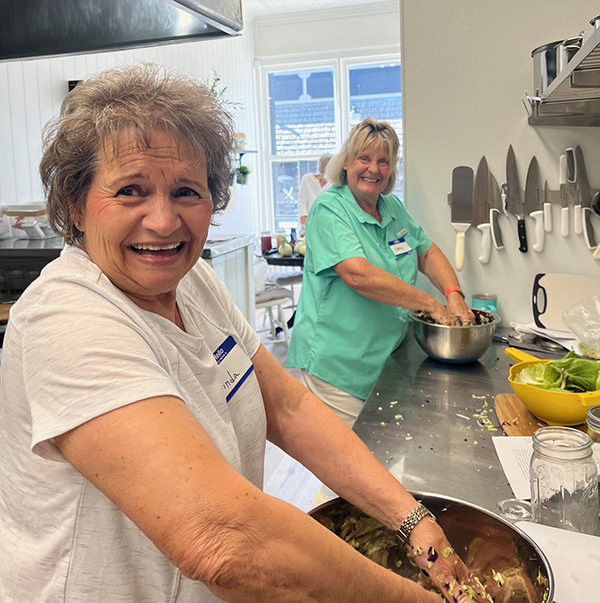
Participants making sauerkraut at a fermentation workshop offered by the author. The interactive workshops utilized a commissary kitchen space in the author’s town.
It has required that I invest in myself to acquire the tools and knowledge to pursue this new undertaking, but the investment, so far, has paid off dividends. The results of this new addition are still out, but we look forward to sharing what we learn in a future article.
Overall, we are pleased with the results of this unanticipated change in our business model and plan. While the negatives are pretty obvious — our crops suffered major devastation — the silver linings were plentiful. First, our expanded sales window and diversified product offerings made our bottomline less susceptible to the fluctuations that are inherent when working with Mother Nature.
Second, they have made us more resilient business people and better able to adapt to change and the strange hand of cards that might be dealt to us in any given season. Third, they have opened the door to new customers for our business by offering new products and products of varying price points. Fourth, they have forced us to grow up as a business in many ways, identifying which crops are the freeloaders and which are the cash cows, meaning which ones routinely lose money for us and those that earn their keep.
This has provided us with the data and tools to better streamline our efforts and make tough, but better business decisions. And, fifth, diversifying offerings has forced me to invest in myself by enrolling in trainings and workshops to better understand certain crops, to learn new techniques and ways of doing things, and to connect with other growers.
For a long time, I thought that evolving one’s business was a sign of weakness or that things weren’t working out. In fact, I’ve learned that it’s a way to grow one’s business and become more stable. Adapting one’s brand and diversifying offerings keeps things fresh. It can bring in new customers who might not have been interested in your previous products or create new ways for your ideal customers, i.e., your biggest fans, to spend more money supporting you.
It has allowed us to feel more sustainable by not depending solely on one sales method or single group of products. It has helped us to develop as business owners and become better farmers (we hope!). As our climate becomes more and more volatile with the unexpected becoming the expected, we encourage you to examine your business and identify one, maybe two, ways that you can explore the opportunities and growth available to you by diversifying your offerings, too.
Melissa Newell is co-owner of Ultreia Farm & Wellness located in the rural town of Cedaredge located on Colorado’s Western Slope. Growing in a high altitude, desert climate, she farms about an acre of specialty vegetable crops and cut flowers together with her husband. You can learn more about Melissa and her farm at ultreiafarmandwellness.com, or follow her on IG or FB at @ultreia.farm.wellness.
Copyright Growing For Market Magazine.
All rights reserved. No portion of this article may be copied
in any manner for use other than by the subscriber without
permission from the publisher.