











#ToolsForGrowingMarket
A friend sent me a link to the video Small Axe Farm posted on their Instagram of a little rolling bed marker they had just made from wood scraps and a piece of threaded rod. I’ve been using rolling bed markers for over 20 years, and even wrote an article about them in Growing for Market all the way back in 2009. The one Small Axe Farm made was the smallest I’ve ever seen, and it was also something I’ve been thinking about making for myself for a long time but just haven’t ever gotten around to doing. I reached out to the farm and had a nice chat with Evan, the one who put the thing together, and got a few more details about their farm and the tool he built.
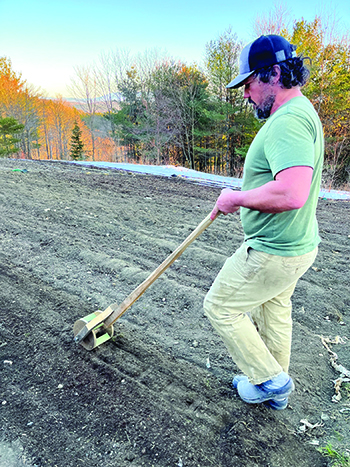 While the small rolling bed marker might not be the ideal tool for marking out a big field of beds, this photo shows it in action giving a sense of scale and the marks it leaves. For a video of how Small Axe Farm uses it in their hoop house for planting lettuce check out their March 13 Instagram post @smallaxefarmvermont.
It turns out Evan had also had the idea in his head for a while before he got around to putting together this little prototype. It sounds like his experience is similar to mine, and often these prototypes end up working well enough to be used for many years on the farm, despite their rudimentary construction.
His rolling marker was specifically for making a 6”x6” grid, a spacing they use for some of their lettuce plantings. Using the formula for the circumference of a circle to figure out the diameter (d = c/π) he figured out that for a 24” circumference (4 markers at 6” spacing) he’d need to cut two 7 5/8” circles from pieces of plywood for the rounds. He screwed four pine cross pieces at even intervals around the circles to hold them 6” apart and then used a piece of threaded rod (aka all-thread) with washers and nylon insert lock nuts to hold it to a yoke he formed from another scrap of wood. For the handle he screwed a long 2×2 to the yoke and used a draw knife to knock down the edges, roughly rounding it to make a more comfortable grip.
Evan tells me it took him about 40 minutes to put the thing together from scraps he had on hand, and it works great. It’s not for marking everything, and the initial use was for lettuce they grow in soil blocks that was getting planted on the edges of beds where there are existing plantings already in them. There are a few other crops they’ll probably use it for, but he’s also thinking about making more for other spacings they use on different crops.
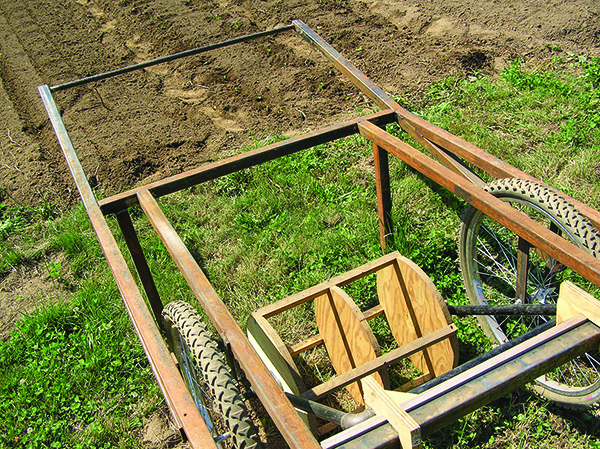 Not as nimble in small spaces as the version Small Axe Farm built, this is a larger rolling bed marker temporarily mounted to a farm cart frame for marking out pathways and full bed tops. The cart wheel tracks mark the pathways and the 3 plywood rounds mark the planting lines with cross pieces marking 12” cross hatches. The design for both the cart and this marker are in the book Build Your Own Farm Tools.
One of the advantages for him is that it’s a really straightforward way to show an employee exactly where to plant the seedlings. The tool is also very light, relatively small, easy to transport and to use, which means it will actually get used.
I can see the small size, and two rows as a distinct advantage in many situations over the much larger three or four row versions I have instructions for making in my book, Build Your Own Farm Tools. Aside from the obvious advantages of the smaller size for both storage and ease of use, having just two rows solves one of the frequent problems with any three or four row version when soil conditions aren’t just right. If the soil isn’t perfectly flat, a three (or more) row marker will bridge low points between two of the wheel markers and miss marking the extra rows.
I think there’s still a place for the larger, three-plus-row bed markers, but similarly there are a lot of reasons you might want to make a smaller one, or maybe even a small fleet of smaller ones for different row spacings. If you’re interested in more of the reasons I think a larger row marker works well too, check out the chapter in my book on them, and the archived GFM article from 2009 called “Dibbling makes planting easier, neater.”
Josh Volk farms in Portland, Oregon, and does consulting and education under the name Slow Hand Farm. He is the author of the books Compact Farms: 15 Proven Plans for Market Farms on 5 Acres or Less, and Build Your Own Farm Tools, Equipment & Systems for the Small-Scale Farm & Market Garden, both available from Growing for Market. He can be found at SlowHandFarm.com.
Copyright Growing For Market Magazine.
All rights reserved. No portion of this article may be copied
in any manner for use other than by the subscriber without
permission from the publisher.