





I think a lot about what makes me want to keep showing up to farm each day, and each year turn the calendar to a new production season. Good food, working outside, mental and physical challenge all come to mind. Yet, being part of a positive crew culture and productive farm team tops my list.
The people on the farm, and how engaged they are in the work and learning, most motivates my own work and learning as a farmer and business owner. Employees who are satisfied and invested get more done and have more fun. I get to enjoy myself and the work, too. These are some of the concepts I try to implement in shaping and supporting my crew each season.
Hiring and scheduling
Our farm usually operates with one or two full-season, full-time employees ($18.50 an hour plus housing); a couple of summer-season part-timers ($15 an hour); two summer interns from a local college (paid by grant); a couple of adult volunteer work-traders; one or two local kids getting their first job experience; and now our kids ages 10 and 13 ($13 an hour). It’s a dynamic and diverse bunch.
Ideally, I post job descriptions by the new year and complete hiring by March. Returning employment offers are never made before someone has survived July in our hot eastern Washington fields. It’s nice to get next season return commitments by the end of September.
Each hire comes with a job description of responsibilities, expectations of hours and schedule, and a set start and end date. For full-timers the standard work week is 35 to 40 hours, and weekends free.
I hire someone specifically to work Saturday market. They come Friday to help harvest and organize the truck and then return the following day to load out and run the market day. This hire has been pivotal in freeing up our family for weekend play, something that has greatly increased in importance since the kids started school.
Each season we try to come up with a tag line for the year. “Better is Better,” “The Best Ever,” “Making it Pretty” are all examples. One slogan, developed by a particularly kick ass crew has stuck around, becoming an almost daily rally cry, “Done by Lunch.”
It’s a congratulations, “Yeah, we did it!” It’s encouragement, “Come on, lets finish this.” It’s a matter of safety on a hot summer day and preserves sanity when picking beans on a really long row. A big push on a hard task with eight people for two hours is much better for morale than two people pushing hard for eight hours.
Operating with a summer “Done by Lunch” mentality, I try to hire and schedule the farm crew for the right number of people working on a given day to finish field transplanting, harvest, or cultivation by lunch. If I accurately plan for this scenario with the whole crew, then it leaves afternoon flexibility for full-time individuals (including myself) to pack orders, do deliveries, run the tractor, and attend to administrative matters.
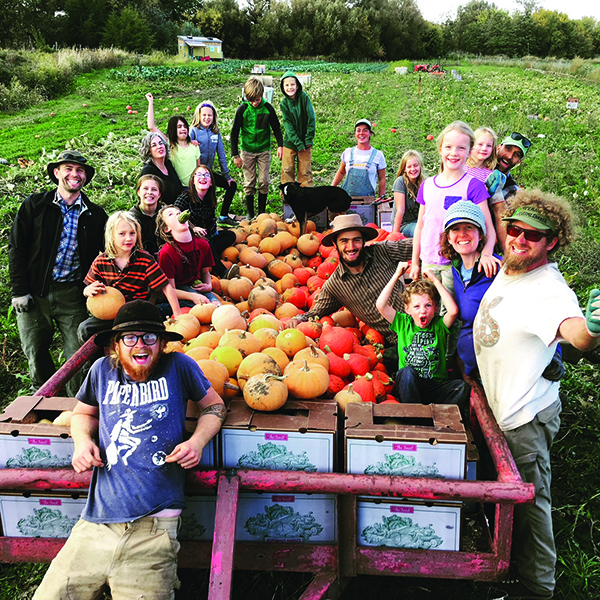 Farm team and family harvesting winter squash on the author’s farm.
All volunteer and intern hours are fulfilled before lunch, so supervisory responsibilities are reduced after lunch. While the day is not truly done by lunch, the afternoons are much lighter and more independent.
In the same vein, I try to hire enough folks so everyone gets a solid week of vacation in the summer and a couple long weekends. I put my personal vacation dates on the calendar by the end of February. Even as I am bringing people on to the crew, we can negotiate their time away well in advance, giving scheduling preferences in order of seniority. This creates a culture that supports off-farm time for rest and rejuvenation and less tolerance for last-minute time off requests.
Communication
To function as a team, it’s important for all members to understand what everybody on the farm does. On an interior wall of the barn, I keep a communication hub of signs and clipboards. There are separate clipboards for time sheets for volunteers, interns, and employees, along with posters with Food Safety and Employment Safety policies, a calendar for special activities and time off, and “Who Does What?” sheets.
These are summaries of job descriptions that highlight who is responsible for work zones such as irrigation, tractor cultivation, crop planning, flowers, orchard management, tending the farmstand, CSA pack-out, animal chores, and so on. Posted responsibilities make it clear where to direct questions. Even if I know how all the arenas on the farm function, I direct questions to the other leads. This helps reinforce the proficiency and autonomy of my teammates and frees me to do my own work.
Everybody also has a physical area of the farm they are responsible for keeping tidy — hand-tools storage, hand-wash station, shop, wash-station, root cellar, flower studio. This tidying serves as a good default filler task for awkward transition moments or an easy exit task to finish up the day.
To start the day, we all meet at 8 a.m. sharp. Full-time employees may well have started hours earlier, working from the harvest list or weekly to-do list, or preparing tasks that the whole group will do later. Everyone meets to go over priorities, give logistical updates, or do quick trainings. Then, we all sally forth together and tackle the major projects of the day.
Morning check-in is a great time to publicly recognize crew member accomplishments. If Keeli kicked out the hand weeding in record time the day before, it deserves a mention. Or to Hazel, I might say, “You did such a great job of picking last time, can you please show Ruth the ideal harvest stage on zinnias today?”
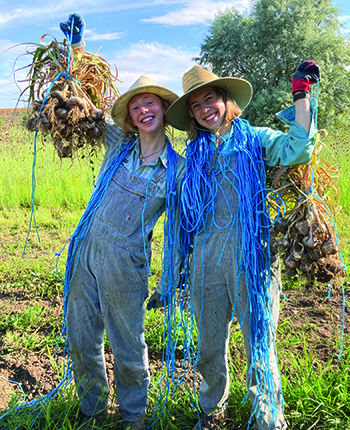 The author’s farm interns at garlic harvest.
Once a crew member has been shown how to do a task and has successfully done it again without supervision, I like them to teach that task to another crew member. This “Each-one-Teach-one” approach common in school classrooms works well in the field. Teaching a task is one of the best ways to cement learning. Being asked to teach a task to another team member is an everyday occurrence at Welcome Table. This relay of info and goals helps everyone understand fully the current project and decentralizes leadership responsibility.
To facilitate communication among crew members, I discourage listening to music or podcasts with ear buds when multiple people are in the same field or working on the task. Independent listening is just fine on a solo task. On group tasks at the wash station or packing out boxes in the root cellar, I provide a Bluetooth speaker for shared listening to music or podcasts. This can be a good source of new conversation topics.
One-on-one check-ins with all crew members happen within the first two weeks, mid-season, and end of season. This is a chance to privately give two-way feedback. I ask them what is good about their farm experience and what could be improved. I share my observations about the specific ways they are doing well in their work and offer a few suggestions of improvement.
Sometimes this is formal with two chairs set up in the shade of the yard and me keeping notes on a clipboard. Sometimes it happens when I arrange for us to do a repetitive task together. I always give at least a day forewarning to collect thoughts.
When there is an under-performance issue, I frame the issue by describing my observations of their slow pace, forgetfulness, or tardiness. I’ll then ask if they noticed the issue and follow up by asking why they think this problem is occurring.
Usually, I learn quite a bit from them about which body part is hurting when they do a certain task, or how they have a hard time remembering tasks from oral instructions, or that they are late because of transportation issues that originate with other family members. We can then move into problem-solving mode as partners.
Especially for younger workers and interns, the check-ins can be a time to encourage self-care both on and off the clock. We’ll discuss behaviors like drinking enough water, taking snack breaks, waking up with time to eat a full breakfast. While this type of character and skill development is rudimentary, there are very few places for young people to learn these skills and apply them with real consequence. It’s tremendously rewarding to mentor workplace capability. Welcome Table Farm’s skilled production manager this year started out as a 16-year-old newbie some seven years ago.
Job perks
Most people who work at a farm like to eat, so access to farm food without charge is a basic job perk. There is a designated “Farmer Food” bin in the walk-in cooler and everyone is encouraged to take food home and experiment with how to prepare it. Eating farm grown food translates into a better understanding of desirable harvest stages and more investment in tending the crop in the field.
During the growing season we often u-pick local blueberries and cherries for personal family use. When possible, I invite crew members to come along on these fun outings to nearby farms. They get the experience of harvesting a crop we don’t grow on our farm, and they get to eat a portion of the extra yummy fruit from the farmer-food section of the cooler. When I buy in select produce, such as eggs, tea, mushrooms, and cheese for our CSA, I give crew members the option to buy food for themselves at the wholesale rate.
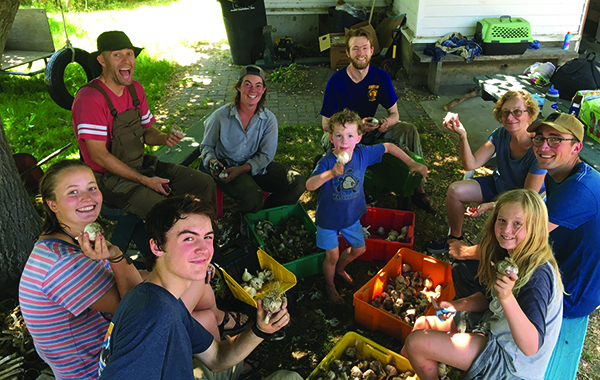 Farm team and family cleaning garlic on the author’s farm. All images courtesy of the author.
Sharing food as a farm team is also very important. Each week we try to share a least one lunch. I trade CSA shares with friends in town who cook and bring lunch to the crew June through August. They get a share for themselves and a second share for lunch preparation. I also ask crew members to each prepare one whole crew and farm family lunch a season, with a buddy is fine. They can use our personal kitchen and are compensated for cooking time. I reimburse for non-farm ingredients.
Sometimes we pair the after-farm lunch time with a topic of discussion or study. One year we did a weekly reading and discussion from the Young Farmer’s Coalition Racial Equity Toolkit. This became a powerful process of shared reflection, conversation, and action.
Eating the food we grow, deliciously prepared by someone else, is the biggest farming reward I know. At the end of the season, I arrange with a local chef to prepare a multi-course meal for the farm team. Its fun to get clean, dress up, and enjoy a masterful culinary experience with the food we produced as a team. Most crew members don’t dine out at the fancy restaurants that feature our food. It’s exciting to see our produce prepared, plated, and paired in such thoughtful ways.
Helping crew members maintain their physical health is also an important part of our crew culture. I try to model good work posture, help people adjust or avoid tasks that aggravate injuries, and increase access to needed health care. Full-time employees each get one CSA share to trade. Most arrange trades for acupuncture, massage, physical therapy, or chiropractic care.
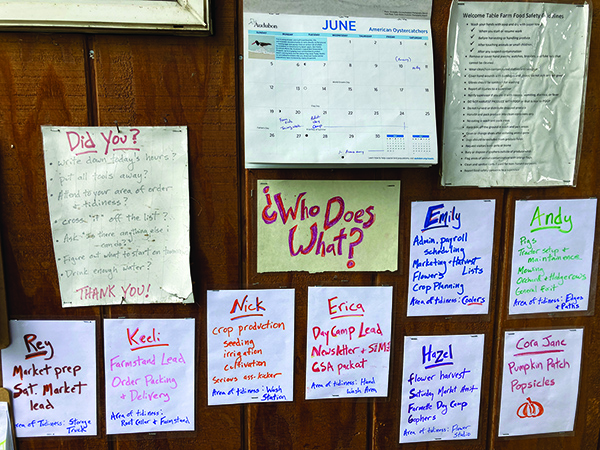 The author’s “Who does what?” wall helps keep everyone organized.
May through September I arrange for a weekly on-site yoga class each Monday. During peak season, when our bodies need yoga the most, it is so difficult to leave the farm and make it to town for classes. By bringing yoga to the farm, we all do it on a weekly basis. The teacher is skilled in stretching and strengthening exercises to counterbalance the stooped and forward posture common to many of our tasks. Friends can come and pay the instructor a drop-in rate. I trade food and flowers for a large portion of the remainder of the class fee.
Yoga is after work hours and optional. I try not to make demands on crew members outside the established workday and am very respectful of private spaces. I only participate in after-hour activities or enter the living space of a crew member by explicit invitation. As a family, we are also private with our own space and after-work time. Keeping boundaries outside of work allows everyone to show up to work with a professional game face, even when home life is chaotic.
Showing care
These many ways of supporting the farm crew — clear expectations, intentional communication, reasonable scheduling, skill development, sharing food, providing access to body care — are all ways of showing care toward the people who labor on this farm. The rewards I reap in return are also expressions of care.
Crew members are timely and reliable. They ask questions and strive to improve. They bake cookies, send postcards while on vacation, and share podcasts. And, they bust ass on a daily basis. Crew members often return multiple seasons. They bring useful experience, take on more responsibility, and lead the “Done by Lunch” rally cries.
Emily Asmus has been farming with her husband, Andy, and kick-ass farm team at Welcome Table Farm in Walla Walla, Washington, since 2007. She is well-occupied in raising vegetables, cut flowers, fruit, livestock, community, and three really awesome kids. Emily can be reached at emily@welcometablefarm.com.
Copyright Growing For Market Magazine.
All rights reserved. No portion of this article may be copied
in any manner for use other than by the subscriber without
permission from the publisher.