











By Ellen Polishuk
During the COVID era my usual travels have been curtailed. So, I got to thinking about what farms I had visited in the past that I knew pretty well, where a simple phone call could possibly stand-in for a proper on-farm interview and tour. First to my mind was Dripping Springs Garden, an oasis of natural and man-made beauty that is the life’s work of a good friend of mine, Mark Cain, and his farm partner, Michael Crane.
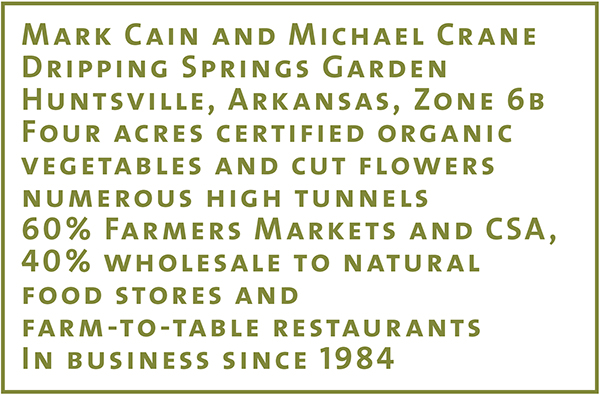
I have known Mark since 2003 when we were in the Experienced Organic Farmers network, a Southeastern group of organic produce farmers with ten plus years of experience. (Note for funders and researchers: That project had more effect on my farming success than any other thing I ever read, heard or watched.) We became friends over the years, seeing one another at conferences each winter. I visited DSG twice, both times in the winter (because I was still farming) and one time to spend a whole week. So, I have a fairly good bank of knowledge to base this profile upon.
Here’s my version of their origin story. Once upon a time, two young idealistic hippies, Mark and Mike, gathered their hard-won cash made from tree planting to buy some land in the Ozark Mountains of Arkansas. Why there? Land was inexpensive, and there was the possibility in rural Arkansas that with plenty of hard work and the help of like-minded folks, a good life could be carved out of the wooded hills.
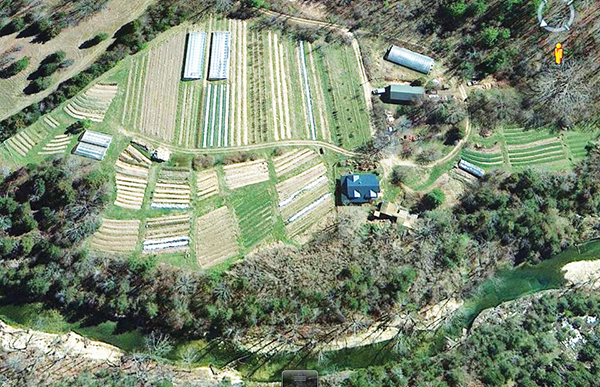
Dripping Springs Garden has been designed to work with the contours of the land. All photos courtesy of the author.
The 40-acre parcel they acquired had two acres of seven-year-old highbush blueberry bushes. A few open acres were surrounded by forest with a crystal clear, year-round stream. Their work was cut out for them: Just a simple dwelling, with no running water, but plenty of enthusiasm. “A rocky clearing in the woods,” as one writer called it.
Mark agreed to spend 90 minutes of precious Sunday day-off time with me doing the interview by phone. He caught the farming bug early in life. He studied biology at the University of Illinois, and then made his way out to California to study with master gardener Alan Chadwick in Covelo at the University of California Garden Project (now the Alan Chadwick Garden) in Santa Cruz.
Chadwick inspired an entire generation of gardeners with his intensive raised-bed techniques and garden-centric vision. See: chadwickarchive.org. Mark met Masanobu Fukuoka, author of One-Straw Revolution, while finishing his apprenticeship at UCSC in 1979. Mark says the encounters with these two revolutionaries set him on his life’s path as a market gardener.
Here’s how Mark meshes the ideas of these two seemingly very different men:
“I actually think they were on the same page. Happiness and truth are revealed to us when we immerse ourselves in the garden and in the work, in what both called ‘obedience’ or ‘service.’ For Fukuoka, it was important not to assume superiority, but to merge with the crop plants. He said, ‘If you want to know rice, ask the rice; become the rice.’ Chadwick would often talk about the tremendous secrets of the plant world, known only to those who pay intimate attention: ‘The gardener doesn’t make the garden, the garden makes the gardener.’ For both, making money from crop production was slightly obscene, a secondary activity after feeding the farmer and family. These men were cultural giants because they touched a nerve — as the pandemic is now touching a nerve — that reaches to the heart of why and how we live, not just how we make money.”
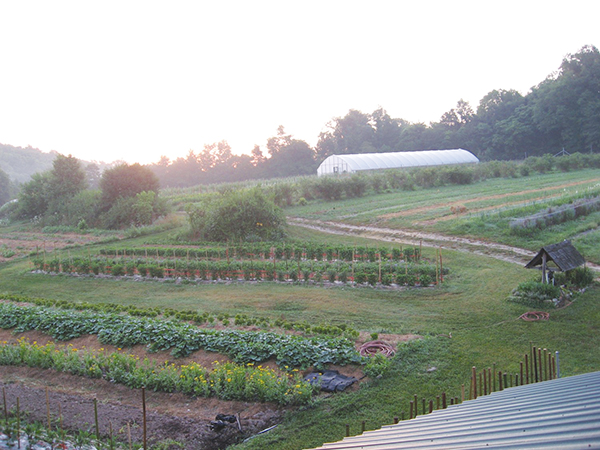
At Dripping Springs, the garden is at the center of everything: work, play, business, and inspiration. As Mark said, “The garden entwines our lives. We live in it and it in us 24/7.” What makes DSG so special to me and others is this commitment to total immersion — giving in to the seasons, to nature. The house is in the garden; the garden is in the house.
Modeled on Mark’s early training experiences, DSG relies on the help of seasonal apprentices to get the work done. All the apprentices live on the farm, today in a fantastic new timber-frame guest house. For those lucky folks (four to five per season), this is often the first time that they will experience what Mark calls the ‘taste’ of life, surrounded by the garden and its work.
Mark and Mike share breakfast and lunch with the team each workday. This set-up is important for creating and maintaining this connected world of the garden and its inhabitants. But Mark also notes that this taste of life can be slightly bittersweet for newbies. “It turns out that this farming life can be difficult, often exhausting, but super satisfying all at the same time. It has real challenges. There is nothing else like it.”
To Mark, scale makes a huge difference in how any farm works, and how one can be compared with any other farm. Because this Dripping Springs farm adventure has been unfolding so long, there have been multitudes of iterations of tools and techniques, but always on a small (fewer than five acres) scale. Based on Mark’s experience at UCSC, they implemented a permanent raised-bed system (at first, á la Chadwick, by hand — a 120-foot bed took three days).
But they quickly moved to using a Gravely walk-behind tractor and a Troy-Bilt tiller for creating and maintaining the market garden for almost 20 years. After meeting permaculturist Emilia Hazelip in the mid-90’s, Cain experimented with partial success with her “synergistic gardening” techniques using permanently untilled, straw-mulched beds. But the results were discouraging in their cold, wet spring soils, declining fertility, and increasing compaction in gravelly soils.
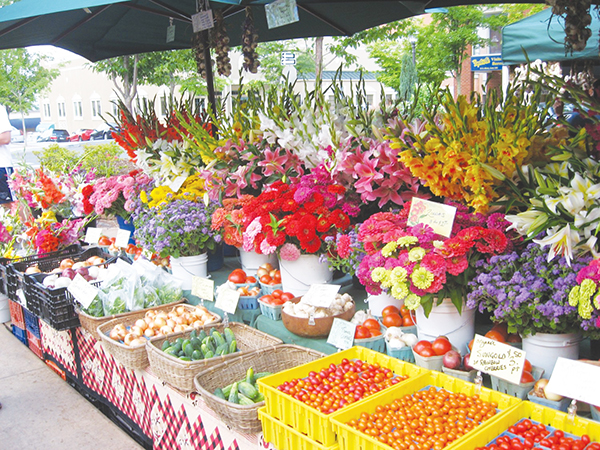
The Dripping Springs Garden farmers market stand shows lots of diversity with flowers and vegetables for sale.
Twenty years in, they bought their first Kubota 26-HP tractor, and then a used Celli spader from a neighbor (who was going no-till). This allowed them to gradually convert an additional two acres of aging blueberries into vegetable and cut flower beds. Mark likes to use an 11-HP BCS tiller in tandem with the 51-inch Celli; the spader for primary cultivation as necessary, and the BCS tiller, fitted with an Earth Tools depth adjustment system, for superficially tilling in amendments and firming seedbeds. A Berta rotary plow for the BCS is used as needed for reshaping beds.
Most recently, they have been experimenting again with no-till farming in the six hoop houses and two caterpillar tunnels. They are broadforking for primary cultivation, then applying one-to-two inches of purchased compost on the surface before transplanting. The BCS tiller/depth system is used for fine seedbeds. Mark calls this his “faux-tiller.” Plenty of landscape fabric and silage tarps are used for weed control, with a heavy emphasis on transplants for intensive stocking of beds.
After all these seasons and all these different modes, how does it all shake out? Basically, the final answer is a simple Zen kind of answer — it depends. Mark is a strong believer that there is no one way to farm that will work for any soil, or any geography, or any crop. All these tools and techniques have positives and negatives. He is completely non-dogmatic. And I say, Amen! Really, truly, the only thing we can say for sure that is an inviolable principle in organic farming is “no poisons.” Other than that, it’s all negotiable, dependent on the place, the operator, the scale, and the crops.
That’s my viewpoint. Mark heartily agreed: “Just because I thought permanent no-till or always spading would work on our farm, it did not make it so for every situation. It is important to see what is effective, to keep our eyes open, to be awake without judgement. I’m not a magical thinker.”
Mark and Mike maintain an amazing balance between the idealism of Chadwick and Fukuoka and the back-to-the-land movement of the 70’s and 80’s, with some dang hard-nosed business acumen and drive. Within the farm and in Mark’s demeanor, one can witness the Yin/Yang symbol personified. On the one hand, here is Mark, an extremely well-trained and experienced yoga practitioner. He has been to India several times to continue his personal training and has been a yoga teacher for many years. He maintains a rigorous daily practice, no matter the season, of at least an hour of yoga. He gives off an aura of wisdom and calm.
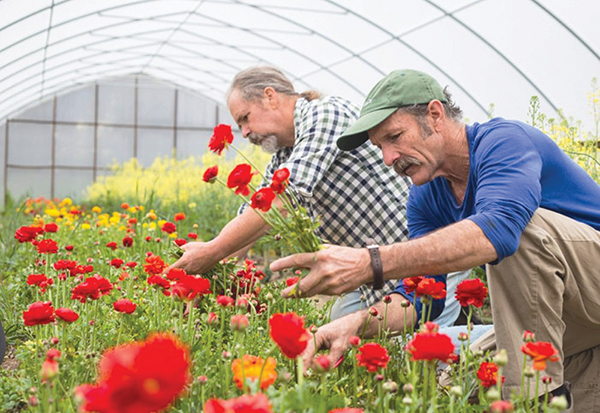
Above right are farmers and Michael Crane (L) and Mark Cain (R) working in one of their greenhouses.
And on the other hand, Mark is super high-energy, fast-talking, extremely hard-working, silly and playful. Mark is taking online classes, pivoting his sales to some online ordering, putting up a new website — thoroughly modern and agile. I find this balancing act endlessly fascinating and inspiring. Yes, the garden totally entwines. And, yes, Mark carves out time and space for yoga and music lessons and practice (he plays the flute, the piano, and his newest love is the accordion). Yes, community is key and central. And, yes, Mark craves and requires quiet down time to meditate and read. It is a beautiful dance.
Mark is 66 years old. He’s been working vigorously outside his whole life. How long can that last? Hello, this guy is a yogi. “The slightly bitter tonic water of yoga,” he says. He invests in it every single day, as he has forever. He can do backbends; he weighs the same as he did at 21. He has great energy and the smarts and maturity to know when to ask for help. His body works really well. “Thankfully, everything is not a chore or painful.” He feels good.
But running this whole place is so much work. People like to ask Mark when or if he will retire. Mark is open to playing with how much of his personal time and energy is necessary to run the show. He knows that when he and Mike are present in the field, it makes the apprentices happy and work well. He also knows the farmers-in-training like being given responsibility and authority. So, a different balance is possible. An old mentor from California tells Mark: “Keep on keeping on as long as it makes you happy.” And for now, they are happy.
What about passing it on to the next generation? Mark explains there is no way it can be the same thing when they are gone. And maybe that’s okay? What matters is that it is good now. Plenty of good information and good vibes and inspiration have gone out into the world via all those who have worked at Dripping Springs Garden. Here Mark refers to Fukuoka, who spoke of his feeling at ease with dying: “Moss growing on my body, warm winter day.” Mark and Mike have no regrets about the choices they’ve made all along. This is the life they have chosen. They love this life.
Mark says, “Are you so in love with this that you don’t want to do anything else? My first taste of farm life was working on an alpine dairy in Bavaria in my 20’s. It tasted like freedom, smelled like manure and forest. It was authentic happiness. Pursue that happiness and freedom wherever it leads you.”
Ellen Polishuk just retired from growing 25 acres of ecoganic vegetables and other crops at Potomac Vegetable Farms in northern Virginia. She is now a full-time farm consultant, writer and teacher. For more information go to ellenpolishuk.com.
Copyright Growing For Market Magazine.
All rights reserved. No portion of this article may be copied
in any manner for use other than by the subscriber without
permission from the publisher.