











Last fall we invested in a bale buster and flat filling machine for our cut flower farm, Moonshot Farm in East Windsor, New Jersey. It’s one of our favorite investments we’ve made to date. The machine has provided significant labor savings and more even planting results. If you’ve been considering investing in one, it might not be as out of reach as you think.
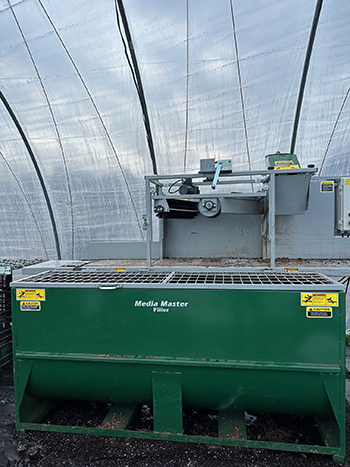
We had some customizations made to the flat filler including inserts for pallet forks and widening the belt to accommodate bulb crates. All images courtesy of the author.
I first went down the rabbit hole of bale mixing machines to solve a very specific bottleneck on our farm. Each fall, we plant tens of thousands of tulips into crates of peat-based potting mix. To grow properly, the tulips need to be watered deeply. However, the potting mix is hydrophobic and difficult to saturate.
With around 2,000 crates to fill with soil and water, this annual task would take our staff many weeks to complete. It also was extremely frustrating to spend so much time watering crates by hand during our busy fall planting season. And, the crates never seemed to get watered properly enough, which resulted in uneven tulip growth and some loss of plants.
A nursery owning neighbor suggested we buy a bale mixer that we could use to pre-hydrate the potting mix before planting. This sounded great, but my initial research showed the machines all seemed pretty expensive just to do some watering. Many on the market were also much larger than what we would need and $20,000 to 30,000 plus.
Eventually, we found two options that seemed more geared toward our small-midsize farm operation. Stilt.Pro offers a few different reasonably priced options and had great customer service. Their smaller-sized machine holds only 1 bale of bagged material at a time, which was a little smaller than our needs, while their larger machine seemed a bit too big.
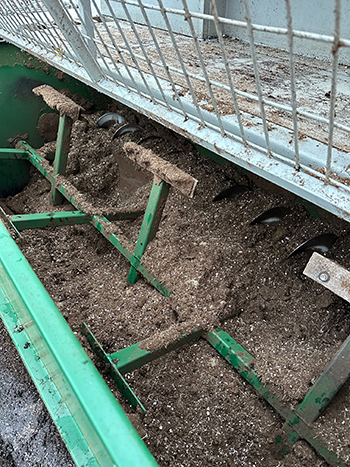
The mixing section of the machine works great to hydrate soil, create custom blends, and add inputs like biofungicide or biochar.
Ultimately, we went with Nolt’s Media Master™ Pot and Flat Filler. It can hold three 3.8-cubic-feet compressed bales at a time, which is just right for our needs. It not only breaks up the bales and lets you add water, but also has a flat filling function to fill trays — essentially two machines in one. The machine is built in Pennsylvania by a guy named Wilmer, whose phone number is in the Nolt’s catalog and who answered all of our questions. Nolt’s also has some website videos of how to use the machine.
As an aside, Nolt’s makes a few different budget-friendly Amish-built versions of more expensive machines, which we’ve had luck with. Another example is their Fogit Greenhouse Sprayer, which is a tenth the price of comparable fogging machines and has become an integral part of our IPM program.
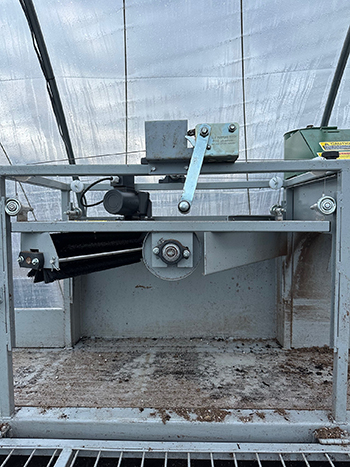
A brush and roller perfectly smooth the soil. It’s easily adjustable with a crank to be the perfect height.
We worked with Wilmer to make a few customizations to the machine. The default design comes on casters, which would be great if we had a concrete-floored greenhouse and could wheel the flat filler around. We forewent the castors for a forklift-movable version, with a solid bottom that could be lifted by our tractor forks.
The second customization was to widen the flat filling section of the machine. The standard design fits trays up to 14-inches wide. We had this part of the machine widened to 16.5 inches so that we could easily fit a 15.5-inch bulb crate. The manufacturer worked closely with us to ensure the machine would be just right for our needs.
The base price of the machine from Nolt’s is currently $10,250 and the customizations cost around a thousand more dollars. We also paid a rush fee so that we could get the machine faster than the estimated six-week lead time. Depending on what time of year you order, discounts may be available from Nolt’s.
Delivery and set up
The flat filler is around 9.5-feet long by 4-feet wide. It was delivered on a flat bed trailer, and we unloaded it with our compact 25 HP tractor forks. The machine is extremely heavy, nearly half a ton. In an ideal environment, like a concrete-floored greenhouse, it would be easy to slide into place. But on the bumpy floor of our landscape-fabric-lined caterpillar tunnel, it was tricky to move. We ended up having our entire farm team of around seven people carefully lift it and move it into place. Hopefully, we won’t need to move it again.
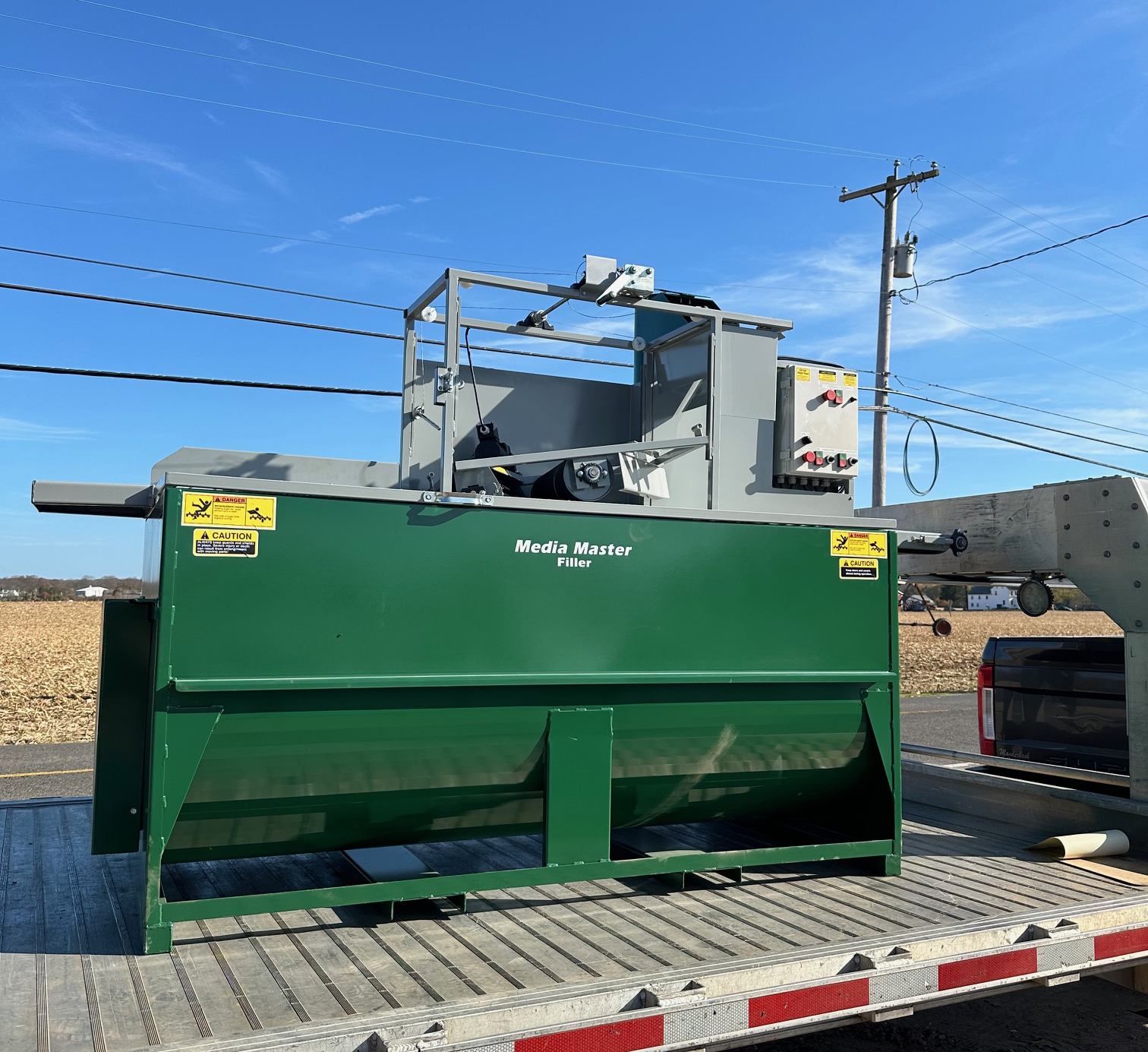
The machine arrived on a flatbed trailer. Its large size and weight make it a bit difficult to move around, so I recommend finding a permanent place.
The machine requires a 220 volt outlet and we ran a line out to one of our caterpillar tunnels, which we set up as our tulip planting headquarters. It arrived completely ready to use with no assembly required, which was greatly appreciated during a busy time of the year. We plugged it in and were ready to get planting.
Using the machine
We found the machine very intuitive to use. It has minimal buttons that were easy to figure out even for our non-English-speaking team. It also has a quick off switch for safety. To use the machine, you dump in up to three compressed bales of soil, turn on the mixing arms, and spray a hose in to saturate it to your preferred moisture.
One issue with our customization is that, as they added a few inches to the conveyor belt section, the area where the bales are loaded is a little too slim to easily fit the bags. We think this will be easily fixed by removing a few unnecessary bolts.
Soil then travels up an auger and dumps via a chute into containers on a conveyor belt. A movable brush flattens soil in trays into an even layer. The conveyor belt and chute speed are both adjustable so that you can get the perfect level of soil. Any excess soil falls right back into the bale mixing area below, so none is wasted.
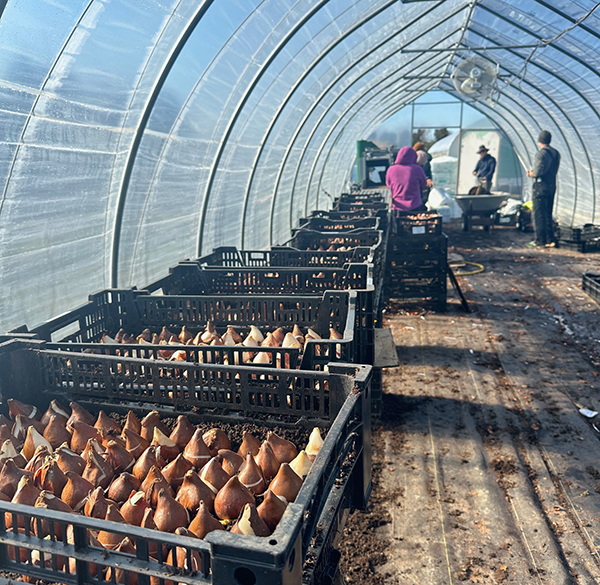
We combined the flat filler with basic conveyor belts we found on Facebook marketplace for a seamless tulip planting “factory.”
The manufacturer can add additional lengths of conveyor belts for a seamless setup. For now, we picked up some cheap conveyor belt pieces off Facebook marketplace. For tulip planting, we only need to fill 20 or 30 crates at a time. Once it’s adjusted, the machine works fast and could fill hundreds (maybe even thousands) of containers an hour.
Benefits
The bale mixing function has completely resolved our watering bottleneck. We’re able to saturate the soil prior to filling crates. The hose can be left running over the machine, so crew members can complete other tasks while the soil is being watered and mixed. The crates come out evenly moist and our tulips are sprouting much more evenly this year.
One great benefit of the machine is that we can evenly mix in different additives. For example, for planting callas we’ve added Rootshield into our planting mix. We’ve also done 50/50 mixes of potting soil and compost. Previously we would have done this mixing in a wheelbarrow with a shovel. The machine mixes much more evenly and easily than we could do by hand. For growers who make their own potting or soil blocking mixes, I think the machine would be a great investment.
The labor savings of the machine can’t be overstated. Rather than filling crates shovelful by shovelful, my staff only has to dump the bales in and the machine does the rest. It cut our planting time for our tulips roughly in half and has greatly improved morale and reduced heavy lifting. My employees love it.
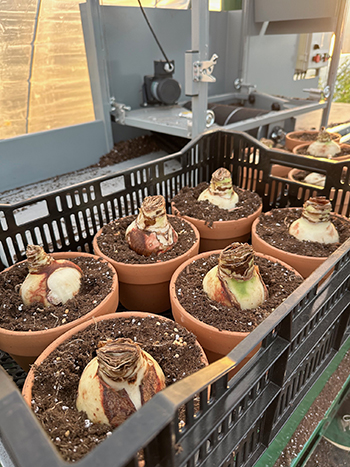 In addition to bulb crates, the machine works great on individual pots and, of course, flats for starting seeds. We used it to fill hundreds of amaryllis pots, saving hours of manual labor.
After using it with great success for our tulip planting, we used it for planting amaryllis into terracotta pots, filling crates for lilies, 4-inch plastic pots for chrysanthemums, and of course, for filling trays for seed starting. The machine is easy to adjust for different uses and has handled a variety of mediums including coconut coir, peat mixes, and compost.
We can’t wait to use it for our big spring and summer seedings as it will make the process so much faster and easier. The machine can also be used to fill up wheelbarrows and larger pots, which has come in handy for us as well.
At a pay rate of $22/hour, it would take us around 500 hours of filling flats and crates by hand to break even on the machine, which I estimate is around a year or eighteen months for our farm. But the improvements in our soil moisture, planting evenness, and morale make the machine well worth it for us.
Drawbacks
Overall, I have very little negative to say about the machine. Initially we expected to be able to move the machine around on our farm based on the seasons, but because it’s so heavy and unwieldy that’s not possible. I recommend finding a permanent home for it before delivery. On our farm, it’s right in the middle of a caterpillar tunnel we usually use for growing lilies, so we are having to shuffle our plans around a bit.
Ideally we’d have it in a climate controlled space, like a heated propagation greenhouse. The manufacturer warned us not to put frozen bales inside, as they could break the mixing arms. Since it’s in an unheated space, we’re careful to empty the mixer fully on nights when frost is predicted to avoid freezing the machine.
Because it’s so heavy, the machine seems well made and like it should last us a long time. If you’ve considered a flat filler/bale mixer but thought they would be too big or expensive, I think this is a great option for small-midsize market farms like ours.
Rebecca Kutzer-Rice owns Moonshot Farm, a specialty cut flower farm in East Windsor, NJ. She grows flowers year-round including in a geothermal greenhouse, for retail markets in and around NYC.
Copyright Growing For Market Magazine.
All rights reserved. No portion of this article may be copied
in any manner for use other than by the subscriber without
permission from the publisher.