











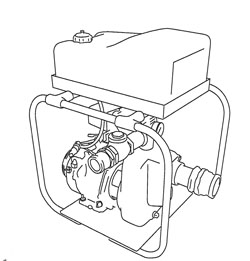
Pumps consist of two main parts: the pump impeller (which pushes the water), and the motor which drives the impeller. Small irrigation pumps can be gas or diesel, electric, or PTO-driven. Electric and PTO-driven pumps will seem to require less time troubleshooting—mostly because electric motors are wonderfully low-maintenance, and PTO-driven pumps are as reliable as the tractors which run them. All the same, the advice here is still worth reading: there are plenty of subtleties to the workings of pumps beyond their motors.
For gas- and diesel-powered small pumps, the motor usually takes half or more of all the maintenance time. Part of this is due to the nature of pumps—they sit off on river banks, away from the shop and out of view, mostly stationary, where farm personnel rarely go except to start the pumps, not to maintain them. Strategies must be developed, then, to make it easier and more convenient to service the pump. For this reason, keeping engine oil and a grease gun (if appropriate to your pump) near the pump station or in an irrigation vehicle will make maintenance much more likely to happen.
Be aware that if you are going to keep engine oil, fuel, or grease out in the field, it’s required to be sealed from the elements and prevented from dripping or spilling onto the ground or into water. A tightly sealed plastic container, lashed in place above the flood line, will do the job. An alternative is sending out your irrigation operator with a designated tool bag containing all the items he or she might need.
Take advantage of rainy periods when irrigation is less in-demand and bring your pumps in for service. Pumps are often forced to do without regular maintenance during the season because of the inconvenience of fetching the pumps back to the farm. Anything you can do to make it easier to transport pumps, then, will make good maintenance more likely to happen. Mount pumps on a trailer, or mount wheels onto the pump’s frame; keep a suction hose and other appropriate fittings at each pump station, so that they don’t need to be moved as often as the pumps; build better vehicle access to pump stations; use an all-terrain dolly or your tractor’s hydraulic loader to carry small pumps with less effort; make fuel tanks easily detachable with quick-disconnect fuel lines. Beyond the problem of transport, the sum total of regular maintenance activities only takes about half an hour on small pumps, so it’s not out-of-the-question even during busy periods.
The impeller is the business end of the pump. In most small irrigation pumps, the impeller works by centrifugal force—a rotating disk flings the water out from the center and on out of the pump housing. The impeller is water-cooled, so a pump that has run dry or lost prime and runs too long without any water in the housing will overheat and damage itself.
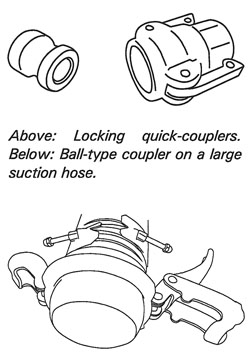
Pumps pull water up from their source through a suction hose. A suction hose requires a very tight seal at all seams to function properly. Also, for the quality of the water that is pumped, the suction hose strainer end must be away from the stream/pond bed and still far enough below the surface to avoid sucking in air. For this reason, the strainer end is often fitted with a combination of weights and floats.
Priming a pump means filling the suction hose with water, all the way up to meet the impeller. A pump must be primed in order to push water. Some pumps are self-priming, including most small pumps. This means that, if they are started with their housing full of water already, they will be able to create enough suction in an empty, air-filled suction hose to eventually draw the water up to the impeller and start pumping. Self-priming pumps usually need high throttle to prime themselves, but they should be throttled down once they start pushing water—too much pressure while filling the lines can break fittings (the water hammer* effect). Other pumps need to be primed manually, usually by a hand-operated primer pump. In either case, water can only be drawn up a certain height by suction. Even before that physical limit, there is a practical limit where a pump will have difficulty priming or maintaining prime. Place pumps as close as is reasonable to water level while still maintaining solid, level footing.
[*Water hammer refers to the pressure wave as water (or any fluid) fills pipes and pushes out air, or abruptly stops and changes direction. A common example is the shudder that can come from suddenly closing a household spigot. Farmers must be aware of the effect and avoid closing irrigation valves suddenly or filling irrigation lines too quickly. The force of the water can blow out drip fittings, dislodge pipes from each other, or split hoses and clamps.]
If your water source is prone to rapid fluctuations in water level, be alert and ready to fetch your pump at any time. Keep fuel cans secured far away from any potential flood level. Tie ropes, straps, or chains from your pump and suction hose to sturdy trees as insurance against losing equipment to sudden flooding or a deteriorating stream bank.
Some pumps come equipped with protective circuits designed to shut off the pump in event of a problem. The primary anticipated problem is a blowout in the water line, resulting in a rapid pressure loss as the water floods the area around the rupture. The circuit operates as a pressure-sensitive switch, then—if line pressure goes down, it will cut off the pump. These switches, when working properly, need to be reset before each irrigation. Some pumps have sensors on their oil level or engine temperature, but if you do not see explicit mention of a protective circuit in the manual, you might assume that your pump has none. Whether you have protective circuits or not, your maintenance routine should be the same, since you should never rely on the switches alone to protect your equipment—it has been my experience that on the farm they do not often function as intended. Valuable as these circuits are, they are one of the first things to check in event of difficulty operating a pump.
Copyright Growing For Market Magazine.
All rights reserved. No portion of this article may be copied
in any manner for use other than by the subscriber without
permission from the publisher.