










How and why to get involved locally
When my husband Casey and I first became interested in farming as a career in the early 2000s, we were also young voters who had become disillusioned with electoral politics. In spite of our youthful idealism and desire to contribute, our first significant campaigning and voting experience (the messy 2000 U.S. presidential election) left us looking for other ways to make a positive difference in our communities and world. We’d continue to vote, but we longed to see more immediate and direct results of our time and actions.
Market farming became that venue for us — we saw it as a way to make a living that represented our values about sustainability and community. Starting our Oregon farm in 2006 felt like a way to make a difference that felt more tangible than through political involvement.
Pulled into local politics
The longer we lived in one place and put down roots, however, the more we realized that traditional politics (especially on the local scale) played a big role in our life and business, whether we wanted it to or not. Farmers as a group have a significant stake in local politics. Because our work as farmers is very place-based, we tend to live in a single community longer than the average American, and local decisions (especially around land-use) can have direct impacts on our farms, families, homes and businesses.
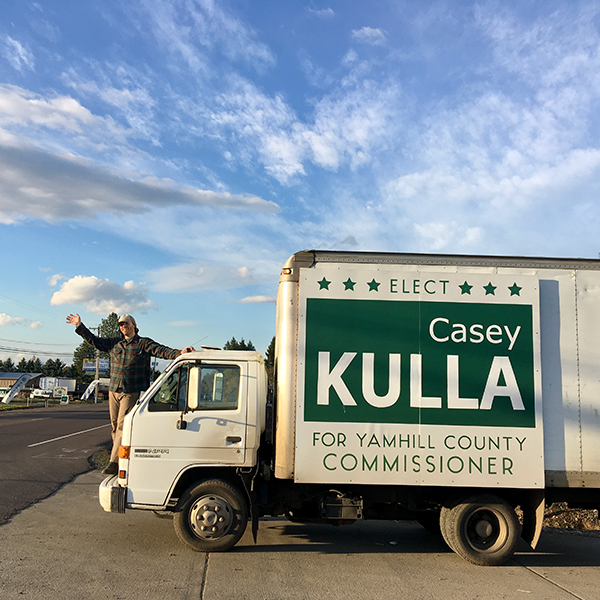 The author’s farm box truck became a mobile campaign sign when her husband Casey ran for local office in 2018. They had a sign maker paint this custom wooden sign, and Casey drove the truck to all his campaign events (as well as on the usual vegetable delivery routes!). In the final days before the election, he aslo parked it alongside major roads and waved at passers-by.
This is what Casey and I realized in 2009 when a gravel quarry applied to convert 225 acres of prime farmland near us from farming usage to extraction zoning. We live on a 3,000-acre river island that is almost entirely agricultural, and this proposed change felt like something that would be hugely negative for all the farms on our island. But the zoning change could only happen if two of three elected Yamhill County Commissioners voted to approve the application.
Thus began our crash course in community organizing and local political action. We learned about Oregon’s complicated and unique land-use system, how these decisions are made, and what kinds of arguments have legal influence over the commissioner’s votes. We put ads in the paper, met weekly with our neighbors for almost a year, testified in multiple meetings, gathered signatures from the wider community, started a non-profit and hired a lawyer. We did not ultimately prevent the zoning change, but we did raise awareness of many issues, and to this day that quarry is not yet operating on our island.
The quarry opposition was a massive project that immersed us in the world of local politics, and since then we’ve stayed very involved. I still don’t enjoy the work of politics — it still feels messy, frustrating and an uphill battle. It’s so much less immediately satisfying than delivering a bin of beautiful carrots to our customers.
But we’ve also learned that big decisions are being made every day that affect us (and our community), whether we get involved or not. That realization has kept us engaged, and ultimately led Casey to run for office himself in 2018. He was elected and is now one of those three elected Yamhill County Commissioners who vote on items like proposed gravel quarries.
Farmer needs, perspectives, and skills
Certainly, running for office is an extreme level of commitment, but wherever you live and farm, there are accessible ways you also could plug in and increase your involvement in the ongoing political work of your community. If a goal of your farm is sustainability, then it’s important to consider the factors beyond the edges of your property that affect your business’ long-term livelihood and the long-term health of your soil, water sources, workers, and customers.
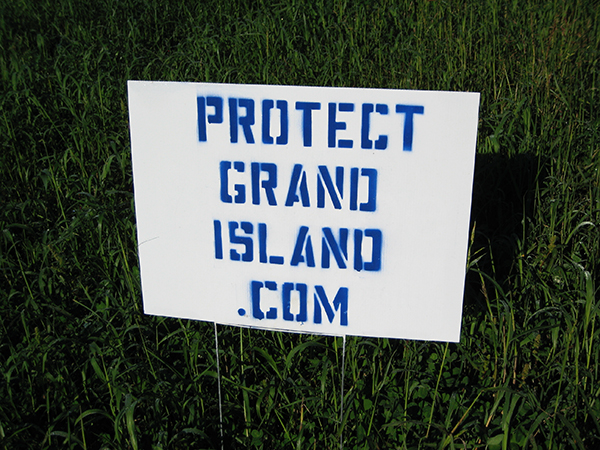 The author and her husband Casey first jumped into local politics in 2010 when an application was made to convert nearby farmland into a gravel quarry. They helped organize neighbors and community members in an effort to protect the land. As part of that work, they built a website with information and a neighbor painted hundreds of signs to spread the word. Some of these signs are still in people’s yards over a decade later.
Farmers also have particularly important voices to offer because of our long tenure on the land, our needs for specific resources (land, water, infrastructure, workers), and our commitment to the local economy and community. Believe it or not, many market farmers also have useful marketing skills that can be applied to political action on many levels — knowing how to grow a thriving local business is very similar work to community organizing and campaigning.
Ultimately, that bigger picture of sustainability and believing we had a unique and important perspective to offer are what inspired Casey and me to dive back in to politics.
Here are tips, starting with the simplest political actions and moving to the highest level of commitment. Local politics operate differently from place to place, of course, especially in regard to issues like land-use decisions (i.e., land use, zoning, etc.). Position titles and processes also vary. But I aim to keep the suggestions general enough that they should apply wherever you live.
Ways farmers can get involved
Vote: If you are eligible, vote in every single election and on every single local race and issue. This is the lowest bar for being committed to the place and community where you live, and this is also where your vote will have the most influence because of the relatively smaller number of voters casting ballots in local races. In our county, important races have been decided by single-digit margins. Time commitment: Approximately one to two hours per year (you can do that).
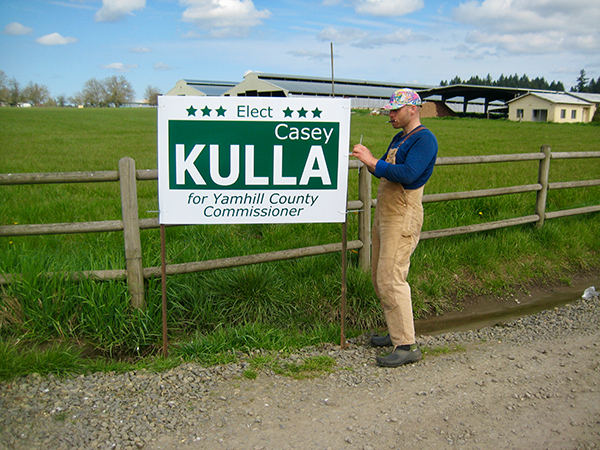 When the author’s husband Casey ran for local office in 2018, he reached out to farmer neighbors about hosting campaign signs on their property, including at this organic dairy on a major road. Casey pounded every t-post himself, being very experienced in such work already.
Keep up with local news: Of course, being informed about local issues and candidates is very helpful when voting, so the next minimum bar I recommend is keeping up with your local news. Our rural community is blessed still to have two local newspapers with local reporters who do their best to cover everything from political decisions to upcoming concerts to scholastic sports.
If you have a local paper, I highly recommend subscribing and reading every issue (local newspapers tend to be short, so this is often a quick task). Not only will you educate yourself and stay connected, you will help financially support local journalism. If you don’t have a local paper, or if you want more engagement, many communities also have social media community groups that can sometimes provide insight into what’s happening.
With the often divisive nature of social media, however, be cautious with this choice — you might be exposed to misinformation or more arguments than is pleasant. So, I recommend the local news outlet if it exists even if you don’t always agree with the way they cover the issues. Time commitment: One to two hours per week. Do it while you drink your coffee.
Connect with local political groups: Does your community have a chapter of your preferred political party? Even if you don’t like partisan politics, party designations can still be helpful for finding information. Or, are there other advocacy groups in your area that might gather people with similar values? Find one of these groups and get involved by signing up for their newsletters and attending meetings. These groups can be a great way to learn more about the issues and local positions, often from a values perspective that is more consistent with your own. There may be simple opportunities to volunteer or help them coordinate for local candidates or issues. Time commitment: One to five hours per month. This is still relatively easy.
Support candidates’ campaigns: There are many local elected offices: mayors, city councilors, county commissioners, school board members, conservation district directors, and more. Who fills all our local elected offices matters a lot. They don’t just vote on specific issues as they come up, they often set the agendas as well, meaning that their values will determine the direction of your community.
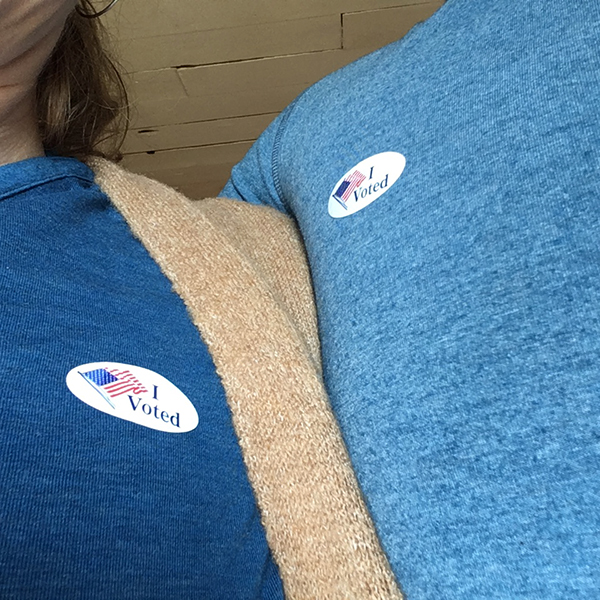 The minimum bar for local political engagement? Voting in every election! You might even get a cool sticker! (In Oregon, where the author lives, voting is all done by mail and there are usually no stickers involved, but she and her husband bought these to share with supporters when he ran for local elected office in 2018.)
Let me tell you from experience, it can take a lot of people to run even a small, but effective campaign. If there are candidates who you think will do a good job in even a seemingly minor local office, reach out and offer your support. At the very least, you could offer your endorsement or write a letter to the editor.
As a farmer with land, you could offer to host a large campaign sign leading up to the election. If you don’t want to be as visible, you could donate money to the campaign. Keep in mind that a donation will still likely be visible depending on the campaign finance laws in your region. Time and money commitment: Varies widely on your investment in the process.
Organize your community around key issues: Our big entrance into politics was around a local issue we cared about deeply. If there is a such an issue in your community, you can offer your support or organizational help: emailing people who you think should know about it, writing letters to the editor, holding meetings with stakeholders, working with a lawyer and so on. An issue might be a land-use decision in your area or a proposed new ordinance or law.
Time commitment: Varies widely. If you choose to take a lead role, this could be a big time commitment.
Offer testimony before a vote: Issues that come before decision-makers also often have opportunities for residents to provide written or oral testimony. These can be critical ways for your elected officials to know their constituents’ views on an upcoming vote. So, I recommend always offering testimony on issues you care about, even if it is very simple. You’ll need to learn what the process is, as the timeline and processes vary depending on the issue and the forum.
I have testified before our county commissioners and state legislators many, many times, mostly on issues related to farmland preservation. It can feel very awkward at first — I often felt I didn’t even have appropriate clothes to wear — but it gets easier, and it’s the only way our voices will be heard on specific issues. Remember to identify yourself as a farmer and explain your stake in the vote. Time commitment: One to three hours per year. This depends how often you feel called to write or speak. Your influence is significant from a relatively small time investment.
Serve on appointed advisory boards or councils: Here in Yamhill County, we have many advisory boards and councils that are not elected positions. Instead, local residents are appointed or volunteer to attend meetings on specific topics, such as water issues, roads, planning and public safety. There are similar statewide boards. Often these groups generate ideas and set values for their topics.
Meeting frequency varies, as infrequent as quarterly or yearly, but ideas expressed in those meetings can have a big impact on how elected officials and administrators set goals and start projects. If you’re interested in serving in this way, contact your local elected officials and find out what boards exist in your region and which one might benefit from a farmer’s voice.
Time commitment: Varies widely, depending on the board or council.
Run for office: This is The Big One! Ready to really throw your entire self into your community? Run for local elected office. There are many positions available, but you’ll need to see which ones you are eligible for based on where you live. Generally speaking, the positions you can vote on are the ones you can also run for (exceptions being positions that might have degree or licensure requirements).
Obviously, running for office is an enormous commitment. Unless you run unopposed (which can happen in local races), campaigning will take more time, money, energy, and emotional work than you could ever imagine. It will also (as I said) take a team of people. Running for office is a process that requires major intention and focus. Have you ever tried to catch a chicken that did not want to be caught? Those birds sure can be fast and tricky. Casey and I used to tell our newer employees that when trying to catch a chicken, “You have to want to catch the chicken.” We say the same thing now about running for office: “You have to want to catch that chicken.”
I would only recommend running for office if you are already well-experienced in all the other categories of political involvement I listed above and are ready for a bigger commitment. Communities deserve elected officials who are knowledgeable both in their local issues and in the processes of governing. That being said, communities also benefit from diverse perspectives and backgrounds, so don’t rule yourself out just because you don’t wear a tie all day.
Your decision-making perspective as a farmer might be critically relevant for your community. And, remember that if you know how to market and operate a farm (and catch chickens), you already have a surprising number of skills that can transfer to campaigning and governing. Time commitment: Potentially infinite.
Will my political actions affect my business?
Perhaps at this point, you are convinced that you should get involved in local politics, and understand how, but are worried that looking political might affect your farm’s reputation or customer base. This is a legitimate question to ponder and something Casey and I considered every step of the way. For us, we also wanted our farm community to be welcoming to all, and we didn’t want potential customers to feel unwelcome if they didn’t agree with us on an issue or candidate that we’d publicly supported.
To that end, in the beginning we mostly engaged in issues that were extremely important to our farm and were consistent with our farm’s stated values and messaging. So, for example, publicly opposing an extractive quarry felt consistent with our values of organic farming and sustainability. Whether our customers agreed exactly with us on this issue, we didn’t think they’d be surprised by our stance given all that we put on our website and in our newsletters about our values.
As time went on, the values that mattered to us grew and grew. It was still a difficult dance, wanting to use our voice to support candidates and issues that we thought would be positive for our community, yet not wanting to do it in a way that alienated customers. Ultimately, we decided that choosing positive forms of support and language was key.
Even now that Casey is an elected official, we still both engage everyone in our community (in person and online) respectfully and use careful, intentional language about our values. Being respectful feels like an important part of our overall value system. Even when politics get rough we maintain that. It’s important to us as humans, but we also think it goes a long way toward maintaining our positive reputation as a farm business. Ultimately, we can’t stop being invested in our community, so perhaps a lost customer or two is worth the larger gains of being involved.
Do what you can, when you can
Please remember that if you get involved in local politics, it likely will feel messy. You will inevitably feel frustrated and perhaps as though you’ve wasted valuable time and effort on something much less tangible than weeding your fields. I understand that farmers working to make a living for our families is a tough business; it can be very challenging to give our time and energy to so complicated an activity as politics.
So, perhaps there are periods in your farm journey when you can only engage in the most basic levels of political engagement (voting and reading the local news, for example). But I encourage you to keep an open mind and consider what you might be able to offer your community. As a farmer, you have a unique stake in your community’s future, and your voice matters. In whatever way you can, use your voice to further the idealistic goals that first drew you to farming.
Katie Kulla lives and farms with her family in Yamhill County, Oregon. You can find Katie at KatieKulla.com and on Instagram: @katiekulla.
Copyright Growing For Market Magazine.
All rights reserved. No portion of this article may be copied
in any manner for use other than by the subscriber without
permission from the publisher.