











By Jane Tanner
At Windy Hill Farm in Elk Creek, Virginia, Michelle Pridgen’s main crops are winter and spring high tunnel greens, along with tomatoes, peppers and flowers. Years ago, she went into the woods on the property to move some black cohosh (Actaea racemosa) into an ornamental perennial border but never considered it a cash crop. Then, a Virginia Tech doctoral student persuaded her to participate in a trial to prove certified sustainable forest crops fetch much higher prices than wild harvested plants like cohosh that are losing habitat and are overharvested.
In 2015, Pridgen earned $25 a pound from Mountain Rose Herbs in Oregon for Forest Grown Certified dried black cohosh root, 25 times more than wild harvested root. However, Pridgen broke even because she didn’t understand post-harvest handling and over washed it, over dried it and meticulously pulled off the root hairs, which could have stayed on.
A few years later, she sold another batch to Mountain Rose at $60 a pound and came out well-ahead with lower labor time. For both sales, she also benefitted from the widely available grants and reimbursements to encourage cultivation and protection of forest plants. The Virginia Department of Agriculture reimbursed Pridgen for about half the cost of organic certification of the cohosh and Appalachian Sustainable Development reimbursed the Forest Grown Certification expenses.
As Pridgen dug up the black cohosh, she simultaneously replanted roots with growth nubs to regenerate it. More than 70 percent of the replanting took; it also self-seeds well. She waits at least three years between harvests and plans to move the black cohosh back from the perennial border. She’s considering starting a patch of goldenseal (Hydrastis canadensis) in her forest.
Chris Sawyer at Jake’s Farm in western North Carolina didn’t consider forest crops until GAP rules cut his lucrative wholesale sales. His farm complied with all the rules but one: dogs. The dogs suppress voles, moles and rabbits that thrive on his isolated wooded property. Jake’s Farm continues to sell at tailgate markets and grows greens all winter along with a long list of vegetables, sweet cherries, strawberries and figs in fields and two 6,000-square-foot-greenhouses.
Yet, loss of wholesale customers like Whole Foods sent Sawyer into the woods. He harvests armfuls of stinging nettle (Urtica dioica) that grows in the woods to bring in about $100 a week in sales to a local herbalist, chefs who use them in soups (although restaurants sales have dropped during COVID-19), along with market customers who cook and eat them like spinach. Blanching removes the stinging properties.
Sawyer converted a used bakery proofing oven into a dehydrator by adding a 1500-watt toaster oven element andincreasing ventilation with two-inch holes in the top of the cabinet. “I personally like to reach 140 degrees for about 15 minutes to ensure most bacteria is killed even if I slow dry with lower temps,” he said. Herbalists prefer dried herbs and Sawyer also dehydrates strawberries and other crops.
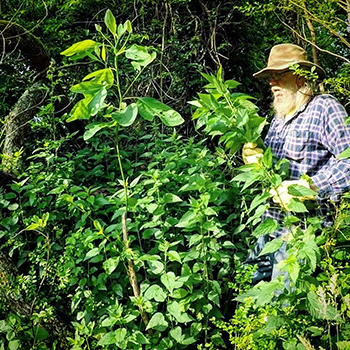
Photo by Courtney Gryzb.
Muscadine grapes grow in the trees on the forest edge, and farther into the canopy Sawyer is starting a patch of giant Solomon’s seal (Polygonatum biflorum). He participated in several ginseng (Panax quinquefolius) workshops and anticipates getting that going. A plant expert helped him identify yellowroot (Xanthorhiza simplicissima) and mayapples (Podophyllum peltatum) already growing in the woods, and he plans to expand those. “It’s something to keep your crew busy when they’re in between crops,” Sawyer said. “There’s undiscovered money in the woods, like treasure hunting.”
Agroforestry — combining agriculture and trees in sustainable systems — is a large umbrella that covers plants under the tree canopy; saps and syrups; forest-edge loving crops such as elderberry, raspberry, sumac, and sassafrass; orchards in areas transitioning back to forest, such as polyculture layering of tall trees (e.g., chestnut) and smaller trees (pawpaw and persimmons) and even trees inoculated with truffles; riparian buffers, where commercially valuable shrubs like witch hazel do well; alley cropping; and silvopasture, combining animals and agriculture.
Areas ill-suited for other crops can work well. Eric Nelson, who has a vineyard outside Lincoln, Nebraska, planted curly willow and cardinal, red and yellow twig dogwoods on two odd-shaped acres that wouldn’t work for grapes. Some trees that went in 20 years ago are still producing. Nelson is part of Nebraska Woody Florals, a cooperative of nine growers producing woody stems for local wholesalers. Nelson averages $5,000 gross income a year selling stems to the co-op.
In addition to florals, agroforestry crops include food and medicinals. This article covers options outside of mushrooms. GFM covered mushrooms in January 2016 and has future mushroom articles planned.
Agroforestry can diversify small farms while demand for many medicinal plants greatly exceeds supply. COVID-19 is further driving consumer interest in plant-based remedies that support immune and lung health and healthy eating overall. Timing for growers is good with support available to enlarge and protect populations of endangered and at-risk plants.
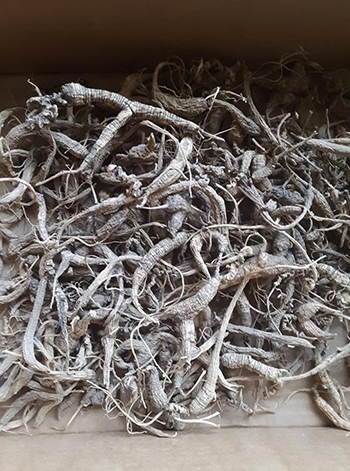
Dried ginseng root ready for sale.
Photo courtesy of Terry Black.
Overall, putting underutilized forest to use is a growing trend, said Jim Hamilton, Watauga County North Carolina extension director. “In many cases, harvesting timber won’t be worth putting that land out of commission for many years. Using the shade of the canopy is a great way to retrieve value out of those lands,” he said.
The conservation value of leaving trees intact and practicing agroforestry is high, including reduced soil erosion and higher soil and water quality. The Natural Resources Conservation Service offers financial support for putting in forest and edge crops, edible buffers and other practices. Jon and Dana Beegle at Stone Root Farm in Floyd, Virginia, used an NRCS invasive species removal cost-share in 2014 to clear out wild barberry in their woods and used the money they saved to buy ramps (Allium tricoccum) and goldenseal to plant. With all the wildcrafting of ramps, they want to help restore them.
Ramps, also known as wild leeks, are native to nearly all the eastern half of the US and Canada and are a good fit for CSA and market farmers because it’s a culinary plant. Harvesting leaves only, common in Europe, is the most sustainable way to use them. The leaves carry the same flavor and can be used in many ways, as spice powders, in vinegars, soups and blended in butters.
The Beegles also used NRCS funding to set up silvopasture for 10 steers. Dana, who has an agroforestry master’s from Virginia Tech, also plans to use another silvopasture approach: chickens to reduce weed and insect pressure among asparagus and blueberry plants. “Agroforestry is a missing piece when you are learning beginning farming practices,” Dana said. “Why not learn how to farm your understory?”
United Plant Savers, which protects native medicinal plants such as ginseng, goldenseal, black cohosh, bloodroot (Sanguinaria canadensis) and many others and their habitats in the United States and Canada, is among groups supporting forest growers. “We see forest farming as taking pressure off of wild populations measured in terms of the value of cultivated plant material going into the market versus wild harvested,” said John Stock, former director of operations at United Plant Savers, which oversees the third-party verification Forest Grown Certification, increasingly valued by wholesale and retail customers.
Today, most forest botanical plants come from the wild. “Right now cultivated is just a scratch,” Stock said. Ginseng is especially decimated by overharvest and poaching because it has averaged over $750 per dried pound. Among other groups offering financial and technical support: West Virginia Forest Farming Initiative, Appalachian Sustainable Agriculture Project, and Appalachian Beginning Forest Farmer Coalition.
Statistics on forest crops are hard to come by. John Munsell, forest management professor at Virginia Tech, points out that the national agricultural censuses ignored non-timber forest crops until the last survey which asked, “Do you practice agroforestry?” but didn’t break it down.
Stewarding or growing crops under the canopy can be low-maintenance or intensive. The continuum of practices runs from artificial shade-grown (the most intensive, costly and disease-prone) to the lightest touch, wild stewarding naturally growing plants.
Wild stewarding nurtures native populations by manually reseeding to ensure seeds make contact with the soil. Leaf litter might be as deep as seven inches, keeping seeds from reaching bare ground. So, it’s necessary to pull back the leaf layer, get the seeds in contact with bare soil and cover them back up. “These are little steps that make the population size grow,” says Terry Black, who consults on forest crops while growing woodland plants and hemp at Shaw Black Farm in Covington, Kentucky. Yields from wild stewarding are lower, but so are labor and other costs and impact on the forest.
Wild simulated mimics natural ecosystems. It involves pulling back the leaf litter and forest floor duff to plant new root starter stock or seeds and covering them back up. Wild simulated plants are highly valued by buyers. Low-density plantings generally eliminate worries about diseases and a need for treatments. Hamilton’s rule of thumb: no more than one ounce of seed per 100 feet.
Yet, in wild stewarding or simulating, you can’t completely neglect the plants. “A lot can happen if you aren’t there to walk your woods,” says Jeanine Davis, associate professor and extension specialist at North Carolina State University. Voles, turkeys and deer can destroy plants, big limbs may fall into your patch, trees may fall down and increase sunlight and erosion. On the other hand, you may need to trim the canopy to let in some light. Ginseng, for instance, likes 70 percent to 80 percent shade. Invasive species may need to be removed.
Woods cultivated or forest grown, the next approach on the continuum, entails some earth works and site preparation for intensively planted rows in raised beds. Although it’s under the tree canopy it mimics mechanized monocrops and often requires spraying fungicides and other treatments. There are natural alternatives, such as the crushed goldenseal rhizome tea Ed Daniels uses to prevent fungus blight on his ginseng at Shady Grove Botanicals deep in the Monongahela National Forest in West Virginia.
Artificial shade-grown is outside the natural canopy and is commonly mechanized. Start-up costs are high and so are disease headaches. Much of Wisconsin grown ginseng is grown in these systems.
The first step is determining if your property is suitable for forest crops. See what is already growing and look for companion plants. (See resource list.) Davis suggests it’s worth hiring an expert to walk your woods with you and talk with old-timers in the area who know what grows in the forest.
PlantShoe Site Assessment Tool (https://plantshoe.org/PlantShoe/) lets people in states east of the Mississippi River plot 10-by-10 meter polygon grids on their property to generate free reports that predict success with black cohosh, bloodroot, goldenseal and ramps. More plants will be added. It ranks habitats based on environmental variables (canopy cover, slope, elevation, soil fertility, moisture and drainage). At a minimum, the reports help rule out sites or target areas for more on-the-ground investigation.
Research on forest crops is underway both to help protect the plants and enhance profit for growers, says Davis. For instance, botanists are studying how much of the ramps can be harvested without weakening the populations. Most of the studies focus on wild harvests, Davis said. “We need more studies on how farmers can be more profitable.”
In general, to enhance and not weaken a native population only a third or less is harvested. And, unlike field crops, the turnaround on forest crops can take from three years to a decade to reach harvestable size. There are intermediary harvests for some plants, such as leaves only with ramps. Buyers such as Red Moon Herbs purchase ginseng tops for teas.
For farmers with patience and longer-term orientation, payoffs can be significant. Daniels recently planted a patch of ginseng for his 5-year-old grandson, Briar. “He can buy a truck when he turns 18,” Daniels said. Daniels wildcrafted ‘seng’ as a teenager and admittedly took smaller roots than he should have. He has done his penance by growing it sustainably and teaching many others.
Daniels went from the forest to the field, recently building a 24-foot-by-74-foot high tunnel to grow produce for the community and start hemp plants that are later moved to the field. He plans to grow more field botanicals.
For his forest grown ginseng, Daniels builds raised beds using downed trees and field stone. He adds mulch from sugar maple trees and manure and lets it sit for a year before planting. He uses the goldenseal tea for fungus and mixes up an organic deer repellent from yarrow. Wild stinging nettles around the ginseng also deter deer.
Ginseng is heavily regulated in West Virginia and elsewhere. Daniels spent just under $300 to get a determination for state licensing, which included a requirement that the GPS coordinates of the outside corners of the ginseng patches could be seen by four or more satellites for map platting.
In Kentucky, a 2011 law prohibits selling plants under five years old and they must have three separate compound leaf clusters or prongs. Any plant division must be within 50 feet of the mother plant and it is illegal to be in possession of ginseng seeds. “I cannot relocate my seed in a quarter acre lot,” said Black, who is advocating to change the law which conflates cultivated ginseng with wild plants. In the meantime, he scaled up goldenseal, cohosh and Solomon seal.
Black, who like Daniels started as a wild-crafter, sells starts of goldenseal, bloodroot,
black cohosh and wild ginger and would like to expand his nursery.
“We need more planting stock,” said Davis. “We need more nurseries. If you wanted to start large-scale goldenseal, you’d need a wild harvester, doing what we don’t want done.”
High Country Ginseng in western North Carolina, which consolidates growers’ harvests, also offers ginseng rootlets, starter kits and education. Shady Grove sells starter kits after September 1, the official start of West Virginia’s ginseng season. Kits include 100 ginseng seeds, 20 rootlets and 10 goldenseal rhizomes that can be split at least once. At the time of this article, the kits sell for $120 plus shipping. For growers in West Virginia, small farm grants cover it.
Daniels and his wife, Carole, make forest herb and hemp value-add tinctures and products to sell directly to consumers, herbalists or chefs. “We want people to be more sustainable in their practices,” Daniels said. “The more you take out in volume the less there’s going to be.” A few roots can be leveraged into lots of tinctures. They focused on elderberry products until the local market became saturated. Now, they are tapping into a wild huckleberry patch on the farm.
Wholesale buyers generally want larger quantities than small farms can produce. Aggregators, like Appalachian Sustainable Development’s Herb Hub, consolidate crops and have specialized equipment growers use to clean and dry plant material.
Penny Frazier, who started Goods from the Woods Wild Crops Farm in Missouri in 1995, emphasizes value-added products. These days she focuses on witch hazel (Hamamelis virginiana), which grows along stream and creek beds that dry. She distills the leaves into hydrosols for personal care products. Frazier mentors others to work with woodland crops to preserve native plant ecosystems by demonstrating economic incentives for wilderness conservation. “Obtaining livelihood and profit from the forest can go hand-in-hand with restoration,” Frazier said.
In 2002, Frazier was fighting legal battles over destructive government land uses in western states when anthropologist Eric Jones, who teaches human dimensions of forest ecology at Oregon State University, urged her to instead demonstrate the value of intact forests. Frazier organized pinyon pine nut harvests on Pikes Peak in Colorado and other western states.
Frazier mentored Kris Boggs at The Boondocks farm in Wentworth, Missouri. Boggs distills berries, leaves and wood from cedar trees (Juniperus virginiana) that grow along her fence line and makes soaps (ground-up wood makes a good exfoliant in the soaps), biodegradable shampoo bars for camping, linen closet sprays, aftershaves and other products. Neighboring farms call her before they cut an inconveniently placed volunteer juniper and she takes those trees.
Boggs also harvests wild plum flowers (Prunus americana) growing in the understory of the 25 acres of woods on her property to distill into facial toners among other products. She’s able to propagate more wild plum through suckers. Boggs always leaves plenty of flowers for the pollinators and fruit to feed birds.
Agroforesty goes beyond the understory and forest edge; old pastures leading up to the trees can be ideal for orchards. These transitional areas over time can be converted into new woodlands. At Red Fern Farm in Iowa, chestnut trees are the main crop, while paw paws, persimmon and heart nut walnuts are growing between and under them. New World Truffles in Oregon is researching scores of native trees that can be inoculated with truffles. A follow-up article will focus on orchards on farms.
Jane Tanner grew cut flowers and specialty crops at Windcrest Farm and Commonwealth Farms in North Carolina, and helped manage the biodynamic gardens at Spikenard Farm in Virginia.
Copyright Growing For Market Magazine.
All rights reserved. No portion of this article may be copied
in any manner for use other than by the subscriber without
permission from the publisher.