











My wife Rachel and I grow 8 acres of vegetables for CSA and farmers markets here in Virginia, with the help of six interns. On May 25, 2013, I broke my foot (playing basketball by myself) and ended up on crutches for six weeks. We have some ideas and experiences to share, both about how to handle a situation like ours and about farm management in general.
I like the word “resilience,” and this experience has been a good test of how well our farm is set up to handle inevitable adversity. We encourage all of you to think now about how you’d run your farm with the loss of a principal person for a significant period during a busy time. Are there things that only one person knows how to do, how to start, or how to find? Are there jobs that require one specific person’s presence to complete? Who can you call on for extra skilled or unskilled labor on short notice?
Overall we are lucky to have a flat farm, mostly well-functioning equipment, and good systems that we can plug different people into. Still, this experience highlighted a few areas where we can improve to become more resilient and adaptable. When I suddenly couldn’t do the things I usually do, it quickly became apparent that there were too many jobs that I was the only one doing. Some of them are easy enough to talk someone through, but others require practice to do quickly and well. Our irrigation system, for instance, turns out to be very straightforward, and a new employee was able to get it hooked up and running mostly on her own.
Most tractor work, though, takes some practice. Rachel had stepped out of using tractors when our first son was born in 2004, and our tractors and equipment have all changed since then. She’d started doing some tractor work again earlier in the spring, but hadn’t had a chance to do everything before it suddenly became necessary for her to do everything. Laying plastic and moving round hay bales in particular get easier with experience, and we wished we had Rachel or someone else with more experience doing these jobs. It’s also clear that while I have a special relationship with the tractor we’ve used for laying plastic for 14 years, that tractor is very shy about working with strangers. In the end we got everything done, but for our farm to be more resilient that tractor needs to be improved or replaced with a friendlier one. Our hay-moving set up is fine, but getting quick with the loader takes time, and after 5 years it’s probably time to re-attach the bed of the hay wagon to the frame so you don’t risk flipping the load if you put too many bales on one side.
I imagine many of you can easily identify similar issues on your farms. Eliminating anything that depends too much on one specific person’s skills, knowledge, or temperament could be a big help, and you don’t even need to break a bone first. I haven’t minded laying 8 miles of plastic by myself every year, but only doing half that amount from now on sounds good too. It took 20 minutes to give Rachel the details about the Saturday market I’ve been doing, and now either of us can do it any time. We’ve been forced to become much more interchangeable (both on the farm and in the house) but we know it will be for the better even as I’m walking again.
Beyond our own work, we were able to rely on current employees, former employees, and friends and neighbors to do what I no longer could and Rachel didn’t have time for any more. We had a good crew of people who picked up on new things quickly, and several old employees who were still in the area filled in occasionally on the farm and at the markets. We were especially pleased that several of our farming neighbors were able to come over and work a day or more here and there, doing the specialized jobs that only a few people know how to do, and helped us get caught up on the daily jobs too. While we’ve also appreciated our family and non-farming friend’s gifts of food and help with our boys, the farmers are the ones helping to keep our business running.
We’d actually considered buying disability insurance this winter, but decided against it, and something this short-term wouldn’t have been covered anyway. Regardless, it turns out we are already insured by our community, and we’re ready to return the many favors we received if anything happens to anybody else.
Another strategy we used was to delay the start of our CSA shares by one week. I hurt myself on a Saturday night, and we were supposed to deliver our first shares on that Wednesday. Instead we contacted our customers on Monday, told the story of our cold spring and my broken foot, and said we’d add a week on to the end of the shares to make up for starting later. It sounded radical when Rachel suggested it, but everybody understood, and it is supposed to be community-supported agriculture, after all.
I suggest resisting the urge to do too much too soon after an injury, and taking the time you need to heal completely. It takes a lot of willpower not to try to take over when you’re slowly talking someone through something you could normally do very quickly, but take a deep breath and keep trying. You can chase after someone on a tractor with your crutches for maybe 50 feet, but after that they’ll need to figure it out on their own or come back with a question. There are too many stories of people doing too much too soon, and ending up needing surgery or having a long-term health problem.
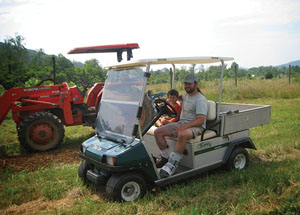
Finally, we now really see the advantages of a hydrostatic tractor and a golf cart on a farm. As I became more mobile, I could get myself onto the tractor and then do everything with my hands until it was time to lower myself down again. A borrowed golf cart was a great way for me to stay involved and check on the fields—they’re easy to get in and out of, they can go anywhere, and they hardly use any gas. Good luck out there, and stay safe!
Eric Plaksin and Rachel Bynum own Waterpenny Farm in Sperryville, Virginia. They can be emailed at waterpenny@verizon.net.
Copyright Growing For Market Magazine.
All rights reserved. No portion of this article may be copied
in any manner for use other than by the subscriber without
permission from the publisher.