











No-till and low-till farming is all the rage right now. Like a lot of newer farmers I began farming quite enthralled by these practices. Pictures of immaculate farms on Instagram, compelling books, and detailed articles in this very magazine tout benefits of no-till farming for healthier soil, fewer pests and weeds, and even reduced labor. No-till farming also makes sense from an ecological perspective as it preserves carbon in the soil and minimizes use of fuel-guzzling tractors.

One result of tillage has been more deeply rooted plants that are able to grow extra tall, strong stems.
It’s no surprise that “tillage” is a dirty word to many no-till farmers, who take an almost dogmatic approach to avoiding soil disturbance. I used to be one of those farmers, clutching my broadfork and convinced that tilling was a terrible idea. But over the last 18 months or so, we’ve started using some tillage on our farm. The results have improved our farm and our business in dramatic ways.
Our no-till beginnings
Before we purchased our property, it was a Christmas tree farm. We hired a neighbor to help remove remaining stumps and plant a pasture mix. We grazed sheep on the property for around a year, and then began breaking ground to plant flowers.
To convert pasture into cropland, we relied on a few different no-till techniques, mostly tarping for several months, then broadforking and adding a couple inches of well-aged compost. We tried straw mulches, but ultimately landed on using landscape fabric to battle weeds. We also experimented with easy-to-terminate cover crops, like buckwheat, and using cardboard to help smother grass.

Tillage has enabled us to rapidly scale up and grow more flowers than ever before without expending even more manual labor.
The results at first weren’t great, but we just kept using these methods as we were assured by many farmers that it would take several years for the system to really work. Earthworms and microorganisms would help work our soil into the dreamy rich earth all farmers fantasize about … right?
Over three years in, we still didn’t have great results. Instead, we had a layer several inches deep of hydrophobic compost, followed by our native, heavily compacted soil. We were losing many plugs planting them directly into compost, which just didn’t hold sufficient moisture especially in the summer heat. When we dug up plants, we noticed they had stunted roots, which usually stretched through the compost then struggled to root deeply into the compacted soil below. Our stems were short. We had what seemed to be extreme pest pressure, especially aphids, which we later learned were attracted to our plants due to imbalanced nutrients.
Then there were the weeds. Using tarping and cardboard quickly smothered cover crops and native grasses, leaving nothing to compete against noxious perennial weeds like mugwort and bindweed. Where we had previously had bits of mugwort here and there became entire mugwort fields. Even leaving tarps on for six to 12 months did nothing to kill the mugwort, which quickly grew back in a matter of weeks. We were spending dozens of hours a year weeding out our no-till beds by hand.
The turning point
In the spring of 2022, we had the disaster that caused us to question everything. We had prepped around 20 beds, using the cardboard-and-compost method we had come to rely on. We planted out around 15,000 seedlings and then they all started to die. Naively, we thought we had under-watered them, so we replanted the beds, kept them very well-watered, and lost another 15,000 seedlings. The only plants that didn’t die? Our ornamental grasses. This was the clue to the mystery: our compost was poisoned with broadleaf herbicide, killing all of the flowers planted into it but not harming grass plants.
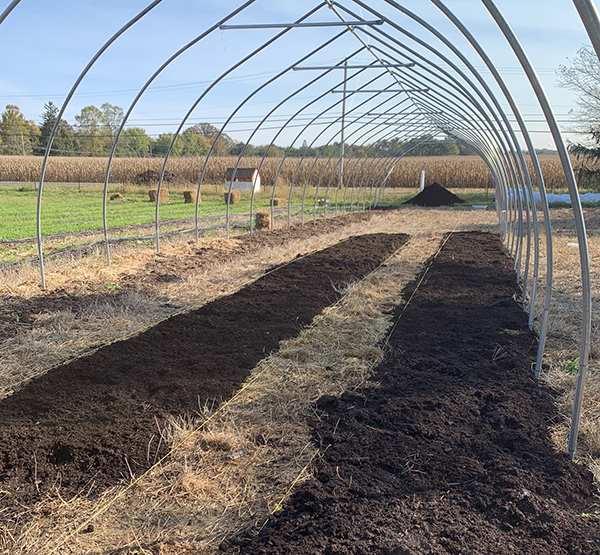
In our initial no-till systems, we used tarps to solarize beds and then piled on the compost.
Working with our extension office, we learned to recognize the signs of broadleaf herbicide poisoning, including contorted leaves. The origin of herbicide in compost is hay, fed to animals whose manure is then used in the compost. Although we had purchased the certified organic compost from a major Mid-Atlantic supplier, we learned that herbicide contamination is becoming more and more common and is difficult for suppliers to prevent.
It’s also difficult to test for after-the-fact. However, dying plants, contorted leaves, and thriving grasses are some telltale signs. I felt wary about applying a lot of compost on the farm again, but I needed to find new systems for bed prep.
Right around this time, I traveled to an Association of Specialty Cut Flower Growers (ASCFG) conference and heard an incredible talk from Ellen Polishuk, who would eventually become an important mentor for our farm. The topic of Ellen’s talk was no-till farming and some of its downsides. It was like she was describing our farm.
Ellen showed pictures of layers of compost sitting atop compacted soil; the pictures looked just like our soil. She also described the environmental dangers of over-applying compost, including high phosphorous levels. Ellen’s takeaway message: “You have to earn no-till.” I realized we may not have earned it. After the conference, I hired Ellen to work with us on soil health and teach us a farming basic: how to till.
Introducing tillage
The first step in our wsork with Ellen was soil testing and our results revealed a lot issues. Our phosphorous levels were super high, as were our levels of salt, both of which were attributed to over-applying compost (especially in our tunnels). We needed an approach to apply nutrients, prep beds, and loosen our soil without using even more compost.
And so we did the previously unthinkable and purchased a rotavator attachment for our tractor. We also purchased a subsoiler, a long bar that rips deep into the soil and helps with compaction.
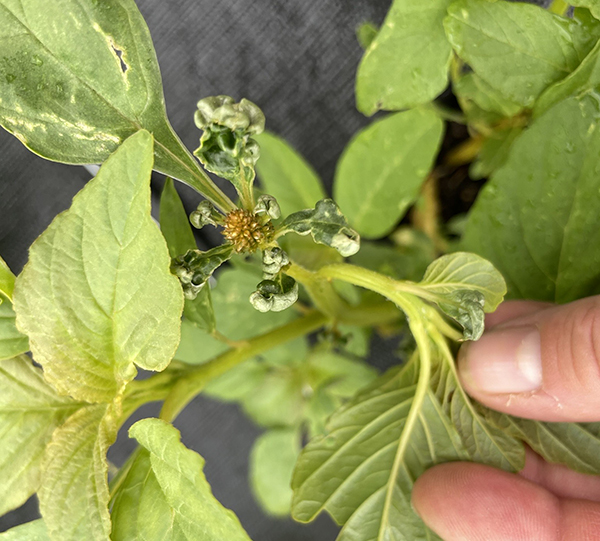
An amaranth seedling showing leaf curl, one of the telltale signs of herbicide contamination from compost.
Heading into the new season, our new approach to bed prep was to cover crop, mow, subsoil, and till, adding specific amendments as needed based on our soil tests. We then added landscape fabric and planted. The difference was immediately apparent.
First, it was much easier to plant into the freshly tilled soil than in our old no-till beds, as plugs just popped right in. Unlike the hydrophobic compost, which needed constant watering and attention to prevent plugs from drying out, our native soil held moisture beautifully. Plugs settled in quickly and took off fast. We also saw significant improvement in drainage from using the subsoiler.
Other benefits appeared as the season progressed. Our plants were taller than they’d ever been, with deep roots traveling many feet into the soil. With our nutrients more balanced, we noticed a drop off in pest pressure. We also saw significant reductions in perennial weeds, which were weakened from the repeated tillage and smothered out by our now vigorous crops.
Tillage further helped our weed pressure by enabling us to introduce more difficult-to-terminate cover crops, like sudangrass, which we previously had trouble breaking down in our no-till system. The sudangrass grew 8 feet tall, outcompeting mugwort and other weeds, and then was easy to work into our soil using the tiller.
New systems, reduced labor, and scaling up
Introducing tilling enabled us to introduce other new crop management systems only possible with tilling. First, we changed how we plant our dahlias. In the past, we had used a variety of labor-intensive, no-till systems for our dahlias, involving lots of compost and hand-weeding. Tillage enabled us to implement a new, mechanized way of planting them, as we had seen on other, larger farms like LaSalle Florists and Greenhouses.
We subsoiled and tilled, then used a used a potato plow to dig a big trench for planting. We then purchased a potato hiller, which we used to re-cover the trenches and hill the plants every few weeks as they grew. The hiller did double duty by eliminating weeds as they sprouted, and it supported the plants with hills of soil, eliminating the need for manual corralling or netting.

Tillage enabled us to hill and manually cultivate our dahlias, saving us weeks of labor corralling them and weeding by hand.
Not only were our dahlias better than ever, but days of manual labor were saved. Mechanizing our dahlias, which was only possible in tilled soil, has made them one of our most profitable crops.
Next, we looked to improve our annual flower production. This year we’ve hired a neighbor to create raised beds and lay biodegradable plastic mulch for our summer annual field. In previous years, it took our team a week or two to spread loads of compost and lay landscape fabric to create our no-till beds for annuals.
This year, it took our neighbor on his tractor about two hours to lay the mulch on an acre of annuals. We were able to quickly plant thousands of plugs by popping them into the loose soil.
In the busy spring when our to-do list seems endless, tillage has freed up many hours of labor and helped us accomplish more than ever before. In turn, it’s allowing us to scale up rapidly to meet our market demands. We’re able to plant more quantities at a more efficient pace, and we’re seeing higher yields from our crops.
Finding a balance
Although we’re reaping many benefits of tillage on our farm, we’re still working toward reducing tillage where we can. For example, in our high tunnels, which we treat as their own mini micro-farms, we’re only tilling annually or every other year. In between, we’re still relying on no-till techniques like tarping, as they work effectively in the small scale of the tunnel.
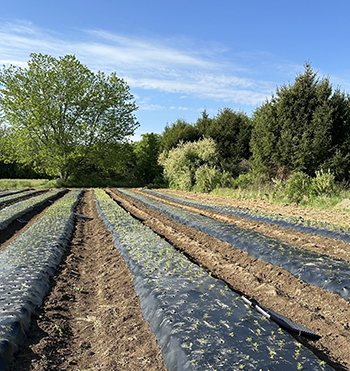
This year we’re trying out using plastic mulch laid by a tractor, only possible by tilling the beds first.
We’re also focusing on planting more perennials, which are naturally no-till plants as they do not require repeated soil disturbance for planting. For many crops, we’ve also been experimenting with strip tillage, or tilling a row but leaving the living pathways untilled. This system retains the benefits of no-till in the aisle while still enabling us to till up the row.
The development of a hardpan, or layer of compacted soil beneath the tilled layer, is an on-going concern. We’re careful to till and drive machinery on our fields only when our soil is dry to help avoid soil compaction. The subsoiler has also dramatically improved our compaction situation, as have cover crops with deep roots like rye and radishes.
Ultimately, we’re finding that a balance between tilling and not tilling to be what works for our farm. I think if we were growing on a more micro scale (less than .5 to 1 acre), a truly no-till approach may make sense. But on our current scale (around 4 to 5 acres in production), mindful tillage combined with strip tillage, perennial plantings, and some areas of no-till is working well.
As our soils and compaction improve, I expect we will be able to till less often as the years go by. If you’ve been scared off from tillage but are seeing issues with your no-till systems, consider this your invitation to consider implementing some careful tillage on your farm.
Rebecca Kutzer-Rice owns Moonshot Farm, a specialty cut flower farm in East Windsor, NJ. She grows flowers year-round including in a geothermal greenhouse, for retail markets in and around NYC.
Copyright Growing For Market Magazine.
All rights reserved. No portion of this article may be copied
in any manner for use other than by the subscriber without
permission from the publisher.