




In our first season of growing flowers, we propped an old doghouse on stilts, painted it white, and called it a farmstand. A neighboring farmer said it might be a nice way to earn a little beer money. We promoted it heavily on social media, and on opening day had a line of cars down the street.
In the three years since then, our flower farmstand has grown to be one of our most lucrative outlets, accounting for nearly a third of our gross sales on our retail-focused flower farm. Each week we have customers drive from all over the region, often an hour or more, just to visit our little shack and grab some flowers. At the same time, it’s by far our easiest outlet as we set it up in the morning and then get on with our day. I think all farms should consider adding a farmstand. Here are some tips to make it work for you.
Start simple
Search “farmstand” on Instagram or Pinterest and you will find an endless scroll of gorgeous custom-built sheds. Before investing too much, test your market and see if the stand will be worth it. You can still make a cute Instagram-able set-up with what you have on hand. Our first stand cost us about $30 in paint. We attached an old doghouse on our property to some 2x4s and wooden trellis, and we were in business.
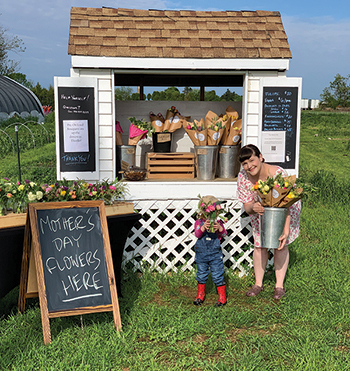
Our original stand was a cheap DIY project. I suggest using what you have before investing in an expensive set-up.
The basic components to any farmstand are weather protection, shade, clear signage, and safe parking. A basic farmers market set-up will do, with tables under a weighted tent. Since we’re aiming for low-stress, ensure it can stand up to some wind and that your product will be protected from the rain. Rain protection will double as shade in the hot summer months.
Our farmstand is open year-round. On days below freezing we use a small propane-powered space heater to protect the flowers from frost. Summer flowers usually hold up great during the heat, but for a few weeks in late spring we have spring blooms and summer temps. Think bunches of tulips sitting out on 80-degree days. For those occasions, we keep extra product in the cooler and restock when the stand runs low.
Signage should include how to pay, pricing, and information about your farm. We find customers don’t know the names of flowers or the difference between a “bouquet” and a “bunch.” So, rather than a menu with all of our pricing, we are sure to put a price label on each individual bucket of blooms. The stand is also a great place to advertise upcoming classes and events at the farm. We set out postcards about the farm and our events, and we have plenty of business cards for people to take.
Safe parking is also key. Be sure customers can pull completely off the road. An existing farm driveway or patch of grass can work, but be cautious that unpaved areas will get muddy with regular use during a rainy spring. If needed, use caution tape to mark out muddy spots so cars don’t get stuck.
We nicknamed our first set-up “The Piggy Bank Farm Stand.” The idea was to use all of its sales toward a larger and more permanent set-up. By the end of that first year, the little piggy bank had grossed over $25,000 — way more than we needed to make the Pinterest-y stand of our dreams. We invested that extra money in a gravel lot to improve parking for our customers.
Limit hours to maximize sales
A common model for farmstands is daily hours, dawn until dusk. While this might work if you have an exceptionally high-traffic stand, it can leave an impression that your product isn’t fresh. It also creates no sense of urgency in the customers; they know you’re always open, so they don’t prioritize their visit to your farm.
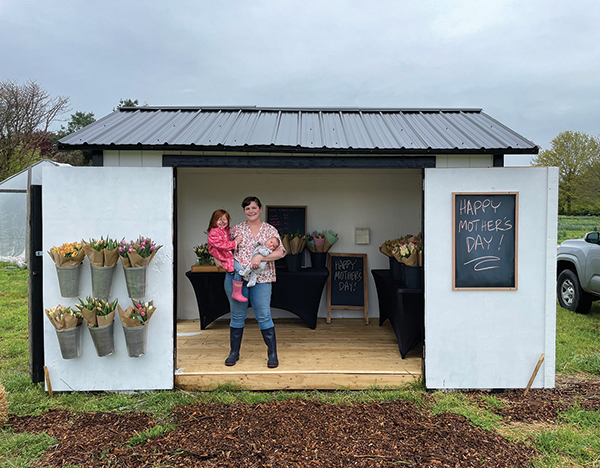 An updated farm stand holds a lot more flowers but the basic elements are the same – shelter from the elements, clear signage, and safe parking.
Our stand was initially open two days a week, but we’re now open only on Sundays, 10 a.m. to dusk (or sold out). By limiting hours, we’ve created a cult-like following. People know that if they want the best product, they need to come at opening. We almost always have a line of cars waiting while we set up. Many have made their visits part of weekly routines. They show up week after week for fresh blooms.
Drawing the crowd
When fellow growers hear we run a successful farmstand, they assume we are located on a busy road. In reality, we’re on a fairly rural road with little traffic, although we do live on the outskirts of a suburban, densely populated area. The farm is in East Windsor, New Jersey, about an hour south of New York City. We get few drive-by customers. Almost everyone who comes to our stand has driven out for the express purpose of buying our flowers.
Unlike a farmers’ market, where only around 10 percent of the customers passing by actually make a purchase, nearly 100 percent of the people who come to our stand buy flowers. They’ve invested time and gas driving out to our stand, so they aren’t going to leave empty handed — even if we don’t have the exact product they came looking for. For us, the key is getting people to show up.
We advertise the stand each week in Instagram/Facebook posts and stories. We describe what flowers we’ll have and give details about our location and what payment methods are accepted. These posts might become redundant for regulars, but when I share a Google Maps link, a few people always click, which means new customers are checking us out each week.
We sell at two busy farmers markets and have a large CSA. In the past, we’ve made the mistake of prioritizing these outlets over the stand. When short on flowers, we would not put much out at the stand. As a result, it started selling out too fast and our sales suffered. I got feedback from customers that they stopped coming to our stand because it was often sold out.
In response, we started stocking it much more. We hired an additional employee on Saturdays just to harvest flowers for the stand. We post updates on social media throughout the day showing that we still have product, and sales have gone back up again.
A happy balance seems to be one of both scarcity and abundance. We usually have a product that is very limited (like mixed bouquets), as well as something we have in quantity (like tulip bunches). Customers know that if they want a mixed bouquet, they need to arrive extra early, but that if they come late there will still be a tulip bunch for them to take home. This helps keep the buzz going while avoiding disappointed customers.
Self-serve options
The best part about our Sunday stand is that we don’t have to be there. We set it up in the morning and usually check it around midday, then return at the end of the day to close it up. This means we get a much-needed day to rest and spend time as a family. A few weeks ago we took our annual vacation and a staff member set the stand up. As I sipped margaritas in a lounge chair, my phone kept getting notifications about farmstand sales. How’s that for work/life balance?
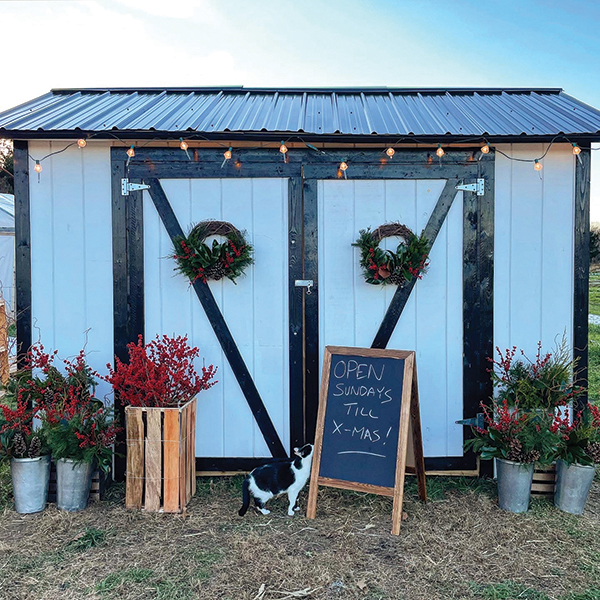 Our stand is only open on Sundays. By limiting hours, we’ve developed a cult-like following of customers who are lined up at opening time.
We include sales tax in all of our prices and indicate this on our signage. Double-check your state/local laws that this is allowed, but we find it simplifies the checkout process. We offer customers a few different options for check-out, with signage on the wall explaining how to pay:
Exact change and local check can go into a locked box screwed on the wall. Customers with Venmo accounts can scan a QR code to pay using the app.
For customers who don’t have cash or Venmo, we have a second QR code that takes them to a self-serve Square website. Rather than listing different items on the site, we allow customers to add intervals of $1, $5, or $10 to their cart. This way we don’t have to update the Square site during the busy season when products change every week.
Offerings
It can be tempting to stock your stand with every product seasonally available to you. We’ve trialed eggs at our stand, as well as vegetables from another local farmer. But managing inventory, product freshness, brand consistency, and the cost of buying in extras ultimately was not worth the headache. By focusing solely on flowers — and a little bit of farm swag — we are able to offer our customers a unique and reliable experience. Yes, people really do drive over an hour just to pick up a bouquet of blooms. This is their self-care time, not their big grocery haul for the week. We try to make the stand a convenient and pleasant Sunday destination. It helps that our field of flowers is in view.
What about theft?
We experience occasional theft at our stand. We track this by keeping a list of what we put out, comparing it with what’s left at the end of the day, and noting any discrepancies between our calculated sales and what we’ve actually collected. Our worst theft was Mother’s Day last year when around $100 of flowers were stolen.
In any given month, we average around $20 to $50 in stolen product. To have an employee working the stand for eight hours at $20/hour wage, it would cost around $640/month — much more than the cost of occasional stolen flowers.
Add a security camera to your stand, or at least a sign that warns of one. Our stand is not connected to Wi-Fi or electricity, but there are several different battery-powered security cameras available online. We bought a cheap one that we haven’t installed yet, but when we added a “You’re on Camera” sign, we noticed theft dropped off dramatically.
Our largest overall theft actually involved Venmo. After noticing losses several weeks in a row, we heard from a customer that she had almost accidentally paid the wrong account. It turned out someone had made a Venmo account very similar in profile name and picture. Dozens of customers had sent them money for our flowers.
A Venmo dispute did not resolve the issue. We were hesitant to quit using Venmo as around 40 percent of our sales come through it. Instead, we stopped advertising our account name and now show only the QR code. The code takes customers directly to our profile and they have stopped paying the similarly named account.
Permits and zoning
Your farmstand may be subject to state, county, and local zoning, permitting and building rules. A good starting point is to give your local zoning officer a ring. Many towns do not require permitting as long as you keep your stand under a certain size. Adding wheels to make it a non-permanent structure and stressing its seasonal nature can also help you get around needing a permit. Additionally, many states cover farmstands in their right-to-farm laws, affording you exceptions.
Here in New Jersey, our farmstand itself did not require any special permits. We did install a gravel parking lot last year for our customers that required a permit. We sent a simple sketch drawn on a Google Maps print-out, filled out a one-page form, and had the permit within a few days. The town official even waived the fees. As tempting as it may be to “ask forgiveness, not permission,” when investing in a farmstand in view from the street, I recommend getting it right from the start.
Nothing to lose
For us, the farm stand is a win/win. It’s convenient for our customers and for us. I hope you’re inspired to start a farm stand this spring.
Rebecca Kutzer-Rice owns Moonshot Farm, a specialty cut flower farm in East Windsor, NJ. She grows flowers year-round including in a geothermal greenhouse, for retail markets in and around NYC.
Copyright Growing For Market Magazine.
All rights reserved. No portion of this article may be copied
in any manner for use other than by the subscriber without
permission from the publisher.