






The first part of this article ran in the May GFM about many of the wonderful spring and summer perennials and natural elements that can add character to bouquets and arrangements. In this, the second and final part of the article, we look at the foraged and woody elements that can be harvested or held for fall and winter design work.
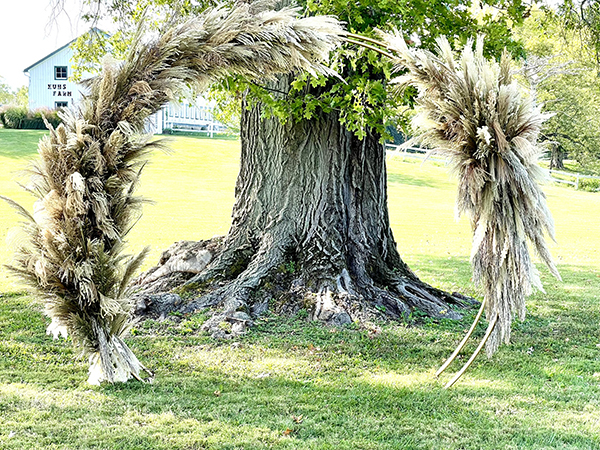
A mix of grasses wired into a moon gate for a wedding. This included a blend of cultivated varieties and wild ones from a pasture. All images courtesy of the author.
As summer fades into fall, there are still many beautiful plants to gather, including:
- Goldenrod (Solidago sp.) – Plumes of tiny yellow flowers that add a sunny element to fall designs.
- Asters (Symphyotrichum sp.) – Daisy-like flowers in shades of purple, pink, and white.
- Snakeroot (Ageratina altissima) – Fluffy clusters of white flowers that resemble a wild baby’s breath.
- Ironweed (Vernonia sp.) – Bold spikes of deep purple flowers that add drama to arrangements.
- Pumpkin on a Stick (Solanum integrifolium) – Decorative fruit that resemble miniature pumpkins on upright stems.
- Beautyberry (Callicarpa sp.) – Clusters of vivid purple or white berries along the stems.
- Bittersweet (Celastrus sp.) – Vining plant with yellow-orange berries that pop open to reveal red seeds.
- Rosehips (Rosa sp.) – Colorful red, orange, or yellow hips that form after rose flowers fade.
- Trumpet Honeysuckle (Lonicera sempervirens) – Coral red berries that contrast nicely with the vine’s evergreen leaves.
- Teasel (Dipsacus sp.) – Spiny, sculptural seed heads that add interest to dried arrangements.
- Purple Loosestrife (Lythrum salicaria) – Tall spikes of vibrant magenta flowers. Note: This plant can be invasive in some areas, so check local regulations.
- Virginia Knotweed (Persicaria virginiana) – Slender spikes of small white or pink flowers, followed by colorful red foliage.
- Seven Sons Flower (Heptacodium miconioides) – A large shrub or small tree with clusters of fragrant, creamy white flowers in late summer and early fall. After the flowers fade, the calyces turn red, creating a striking two-toned effect. The bark is light tan and exfoliates in thin strips, adding winter interest.
Again, most of these fall offerings are overlooked as either natives or invasive, but florists call me early in the season waiting to hear when purple asters and goldenrod are available (if you buy the latter out of a wholesaler’s cooler, it’s called solidago). Seven Sons is a gorgeous dwarf tree that produces tiny white blooms, but after it sheds its petals, the structure is magical. Snakeroot looks like a weed (and it is) but it’s nature’s answer to baby’s breath, and I use it in that same capacity in arrangements.
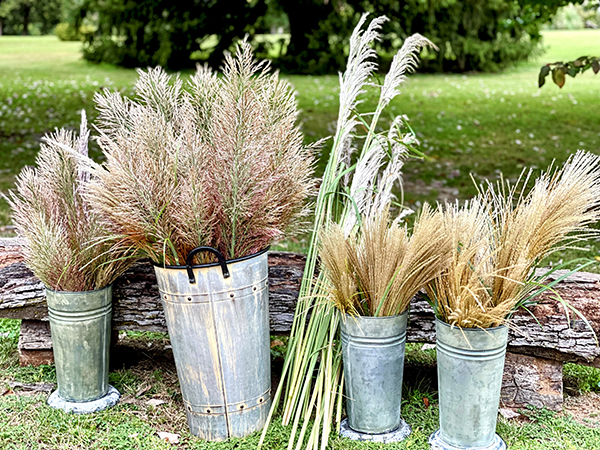
Different varieties of fountain grasses the author grows- some purple, some copper, and some reed grass. They continue to fluff out after they’re cut. They don’t mature until September- but then they’re prolific and can be used for anything. The author lets some winter over and can cut them in the spring. They get sturdier over the winter and can be used as supports the following spring, much like bamboo stakes.
Make sure to check with your local department of agriculture to see what’s invasive in your area before planting, because it varies quite a bit. Invasives may already be growing on your farm or forest; if you identify any of these, you could harvest them in a manner to eradicate them over time or at least limit their spread. Just be careful with any part of the plant that can be propagated, like mature seedheads or pods.
Grasses
Grass tops — whether the fluffy pollinated blooms at the top of fountain grasses or ornamental grasses, or simply the wild grasses at the side of the road — late in the season they all have distinct textures and colors that are highly sought after for fresh arrangements and dried statement pieces. Again, like growing flowering branch varieties, you would do well to connect with wedding design vendors in your area as they will likely buy everything you have available in grasses during fall wedding season.
Some of my favorite Grass Tops:
- Maiden Grass (Miscanthus sinensis) – Tall, upright grass with arching foliage that turns golden-bronze in fall. Silvery tassel-like plumes appear in late summer and persist through winter. Popular varieties include ‘Gracillimus’, ‘Morning Light’, and ‘Adagio’.
- Purple Fountain Grass (Pennisetum setaceum ‘Rubrum’) – Clump-forming grass with burgundy-purple foliage and soft, fuzzy, bottle-brush plumes in summer and fall. Adds a striking vertical element to designs.
- • Mexican Feather Grass (Nassella tenuissima) – Fine, hair-like green foliage that sways gracefully in the slightest breeze. In summer, delicate golden flower spikes appear above the foliage, maturing to a pale straw color.
- Blue Fescue (Festuca glauca) – Low-growing, clump-forming grass with striking silvery-blue foliage. Adds a cool, frosty texture to designs. Popular varieties include ‘Elijah Blue’ and ‘Boulder Blue’.
- Northern Sea Oats (Chasmanthium latifolium) – Upright grass with broad, flat, bright green leaves that turn copper in fall. Dangling, oat-like seed heads appear in summer and turn a golden-bronze color, persisting well into winter.
- Switchgrass (Panicum virgatum) – Tall, upright grass with airy, open flower panicles in summer that mature to a beige color. Foliage turns a beautiful golden-yellow in fall. Popular varieties include ‘Shenandoah’, ‘Northwind’, and ‘Heavy Metal’.
They might be giants (grasses):
- Giant Reed Grass (Arundo donax) – A tall, robust grass that can reach up to 20 feet. It has thick, bamboo-like canes and long, slender blue-green leaves that can grow up to 2-feet long. In late summer, large, feathery, purplish-brown plumes appear at the tops of the canes. Giant Reed Grass makes a dramatic statement in large-scale arrangements and can be used as a natural screen or backdrop in outdoor settings. Note: In some regions this grass is considered invasive, including most of the southwestern states and Florida, so check local regulations before planting.
- Arundo Grass (Arundo spp.) – This genus includes several species of tall, reed-like grasses. The most common ornamental variety is Giant Reed Grass (Arundo donax), described above. Another species, Variegated Giant Reed Grass (Arundo donax ‘Variegata’), has striking white and green striped leaves that add a bold, graphic element to designs.
- Variegated Fountain Grass (Pennisetum setaceum ‘Fireworks’) – A clump-forming grass with slender, arching foliage striped in hot pink, burgundy, and green. In summer, soft, bottlebrush-like purple plumes rise above the foliage, adding a feathery texture. This grass is a more compact variety, typically reaching 2-to-3-feet tall. It’s drought-tolerant and heat-loving, making it a good choice for summer arrangements. The vibrant foliage adds a tropical flair to designs.
- Broadleaf Cattail (Typha latifolia) – A wetland plant with long, strap-like leaves and distinctive cylindrical flower spikes. The dark brown, velvety spikes are actually made up of thousands of tiny flowers. In late summer, the spikes release fluffy white seeds that can be used in dried arrangements. Cattails can add a rustic, natural element to designs and are often used in fall and winter décor. They’re also useful for adding height and structure to large-scale arrangements.
- Reed Canary Grass (Phalaris arundinacea) – A tall, perennial grass with wide, flat, green leaves. In summer, the grass produces large, loosely branched flower panicles that start out green and mature to a beige color. The seed heads have a slightly purple tinge. Reed Canary Grass is often used for its foliage, which can add volume and texture to arrangements. The mature seed heads can also be used in dried designs. Note: Though native to North America, this grass can be invasive in some areas, so check local regulations before planting.
- Common Reed (Phragmites australis) – A large, perennial grass that grows in wetlands and along riverbanks. It has tall, hollow stems and long, slender leaves that are blue-green in color. In late summer, the grass produces large, feathery, purplish-brown plumes that can reach up to a foot long. Common Reed is often used in dried floral arrangements for its striking plumes and architectural stems. The leaves can also be woven into mats or baskets. Note: This grass is considered invasive in many regions, so it should not be planted and should only be foraged where legally allowed. Interestingly, a subspecies (ssp.) of common reed, americanus, is native to the US and Canada. But a ssp. australis from Europe outcompetes the native subspecies and is now considered to be “one of the most problematic invasive species in North America,” according to the USDA National Invasive Species Information Center.
- Feather Reed Grass (Calamagrostis x acutiflora) – A clump-forming, cool-season grass with upright, slender stems and narrow, green leaves. In early summer, the grass produces feathery, pinkish-purple plumes that rise above the foliage. The plumes fade to a wheat color and persist into winter. Popular varieties include ‘Karl Foerster’, which is known for its strong, vertical growth habit and early blooming. Feather Reed Grass adds a soft, hazy texture to arrangements and can be used fresh or dried.
These grasses offer unique textures and forms that can add interest and diversity to your floral designs. Cattails and Common Reed are particularly striking in fall and winter arrangements, while Reed Canary Grass and Feather Reed Grass can add a soft, naturalistic feel to summer designs.
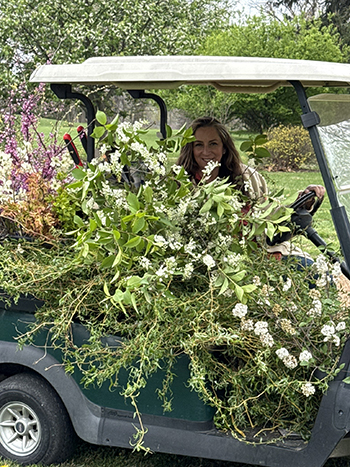
The author on her way back from a foraging excursion. Having a harvest vehicle helps as branches can take up a lot of space.
These grasses are known for their impressive size, striking colors, and unique textures. They can add height, volume, and a sense of drama to large-scale arrangements, installations, and event designs. The plumes and foliage also dry well, allowing for extended use in everlasting designs. These grasses offer a diverse range of colors, textures, and forms that can add movement, structure, and seasonal interest to floral designs. Many of them also dry beautifully, making them versatile elements for both fresh and everlasting arrangements.
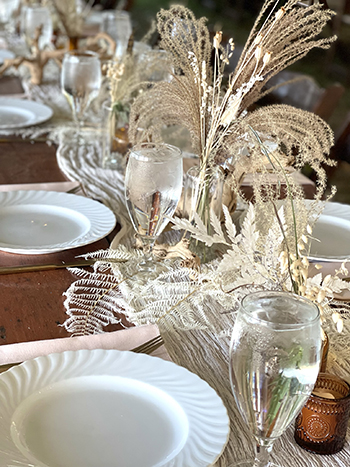
This place setting was for a bride who wanted a very bohemian/bleached botanical curated vibe, so the author used a mix of amber and clear glass and many different grasses.
Added benefit: I grow the Giant Reed Grass around the edges of my flower fields as a windbreak. Since they are fast growing and reach 22 feet in a single season, by the time the summer heat is oppressive, they are at the height as the sun angle shifts to provide some shade in the hottest part of the day. Knowing that, I design my row layouts considering which varieties could use an afternoon break from the burning sun.
As with any ornamental grass, be sure to handle the blades and plumes carefully, as some can have sharp edges. And always check local regulations and invasive species lists before planting, as some of these larger grasses can spread aggressively in certain environments.
Evergreens, berries and more
While the growing season may wind down after the first frost, there are still plenty of beautiful foraged materials in the cooler months. Many make stunning additions to seasonal and holiday arrangements, offering continued revenue streams year-round. Some of my favorites include:
Evergreens:
- Pine (Pinus sp.) – Needled evergreens with a classic Christmas tree shape and distinctive pine scent. Needles range from short to long, and soft to sharp, depending on species.
- Cedar (Cedrus sp.) – Large evergreens with bluish-green needles and a pleasant, woody aroma. Branches have a graceful, slightly drooping habit.
- Juniper (Juniperus sp.) – Scaled evergreens that come in both low-growing and upright forms. Foliage can be green, blue-green, or yellow-green, with a spicy fragrance.
- Magnolia (Magnolia grandiflora) – Broadleaf evergreen with large, glossy, dark green leaves that have a fuzzy brown underside. Leaves are popularly used in wreaths and garlands.
- Holly (Ilex sp.) – Glossy, spiny leaves and bright red berries on female plants. Quintessential Christmas evergreen. Leaves can be variegated with yellow or white margins.
- Boxwood (Buxus sp.) – Small, rounded evergreen leaves that grow densely along stems. Commonly used in holiday wreaths, garlands, and topiaries. Foliage has a distinctive scent.
Berries:
- Winterberry (Ilex verticillata) – Deciduous holly that loses its leaves to reveal dense clusters of bright red berries along the stems. Berries persist through winter.
- Beautyberry (Callicarpa sp.) – Clusters of small, vivid purple or white berries that encircle the stems. Berries appear in fall and hold well when cut.
- Hawthorn (Crataegus sp.) – Clusters of small red or orange-red fruits that resemble tiny crabapples. Branches are thorny, so handle with care.
- Snowberry (Symphoricarpos sp.) – Clusters of large, white berries that appear in fall and winter. Stems have an arching habit.
- Rosehips – The colorful red, orange, or sometimes purple fruits of rose plants (Rosa sp.). They appear in fall after the flowers fade and add bright pops of color to arrangements.
Other treasures:
- Pinecones
- Acorns
- Seedpods
- Dried grasses and seedheads
- Lichen-covered branches
- Curly willow
- Harry Lauder’s walking stick (Corylus avellana ‘Contorta’)
The key with evergreens is to look for a variety of textures and shades of green to add depth to designs. Conifers like pine and cedar offer a classic holiday fragrance, while broadleaf evergreens like magnolia and holly add glossy pops of emerald.
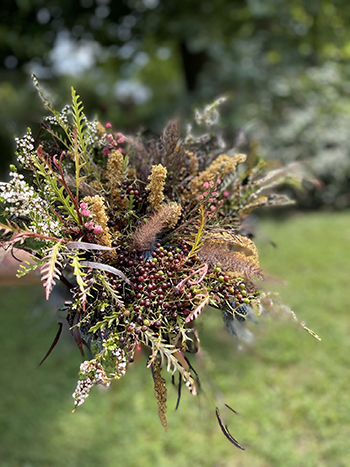
This bouquet was for a bride who wanted something like a wild/native Scottish Highland bouquet, so the author used elderberries, knife edge, heather, grasses, and a lot of weeds.
Berries introduce jewel-like color and festive cheer. Winterberry hollies are a standout with their masses of bright red berries that persist through the season. Don’t forget other natural elements like pinecones, acorns, and intriguing seedpods and dried grasses. A walk through the early winter landscape reveals an array of sculptural shapes and earthy hues waiting to be incorporated into seasonal designs.
As with any foraging, be sure to collect these materials sustainably with respect for the plant and surrounding ecosystem. Some berried shrubs can be quite sensitive to over-harvesting.
To forage or not to forage
There is a growing community of voices that do not like using invasives. It’s a personal choice, and I personally like using them. While foraging connects us to nature and expands our creative palette, it’s essential that we do so responsibly to preserve wild populations. Some key guidelines: Never forage on private property without express permission. Establish relationships with local farmers and landowners.
On public lands, check with the managing agency about foraging rules and permits. Many state and national parks prohibit collecting. Harvest minimally from each plant. Never collect rare or endangered species. Use sharp, clean pruners to make precise cuts that don’t damage plant health. Avoid foraging in areas that may have chemical contamination, such as roadside ditches. Consider propagating some wild favorites in a dedicated cutting garden to reduce pressure on wild populations.
Adding forageable/wild elements to your farm is a great way to offer something unique to your customers and connect your offerings to your regional ecology. To get started, consider: Allow edges of your fields to grow wild and harvest volunteers like goldenrod and asters. Plant hedgerows with a mix of native flowering shrubs like dogwood and wild roses. Include flowering vines like honeysuckle or clematis on trellises. Manage a small coppiced woodland for woody material production
Keep in mind that the varieties and seasons I’ve listed are for my Midwestern 7a USDA zone, so bloom times will vary based on your region and microclimate. The best way to get to know your local wildflowers is to take walks in natural areas throughout the growing season, observing what’s in bloom and jotting down notes and photos to build your own foraging calendar. Seek out growers who specialize in woody varieties, willows, flowering trees and grasses. Adding them to your growing practice has so many benefits to you and the environment.
You can also partner with local conservation organizations or landowners to establish foraging best practices and sanctioned areas, ensuring a sustainable supply of foraged goods.
Whether you’re harvesting from the wild or from your own fields, foraged florals are a beautiful way to diversify your designs, support sustainability, and celebrate your local ecology. With responsible practices and an eye for unique beauty, foraged and wildflowers are becoming an essential part of the progressive flower farming and floral design movement.
Elizabeth Fichter of Queen Bee Blooms & Kuhs Estate and Farm is a flower farmer and floral designer based in St. Louis Missouri. With a passion for sustainable floristry and celebrating the beauty of local ecosystems, she specializes in incorporating foraged and wild elements into her designs. Elizabeth shares her knowledge and love of nature through photography, workshops, writing, and exploring the intersection of art and science with flowers. Connect with her at queenbeeblooms.com and on Instagram and Facebook also as Queen Bee Blooms. Eighty-three newly released varieties of gorgeous bloom varieties are available on the Queen Bee Blooms website. Please feel free to reach out with questions or assistance.
Copyright Growing For Market Magazine.
All rights reserved. No portion of this article may be copied
in any manner for use other than by the subscriber without
permission from the publisher.