











There are only two ways to increase the profits of your flower products: increasing the price of the product or decreasing the cost of production. When increasing our prices is not feasible, we can decrease the cost of production by being more efficient with our time and resources. By improving our efficiency, we minimize our inputs, and therefore, maximize our profits.
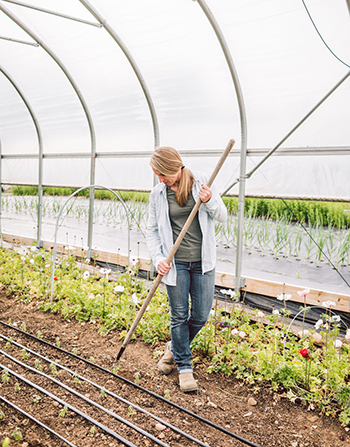
The author cultivating in her greenhouse. Have a system in place to scout for weeds weekly and they should never get out hand.
For example, let’s think of your business like my niece’s summer lemonade stand. With entrepreneurial-minded parents, my niece inherited the work-hard-to-make-money gene. Since they live on a very busy road, she capitalized on the opportunity by opening a homemade lemonade stand. She wanted to make more money from her lemonade stand this summer, but she didn’t want to charge more than a $1 per cup. I suspect mostly because she didn’t like to make change.
Therefore, her only option to increase profits from her lemonade was to reduce the cost of making it (which is like cutting the costs of producing your flowers). With her parents help, she focused on making her process more efficient. She found a new recipe that used less sugar and fewer lemons and had her little brother make the lemonade faster by making a large batch of lemonade at once, instead of one cup at a time. He got paid 25 cents an hour. Because she was more efficient with her ingredients and her “employees” time, she ended up making the same amount of lemonade for less money, and in turn, kept more money herself from each sale.
In your flower business, the process is exactly the same. Improving your efficiency — whether through better use of labor, using fewer resources, finding cost-effective ways to grow your flowers, or improving workflows — means you can cut costs and keep more of the revenue in your pocket. Just like my niece’s lemonade stand, your goal is to make your flower business run more cost-effectively, ensuring greater profits without needing to dramatically raise your prices.
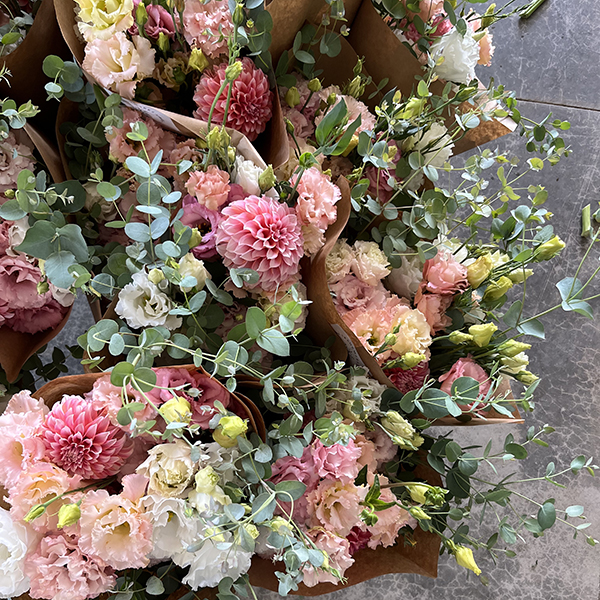
Three-ingredient bouquets have worked well to be more efficient and profitable. All photos courtesy of the author.
At some point during my growing career, just like my niece, I felt like I was working far too much and earning too little. I was frustrated with how much time every task took and thought I could be earning more. I began scrutinizing everything we did in an effort to fully maximize the efficiency of our systems, and squeeze out more money (and time).
I analyzed things like how many steps we took from the cooler to the processing tables in our studio, the exact number of times we touched crops from seed to harvest, how much time it took to plant in landscape fabric versus bare ground, and more.
Based on my findings, we’ve changed a lot over time. And luckily, it has resulted in massive success. We increased profits on our crops and the farm’s overall profit. We narrowed our staff’s working hours to fewer than 40 hours a week. We completed tasks we vowed we would “someday” get to (like keeping the farm looking clean and tidy — mostly). And, We improved our work-life balance in a way I didn’t think possible.
The most notable successes were saving hundreds of hours through our improved weed management system, earning more from our mixed bouquets, and increasing the profits we earned from our ranunculus crop by nearly 30 percent.
Here’s how. I put systems in place where we didn’t have them and changed existing systems on the farm to be far more efficient. To be more efficient, I eliminated, shortened, or simplified the steps in the processes. I find that if I have a system in place, I am able to apply these three principles of eliminating, shortening and simplifying to just about anything in order to squeeze out more profits and get some of my time back.
You can implement the same success that my niece and I have had by first putting systems in place, then analyzing the steps in those systems to eliminate what’s not necessary, and finally, shorten and simplify steps whenever possible to maximize efficiency.
Put systems in place
The first step is to put systems in place wherever possible. A system is a structured set of processes or procedures that your farm uses to manage its operations — often in the form of a set of defined steps that ensure smooth functioning and completion of tasks. We utilize “standard operating procedures” as a part of our systems.
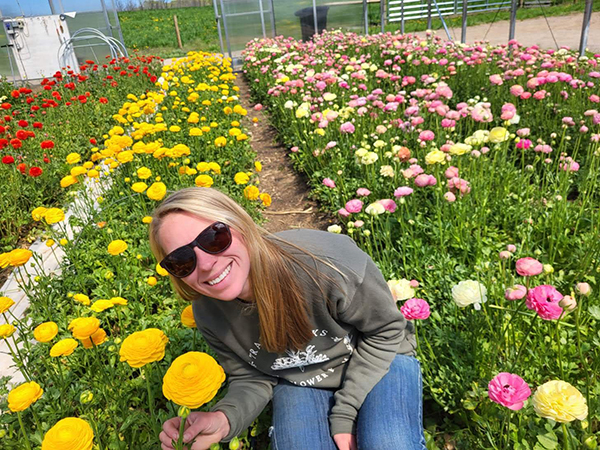
Two different processes can yield the same result, only with more profits.
For longer than I’d like to admit, we didn’t have a true system in place for weed management. There are endless techniques to approach weed management. We employed many useful ones, always trying to tackle weeds at thread stage to make it more manageable. It didn’t always work.
Hand weeding is time consuming and terribly inefficient, so I tried to avoid it at all costs. Yet, it seemed like we always did some of it around the farm. This was frustrating because I knew we could use the time we spent hand weeding for other tasks that actually made the farm money.
Let’s say on average it takes an hour to hand pull weeds from one bed. If you did that three times over the course of the season, it adds up to three hours. Multiply that over a farm with 100 beds and you’ve spent 300 hours weeding that season.
By contrast, the time it takes to wire weed one bed with weeds at thread stage is fewer than 15 minutes. If you do that three times over the course of the season, it adds up to one hour. Multiply that over the same farm with 100 beds in it, and you’ve only spent 100 hours weeding.
Just by employing a wire-weeding method over a hand-weeding method it could potentially save this hypothetical farm over 200 hours of weeding a season. If their labor rate is $25/hour, that means the farm would save $5,000 in weeding labor alone. Impressive, right?
As this example illustrates, we always strived to murder weeds at thread stage with our various weeding tools. Yet, often beds that we weren’t harvesting from or visiting often would get forgotten about. Unchecked weeds would grow so big that our trusty wire weeder and collinear hoe were deemed useless. Hand weeding became the only option.
The solution was to put a system in place. Instead of trying to keep track of what beds might need to be weeded and when, we decided to make Thursday afternoons our non-negotiable weeding time. One of our employees is delegated the task to wire weed the high tunnel beds to ensure weeds are attacked at thread stage. She knows that every single Thursday afternoon is reserved for checking for weeds. Sometimes she finds that no weeding is necessary in certain beds, which is great. She just moves on to the next task for the day and often finishes early.
Now with this system in place, it’s rare that a bed of weeds gets out of hand, and we have virtually zero weeds in our growing beds, making our flowers more productive, healthier, and the farm looks much more visually appealing. We not only save thousands of dollars avoiding the time it takes to hand pull weeds, but also enjoy the benefit of reaping extra revenue from the increased yields of our weed-free beds.
Take a look around your farm for frustrations and disappointments, and I’ll bet there’s a system you can put in place to solve the problem, make your farm run more efficiently, and put more dollars into your pocket.
Eliminate
The next step is to eliminate any steps in processes that aren’t necessary or aren’t adding a substantial benefit (or eliminate a process altogether). As a rule, I try to avoid making mixed market bouquets whenever possible. Instead, I focus on selling straight bunches because it’s easier, faster, and part of our sales plan. However, we do sell a few of them, but we make sure it’s mega-efficient. We’ve made sure of this by eliminating whatever isn’t necessary in the process.
When I first started my flower farm I was taught that every mixed bouquet needed five types of ingredients: a focal flower, filler flower, disk flower, spike flower, and foliage. Switching between harvesting so many different ingredients and physically putting the bouquets together took a long time, and I felt that some of the ingredients weren’t necessary to make a beautiful bouquet that sold well.
Instead of following the traditional five ingredient bouquet recipe, we’ve eliminated ingredients and now focus on making only two-ingredient pairings (such as lisianthus and eucalyptus) or three-to-four ingredient mixed bouquets (such as dahlias, lisianthus, and eucalyptus) whenever possible. This cuts down on task-switching and makes bouquet-making incredibly quick, easy, and more profitable.
Harvesting more stems of one kind of flower is much more efficient and faster than harvesting fewer stems of many kinds of flowers. Anytime you switch tasks, you introduce more time into the equation. To harvest for three-ingredient bouquets with 30 stems, you’re only switching harvest tasks three times. So, harvest happens fairly quickly and efficiently. To harvest for a ten-ingredient bouquet with the same amount of stems, it might take you twice as long since you’ll be walking to other parts of the field, getting different buckets, tools and cleaning snips, stopping to check the harvest list every time.
This may sound minimal, but if it takes you five minutes to walk from one side of your harvest field to the other to cut a different crop, and you do this four times a day, that adds up to over 80 hours of time over the course of an average growing season. Not only does eliminating unnecessary mixed bouquet ingredients speed up the harvesting process, it also makes putting bouquets together faster, too.
Our market bouquets take an average of 50 seconds to put together, from the time we grab the first flower to the time it’s banded and sleeved. Setting up the bouquet making table and cleaning up afterwards is quicker and easier as well.
The best part is that these simple and quick to make three-ingredient bouquets sell just as well as (if not better than) our previous five-to-eight ingredient recipes. A typical summer three-ingredient bouquet would include just dahlias or zinnias, lisianthus, and eucalyptus.They are simple, beautiful, and we make a much larger profit on them.
We estimate that we have cut the time it takes to harvest and make our mixed bouquets in half just by eliminating a few ingredients. We still charge the same amount per bouquet as before (which includes the value of the stems plus labor). However, we now get to keep a much larger percentage of that in our own pockets.
Shorten plus simplify
The final steps are to shorten and simplify steps in your systems. I have found this to be most effective (and honestly, mind-blowing) when applying it to growing processes. For example, we used to grow our ranunculus by soaking the corms and then placing each individual corm in 50-cell trays with the “legs” pointed down. We’d grow these in our greenhouse for about four weeks into beautiful plugs, and then transplant into our high tunnel beds. It took about 20 labor hours per bed to do so.
I took a hard look at every step in this process, and shortened or simplified every step I could. Now, we grow them by soaking the corms, then dumping them into a 1020 flat, covering them with a bit of soil, and letting them pre-sprout for about seven to ten days in the greenhouse. Finally, we transplant them as pre-sprouted corms, which are much quicker to transplant than big-fat, 50-cell plugs.
This takes fewer than four labor hours per bed of ranunculus. With this method we use far fewer trays, less soil, and don’t bother turning on the heat most of the time. We just cover the trays with humidity domes on top of heat mats. Because of this, we save a considerable amount of money on labor, materials and heating costs.
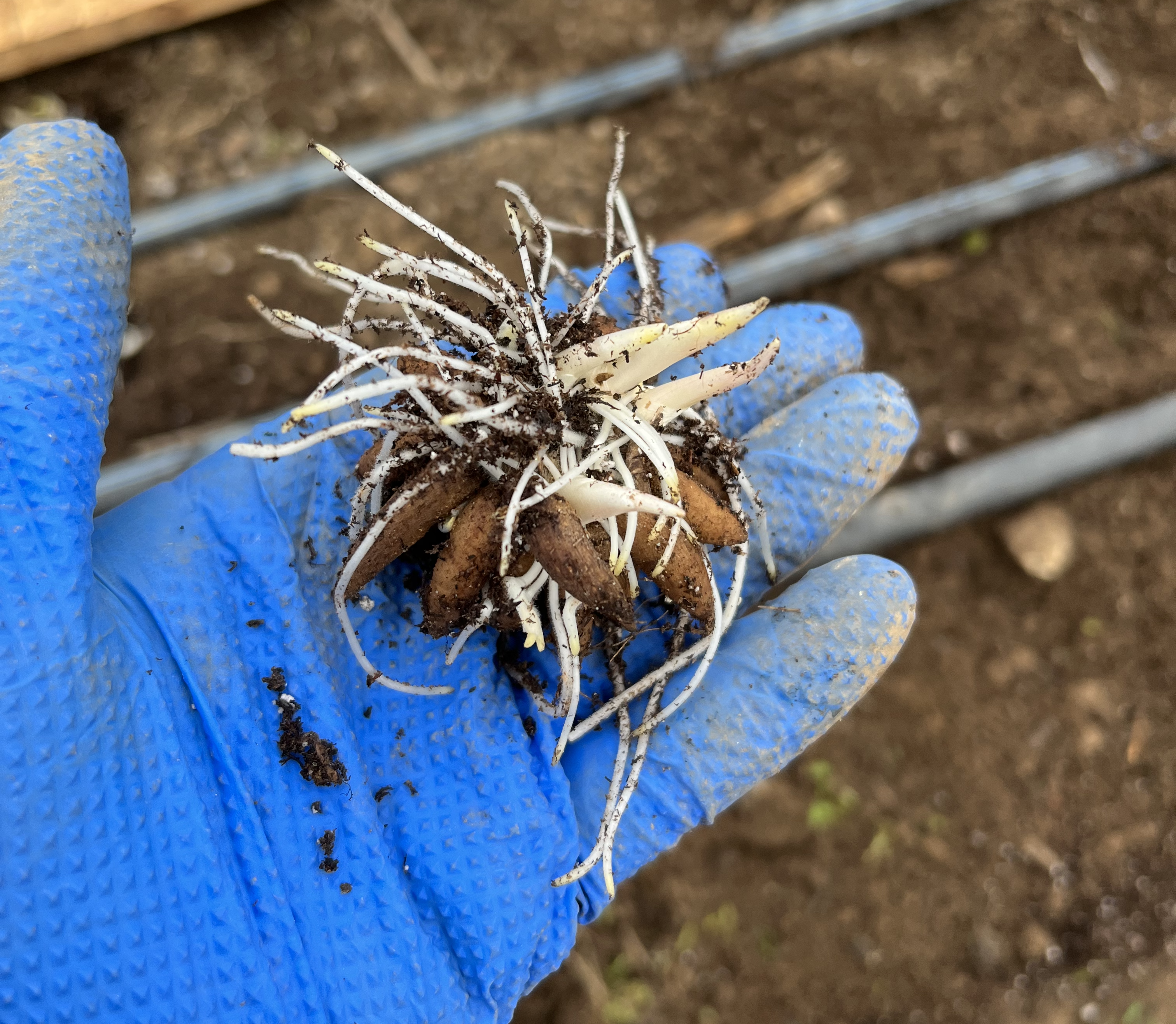
Transplanting ranunculus as pre-sprouted corms, rather than as plugs, has resulted in greater efficiency.
Just with these simple technique tweaks, we save over 96 hours of labor time alone (a cost of $2,880), not to mention the savings in supplies, materials, and greenhouse heat. The results are the same: insanely beautiful flowers that bloom at the same time as the previously planted plugs. We experienced nearly a 30 percent increase in profit by simply changing the way we grow this crop to be more efficient.
These simple steps of putting systems in place, then eliminating, shortening and simplifying steps have been life-changing for our farm. The results I’ve just shared with you have been some of our biggest successes to be more efficient, and therefore more profitable.
Imagine if you could do just a fraction of this, perhaps increasing some of your product profits by 5 percent, or even 10 percent. Your farm’s overall profit could increase significantly, just based on the efficiency of your systems and completion of tasks. You could also free up a considerable amount of time to use for more important tasks such as marketing and selling — or perhaps seeing your family more or relaxing by the pool.
Take these examples from my niece’s lemonade stand and my own farm as inspiration to implement new, more efficient processes on your own farm this season. Although I’m fairly certain you won’t find an employee willing to work for 25 cents an hour like my niece did (nor should you), I can guarantee that you’ll find better work-life balance and a large increase in your profits, if implemented well.
Jenny Marks is owner of Trademarks Flower Farm in New York and Trademark Farmer, where she teaches small-scale flower farmers how to earn a healthy profit and find work-life balance. She also is the host of the Six Figure Flower Farming podcast.
Copyright Growing For Market Magazine.
All rights reserved. No portion of this article may be copied
in any manner for use other than by the subscriber without
permission from the publisher.