








I was privileged to attend the 2016 Frozen Ground Conference held this past August in central Vermont. There were two days of discussions, demonstrations, and networking about winter growing for farmers from across the US and Canada.
This was the second Frozen Ground Conference. It was organized by Sandy Arnold of Pleasant Valley Farm in Argyle, NY. The first one was organized by Arnold and Eliot Coleman in 2014, and its great success spurred this one.
The format was a large round-table discussion, where everyone shared freely his or her research and production pictures. The conference was a mix of experienced farmers, extension agents, and seed company representatives. I left with several great takeaways.
Long-term soil fertility
One topic of much interest was maintaining soil fertility and production in tunnels. Given the expense, most farmers are continuously cropping, never giving the soil a chance to rest. Reported soil organic matter for most growers was in the 5-12% range.
Eliot Coleman mentioned how he seemed to have reached a plateau of production in his houses even with copious additions of compost and nutrients. Moving his houses and rotating in a grass cover crop helped push yields back up.
Sandy Arnold stated that she removes the plastic from one of her three high tunnels every year and grows a summer cover crop inside. This reduces the summer management load, flushes salts, and seems to reinvigorate the soil.
Conor Crickmore talked about the no-till methods that he uses. Since his soil structure stays intact, he is able to maintain high yields consistently. His point was that the cover crops are just helping put structure back into the soil that tillage destroys.
Soil salt buildup
Salt buildup was another area of concern, which can be caused by application of manure or high salt fertilizer. Problems usually start showing up after 3-5 years of covered growing. It was noted that if manure is to be used, grass-fed animals normally have less salty manure.
Poor germination is a common indicator of salt buildup. This can be alleviated by transplanting into the tunnel, or keeping beds consistently moist during germination. Watering causes salts to be flushed down in the soil profile. When soils dry out, the evaporation causes salts to rise back to the surface.
Because of concern about salts, many have switched to using peat moss to increase organic matter instead of compost, and mineral based fertilizers instead of manures for fertility.
New tools and supplies
Several new or improved tools were discussed including weeders, soil block makers, and an improved paper pot transplanter.
After using the Lucko wire weeder, I developed a crude stand-up wire loop weeder several years ago, which I demonstrated and asked for commercial development on at a slow tools conference. Since then, it has gone through several iterations, with Eliot Coleman showing his latest improvements that simplified and strengthened the design substantially this year. The goal is that it will eventually be available through Johnny’s Selected Seeds. A current version is available at www.twobadcatsllc.com.
Adam Lemieux of Johnny’s showed several improved soil block makers of varying sizes that are a better fit for the standard 1020 tray design. One is available now from Johnny’s, with more designs to be released in the future.
Lemieux also showed a sturdier and improved version of the paper pot transplanter that is in development. More reliably certified organic pots may also be developed, as there is a discrepancy in the current pot certification between different certifying agencies.
Solawrap, a heavy-duty multi-layer greenhouse film, was another product that was reviewed. Although the upfront cost is substantial, it comes with a 10-year warranty with many growers seeing much longer life. Other benefits are light diffusion, hail resistance, snow shedding ability, and 100 mph wind rating. There will be some data available on side-by-side trials this coming winter with Solawrap.
Supplemental heat
Heating the soil for increased production and protection was discussed at length. This is a topic that many people still don’t have empirical data on to answer the following questions: What is the return on investment of heating the soil? During which months does heating bring the best return? Up to what temperature does it still pay off?
Of the attendees, some have houses they keep at 32 degrees all winter long to prevent freezing. Several large growers use soil heat, but really only count on it to keep the plants alive during especially cold stretches. Other growers rely mainly on multiple layers of row cover when it gets cold, only using heat for harvesting or acclimation in the fall.
A key point agreed upon was that it’s not necessarily the cold that kills plants, but the desiccating wind, drastic changes in temperature, and poor acclimation (or hardening off) that does. Another point of agreement was that soil temps of at least 42-45 degrees are necessary for good soil biological activity. In larger houses zone 4+ this is usually not a problem, but smaller hoophouses are more prone to freezing.
Innovative heating systems
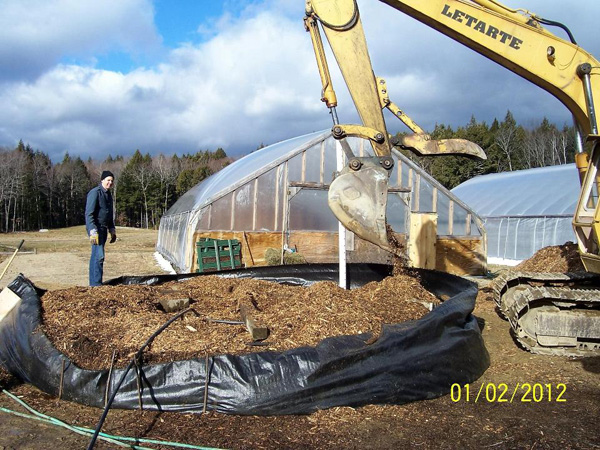
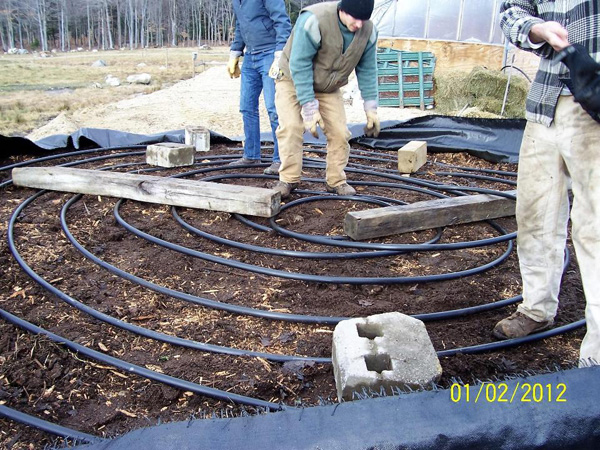
Hank Letarte of White Gates Farm talked about his compost heat system. Using a pile of green wood chips 22 feet around by 10 feet tall, he heated a 1500 foot tunnel for the entire winter, tripling production compared to the unheated house next door. In the pile, he spiraled 300 feet of plastic pipe every 14” for a total of 7 layers in the pile. The pipe was then run into the greenhouse radiant heat system. Hank said that building the pile was an endeavor, preferably done with an excavator or large tractor. Jean Pain, a Frenchman who lived in the 1900’s pioneered this system, which is detailed here http://permaculturenews.org/2011/12/15/the-jean-pain-way/.
Below: Making a compost-powered greenhouse heating system on White Gates Farm in New Hampshire. Green wood chips are layered in with 300 feet of plastic pipe every 14” until the pile is 22 feet around and 10 feet high with seven layers of pipe. The decomposition of chips provides the warmth for a radiant heat system. Photos by Hank Letarte.
Climate batteries were discussed as another way of heating the greenhouse and reducing humidity. A climate battery is a network of pipes underneath the greenhouse through which air is pumped. During the day, warm, wet peak air is forced through the pipes, warming the ground and condensing the moisture on the cool earth. During the night, the now warmer soil temperature air is pulled up into the greenhouse to keep the plants above freezing. Several farms (not in attendance) are using this successfully, but no research was available for further consideration. More information is available here: http://www.ecosystems-design.com/climate-batteries.html.
Soil steaming
Although Andre Cantelmo of Heron Pond Farm couldn’t attend, we discussed in detail his work with soil steaming for weed and disease control. At the last Frozen Ground Conference in 2014, Andre had asked for feedback on his ideas about steaming for weed control. Building on that, he has successfully steamed his winter growing beds with amazing results.
Using steam forced under tarps in the greenhouse, Andre has effectively eliminated weeds in his winter greens. An excellent webinar that Andre did on the process is available here: (https://www.youtube.com/watch?v=HMVNdrYXiRE)
Other considerations
Black plastic doesn’t dramatically affect the soil temperature unless it is quite tight against the bed. The benefit is more from weed suppression and concentrating the carbon dioxide being released from the soil to right around the plant, which promotes growth.
Consider removing the anti-drip component of overhead irrigation systems for winter production. Though nice for summer production, anti-drip hardware keeps water inside the system and can break or blow it apart during freezing weather.
Light is a key part of the equation in the low light months; even with ground heat, crops just can’t put out that much production due to light levels.
Many growers are insulating down into the soil around their houses to prevent frost/cold from creeping in. This is done either through placing 2” foam insulation down 12” in line with ground posts with the top of the insulation at ground level, or laying insulation outside the tunnel on top of the ground several feet out and covering it with ground cloth.
Final thoughts
A key take away from the conference was just how much we don’t know and the amount of research that is needed. For example, we still don’t have solid, research-backed winter yield data that takes into account different temperatures, soil organic matter, and nutrient levels.
Disease control in winter tunnels is also a relatively unknown area. A researcher from Massachusetts shared the results from a biological fungicide trial for diseases in spinach. No significant improvements were noted, and none of them worked below 42 degrees anyway.
One recommendation would be for a season extension and winter growing institute that would research the best practices for year-round production. It would cover topics ranging from how to extend field production and store crops, to the dynamics of heat, light, and how tunnel size affects production, to disease and insect control; all of these topics require research that would be beneficial to winter growers. I still think on-farm, grower-based research is paramount, but it would also be helpful to see a large-scale project that could compare multiple variables.
Michael is a farmer, presenter, inventor, and consultant who lives to help farmers be successful and sustainable. He has managed a large certified organic farm for over a decade, is a frequent presenter at farm and agricultural conferences, and consults with farmers around the country.
Currently he is helping small farms become sustainable and effective businesses, researching four season farming and season extension, and developing tools for small farms. Michael spends most of his time in Southwest Ohio. He and his wife Savannah have a one-year-old daughter, Charlotte. You can find him on Facebook or follow him on instagram @michaelkilpatrick1. He recently released an ebook on his blog “Winter growing secrets we wish we knew when we started,” which you can find at michael-kilpatrick.com.
Copyright Growing For Market Magazine.
All rights reserved. No portion of this article may be copied
in any manner for use other than by the subscriber without
permission from the publisher.