











An Alaskan urban farm’s lessons for wedding design and retail
Farming and gardening are in my soul. From a young age, I was intrigued by gardening, and I fell into a first job at a local nursery and then moved on to the Anchorage, Alaska Parks and Recreation department landscaping. I’ve always had a backyard garden and have always been in love with plants.
If you’re reading this, you also gravitated toward growing because it somehow fills your soul. If so, congratulations on finding the courage to create a life doing what you love. After multiple twists and turns, I came back to growing on a 40-acre Wisconsin farm in 2013.
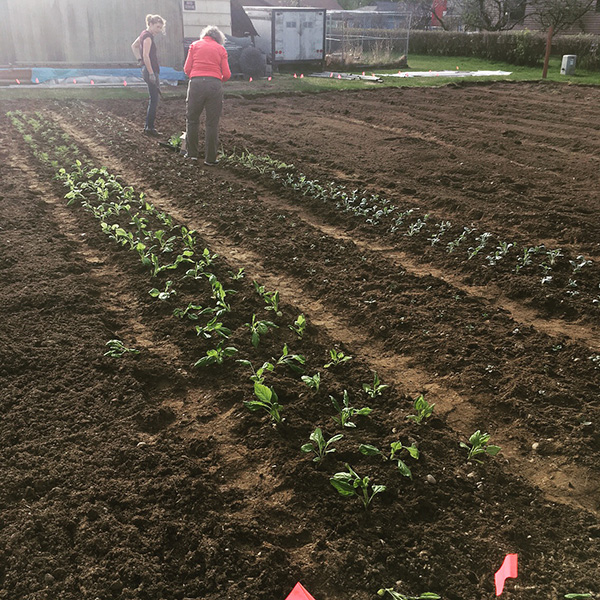
The first year of planting on our vacant lot (2017). Sod was scraped, manure was tilled, plants were put in.
I’d say I fell into flower farming by complete accident but also perhaps by guidance from the universe. We rented a farm that had a large perennial flower garden, and that first year I planted as many annual flowers as I could. A friend handed me The Flower Farmer by Lynn Byczynski and I haven’t stopped growing flowers since. I’m now into my 11th year growing and selling flowers. I’m filled with gratitude as I look back over the years. I’ve learned so much and grown my business beyond what I originally thought possible.
This is a little snapshot of where my business started and where it is now, along with a few lessons I’ve learned and challenges that continue today. I’ll cover where I am now in relation to growing space and location, product choice, income streams, sales processes and business challenges.
Location
Gardenwild Floral is an urban farm in Anchorage, Alaska, that focuses on wedding design and retail floral. Our growing space is on a vacant lot in an urban neighborhood, a seven-minute walk from my house. Our total growing space is around a sixth of an acre. Living in a northern urban setting, land access and season length are among our biggest challenges. Moving back to my hometown after a handful of years farming in Wisconsin, I decided to try urban growing.

The first year harvesting from the farm. Author with yarrow. Photos by Gardenwild Floral.
I poured over tax plat maps to find the biggest lots and vacant lots in my area and then got to work sending letters. Quickly I found a landlord that was excited about my farm vision. That first season I paid a local landscaper to scrape the sod, brought in a dump truck full of manure and tilled it in. We built a fence and started growing early in the summer of 2017.
Income streams
That first season, I grew a variety of products including salad greens, herbs and flowers. I quickly realized that having three separate harvest and processing operations was highly inefficient so within two years I cut everything besides flowers.
After lots of trial and error over the years, I’ve settled on selling our flowers through a Summer Flower Club (a monthly or weekly subscription) and through wedding design. Each year I take on around 20 plus weddings that range from $500 to $10,000. Over the last 12 months, our weddings make up about 75 percent of our overall income. The remaining 25 percent comes from retail sales like Flower Club, pop ups, holiday flower orders, one-off orders from our online shop and most recently, from walk-in customers to our brick-and-mortar retail shop.
Sales process
That first year of sales, I began selling at a farmers market. This helped me grow my email list and started to get people to recognize me, my farm and connect face to face. In person events and selling is so important during those early years of growth and beyond.

Lush and wild 100% Alaskan grown wedding flowers with flowers sourced from the Gardenwild urban farm in Anchorage, AK, Alaska Stems in Homer, AK and Brown Hen Farm in Chugiak, AK. Credit Lauren Roberts.
All my retail sales go through my Squarespace website shop. I use the advanced commerce plan in order to manage a membership function where folks can make any product a recurring subscription product and be billed monthly as opposed to paying one large sum up front. These sales are initiated through Google searches and weekly emails from me to my email list through Mailchimp.
I grow my email list through quarterly events like holiday markets (Valentines Day, Mother’s Day, Christmas) and pop-up shops in the community. Partnering with other local businesses has been huge in getting my name known in my community. I’m passionate about in-person marketing; I encourage you to make sure in-person marketing is part of your overall marketing plan.
Farm operations, flower sourcing
On my small plot, I can serve about 30 to 40 customers per week through the summer blooming months, plus I can pull extra flowers for weddings. Since my growing footprint doesn’t cover my year-round income needs nor provide all the flowers I need for larger weddings, I’m sourcing flowers from all over.

The author in the garden with a bridal bouquet. 75% of their revenue comes from weddings. Credit Lauren Roberts.
The more my business grows, the more I can support other farmers. My goal is to never sell out. My plan is that if I sell too much, I just buy in more from other farmers or hire more people. My customers understand that I source first from my farm, then from other Alaskan farms, then from beyond. Beyond is usually from our local wholesale market or from out-of state wholesalers like Mayesh and Florabundance.
While I try hard to source American grown, I’ve had so many shipping disasters that I’ve loosened my policies around that. I’ve had flowers sitting in the FedEx office, unable to reach them, then arriving hot in the center because they started composting in the shipping box. Ugh.
My local wholesalers have mastered the logistics of shipping and although they primarily source globally, I hope my gentle nudging will get more American grown into their warehouse. Alaska is not well known for a thriving local flower market. Our agricultural areas are spread thin and the season is short. We do however have loads of peonies, and more flower farms are coming onto the scene.
As a business owner that straddles the line between farmer and florist, I empathize with the challenge of ordering flowers. One of the pain points for retail shops and designers is ease of ordering. The logistics of ordering from multiple sources can become time consuming.
If you’re wanting to expand through ordering in more flowers here’s how I go about it. For weddings, 18 to 20 percent of the revenue (minus my design fee) from each wedding goes to flowers. I make sure to account for each of the stems from my farm as if I’m buying them from another grower.
After I account for flowers from my farm, I then reach out to my local growers. The ones who use online platforms like Rooted Famers are my favorite. They update weekly, and I can go to their shops on Sundays and order for the week. Two additional farms that I order from simply send an email with an availability list. After ordering from these local growers, I’ll pop over to my wholesaler and fill in the gaps. Luckily for me, my studio is just blocks from our wholesaler, so this is easy.

The farm plot in early summer. We have 17 beds that are each 2.5 ft wide and 50 feet long. Credit Gardenwild Floral.
Because I value ordering in from other Alaskan farmers, going 100 percent American grown is not the best choice for my business. If I went that route, I’d have to pre-order a week or two out from a national wholesaler. Then, I could miss the opportunity to order week-of from my farming friends. In my mind, the benefit of putting my local farmers first outweighs the benefit of going 100 percent American. But if you can manage both, go for it.
Farmers, if you’re wanting to sell wholesale, make it easy for your buyers. Be consistent. Send out a weekly availability list or use an online platform and maybe even teach your buyers how to use it. Expect slow sales at first. Designers need to try your product and test its quality and vase life.
It takes some time to build trust with a buyer. Obsess over proper harvest stage so that flowers are in prime condition when you deliver them. Follow up and ask how the flowers performed. Getting honest feedback about your product is pure gold for your business.
Weddings
Over the years I’ve adjusted my wedding offerings and sales process to the sales machine it is today. I’m honest when I say getting to this place has been one of the biggest challenges of my business. Building confidence in my product, selling a $5,000 price tag wedding and then a $10,000 price tag wedding and clearly communicating everything takes time and practice and lots of mistakes. I think back to some wedding sales calls and laugh at how much I botched them.
When pricing weddings I follow this rough guide: each piece is the cost of flowers times 3 or 4 (depending on the flower), plus supplies, plus 15 percent labor. Weddings that are under $4,500 get an additional 5 percent operations and design fee. Weddings that are over $4,500 get an additional 10 percent operations and design fee. This operations fee is pure profit. It doesn’t go into the equation when I budget how much to spend on flowers, supplies, labor, etc.

Floral arch for wedding using a combination of Alaska grown and wholesale flowers. Photo by Gardenwild Floral.
I only deliver and set up for weddings that are $4,500 or greater. Each year I up this minimum as each year my delivery schedule brings in a higher demand. Delivery is set at a cost of $1.50 per mile plus a driving cost of $60/hour. Set up at a venue is charged at $60/hour. It’s important to me that I charge enough so that I can hire someone to do all the labor and still make a profit.
My sales consultation process in a nutshell: I have an embedded inquiry form on my website, then folks are invited to book a free consultation via Google Meet. We schedule this meeting through my CRM software, HoneyBook. During this call I then figure out where their price point lies.
If it’s a lower price wedding, I send over a questionnaire and create a mood board and proposal on Canva. All further contact is through email. I send the proposal, which includes a moodboard, sketch renderings and itemized pricing via email with a link to a video walk through.
I make simple proposal videos through Loom, where I can explain the entire proposal in a three to five minute video. This makes it so convenient for both me and the booking couple as we don’t need to set up another meeting. I’ve done a lot of practice with these videos and over the past six months, and I’ve gotten to a 90 percent booking rate. In other words, if someone moves through a consult and gets a video proposal, it’s 90 percent likely they’ll book with me. This is such a huge win and it’s taken me almost seven years to get here.
If you’re doing weddings right now and struggling with the sales process, hang in there. Learn from each one and hone your process slowly based on what works and what doesn’t work. And most importantly, don’t budge from the prices you need to charge.
Weddings that are on the higher end ($3,000 or above) get a questionnaire after our first free consultation, then they book a creative call which costs $100. At this point in my career, I’ve done so much work for free. Each potential customer needs a proposal, back and forth emails and adjustments. When folks ask for a proposal and then ghost me or don’t book, this is work I’ve done at no charge.
I made a decision early this year that if someone wants to move forward with a larger wedding, we first need a booked and paid-for meeting where we can go over everything together: their inspiration photos, all their items, answer any questions, and talk about next steps for booking with me.
These “creative calls” really build rapport, and the couple is much more likely to book. Since higher-end weddings take longer to create proposals for, this charge also covers part of the time it takes to put this together. Once finished, I send over the proposal and a video walkthrough and we move forward.
On the horizon for me is a click and buy option for weddings. I want to continue to streamline my sales process so I can just send folks to my wedding shop page and they can shop right there and order their wedding flowers. I’ll offer four different color palettes (spring, summer, fall, and blush) and because this will take less of my time, prices will be lower and more accessible for folks who are okay with giving up a little bit of custom service.
My photo shoot for this line of products is taking place in late July so the shop should be up and running by the end of September. If you want to pop over there and take a look, go to www.gardenwildfloral.com.
Retail operation
In addition to weddings, I sell about 25 percent of my flowers through retail. I began selling retail flowers at our local farmers market, with the addition of flower subscriptions and three to four different drop off/pick up locations.
In 2022, I moved into a shared warehouse/studio, which allowed me to move my floral design out of my home. This was huge. I can now handle about $10,000 a week in wedding sales. To make the most of my space, I’m in the process of figuring out how to handle walk-in customers to grow my retail shop.
Our retail shop is open to the public from noon to 6 p.m. on Wednesdays. I’m modeling my retail experience like a farm store: limited hours with limited products. I’m still working out the kinks here, but it allows a physical location for face-to-face interaction with my customers. Plus, I’m now done with drop sites. Folks who are part of my flower club or are a one-off retail customer either come to my studio or purchase home delivery which varies from $10 to $20 depending on where they are in my city.
When pricing retail flowers, I budget 30 to 40 percent toward flowers. Most of my retail flowers are pre-sold so there is very little waste. Seasonal bouquets range from $45 to $97. Standard retail arrangements range from $99 to $147.
My goal is to keep our retail options super simple: three seasonal bouquet sizes and three vase arrangement sizes. All my retail products are florist choice in colors. From a back-end perspective, it doesn’t make sense to cater to various color palettes at my current scale. Our shop would have too much waste.
For my Flower Club (aka bouquet subscription), I do a five-day sales launch to my email list twice a year for our monthly or weekly membership. Folks join and then are billed each month for their flowers. They can cancel at any time. To date, only one person has canceled the membership. We offer a monthly summer flower club that runs May through September and a monthly winter flower club that runs November through March.
Our weekly membership is organized more like a traditional CSA. It gives people eight weeks of flowers from our farm starting in mid-July. The total for the season is paid up front. All Flower Club members (weekly or monthly) get 10 percent off their flowers.
Areas of opportunity
As a curious business owner and entrepreneurial coach for other small business owners (my passion-project/side-hustle), I’m always fascinated by folks’ pain points, areas of growth and struggle.
This wouldn’t be a true farm/business profile without mention of my current pain points. Right now my biggest challenges are: 1) getting more eyes on the business and more customers to my site. 2) creating the processes needed to seamlessly hand off work and tasks to employees. 3) juggling the responsibilities of home life, single motherhood and business demands.
Challenge number one and two are my top priorities for winter work this year: creating a solid marketing plan for more engagement and new customer growth and creating standard operating procedures for retail and wedding work. The final challenge is an ongoing one that I buffer with solid daily and weekly planning, reasonable expectations for myself and my kids, lots of room for learning and adequate personal care.
Greta Lewanski, owner of Garden Wild Floral is on Instagram @gardenwildfloraldesign. You can email her with questions at gretalewanski@gmail.com or at gardenwildfloraldesign@gmail.com for her 2025 pricing guide.
Copyright Growing For Market Magazine.
All rights reserved. No portion of this article may be copied
in any manner for use other than by the subscriber without
permission from the publisher.