











#toolsforgrowingformarket
Scrolling back through all of the photos tagged #toolsforgrowingformarket on Instagram I found a post of some long gauntlet gloves hanging in a packing shed that was posted by Kat Johnson when she was manager of @fieldsedgefarm back in 2020 (I also wrote up Kat’s pocket magnet knife holder in this column a few years ago).
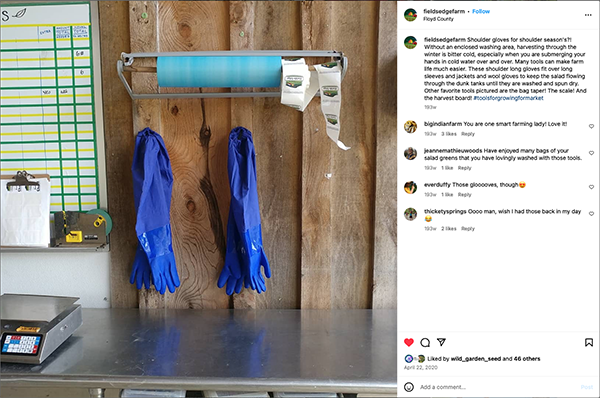
Above the elbow length wash gloves shown in an Instagram post from Fields Edge Farm by Kat Johnson. Gloves like this have an elastic band at the opening that keeps them from slipping down.
As I spent most of the day yesterday washing mud off of veggies in an open shed, taking extra care not to get water into my gloves, this was yet another reminder to me that I need to order a couple pairs of these gloves for me and my crew. That’s been something on my long to-do list for probably a dozen years, ever since a farmer at an annual farmer-to-farmer event talked about picking up a pair of these waterproof gloves with sleeves attached at a commercial fishing supply store and how much it improved his quality of life while washing winter veggies.
The gloves in the photo appear to be Showa Atlas 690’s, which is a cotton lined PVC dipped glove with a textured palm. I’ve used the shorter version of these, the 660’s, for many years. The 660’s are kind of like a heavy-duty dish washing glove. They are available at my local hardware store for about $10 in lots of sizes, and while they don’t offer great dexterity I can size them up to fit a liner glove inside and then use them in the field to basically keep my hands completely dry and warm when temperatures are in the 40’s and it’s soggy out (which is a lot of the winter here in the PNW). Sizing for maximum dexterity is always a tradeoff with sizing for warmth as tight gloves definitely restrict circulation enough to make hands colder.
For tasks where I need better dexterity I use the thinner Showa Atlas 730 which is a much thinner version that’s all nitrile and a little less expensive. These have the same length gauntlet, but the material is more flexible, so they tend to bunch up around my wrists which eventually lets water in, soaking my glove liners. Part of why these gloves are thinner is the nitrile, and the other part is that they don’t have a cotton lining. This makes it possible to clean them inside and out, something that’s not really possible with the lined 660’s.
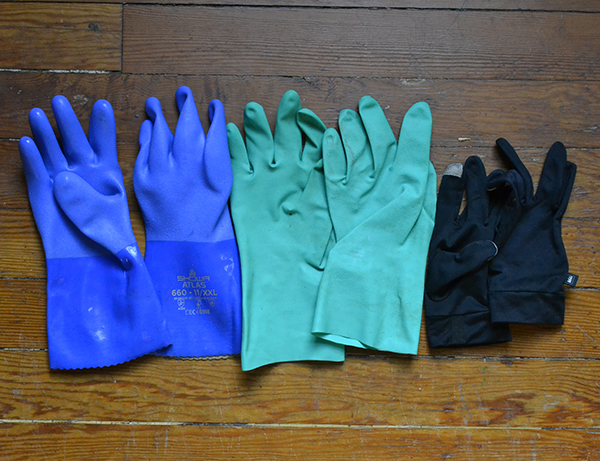 L to R Atlas 660, Showa 630 and synthetic glove liners are my winter harvest and wash-and-pack gloves of choice when it’s cold out.
There’s also a nitrile version of the long gauntlet 690, the 772, which is lined so likely a little heavier, and an in-between length 747. I prefer nitrile over PVC in general because it’s less toxic to produce and more wear and puncture resistant than PVC. I’ve worked on farms that used neoprene paddling gloves for winter work and while they work well to keep hands warm even when soaking wet I find them more much more expensive and difficult to clean thoroughly during the work day.
My two other main gloves on the farm in the winter are Showa 377’s, which are fully dipped for water proofness, but have a knit cuff and a foam dipped palm. The foam dip gives a little extra insulation and grip, but less dexterity and it’s basically impossible to get completely clean if you’re trying to keep them clean for harvest or washing and packing so I reserve these gloves for other field work.
When I need higher dexterity in the field and it’s not actually raining or excessively wet (which is rare here) I wear the same gloves I wear in the summer– Atlas 370 – which have a thin nitrile dipped palm that’s surprisingly durable and gives great dexterity for a glove and stretches to fit over my liner gloves.
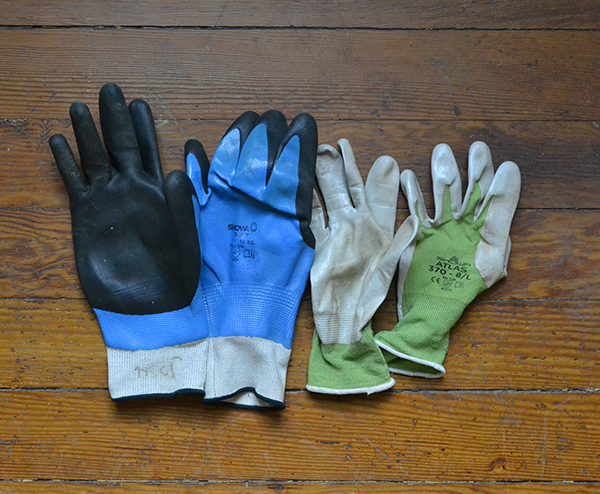
L to R Showa 377 and Atlas 370 are my field work gloves, typically also sized up to fit with glove liners in the winter.
This may all sound like an advertisement for Showa gloves and I have no preference for their gloves other than they’ve been available, reasonably priced and have worked well for me. I’d love to hear what gloves are working well for other folks out there for winter harvests and field work.
On my farm we also have boxes of both nitrile and vinyl examination glove which are essentially single use gloves. When worn over liner gloves these give the best dexterity for things like cutting salad greens. We don’t do a lot of that type of harvest, and I dislike the waste, but they’re a good option when the dexterity is really needed but it’s just too cold to go bare handed. We keep them around in case of cuts to hands as well – which allows someone with a band aid to continue harvesting without worry of contaminating the harvest.
With all of the gloves we use for harvest our crew washes them just like they wash their hands. Gloves are washed before they go out to harvest – soap and water with a good scrub, while they’re wearing the gloves – and any time during the day when hands would normally be washed such as when coming back from a break.
One other note on gloves, there’s a super simple to make glove drying rack in my book “Build Your Own Farm Tools.” How to best hang gloves to dry was always a problem at farms I worked on but if you have fence wire or an old wire hoop you can bend it into a series of long fingers and then drill angled holes into a low beam or piece of wood to mount. Gloves slip over the fingers with the wrist openings hanging down at an angle for drainage and to hold the gloves open. Works great and only takes a few minutes to make once you collect the materials and tools.
Josh Volk farms in Portland, Oregon, and does consulting and education under the name Slow Hand Farm. He is the author of the books Compact Farms: 15 Proven Plans for Market Farms on 5 Acres or Less, and Build Your Own Farm Tools, Equipment & Systems for the Small-Scale Farm & Market Garden, both available from Growing for Market. He can be found at SlowHandFarm.com.
Copyright Growing For Market Magazine.
All rights reserved. No portion of this article may be copied
in any manner for use other than by the subscriber without
permission from the publisher.