











Market analysis, crops and partnerships
Welcome back, or thanks for joining us. This is part two of a four-part series on growing flowers for weddings. In part one from last month’s magazine, I shared about the changing face of weddings in terms of the new generation of engaged couples, a change of the guard in the wedding industry, and why it is a great time to consider growing flowers for weddings.
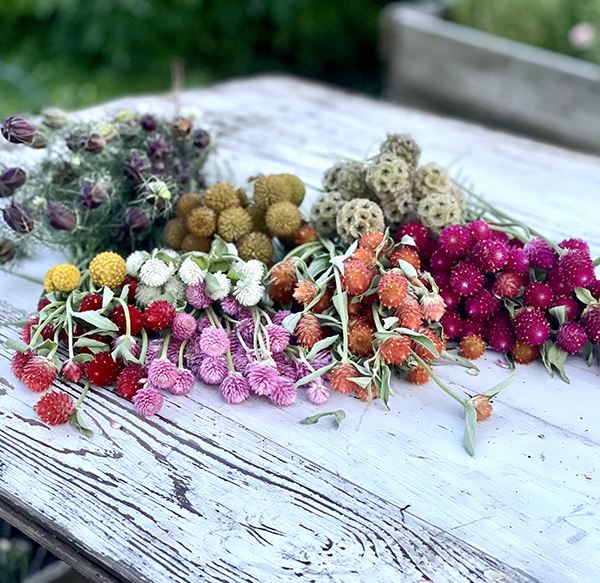
Grow lots of unforgettable signature details to set your wedding work apart. All photos couretsy of the author.
I also shared my unique vantage point as a wedding venue owner, wedding planner/designer, and a farmer florist. My intention is to bring my experience to the table to help you explore this financially lucrative element of growing flowers.
I provided a set of questions to determine your level of interest and comfort. I also explained the different roles in the wedding floral industry. If you are interested, most importantly, you need to find your “why” that will sustain you. It needs to really resonate with you, and that becomes your origin story.
Laying the groundwork
You don’t have to stop what you’re currently doing. Growing for weddings should be something you move into in phases. Before you make a single purchase or change anything, dig into the front-end research. It is not going to be found in a Google search, AI can’t do it for you, it doesn’t exist in a blog. You need to research the flower landscape immediately around you.
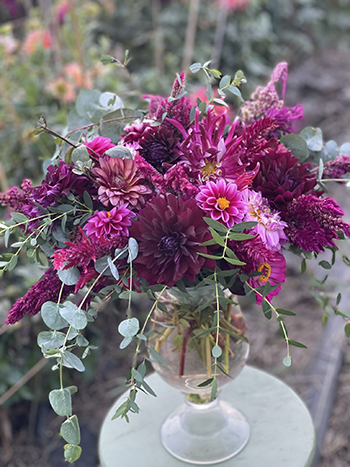
Reset button – colorful weddings are here.
Know your local wedding market. Understand your operation and ability and how it aligns with the typical calendar for weddings in your region. Assess how your growing zone will affect your outputs. Establish the acreage/growing space you could devote to growing for weddings. Understand wedding flowers and how they are used. Reach out to potential partners and buyers to learn what they buy, pay and the volume of orders to create relationships and specify crops.
Market analysis
There are several really important factors in making the decision to grow for weddings. More than anything, know your market. Where you farm, your closest city and the local wedding industry will clarify what makes sense for you. The major wedding planning platforms like The Knot, Brides and Wedding Wire all track statistics on weddings around the country and break it down for brides, including budgeting and typical vendor cost ranges.
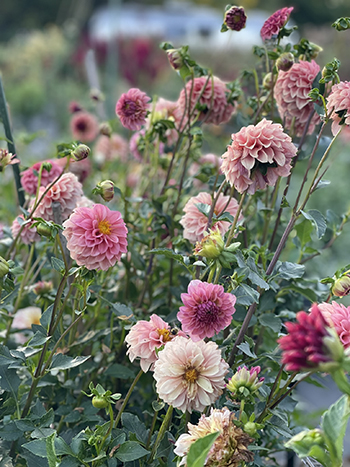
Santa Cruz dahlias – one of the most sought after wedding flowers.
Weddings in major U.S. cities are more expensive (relative to the local cost of living) and have fewer guests than other parts of the country with lower cost of living and larger numbers of guests. The wedding budget is tied to the number of guests. The venue, music and photographer are all fixed costs, but elements like flowers, food, drink and rentals are intrinsically tied to the guest count.
Across the board, across the country, one statistic stays predictable: flowers represent anywhere from 10 percent to 25 percent of the entire cost of a wedding. So, where you live will tell you a lot about the local wedding market and what kind of wedding flower farmer you want to be.
Climate and growing zone
Your climate and your ability to extend your season in both directions will come into play. Are you currently a small operation with limited space? Do you have room to expand, open field space, high tunnels, or full season extension greenhouses? None is a dealbreaker, but we’re looking to optimize what you’ve got.
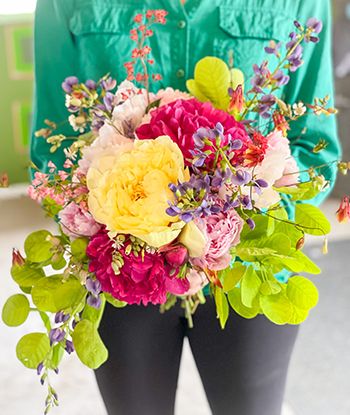
Spring bridal bouquet grouping for a fellow farmer’s wedding.
Ask florists, wholesalers, planners or designers what their top sellers are and their price points. You’re looking to replace at least some of their suppliers of repeat-order wedding flowers. Distinguish yourself not only by what you can grow and replace, but also by growing what’s not available elsewhere. That is going to be your hook. That and flexibility for last-minute order additions and extended availability windows. These will create committed partners.
All of this depends on what, how much and when you can deliver it — all of which are dependent on Mother Nature. Although there is uncertainty about government funding, look into USDA and EQIP programs to see if you are eligible for season extension and conservation practices. If you’re eligible or were pre-approved, you may be able to extend your flower growing season.
Growing space
The next consideration is growing space available for wedding florals. I am a firm believer in taking a balanced and forward-looking approach. Growing for weddings can be done in stages. Decide what level of dual purpose you can manage. Example: if you currently grow for farmers markets or a CSA and need to keep that in place, how much space can you reduce your current practice down to and still be profitable?
Can you expand your growing footprint on your land? Can you add to your parcel or lease adjacent land? Is there nearby land that you can rent?
Growing specifically for weddings
Beyond space for annual crops, what space can you devote to perennials and woodies, which can be the backbone of your wedding floral supply. One of the best things I did was to start the long game early. I began by planting woody elements, trees and shrubs, along with perennials. Once established, these created a non-stop seasonal supply of materials to use. (See my articles “Foraged floral and woody elements” parts 1 and 2 in the May and June/July 2025 Growing for Market for more on that.)
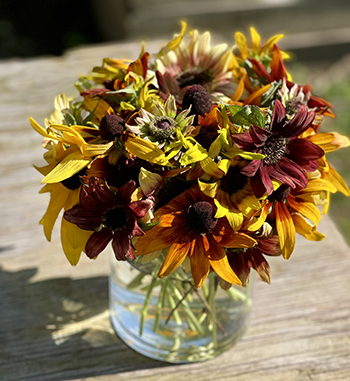
Sunflowers are great for market bouquets but most of them have too much pollen for bridal bouquets.
Identify space to commit indefinitely to planting, establishing and caring for some of the highest-value wedding floral materials. This is land that you’re taking out of your annual growing plan, so make sure you can commit. It will be well worth it.
In the wedding market and wedding floral design, there are several types of materials we use. We need all of them, and it is important how they work together. Every wedding is a story in flowers. Whether it is conceived by the couple, planner, designer or florist, it tells a story. The selection, the varieties, the colors, the details, the seasonality, the chromatic range, the evocative aspect or importance to the couple create a story.
The flowers and foliage are the ‘actors or players.’ Specific actors are chosen for how they will play their part in the collective narrative. When a beautiful story comes together through artistry and the beauty of the flowers, it is pure magic, and I would be remiss if I didn’t point this out.
Understanding wedding flowers
Like any great story, you have your leading characters or main actors, supporting actors, regular cast, standout roles (cameos) and extras (used to make the rest of the cast look full or sparse or to act in unison). Wedding flowers fall into several categories.
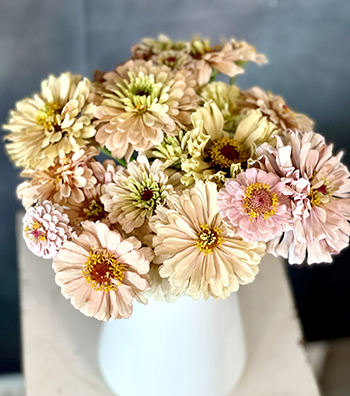
There is a new generation of zinnias with more subtle colors that are great for weddings.
Personal flowers are bouquets, boutonnieres, corsages — flowers on or attached to a person (couple, family, wedding party). These are your main actors and the anchors of the story. The most beautiful flowers are in the bride’s bouquet, the consolidated wedding story in its perfect form. This iconic wedding floral design consists of the best blooms. The best dahlias, roses, peonies or whatever signature blooms.
Playing supporting roles are the secondary flowers — they’re lovely but they are meant to accompany and make the stars look good. After that, you also have the next level that look pretty but just amplify the more important flowers. Next you have your cameo appearances that show up and act memorable (details, unique pieces, textures or quirky bits), until finally, your ensemble cast (foliage and filler greens) that hold around the other stars and frame them to look more full or balanced. The bridal bouquet should immediately tell you the floral story and all the other personal floral pieces are abbreviated shorter translations of the same story with feature blooms.
Ceremony flowers and installations are flowers at the church or ceremony site, moon gate, framing installations, suspended pieces or completely covered archways or structures, flowers along the aisle or attached to the pews or aisle edged seats.
Ceremonies are usually the shortest part of the event, less than an hour. However, they also need to tell the complete story in an extended and expansive version (think directors cut of Titanic). They need to be impactful and showy for all the framing in the ceremony photography, and also the post-ceremony backdrop. There is real art to ceremony flowers because they need to be something beyond actors. They need to be magicians. They need to give the illusion of greatness and extend the impact of the main actors to feel like the design has more of the superstars than it actually does.
Then, in less than an hour they are abandoned for the cocktail hour. Ceremony florals use usually a small amount of the premium blooms and lots of the supporting, background and filler actors along with greenery and foliage. The goal is to look big, tell the story, but not waste premium floral budget on a short part of the event.
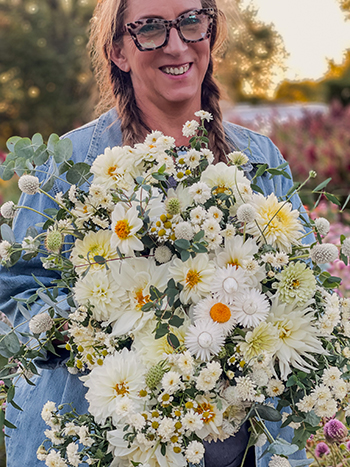
The author with the new bridal whites – grown in the climate of your wedding.
Ceremony flowers and reception flowers make up the bulk of the floral budget, not your most expensive flowers, but rather durable, big and flexible in what they can accomplish (magic) and the lengths you can push them to perform. These include eucalyptus, curly willow (that can be shaped and formed in endless ways) mums (big impact but smaller price) stock (color and continuity and unbeatable fragrance) and the always wonderful hydrangea.
And if you ask me, hydrangea is the most versatile of all creatures. She can take up space, be stripped down to fit into a particular role, be tinted to match a specific hue or color palette, be gilded for more ornate and over-the-top designs — and she looks wonderful dried in different stages of ombre. A hydrangea bush you plant this fall will yield blooms all spring and summer long for years to come. Curly willow? The possibilities are endless.
Reception flowers are the flowers on the guest tables. We go back to the primary flower story and have each arrangement telling some part of the wedding flower story. The typical range of costs that couples pay for this one wedding floral design usually is equal to the cost per guest (for place setting, chair, menu, bar and dessert per person amount) — $125 dollars or so.
The multiplier of your premium blooms is times the number of tables and then some. So, this is the heart of the floral budget. Reception flowers use the most premium flowers and others for the greatest impact, so are central to your growing plan and the selection you can provide. This arrangement is the balance of all floral elements of the event. Providing an abundance of these blooms is a recipe for success.
What to grow
This is really up to you and based on how you decide to market or sell your flowers, your target buyer, and if you decide to grow to fill established needs. I wanted to share what I grow because I do my own design work, I also sell to DIY brides, florists and designers, and occasionally to wholesalers with abundant crops like zinnias and celosia. It’s just me so everything I do needs to be the best and most time efficient way to get maximum output and results. None of these things are essential, but consider it a roadmap.
After laying a foundation with woodies, blooming trees and perennials, the natural flow of the Midwestern seasons gives me all of these essential ingredients with little effort: tulips, peonies, tree peonies, Lily of the Valley, poppies, blooming Spring branches, viburnum, lilac, echinacea, silene blushing lanterns, willows, hydrangea, smokebush, privet, eucalyptus, heirloom mums, hybrid, tea and garden roses, lilies, cosmos, mint, eryngium ,bachelor buttons, celosia, Forget Me Nots, calendula, Sweet William, rudbeckia, larkspur, mock orange, ornamental grasses (details for fall), crepe myrtle, bluebell, chamomile, feverfew, bupleurum, pennycress, bee balm, ox eye and shasta daisies, dill, Queen Anne’s Lace, Dara flowering carrot, marigolds, spirea, Russian sage, lavender and talinum (Jewels of Opar).
Beyond this, my annual planting is actually minimal so that I can focus on dahlias, zinnias and any other elements I want to experiment with annually.
If you have the space to set aside to make a plan similar to mine, you won’t regret it. It allows you the flexibility to pivot and grow and trial new varieties, custom grow for contracts or commitments with florists or wholesalers, and allowing for a large chunk of your inventory that gets excluded from traditional crop failures, drought or acts of God.
Partnerships
Whatever level you’re producing and selling, look for natural ways to open up or expand existing channels. Reach out to other local growers you may not know and get familiar with them, their operations and what they grow. There may be co-ops or collectives, or informal versions so a farmer growing for weddings can source materials from other farms.
It’s in your best interest to see what other people are growing to learn if you’re duplicating a crop already in abundance or if there’s a need for a particular crop to claim your niche. These other farm crops are extra elements, putting you in an excellent position to approach buyers with confidence.
There is way too much to cover to fit in an article (or even 4), so I’ve broken important chunks up into deep-dive topics with corresponding worksheets and downloadable PDF files. For Part Two, you’ll find a sample wholesale price sheet for wedding and event flowers during peak fall wedding season, along with information for creating customized promotion or outreach to different types of buyers, sample outreach scripts and tools for you to use, relationship strategies, common challenges and ways to overcome them, collaboration ideas and loads of other helpful tools for this process. I will also be releasing worksheets for part three in advance so if you want to work ahead, in the next part of the series, you’ll have worksheets, resources and context before moving ahead. Again, those can be found at: queenbeeblooms.com/gfm-weddings-toolbox.
Remember, you can move forward in degrees. My goal is to paint the landscape as specifically as possible so that you understand the subtle shift and the nuances you’ll be adding to how you already approach growing flowers for market. I’ll see you back here for part three, as we dive head-first into promotion, supplying weddings, harvest & handling.
If you missed Part One, I have made a dedicated link with helpful worksheets that I will be adding to throughout this series to stay current with the research needed, planning, calculating and connecting necessary to get you off to an excellent start. The initial set of questions can be found at queenbeeblooms.com/gfm-weddings-toolbox).
Elizabeth Fichter is a flower farmer, botanical artist and writer who grows flowers as Queen Bee Blooms, and creates floral art as Floral Alchemy in St. Louis Missouri. She can be found on social media @QueenBeeBlooms. Queen Bee Blooms specializes in growing people who grow flowers, with education, resources, support, seed sales and inspiration. Her super flower is CELOSIA. Queen Bee Blooms has over 150 seed varieties and bespoke mixes at queenbeeblooms.com/shop-seeds.
Copyright Growing For Market Magazine.
All rights reserved. No portion of this article may be copied
in any manner for use other than by the subscriber without
permission from the publisher.