









Turnips and rutabagas are reliable root vegetables in the brassica family. Traditionally grown as winter storage vegetables, they are now also available in gourmet varieties, to be eaten small, young and tender.
A cool-weather crop which has no trouble germinating at high temperatures, turnips do best in much of the U.S. as a fall crop, or a quick early spring crop. In colder areas, sow turnips in spring and harvest in fall. In hot areas, sow in late summer and harvest in fall, winter or early spring. Because turnips are quick growing when conditions are right, they are a worthwhile winter hoophouse crop to provide an alternative to the usual leafy greens.
These vegetables have long been cultivated, and their fortunes have risen and fallen. They spread from China before potatoes spread from the Americas, and were valued in northern Europe as a staple. They fed the Roman army, and improved the crop rotations of British farming. But at other times they were thought fit only for cattle feed.
Rutabagas are among the hardiest of vegetables, and can be left growing (or at least not dying) until all other crops have been harvested. Turnips are among the fastest crops other than leafy greens. Both have a place in providing food for the entire eating season.
The rising interest in local, sustainable, healthy food, means more people are seeking out these crops. They may be eaten raw (grated or sliced), lightly steamed, roasted or baked.
Varieties
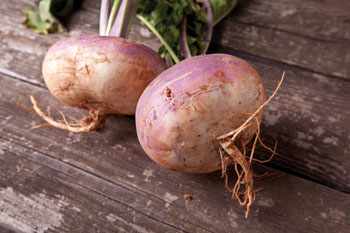
First, to clarify the distinction: turnips are Brassica rapa, like Chinese cabbage and mustards. Turnips come in a range of colors, white or yellow flesh, with white, purple, red or golden yellow skins. The leaves are bright grass green, usually hairy, and not waxy. Turnips do not have a neck or secondary roots.
Rutabagas (known as Swedes in the U.K.) are Brassica napus, closely related to the main brassica crops. Botanically, rutabagas are part swollen tap roots, part swollen stem – the upper portion of the vegetable which forms the neck – the distinguishing feature of rutabagas. The tap root has secondary roots. Rutabagas are mostly yellow-fleshed with a tan and reddish or purplish skin, although there are white-fleshed varieties. They all have blue-green waxy leaves.
Generally rutabagas are grown large for storage, while turnips are often preferred small. Even when cultivated for large storage roots, turnips are usually smaller than rutabagas. While all are good sources of fiber and vitamins A and C, rutabagas have twice the nutrients of white turnips. The leaves of both crops, at least while young, are also tasty and nutritious.
Main crop turnip varieties include Purple Top White Globe, 50 days, OP. The biggest turnip, it can reach 6” in diameter, and has white flesh, high yields, and is a good storer. Another popular main crop variety is Gold Ball, 45 days, OP. Smooth skin, soft golden flesh, best flavor and sweetness at 3” in diameter, it also is a good keeper.
The delicious F-1 hybrid Hakurei, 38 days, a smooth white flat-round shape, with crisp sweet flesh, and hairless leaves, is the most famous of the gourmet varieties to be eaten young and tender – 35-50 days after sowing, up to 2” in diameter. These turnips are so mild they can be enjoyed raw. Others include White Egg, 46 days, OP, which has smooth skin and very white sweet flesh. Roots are egg-shaped and grow half out of the ground. They are ideal for bunching before they attain full size. Surprisingly for such a tender vegetable, these are a good keeper, and the flavor intensifies in storage. Oasis, 50 days, F-1 hybrid, is most similar to Hakurei, with smooth round roots, a pure white color, sweet flavor and crisp tender texture. They are best harvested small, but do retain quality for a while. Scarlet Queen, 43 days, OP, has beautiful red-skinned roots with a slightly flattened shape and sweet crisp white flesh with red splashes of color in the flesh. Best when harvested at 2-3” in diameter. Tokyo Cross, 35 days, F-1 hybrid., produces very uniform 1-3” diameter, round, crunchy salad turnips The high yields of bright white, smooth roots have good flavor raw or cooked when harvested from baby to mature size. Red Round, 55 days, OP, is similar to Scarlet Ohno turnip, (no longer commercially available), with the same tennis ball size, bright red skin and white flesh with some blushing.
There are also turnip varieties specifically grown for greens, such as the 45-day Seven Top and the serrated leaf Namenia.
Rutabagas come in fewer varieties. Laurentian, 95 days OP, has a deep purple crown and cream yellow bottom. The uniform 5–6” roots have pale yellow flesh. Marian, 90 days, OP, looks similar to Laurentian, with the added advantage that it is somewhat tolerant to club root. Its shorter, wider leaves can grow to 8” across, so allow more space. Magres is used for very early production from cell plugs in Ireland and the U.K., a method which produces an attractive round root shape. (See below). It has fine grained, good flavored, yellow flesh, and is tolerant to bolting. Gilfeather, 85 days, OP, is sold as a turnip, but is botanically a white rutabaga. Sweeter and later to mature than turnips, it doesn’t become woody even at softball size. The flavor improves after frost.
Crop requirements
Keys to growing mild, sweet-tasting roots include cool temperatures, sufficient irrigation, and no competition from weeds or overcrowding. Excess nitrogen will cause too much top growth at the expense of good roots, and may cause cracking of the roots in hot weather. Boron deficiency causes the middles of the roots to turn brown. Fall crops sown too early in the summer can develop woody roots. Root crops do best in loose, fertile soil with a pH of 5.5-7.2.
Time your plantings so that the roots develop in cool weather, 68°F max. Germination at the minimum temperature for turnips of 41°F takes 9 days. The optimal range is 59-95°F, when germination takes only 1-3 days. At the optimal temperature of 77°F, 100% of the seedlings which emerge are normal. At 50°F, 79% seedlings are normal, at 59°F 98% are normal. Rutabagas are similar in temperature requirements, but are a little slower to germinate.
For small plantings, plan on 10’ per person. Yields can be 100 lbs. of turnip greens and 50-120 lbs of roots/100’. Yields of rutabagas can be 50% higher. On a large scale, reckon on turnips yielding 30,000 lbs/acre, and rutabagas up to 44,500 lbs/acre.
Sowing
In zone 7, we sow a small crop of turnips outdoors under row cover March 15, or earlier if spring is mild, then a bigger fall crop for winter storage, Aug. 6 to Sept. 15 at the latest, allowing 70 days before the first hard freeze date. In the fall and winter, we sow in the hoophouse three times, for eating fresh, young and tender during the winter. These make a pleasant change from our stored main crop outdoor turnips. Rutabagas are sown here only in late summer for winter storage. They take longer to grow to full size than turnips, so it is necessary to start earlier: July 15 to Aug. 4, allowing 90-100 growing days before a hard freeze. For both crops we sow four rows across in 4’ beds. When flea beetles or grasshoppers are a problem, we sow under row cover.
I used to believe that these root crops had to be direct-seeded, as transplanting damages the all-important root. Since then I have read of Canadian work on transplanting, using soil blocks or modules/plugs from cell flats. Never say never about transplanting! It is important to keep transplants above 41°F until they are 10 weeks old, or else they will bolt. As few as 3 nights with temperatures around 37°F will ruin them. The rewards of this extra effort are beautiful early crops.
Turnip greens are sown in successions in the Southeast, making a new spring or fall sowing when the previous crop is 50% emerged. Rows should be 12-24” apart and the plants 1-2” apart in the row. Sowing dates are dependent on the climate, from late winter to May when it gets too hot. For the fall, they are sown in late July/early August, until late September/early October. Seeds need to be 0.5” deep
Cultivation
Early thinning is important for well-developed roots, especially for rutabagas. Small thinnings may be used for salad mix. Turnips can be thinned initially to 1”, then to 3”, for better greens from the thinnings. Then next time either harvest all at once, or pull the largest, leaving others to fill the space.
Rutabagas should be thinned to 4” when 1” tall, then to 10” when 2-3” tall. If not well-thinned, they will grow in odd shapes and be small.
Many common weeds are in the Brassica family, and could harbor pests and diseases that could attack the crop, so use crop rotations, stale seed beds and clean cultivation to remove the weeds.
Pests and diseases
Aphids, flea beetles, cabbage worms and grasshoppers can all be a problem. Rutabagas have worse trouble with aphids than turnips. Brassica flea beetles are not the same species as nightshade flea beetles often found on eggplant. Row cover and the planting of insectaries (flowers to attract beneficial insects such as ladybugs) can help avoid the problems. Bt can be used for the caterpillars, soaps for the aphids and Nolo bait for the grasshoppers (except where banned in order to preserve rare species of grasshopper).
Much good information (particularly descriptions of pests and diseases) is available in the Prince Edward Island Department of Agriculture, Fisheries and Aquaculture Turnips and Rutabagas Production Guide (If you stop at page 11 you can avoid the pesticide list, which is not organic.)
The main diseases of turnips and rutabagas include clubroot, downy mildew, powdery mildew, rhizoctonia rot, bacterial scab, and blackleg. All except scab are fungal diseases. Organic methods of prevention are crop rotations and field sanitation (plowing in residues promptly, removing weeds). Clubroot fungus is able to live in the soil for up to 10 years, so is hard to eliminate. Avoid all brassica crops in that field for 10 years, and be vigilant about eliminating brassica family weeds. (Develop a fondness for spinach, chard and beet greens!)
Harvest
Small spring turnips can be pulled by hand – ours are ready May 20, and we clear the last of them in early June, refrigerating them till mid-July if we have enough. Fall turnips are ready from late September (greens and roots). We harvest ours as needed several times a week, then dig the last in mid-November for winter storage. Our rutabagas are ready from mid-October.
For manual harvest, loosen the roots with a digging fork as needed, then pull. Trim tops and tails in the field (or in the shade if hot). All foliage should be removed for successful long-term storage. For turnips, cut cleanly between the leaves and the root. For rutabagas, cut through the neck. Then wash, drain and store. Young turnips can be pulled, banded, washed and sold with tops intact. Prompt cooling is important to keep the leaves from wilting. For large plantings of storage roots, top cutters and undercutters can be used. Some potato diggers will also tackle turnips and rutabagas.
Cut and damaged roots do not store well. If you haven’t enough humans to feed them to, but you have milking animals, you could chop them (to prevent choking) and feed them to your livestock. Even moderate quantities will not flavor the milk. The flavor of rutabagas is pleasantly sweetened by a few frosts.
Postharvest and storage
Prompt washing before the soil dries on the roots will make them easier to clean. Storage in perforated plastic bags under refrigeration works well for us. Turnips will keep for about 4 months at temperatures close to freezing and humidity of 90-95%. Higher humidity will make them rot. Rutabagas can store for as much as 6 months, and do best stored above 95% humidity. They can survive lower temperatures than turnips.
In my 20s, I lived in a commune in England where we grew turnips one year for winter feed for our three Jersey cows. We lacked machinery, so we dug the turnips by hand and stored them the old-fashioned way in a “clamp” in the field: we dug a circular drainage ditch, piled the turnips in the middle, covered them with straw and slapped a final coat of soil on the sides of the mound. We left a straw “chimney” poking out, so the roots could breathe. We spent several days at this task, and came to notice that our sweat smelled of turnips, simply from handling so many. You have been warned! Oh yes, the storage system worked fine. We just uncovered one side every time we needed to extract some roots, then covered it up again.
In the U.K., rutabagas are not waxed as they are in North America. In fact, they store well without waxing, and I encourage you to try skipping the petroleum product.
Season extension
Rutabagas (but not turnips except in warm climates) can be stored in the ground. Mulch over them with loose straw once the temperatures descend near 20°F. If you don’t manage to eat all the roots before spring, they will re-sprout and you can have an “early spring bite” of greens (a term more usually used for cattle fodder crops).
Turnips do very well in the winter hoophouse. We sow our first ones Oct. 15 (around our first frost date) for harvest from Dec. 4. We like Red Round and Hakurei and have tried out Oasis and White Egg to find a cheaper replacement for Hakurei. (Oasis is the closest). We sow in rows 7.5” apart, 6 rows to a 4’ bed. We do a second sowing Nov. 9, and a small third sowing Dec. 10, but these are only worthwhile if thinned promptly, else they bolt rather than size up.
Seed saving
Isolate by a minimum of 600’for home use, 0.25-1 mile for pure seed. Also isolate turnips from Chinese cabbage and mustards. Isolate rutabagas from all brassica crops, such as cabbage, broccoli, kale and collards. The International Seed Saving Institute http://www.seedsave.org/issi/issi_904.html recommends: “Plant at least 6 different plants to ensure a reasonable amount of genetic diversity.”
Resources
Innvista www.innvista.com/health/foods/vegetables/turnips.htm
Prince Edward Island Department of Agriculture, Fisheries and Aquaculture Turnips and Rutabagas Production Guide
www.gov.pe.ca/agric/index.php3?number=69770&lang=E
Pam Dawling is the garden manager at Twin Oaks Farm in Louisa, Virginia. The gardens provide 100 residents with nearly all their fresh and processed produce. She can be reached at pam@twinoaks.org.
Copyright Growing For Market Magazine.
All rights reserved. No portion of this article may be copied
in any manner for use other than by the subscriber without
permission from the publisher.