











Home delivery services of fresh produce are proliferating across the U.S. and Canada. These businesses run the gamut from corporate supermarkets to mom-and-pop entrepreneurs. Total sales are estimated at $200-300 million a year.
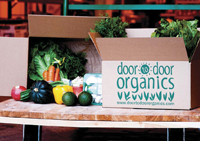
Thanks to the popularity of local food, many produce delivery services are seeking to buy from growers. But is selling to a delivery service a smart business move? As this new marketing opportunity picks up steam for the 2011 season, GFM talked to some key players about the pros and cons. Among the benefits: having another outlet that can absorb surplus production. Among the obstacles: getting wholesale prices. As always, plenty of factors need to be weighed.
“We do a couple of things that create great opportunity for small-scale growers,” said Chad Arnold, president of Door to Door Organics. “Because we’re a home delivery service, we have vehicles moving all over and typically returning to the warehouse empty, so we have resources to move smaller quantities of high-quality products back to our warehouse.”
Door to Door Organics was started in Pennsylvania in 1997 and has since expanded to Colorado, Michigan, Kansas City and Chicago. Customers order online and can choose from four box sizes ranging from $26 to $56. For example, in mid April, the smallest box — a “bitty box” — included two russet potatoes, one cucumber, one bunch broccoli, one Bok Choy, one head of Romaine, one mango, two oranges, two apples, and two bananas. Customers can substitute up to five of the items from a list of other available produce. Everything is certified organic. Price includes delivery to a home or office.
With hundreds of customers in a delivery area, the company needs to buy large quantities of produce for those basic boxes. Farms of 10 acres and more tend to be the best suppliers for the company. But there is still room for smaller growers to sell smaller amounts, Arnold said.
“We will take very small quantities of produce, like two cases, even on an infrequent basis, if we can figure out the logistics,” he said. “If we hear from a grower who has three cases of amazing heirloom tomatoes, we will try to buy them. Because we have a template menu and allow customers to make changes, if we have just two cases, four cases, 10 cases of something, customers can add that to their box. What we have the capacity to do is build a small group of customers who love a particular farm.”
Arnold said his company was willing to go out of its way for local growers because local is so important to customers.
“The localized supply chain is important to us from a values perspective as well as a customer perspective,” he said. “I will make the argument that it’s the only obvious way to make the local supply chain work. The challenge is, we are still a middleman so we are buying at wholesale and selling at retail.”
As with all wholesale and institutional markets, selling to a home delivery service comes down to price vs. supply. When you’ve sold all you can to higher-paying customers and you have surplus, a wholesale account makes sense.
Eleanor O’Brien of Persephone Farm in Lebanon, Oregon, says they started off selling 100% wholesale but over the years have reduced that to 20%. Most of their produce is sold at farmers markets in Portland and Salem. They occasionally sell to a home delivery service, Organics to You. “When they’re able to offer a price that reflects a local grower’s price structure, that can be pretty beneficial,” she said. “It’s simply another outlet for us.”
But as most growers with 10-plus acres of vegetables know, a few high-volume crops sold to wholesale accounts can be an important part of the marketing mix. In the case of Persephone Farm, they picked a few wholesale crops such as cabbage and cucumbers that grow well for them and fit nicely with their other work. They also focus on winter storage crops, so having year-round accounts like a wholesaler and home delivery can be helpful.
Aleisha Gibbons, the owner of a family-owned home delivery service, Berkshire Organics, says that her business has purchased more than $1 million in local products since she started in 2008. Because she operates year-round, she provides a new outlet for growers and she says she has seen some of her farmers increase their season extension as a result.
“A lot of farmers don’t want to focus so much on the customer service side,” she said. “It’s nice to work with a small local business as opposed to a corporate entity. They don’t feel like they’re getting beaten down on price.”
Not only does she try to offer a fair price, she says, she also pays her growers when they deliver.
Some growers worry that home delivery services will take business away from farmers markets and Community Supported Agriculture. But those in the home delivery business argue that there are plenty of customers for everyone; if any business is losing out, it’s the supermarkets.
“Initially, I thought they were going to compete with farmers markets, said Lonnie Hail of Bearcreek Farm in Osceola, Missouri. “Now I think they’re actually going hand in hand with markets. A lot of people, for one reason or another, don’t make it to market every week. And like it or not, certified organic fruits are not always available here.”
Lonnie and his parents, Robbins and Jim Hail, sell at two farmers markets, Whole Foods Markets, and other direct accounts. Door to Door was an occasional outlet last year, and they were satisfied with the relationships so this year they hope to increase sales. “We’re looking for as many outlets for our produce as possible,” Lonnie said.
Gibbons of Berkshire Organics said: “Farmers access a portion of the market they wouldn’t normally through CSAs and farmers markets. Our clients typically work full time and don’t have time or resources to commit to either of these programs.”
Arnold said that because Door to Door doesn’t require a commitment from customers, they can come and go as they please. “We operate in seasonal markets and have a lot of customers who go back to CSA in summer,” he said. “I’m confident that people who want the CSA or farmers market experience are going to get that whether we’re in their life or not. Some people want convenience and if they don’t get that at a farmers market or CSA, they’re just going to go back to the grocery store. We act as a better way. Home delivery is one of the key pieces in the food system.”
If you’re interested in selling to home delivery services, now is the time to make yourself known to them. Search online for home delivery in your state and see whether there are any nearby. Then contact them and find out what’s required to become a vendor. Some may require GAPs certification, organic certification, or other specifics. You’re not likely to get a contract to grow for them but you will at least know the procedure for selling when you’re ready to harvest.
Copyright Growing For Market Magazine.
All rights reserved. No portion of this article may be copied
in any manner for use other than by the subscriber without
permission from the publisher.