











The body of knowledge about using hoophouses for cool-weather crops has grown each year, and the options are many. Each grower will want to customize the mixture of crops to suit the local climate, market, and desired work schedule. For example, our focus is on supplying a wide range of fresh produce all winter and spring to feed 100 people. If your goal is to maximize harvests in December, and then read novels by the woodstove till mid-February, you might rather plant a large amount of spinach to overwinter and harvest after your time off.
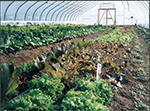
At our farm in central Virginia (Zone 7), we grow salad crops, cooking greens, turnips, radishes and scallions in the hoophouse. We also use some of the space to grow bare-root transplants for setting outdoors in February and March. Our outdoor beds can provide spinach, kale, collards, and leeks all through the winter, although the rate of growth doesn’t compare to what happens in the hoophouse. We aim to be able to harvest greens in the hoophouse after the outdoor crops slow down, and turnips after the stored outdoor fall turnips have all been eaten, or as an occasional delectable alternative.
We have a 30’ x 96’ Clearspan house from FarmTek, the gothic arch type, with bows 4’ apart. We use an inflated double layer of plastic. Our hoophouse does not have roll-up or roll-down sides. We built it for maximum winter coziness, and so only the ends open. We don’t use row cover over our winter crops. We like that the insulation provided by the double plastic means we can move around freely and work inside the tunnel, unhindered by row covers. We don’t need them for warmth, and in winter the amount of daylight is a limiting factor, and row cover does reduce the light. If you are in a colder climate than we are, the extra benefit of row covers can pay off. Compared to using row cover outdoors, inside the hoophouse is easy – no gusts of wind, no rain, no snow!
Inside, we have seven lengthwise beds. The two edge beds are 2’ wide and the rest 4’. The paths are 12”. This is the same size we use outdoors, and works well for us. It really isn’t much path space. (Do yoga! Or make wider paths.) We do only handwork in the hoophouse – no tractor or rototiller. The lack of rain indoors means there are very few weeds, and by not inverting the soil at all, we get few new weeds. We enjoy the peaceful, enclosed, intensively planted miniature garden, protected from winter weather and heated by the sun.
Persephone Days
If you want to harvest in the darkest days of winter, called Persephone Days by Eliot Coleman and the Solstice Slowdown by Alison and Paul Wiediger, you’ll need to plan to have a good supply of mature crops to take you through. Be aware of the increase in days to maturity in winter. Here at latitude 38°N, daylength is less than 10 hours from Nov. 21 to Jan. 21; during those two months, there is little plant growth. For most of the winter, our plants are actively growing, not merely being stored for harvest, as happens farther north, so we can continue sowing new crops even in December.
Crop overview
Our winter crops are a mixture of direct sowings and transplants brought in from outside (in the fall), or grown insideand transplanted during the winter. We start in early September, sprouting some spinach seeds in a jar in the fridge, and sowing Bibb lettuces outdoors, to transplant later into the hoophouse. Meanwhile, we clear and compost one of the beds inside to sow the one-week-old sprouted spinach seed, some radishes, scallions, Bulls Blood beet greens and tatsoi. We make outdoor sowings on Sept. 15 and Sept. 24 for crops to later transplant into the hoophouse at 2-4 weeks old. The Sept. 15 sowing includes about 10 varieties of hardy leaf lettuce, Pak Choy, Chinese cabbage, Yukina Savoy, Tokyo Bekana, Maruba Santoh, and chard. The Sept. 24 sowing consists of Red and White Russian kales, another 10 varieties of lettuce, Senposai, more Yukina Savoy, Mizuna and arugula, and resows of anything from the previous week that didn’t give a good stand of seedlings. We cover this outside bed with hoops and rowcover to keep bugs off, and water it frequently.

By the end of September we clear the summer crops from at least one more hoophouse bed, add compost and work it in. We transplant the Tokyo Bekana, and Maruba Santoh at just 2 weeks old, the Chinese cabbage, Pak Choy, Yukina Savoy at about 3 weeks old and the bibb lettuce at 4 weeks. (Plants grow so fast in September!) By mid October we clear and prepare another bed and transplant 280 lettuce at 10” apart, and the chard. We also sow various tender turnips and radishes. We transplant the second lettuce (300 plants), the kale, Senposai, Mizuna and arugula and the second Yukina Savoy at about 4 weeks old, in the fourth week of October, after preparing the remaining beds.
We sow our first baby lettuce mix Oct. 24, along with our second spinach and chard. At the end of October, we sow some “filler lettuce” to transplant later to fill gaps. We try hard to keep all the space occupied, mostly using lettuce and spinach. On Nov. 10 we sow our second turnips, Mizuna and arugula, more filler lettuce and spinach, and also our first bulb onions for outdoor transplanting as early as possible in the new year – we aim for March 1.
From Nov. 10 on, we have a fully planted hoophouse, and as each crop harvest winds down, we replace that crop with another. Our winter and spring crops come to an end in March or early April, when we dig holes down the centers of the beds to plant the early summer crops of tomatoes, peppers, squash and cucumbers. Usually we harvest the winter crops from the center rows first, plant the new crop down the center, then harvest the outer rows bit by bit as the new crop needs the space or the light. This overlap allows the new crops to take over gradually.
Varieties that work for us
Asian Greens: We like the big heads of Prize Choy or Joi Choi Pak Choy, as well as Tokyo Bekana and Maruba Santoh, which have tender, bright yellow-green leaves. When small, the leaves are good in salad. When big, whole heads can be cut for quick-cooking greens. Tatsoi and its bigger cousin Yukina Savoy are good on flavor and strong dark color.
Chard: Bright Lights, Rainbow. Although green varieties grow faster in low light, we don’t need a lot, and we enjoy the varied colors.
Chinese/Napa Cabbage: We like Blues, but the Michihili types are taller and narrower, and might make more sense in terms of space use.
Kale: the White and Red Russian kales do well in our hoophouse, but not outdoors, where they get weather-beaten. Inside, they do better than Vates, our outdoor kale.
Lettuce: Oscarde, Merlot, Tango, Red Tinged Winter, Lollo Divino, Galisse, Salad Bowl, Red Salad Bowl, Rouge d’Hiver, Winter Wonderland, Outredgeous, Hyper Red Rumpled Wave, Revolution, Green Forest Romaine. Looseleaf varieties, mostly. We look for ones that do well in winter, not just in early spring. Romaines and bibbs are good for harvest in December and late February onwards, but can get tipburn in midwinter.
Lettuce Mix: various mixtures, some homemade.
Mizuna: purple and green. Ruby Streaks looks very good. It adds texture to salad mixes.
Radishes: Cherry Belle are the “Industrial” radishes – all ready at once, quickly, looking perfect. We also like the multi-colored Easter Egg for variety and an extended picking season. It does well in the later plantings, staying mild in sometimes hot conditions in March, as does White Icicle, a long, crunchy, tender root.
Scallions: Evergreen Hardy White
Senposai: (the name translates as Thousand Wonder Green.) Fast-growing, tender, delicious. Grows big, and will provide bunches of leaves many times over.
Spinach: It’s Tyee every time, for us: reliable, and tolerates varied conditions.
Turnips: Hakurei (short tops), Oasis, White Egg, Red Round.
Most of our seeds for greens come from Fedco, Johnny’s or Southern Exposure.
Crops we tried, didn’t like
Hot, bitter and sour greens don’t go down well with our crowd. We have tried and rejected chicories, endives and pungent mustards. We’re also less wowed by crops that are tiny or have to be harvested very promptly: Chinese broccoli (Hon Tsai Tai), mache (corn salad), claytonia. For us, it works better to use the space for more lettuce or spinach. In colder climates lettuce grows slowly, and smaller, hardier crops are more worthwhile.
We tried Nero di Toscano/Dinosaur kale, but it didn’t do well for us. It harbored aphids in the curled leaves, and never developed the good flavor we hoped for. We have also tried various large Asian greens and hybrids that ultimately seemed too rambunctious for our hoophouse: Komatsuna, Mizspoona, Tyfon Holland greens.
Daily tasks
We reckon on about 2 hours work each day in winter, (only one hour in the summer). We aim to keep the temperature in the 65-80°F range, opening the big high windows, and some of the doors as needed. If the sun is shining, we usually open the windows around 9 a.m. and close them around 2.30 p.m. to store some of the warmth. The number of daylight hours will depend on your latitude. On cloudy days, we use the thermometer to help us decide if we can open the windows. Even in cold weather, plants need fresh air! While photosynthesizing, plants need carbon dioxide, so just walk around in there, breathing, and you are doing “carbon dioxide enhancement”! When it’s below freezing and cloudy, you’ll want to keep the place closed up.
High-density cropping can really use up the carbon dioxide in a closed hoophouse very quickly. When this happens, photosynthesis crashes, and plant growth becomes limited. Good organic matter has high levels of soil organisms producing carbon dioxide, and dense plant canopies can trap this near soil level, where it is of great use.
Once the night temperatures are reliably above 45°F, we leave the windows open at night, to slow down the bolting tendencies of the cool weather overwintered annuals. In March and April we have to balance this need with that of the newly planted tomatoes, peppers, squash and cucumbers for warmth. If night temperatures will be above 55°F, we also leave the doors open.
Our main task each day is harvesting. In the winter of 2009-10, we had frozen soil or snow on the ground outside for a month (very unusual here). We were able to keep 100 people in fresh salad and cooking greens (with turnips and scallions for variety) for the whole month.
Aside from harvesting, jobs include planting new crops, clearing old ones, spreading compost, hoeing, hand-weeding, and supplying water as needed. We have drip irrigation, with 3 lines of drip tape in a bed. We hand water new sowings and transplants using a hose. In the middle of winter, not much water is needed, and we try to only water when a relatively mild night is forecast, with the idea of minimizing cell wall damage by not having turgid leaves in freezing conditions. For new hoophouse growers, it can come as a shock to find everything frozen in the morning, and equally shocking, but much more pleasant, to find everything thaws out later and recovers just fine.
Last winter’s trial crops
Each year we try a few new ideas, or tweak something we tried the year before.
Spring Cabbage Greens, sow outdoors Oct. 15, transplanted inside Nov. 2, harvested March 13-27. In the UK these are sown in early August, grown outdoors, and called spring greens. They are actually adolescent cabbages of particular varieties that will overwinter there. They are transplanted about 4-6” apart, harvested once by cutting alternate plants, then cleared as they start to head up. Some UK varieties include Offenham Flowers of Spring, Durham Early, Dorado, and Avon Crest. I’ve tried Early Jersey Wakefield, because they are the right pointed shape, but they don’t work as well as the real thing. This crop provides a very dark green, great flavored unhearted cabbage. It took a bit of work to convince people to try them.
Celery grown outside for the summer, then transplanted big into the hoophouse Oct. 24, 12 plants, at 10-12”. This keeps the plants alive, producing stems to add zest to winter stir-fries and salads (chopped). Harvested Dec. 26 – April 30.
Wild Garden Seeds’ Pink Lettucy Mustard salad mix, sown Nov. 2. We’re still experimenting to find the best sowing dates here.
Bulb onions sown Nov. 10, transplanted early March in a single row along the south edge of beds, for an early crop. We got good onions but they dwarfed the pepper plants behind them. Maybe planting them on the north side of the bed is better?
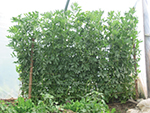
Fava beans sown Nov. 15, harvested mid May. This worked well, we may do a bigger planting next winter. Legumesadd diversity to the rotation.
Snap Peas ‘Sugar Ann’ sown Feb.1, harvested April 21 – May 15. Very successful. We’ve now added this to our repertoire.
Peashoots – sometimes a fallback crop (called a “catch crop” in the UK) if we have unexpected open space and leftover soaked seed from our spring outdoor planting, mid-March. Harvested April 10 – May 5.
Brassica Salad Mix, sown Feb 6 and Feb. 12 for March and early April harvests. We mix our own from leftover random brassicas. For a single cut, almost all brassicas are suitable. Worthwhile if other crops fail, or outdoor conditions are dreadful and you need a quick crop to fill out what you have to sell.
Rotations
Rotation of crops in the hoophouse could be a big topic on its own, as the desire is to grow the same crops every year. Our approach is to vary crops, so that even if we end up with lettuce in the same bed two winters running, we have had two other crops there in between, such as squash and cowpeas. We do keep track and do our best to rotate, but the task is like making a patchwork quilt, where the scrap of Aunt Rosie’s wedding dress just has to be included somewhere. Or Vegetable Sudoku, with only one possible solution.
Crop requirements
Because crops grow so fast in the hoophouse, the organic matter in the soil is consumed at a rapid rate. Each new crop requires a fertility boost. For fall planted crops, we spread 1” of compost across the beds and work it into the top of the soil with scuffle hoes or rakes. In general, for each crop, growers add compost at a rate of 15 tons/acre. We use about 4 wheelbarrows (not full) per 4’ x 96’ bed. A full wheelbarrow generally holds 6 cubic feet – about 40 gallons, or 170 liters.
For the early summer crops planted in March and April, we dig a hole for each plant and put a shovelful of compost in each hole. When we grow edamame or cowpeas in the middle of summer, we do not always add more compost at that point.
Sowing
Is usually done by hand, but other growers use an EarthWay type seeder or the more precise 4- and 6-row seeders sold by Johnny’s Selected Seeds. Some growers buy several used Earthways and bolt them together for a multi-row seeder.
Transplanting
Because space is at a premium, it’s good to measure plant spacings in some way, rather than drift to wider spacing and end up with fewer plants. We use wooden sticks. Rulers are cheap and convenient. Many growers turn on the irrigation, and use the wet spots to plant into. Hoophouse crops grow bigger than they would outdoors, so sometimes the spacing needs to be larger.
Cultivation
We use scuffle hoes, Cobrahead hoes, and the hand cultivators that are commonly available for backyard gardeners. We call them “Claws” – they have 3 tines and a short handle. Few weeds grow, but sometimes the soil texture looks in need of some help, because of the lack of rain.
Pests and diseases
Voles are our most frequent winter mammal visitor. We use mousetraps, the plastic Intruder type. Our worst winter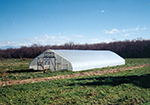 insect pests are aphids and Vegetable Weevil Larvae. For the aphids, we bring in hibernating ladybugs (they wake up with warmer temperatures!) or spray with soap. For the Vegetable Weevil Larvae, which love turnips and Chinese cabbage, (but will move on to spinach), we use Spinosad. We also try to attract beneficial insects by planting flowers – you can put them in pots and move them around to where they are needed. We have used Alyssum and Echinacea and Buckwheat.
By far our worst disease problem is the fungus we call Solstice Slime. It’s scientific name is Sclerotinia drop. It attacks lettuce when the days are short and temperatures chilly, causing the whole plant to collapse into a soggy grey pancake. So far, our approach has been to finish our shift by collecting up the slime and taking it outside, then washing our hands before returning. Prompt action does seem to limit the spread. The Wiedigers, who have several hoophouses, use solarization of one tunnel each summer to kill the spores. Tipburn (brown leaf margins, including internal leaves) is caused by quick drying of the soil, when the weather makes a sudden switch to bright and sunny from overcast. Be ready to irrigate when the weather suddenly brightens.
Harvest
Starting in November, we harvest spinach, lettuce leaves, Mizuna, arugula, beet greens, Tatsoi, brassica mix for salad, as well as radishes and scallions. Lettuce is harvested by the leaf, leaving the center to keep growing. We switch to harvesting the heads in late January, when growth begins to pick up.
From December we also have baby lettuce mix, Tokyo Bekana, Maruba Santoh, chard, kale and turnips. Kale grows whenever it is above 40°F.
The bigger greens, including Senposai, Pak Choy, and Chinese cabbage, feed us from January till mid-March, if we plant enough. Yukina Savoy starts in the New Year.
Spinach is harvested by the leaf, using scissors, until the plants start to look a bit past their peak, then we “crew-cut” or buzz-cut them. Which brings me to another nice thing about hoophouse growing. For winter crops, (even kale), there is no need to remove finished plants to the compost pile, if they are not diseased. We simply leave them on the surface to dry up and disintegrate, improving the texture and nutrients in the surface layer of the soil.
Nitrate accumulation
In winter, when light levels are low, there is an increased likelihood of high levels of nitrates in leafy vegetables. This is generally thought to be a health hazard, (although recently this has been questioned) – nitrates can be converted in the body into nitrites, which reduce the blood’s capacity to carry oxygen, and nitrites may be further converted into carcinogenic nitrosamines. To keep nitrate levels as low as possible:
Grow varieties best suited for winter.
Avoid fertilizing with blood meal or feather meal
Water enough but not excessively.
Provide fresh air so that carbon dioxide levels are high enough.
Harvest after 4 or more hours of bright sunlight in winter.
Avoid harvesting on very overcast days.
Harvest crops a little under-mature, rather than over-mature.
Use crops soon after harvest.
Store harvested greens at temperatures close to freezing.
Spinach contains about twice as much nitrate as lettuce, so mix your salads, don’t just eat spinach.
Books
Walking To Spring by Paul and Alison Wiediger
The Hoophouse Handbook from Growing for Market
The Winter Harvest Handbook by Eliot Coleman
GFM subscribers get a 20% discount on these and all books.
Here is the information you need to take advantage of these benefits:
1. Go to www.growingformarket.com. In the right-hand column, you will see a Member Login box.
2. Type “print” into the email field and “member” into the password field.
3. When you see the screen that says “You’re logged in!” scroll down to the image of Extending the Season book cover and follow the links to the download center. If you want to buy books, click on the Online Store text in the left column. As you shop for books, you will see the regular price crossed out and the member price above it. Shop and checkout as usual. or call to order at 800-307-8949.
Other resources
www.hightunnels.org has information and a link to the Hightunnels listserv.
ATTRA, www.attra.ncat.org, has lots of information on, including Season Extension Techniques, and Specialty Lettuce and Greens: Organic Production.
Noble Foundation, www.noble.org, does research and publishes information about hoophouse growing.
Copyright Growing For Market Magazine.
All rights reserved. No portion of this article may be copied
in any manner for use other than by the subscriber without
permission from the publisher.