
Earlier this year, we invited readers to send us photos of do-it-yourself methods of increasing hoophouse ventilation. We were hoping to get ideas that anyone could implement without spending a lot of money. We received many good ideas, some easier to execute than others. Our contest was sponsored by Carts and Tools, a small, farm-based company in Oregon that makes battery-powered tools for small-scale farms. The grand prize was a Tillie, a battery-powered tiller from Carts and Tools, featured in the ad on page 9.
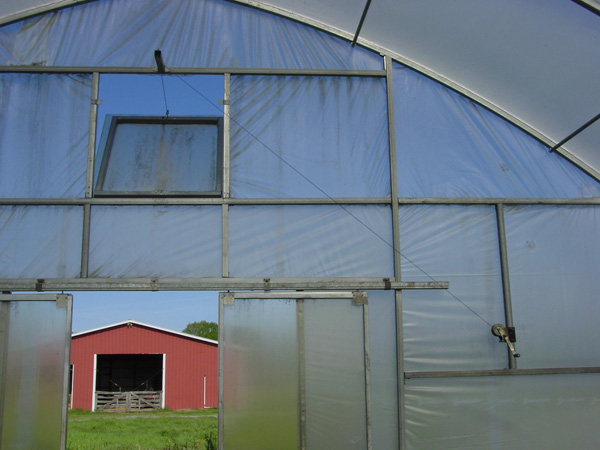
We chose as our winner Jim and Julie Vaughn of Rocky Glade Farm in Eagleville, Tennessee. Their design, pictured below, seemed to us to be something anyone could easily add to an existing hoophouse. Here is Julie’s explanation of their ventilation system:
“We have three 35×144 passive solar hoops. My husband came up with the idea for these windows to ventilate the “tops” of the hoophouses since these houses are so tall. We made a window frame out of extra pieces of end wall metal, covered with corrugated sidewall covering that overlaps the endwall window frame to form a tight seal when closed. He added home-made PVC weights to help the windows descend when opening. In order to open we have a winch system set up inside the houses, one for each window. The winches have cranks and catches to keep the windows at the level you want them. These windows are on both ends of our hoophouses. In our winter growing months this is usually the only ventilation we use. The windows really help to let the moisture out of the houses without allowing cold air to enter the houses at plant level. The great thing about our windows is that you can open them as much or as little as you want/need, which is great for the extreme weather days (hot, cold, rain) that we can encounter here in TN. It is also a great “safety” for us to allow some ventilation ahead of storms without getting caught with our sidewalls down.”
In addition to the grand prize winner, we had several other entries that we thought worthy of mention. The folks who sent in the photos on these pages will receive a free copy of The Hoophouse Handbook Second Edition when it becomes available.
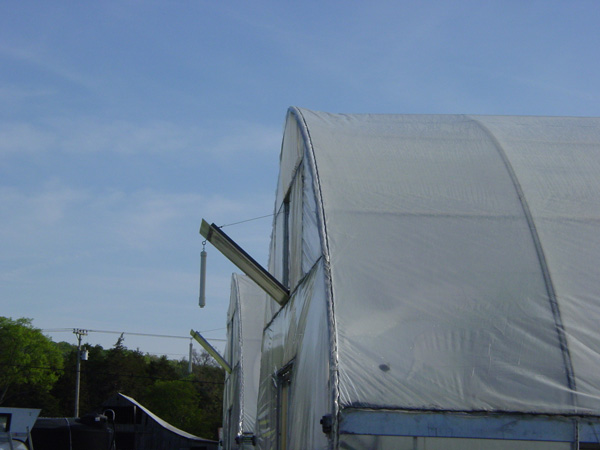
The solution pictured below is from Kathy Thorne of Blue House Market Garden in Loranger, Louisiana., who keeps
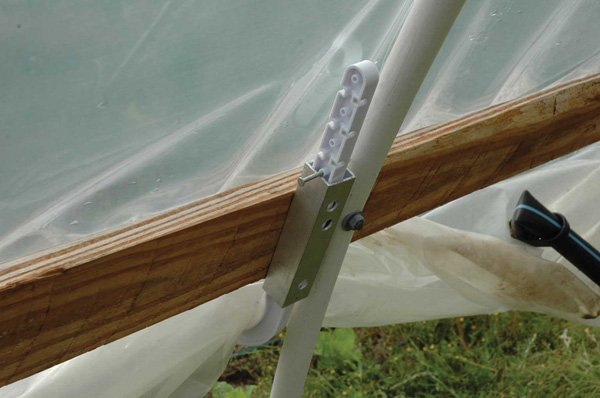
the sidewalls rolled up all summer in her hot climate. She wrote: “The system uses pipehangers ($0.90 each) and 1-inch aluminum channel ($12 for a 3-foot length). The ends are tucked under and clipped on the end ribs. I anticipate that it will be easy to stow when I need to roll the sidewalls down – just pull the pin and drop the hooks.”
Beth Van Sandt of Scenic Place Peonies in Homer, Alaska, chose a ventilation system that will work in her snowy winters.
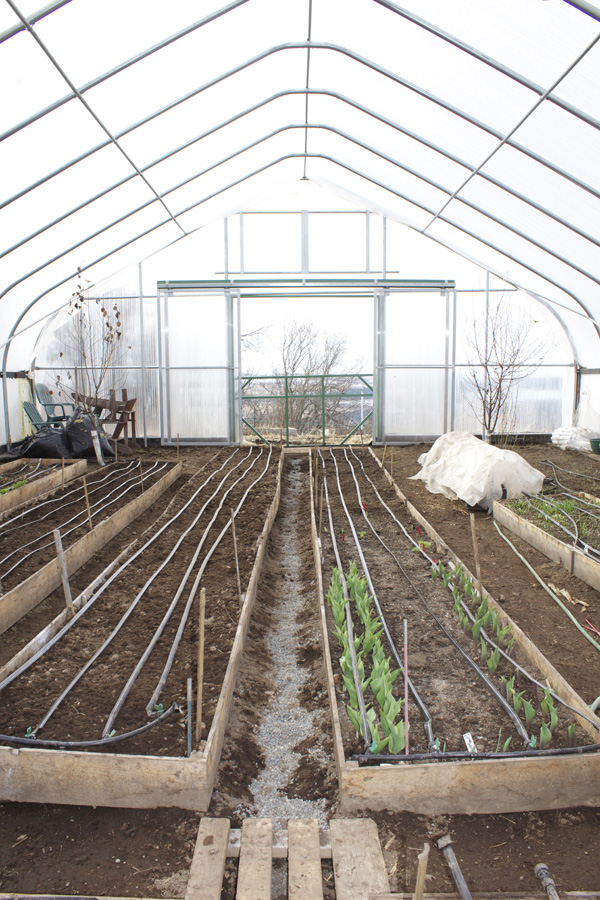
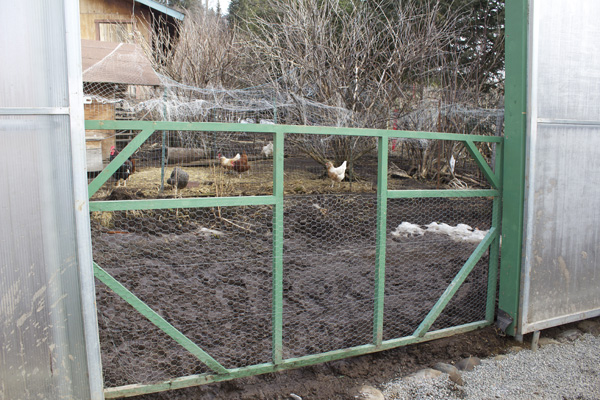
“The following photos are of our 30×72 high tunnel. We erected it in 2010 and have been loving the season extension that it gives us here in the great northern state of Alaska. We opted to go with inside sliding doors on both end walls for our system of ventilation. Due to our ginormous amount of snow in the winter we opted for inside sliders so as to be able to get into the HT. Each door is 4×8 which leaves us a nice large opening at each end for air flow. Our HT is oriented North to South in order to be able to take advantage of the updrafts of wind off of the southend of our property that overlooks the bay. We built movable fencing for each end to keep out our free-range chickens and snowshoe hares, which in the past two years have undergone a population explosion. When we originally ordered our HT we framed in vents and and an exhaust fan; happy to say that we do not need them.”
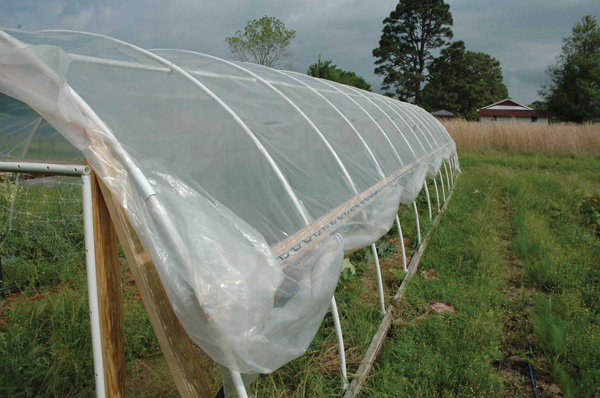
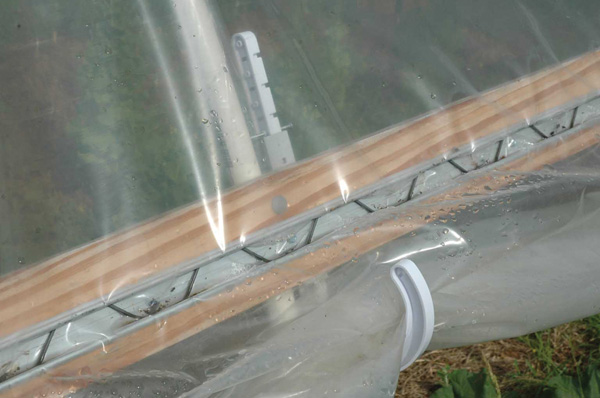
Finally, we received these photos from Steve Bender of Homestead Flower Farm in Warrenton, North Carolina, who built his high tunnel with a ridge vent. He writes: “We’ve been very pleased with the ability of this roll-up ridge vent to lower the temperature in this 30 ft X 100 ft hoophouse. The two hoop halves are offset 1.5 feet to create the vent opening and then are braced to each other and to the lower cross pipe in two triangular forms. Every other hoop also rests on a post which carries the weight to the ground. The plastic that covers the vent is screwed underneath battens to a 3/4 inch metal conduit, the end of which is attached to a small bicycle wheel rim. Metal is bolted to the sides of the rim to extend the groove of the rim to about 4 inches deep. Attaching a wound rope to the rim, the entire length of the ridge vent can be carefully, but quickly, raised or lowered as needed.”


If you have questions about any of these ventilation systems, email Lynn and I will forward your email to the correct person.
Copyright Growing For Market Magazine.
All rights reserved. No portion of this article may be copied
in any manner for use other than by the subscriber without
permission from the publisher.