







How do you decide what tools to spend money on and whether they will be a good investment for your farm? I think a lot of us go with our gut feelings for smaller tool purchases and base the decision largely on our perception of how much “pain” the tool will relieve, whether that be the actual physical exertion pain, the pain of frustration at our current tools or lack of tools making a job hard to do, or even impossible to do. The promise of a tool saving time is often the motivator, but how often do you actually calculate out the full cost of the time savings versus the cost of purchasing and maintaining the bright, shiny new tool? How can we incorporate savings other than just time into the calculation?
Making the actual calculations isn’t complicated in theory and so I want to walk you through the process I use for putting actual numbers for “return on investment” estimates when I make tool purchases. By “return on investment” I mean that I expect to invest money in a tool, and then as a result of that to see either cost savings or increased income that pays back that initial investment plus some.
In practice, putting numbers on future returns on investment is always somewhat of a guessing game, just as any prediction of the future is. Understanding how good your guesses are in some ways is the trickiest part of the process, but even with there being some guessing involved I always find the process useful and informative.
The basic approach is to identify everything that will change with the new tool purchase. Some of those changes are obvious and have clear dollar values associated with them. For example, I’m currently thinking about investing in a battery powered wheel hoe. The first and most obvious change if I buy the tool is that money will come out of my bank account and will be replaced by the tool – this has a clear dollar value. The second change, and the primary goal of purchasing this specific tool, is that I will save time and energy pushing our current wheel hoe. The dollar value behind this change is less obvious, but I can make some estimates.
I’ve created a simple table of the costs of the current system that would be saved versus the costs of the proposed new system. In the table you can see that the only ongoing cost to be saved by switching is the labor to push the wheel hoe and I’ve estimated that time and the associated expense to be $360 per year for our current method. For the proposed tool investment there would be the upfront costs of purchasing the tool and then the ongoing costs of the labor and electricity to run it. You can see that I’ve estimated this cost at $472 per year.
Taking this at face value it should be obvious that purchasing the new tool for this purpose is not a good investment and in fact would reduce the farm’s bottom line by adding $112 in expenses per year. In my particular case, the reason this tool doesn’t make sense is probably because my operation isn’t big enough to really fully utilize it. If I had many more paths, it would make sense, and maybe if I found more tasks that the tool could be used for and that would save more labor it would still make sense. Having the numbers in front of me helps me to understand that.
It is always worth taking a second look at all of your numbers, estimates, and assumptions, thinking about how good they are, and perhaps running a few more scenarios. For example, I’m assuming here that I would only be using the E-Ox for cleaning paths on the farm, and it’s possible that I might also use it for other tasks in which case I should include those in the analysis. Are my estimates of how long it takes to use the wheel hoe, versus how long it will take with the E-Ox good, or might there be a bigger difference? Is that actually the number of passes I need to make to keep the paths clean? Is there extra cost because I’ll need to build out a storage space for the new tool to keep it out of the weather when it’s not being used?
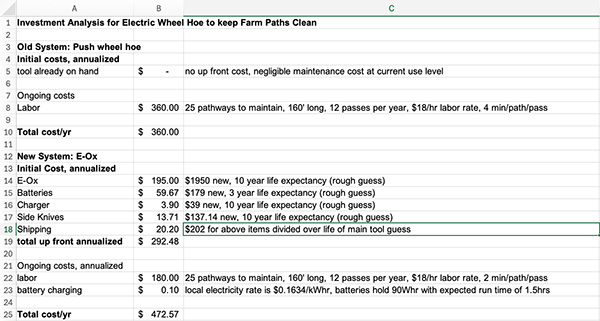
When considering changes on the farm, like a tool purchase, I make a simple table comparing the costs involved with the change versus the costs of continuing the way we’ve been doing things. If there is an income difference as a result of the change I’ll also include that in my comparison. In this case there is no income difference. Table courtesy of the author.
For some of these numbers, which are ultimately guesses at the future, I can use my same table to make high/low estimates. For a high/low estimate I simply run scenarios for best-case numbers and worst-case numbers and see how much of a difference that makes. If in both scenarios there is a net benefit, the decision is easy. If in both scenarios there is a net cost, again the decision is easy. If there is net benefit in the best case, but net cost in the worst case then I have to weigh how likely each scenario is and the decision is more difficult.
Cash flow is another consideration. In the example I’ve given I’ve assumed that I can lay out the cash for the purchase up front, but I only consider the annualized expense versus the savings. The reality is that it requires enough cash on hand, or credit, to make the purchase up front and the ability to wait for the savings which will come later. If you are using credit to finance the purchase up front then you need to add in the cost of that credit (the interest expenses and any fees) as part of the costs analysis.
Most significant changes will have dollar values that can at least be estimated but there are always going to be some that won’t. For example, it’s hard to put a dollar value on how much of your own energy a new tool will save, or how much stress it will relieve. To get a gut feel for the value of impossible to calculate numbers like this I look at the bottom line of my “return on investment” number. If the tool will clearly break even or pay dividends then I don’t even need to put a number on this, it’s a good investment and any additional benefits are icing on the cake.
If the “return on investment” is negative, meaning the numbers are adding up to it being an overall expense rather than cost savings I then use a little thought experiment. Say the overall expense will end up being $100 per year of use, I then ask myself, “would I rather have someone give me the tool, or give me $100 each year?” This flips the question from would I prefer having the tool, to would I prefer to be given $100 and not have the tool. Mathematically this is the same as asking the question would I prefer to spend $100 and have the tool, or to not have the tool but for me it’s helpful to look at it from a new angle.
It’s important to remember that if your farm is your business, it ultimately needs to be financially sustainable. Any optional business expenses need to generate actual revenue either directly or indirectly. Any optional expenses that don’t contribute positively to the bottom line may be able to be justified, but ultimately they are reducing the financial profitability of the business.
There’s a great line in the book Fearless Farm Finances: “In reviewing the draft of this book one farmer commented that doing all of this analysis “takes the fun out of buying something new.” Author Paul Dietmann, with many years of experience assisting farmers in desperate financial trouble, responds: “Facing bankruptcy at the end of a long series of poorly considered investment decisions tends to take the fun out of farming too!”
It took me about an hour to collect and crunch all of the numbers for the analysis in the table so there’s an expense to doing the analysis. That expense of an hour potentially saved me from making a poor decision that would have cost me much more and helped me understand how I might make improvements by just making sure we use our current wheel hoe for shorter periods of time more often rather than trying to plow down overgrown weeds after they’ve already gotten away from us. That’s still not as fast or easy as doing it with a fancy electric tool, but the money saved by not buying that fancy tool is more than enough to pay for the extra labor.
Making a tool purchase is just one of many changes you can make on the farm, and really any potential change can be analyzed using this same framework. I frequently use this same method to compare the difference between transplanting or direct seeding certain crops, or even decisions like whether or not to pre-pack CSA shares for our members or set them out farm stand style to pack them themselves. Understanding how changes like these will impact the bottom line is one of the keys to staying in business.
Josh Volk farms in Portland, Oregon, and does consulting and education under the name Slow Hand Farm. He is the author of the books Compact Farms: 15 Proven Plans for Market Farms on 5 Acres or Less, and Build Your Own Farm Tools, Equipment & Systems for the Small-Scale Farm & Market Garden, both available from Growing for Market. He can be found at SlowHandFarm.com.
Copyright Growing For Market Magazine.
All rights reserved. No portion of this article may be copied
in any manner for use other than by the subscriber without
permission from the publisher.