






As farmers, we like to complain about the weather, but mostly what we do is adapt to it as best we can as it happens. We have bags of tricks to coax plants into early growth or to survive frost. I inherited the many generations of tricks through my family of farmers and gardeners from Arizona, Kentucky, and Oregon, and added many more in the last eight seasons of market farming.
But last year, that bag had nothing to offer me during the four-month long heat dome in the Pacific Northwest. After a lifetime of reading about climate change and what we might face, I felt I had finally reached its front lines in the arid West. I knew it was coming, but in its midst, I felt thwarted and unprepared.
My farm is in the arid, high desert of eastern Oregon. We average about 16 inches of rain per year and our temps during the hottest months—June through August—spend a few days in the upper 90s. Last year June and July topped out at 108. While our rainfall this year was fair-to-middling, the timing was bizarre. Our rainiest months are generally April through June, but last year we received three times as much rain in August as April. Basically, our spring was non-existent; we went directly from nights in the 20s to days in the 90s.
None of these conditions alone pointed to a climate change smoking gun. However, on the ground farmers are talking about a trend of more extreme conditions. In one year it feels like we see combinations of wet/cold, dry/cold and dry/hot that are unfamiliar, confusing, and unpredictable.
Here I present my own experience and that of several other growers and authors as we manage growing in hotter, drier climates. Everyone interviewed wanted to share experiences to help others more quickly adapt. As grower Katie Swanson told me, “We need communication and information sharing across the regions. What I’m facing now in the high desert, folks in more temperate climates may be facing soon.” (See GFM October 2021 “Climate change on farms in the Intermountain West.”)
This year both Katie and I struggled to keep plants alive with weeks of temperatures over 100 degrees. I had multiple, critical germination failures with direct-seeded crops. Varieties planted in April generally suited for May or June immediately bolted. I had to scramble to replant varieties more suited for July and August.
I kept thinking this heat will break, but it didn’t. The conditions were outside the range of what I knew. I made poor decisions and didn’t react fast enough to conditions on the ground because of a lifetime of experience living and growing plants in this exact place. Perhaps the extreme heat, drought, and wildfires of 2021 are an anomaly. Perhaps they are an extreme we will see more often. We are trying to prepare without knowing what the new range of possibilities will be. “Nature doesn’t sit still and that’s even more so now with climate change,” Katie said. “You just don’t get to rely on what you did last year anymore.”
In search of methods and tips for adapting, I went looking for resources. In July a fellow grower from a hotter, lower, neighboring county at my farmers market had beautiful carrots. I was surprised since I had many (unusual) germination failures due to the heat. We started talking, he gave tips and tricks, and I realized if I talked to growers from places hotter, lower, more extreme or just south of me, I could more quickly adapt to the conditions I was facing.
I read Gary Paul Nabhan’s book Growing Food in a Hotter, Drier Land and started to feel that adaptation was possible by learning from desert farmers past and current. Nabhan tells the story of a desert farmer, explains the principles, then details how to plan for the future and put desert farming principles into practice in a place-based way. If you expect hotter, drier or more extreme conditions in your region as the climate changes, these are the foundational principals we can learn from desert farmers around the world.
Adjust your crops: Grow perennial vegetables and deep-rooted crops. Plant quicker-maturing crops. Test varieties on your farm for heat and bolt tolerance and drought resistance.
Get more efficient with your water: Harvest rain, seasonal flood waters and precipitation. Improve water use efficiency with systems beyond drip irrigation. Work with your landscape to move precipitation to your crops. Keep the soil surface covered or mulched to conserve water.
Improve your soil: Practice low/no-till agriculture to maintain soil structure. Increase soil organic matter to increase water-holding capacity.
Reduce heat stress: Establish perennial living fences and hedges around your growing area to create cooler microclimates, attract pollinators, and direct water and wind. Plant place-based polycultures or guilds of intercropped trees and plants. (See the February 2021 GFM article “Small orchards and agroforestry in the field.”) Add compost and mulch to the soil surface to reduce heat stress to soil biology and plants. Utilize shade cloth and naturally shady places on your farm to grow.
Plan for pollinator disruption: Maintain riparian and natural habitats on the farm for pollinators. Plant a wide variety of plants that bloom throughout the season for pollinators.
Assume there will be asynchronicity between crops and pollinators due to extreme weather. Be ready to adjust your planting schedule to match up with pollinators.
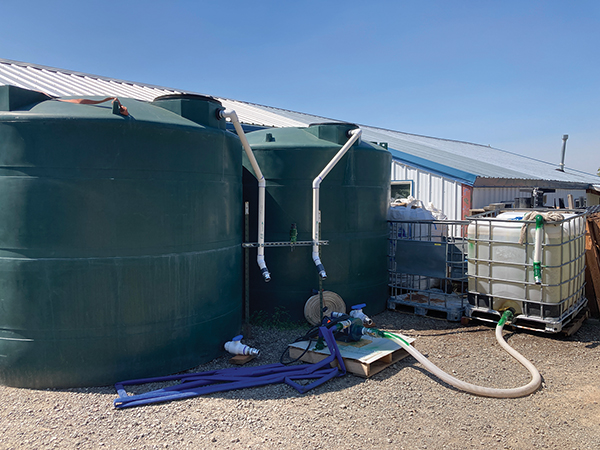 Emergency water storage at the author’s farm.
These key principles outlined in Nabhan’s book were in practice on the three farms I interviewed. Each was incorporating these principals through long-term planning and short-term scrambling on their home ground and finding ways to make it work.
Sweet Union Farm, Klamath Falls, Oregon
Katie farms on the native lands of Klamath, Modoc and Yahooskin First Nations where today average annual rainfall is 16 inches. So these practices sound familiar or just sound like farming. “The heat, the lack of water, the temperature extremes and swings are something that I’ve gotten so used to that I forget these aren’t the conditions everyone has to deal with,” Katie said. But, as more farmers in temperate or wet climates face conditions like hers, what she has to say might sound something like, “Hello, this is Katie from the future.”
“I feel like when folks talk about climate change, they are worried about things I already experience.” So what are Katie’s strategies?
Adapt day by day: “I can get stuck in my patterns. I will think, ‘I don’t usually put shade cloth on now,’ but it may need to happen now based on weather conditions.” Spring in Klamath Falls keeps you on your toes and you must be responsive, she says. “Spring is short here—it can go from snow on the ground to 90 degrees in two weeks.”
Everything is compressed and more intense when you have a short spring, and more farmers may start seeing shorter springs. “I am pushing the spring greens production earlier into tunnels each year so when the temperature flips from snow to heat, I can transplant greens outside the tunnel and the tomatoes inside the tunnel,” she says. She knows from experience that even when there is still snow in April, May won’t be hospitable for greens in the tunnel. She has both greens and tomato transplants ready to go when the switch flips.
No-till and compost: Katie has practiced no-till market farming for five years on her farm. “Adding compost as a mulch has been helpful for transplanting and water retention,” she says, emphasizing again that responsiveness is especially important in extreme or anomalous weather years like 2021. “It was easy to get set in an irrigation schedule, but you have to check what actually needs water when you don’t have much. With the deep compost and drip tape combination, it may look dry but if you poke your fingers in the soil, it is wet enough.”
Place-based adaptation in context: Of course, everything in farming books, on YouTube or in this article will not be appropriate for every farm. Test approaches out and whittle down to what really works.
“I’ve stopped raising beds because there’s no reason here, we don’t get flooding,” Katie said. “If anything, I should have sunken beds.” Raised beds are commonplace in the market farm world, but they don’t make sense in Katie’s context. In fact, Nabhan writes that sunken beds are a common practice of desert farmers around the world so precipitation can be captured and held.
Katie is also planning for hotter, drier conditions by selecting more seed from high desert growers such as High Desert Seed + Gardens and Wild Mountain Seeds. Her conditions require sturdier plants, too. “I start a lot of things inside under lights for a longer time because the temps are so dramatic here.”
Going forward, and especially after last season, she is planning to do more intentional intercropping so things can be shaded and create more windbreaks and hedgerows to prevent water loss from wind.
Sticking it Out: With the harshness of her climate and the eight weeks of smoke and zero ditch irrigation water last year, I asked why she is sticking it out and expanding her farm in Klamath Falls. “I know I’m taking a huge risk in expanding with unreliable water. I basically decided to be more adaptive with my CSA business model and get really creative with unreliable water.” She is committed to her community and finds joy in helping fulfill the need for produce. She knows her farming experience in the high, dry desert will be valuable to other growers in the future. “There’s a lot to be learned yet from this climate.”
Rocking TT Bar Ranch, Augusta, Missouri
After five years of ranching in Colorado’s high desert in Carbondale, Colorado, where average annual rainfall was 16 inches, Jose Miranda adapted to climate change by moving his water buffalo meat and dairy operation to Missouri on land previously occupied by the First Nations Kiikaapoi (Kickapoo), Kaskaskia, Osage, O-ga-xpa Ma-zho (O-ga-xpa) and, Ochéthi Šakówin.
“I lived in Colorado 18 years,” Jose said. “I have deep roots there, but I didn’t own property.” Signs of a drier, hotter climate were piling up on the range. For the last five years, the snow melt was gone much sooner, and the snowpack much smaller. In 2020 and 2021, he received zero irrigation water. Due to development pressures, he couldn’t find affordable land with reliable water.
“I tried to bulletproof my business against drought and wildfire by leasing six properties at different elevations in different watersheds,” he said. “But when the neighbors I bought surplus hay from started buying hay outside the valley, I knew that was it.” He started to think about relocating. “I could act quickly since I was leasing land rather than owning it,” he said.
He and his family chose their new place in Missouri because of improved access to water (average annual rainfall 44 inches), a longer growing season, proximity to the St. Louis market, and opportunity to grow the business and brand. “We have to be realistic,” Jose said. “We have to assume that our growing zones will change and prepare for that now. The water buffalos, for example, can handle more diverse weather conditions than cattle and will probably perform better in Missouri. You have to pick the right crop for the right place.”
Bimodal, quadrimodal varieties
Nabhan, based in Patagonia, Arizona — native lands of O’odham Jewed, Tohono O’odham, Ópata (Tegüima-Eudebe-Hoba), Sobaipuri, and Hohokam — calls plant varieties or breeds like Jose’s water buffalo that tolerate a wider range of conditions bimodal or quadrimodal. Essentially, they can take a wide range of heat, cold, wet and dry better than other varieties. As weather becomes more unpredictable and extreme, planting or raising bimodal or quadrimodal varieties is hedging the bet.
In addition to bi- and quadrimodal varieties, Nabhan encourages adapting by growing deep-rooted, short-season and perennial crops. As a vegetable grower in zone 6b with clay soil, my crops are currently and exclusively annual. Nabhan wasn’t surprised.
“Market gardeners don’t think there is a big repertoire of perennial vegetables,” he said. “Yes, some of them are region specific but there is a big range of them—120 of them grown in the U.S. from artichokes to taro. Alliums, perennial brassicas like kale and broccoli, Chinese artichokes, water chestnuts, goji berries, asparagus. They aren’t that exotic—they are in the seed catalogs. We just need to transition to and demystify perennial vegetables.” Nabhan says we must expand our notion of what a vegetable is and teach our customers to do the same. He recommends Eric Toensmeier’s Perennial Vegetables from Chelsea Green.
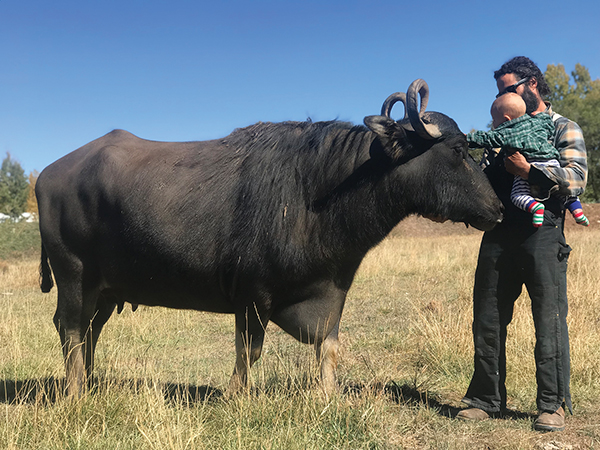 Jose Miranda with son and water buffalo on Rocking TT Bar Ranch in Augusta, Missouri.
While desert-adapted plants and seeds aren’t exotic, as an ethnobotanist involved in seed repatriation efforts to First Nation tribes, Nabhan advises caution. “I’m really cautious about people growing Hopi Blue Corn without Hopi permission, but if we talk about things at the species level, there are non-patented, heirloom crops that are available for every region of the U.S.” You can find climate-appropriate crops without culturally appropriating seeds, he says.
LoveBug Farms, Gresham, OR
Rachel Erdman and Alex Swift farm on lands native to the Cascades, Confederated Tribes of the Grand Ronde and Confederated Tribes of the Siletz Indians. Their average annual rainfall is 56 inches and I also wanted to talk to farmers in wetter places to see how they were adapting to higher temperatures and climate change.
On the lush, Oregon-Trail-destination side of my state in the Willamette Valley, Rachel and Alex have a market garden, grow heirloom seed, and sell pullets and eggs from their multi-species poultry farm. This summer’s record temperatures in the Pacific Northwest hit them hard, too. They were ahead of the game because they had an earlier water crisis, their well was going dry.
“We were in crisis mode for three months with only enough water for drinking and showers,” said Rachel. “Immediately we had to figure out how to water plants and poultry in a different way.”
They worked with their roof tops and contours of their landscape to establish passive water catchment for the farm. “We started with a gutter on the side of a barn. We up-cycle barrels to collect water for the chickens. We set up a 1,000-gallon stock tank during the heat wave. We made sure the existing pond that the ducks and geese use (and poop in) drains to our garden.”
Like Katie at Sweet Union Farm, Alex and Rachel used shade cloth for greenhouses and poultry. “We set up a misting area under shade cloth for the poultry,” Rachel said. Alex added: “They also have access to the shade from huge trees neighboring our property.”
While many people in the Willamette Valley lost poultry during the 110 degree days, they didn’t. They helped folks replace lost hens with new pullets because they successfully reduced heat stress. They will keep planting perennial fruiting shrubs, shade trees, and ground cover to create more shade, increase poultry forage, reduce erosion, and fortify their property during drought.
They also are continuing to trial heat-tolerant, climate-resilient crops. “We had a lot of root crops bolt early due to heat,” Rachel said. “We had to feed the roots to the poultry.”
“What really took a hit this year was greens,” said Alex. “They bolted; they were bitter. We didn’t have them for a two-to-three-week period. They went from babies to gross awkward teenagers too quickly. Same with the pullets.”
They shifted what they planted and when because of the extreme heat. “I planted more summer squash where I would normally plant fall crops. Usually, I plant summer squash to brassicas, but this year I just planted more squash,” said Alex.
The CSA model is part of the climate resiliency plan. “We don’t have to promise anything in particular with a CSA, it is more flexible and ultimately at our discretion,” Rachel said.
“I really had to rethink what people want versus what’s realistic,” said Alex. “My mantra for next year is do what works and don’t over complicate things, don’t fight the temperatures, and plan for uncertainty. We have a lot overwintering. We are going to start a month earlier in early March. We will have everything in the greenhouse ready to transplant outside in April. We’re going to try to emulate late spring in early spring. That’s not going to solve all of our problems, but every year is an experiment, and we hope that it works out.”
Nella Mae’s Farm, Cove, OR
I grow in the native lands of Nez Perce, Cayuse, Umatilla and Walla Walla where average annual rainfall is 18 inches. Learning from these farmers and authors, my own experience this year and that of my neighbors, here’s what I’m putting in place to adapt to hotter, drier conditions with the infrastructure and resources I have and lessons in this record-breaking year.
Continue the transition to low/no-till agriculture: Last year was my first year transitioning to low/no-till. I’ve seen a lot of my time go from tilling and weeding to sourcing, making, and spreading compost and mulch. I invested a lot of money in a flail mower, the now most beloved tool on the farm. I have invested a lot of time in tending my huge compost pile this year because compost is so critical to my soil-building, water-conserving, weed-avoiding, no-till practices.
Increase water storage and decrease heat stress: This year my mentors at a neighboring nursery lost their spring ditch water six weeks early at the height of the heat wave and growing season. We scrambled and borrowed several 200-to-500-gallon tanks and filled them with municipal water from the neighboring town to keep their native plant nursery alive. We also borrowed spare greenhouse shade cloth from a few neighbors to decrease the plants’ heat stress and water needs. In the end, we eked by thanks to our local ag community, but it was extremely stressful for both plants and humans.
All the grower experiences in this article point to a need to prepare for new, uncertain, and extreme heat and water shortages in the arid West. My dad has a 400-gallon tank on a 20-foot scaffold in his “inventory” (junk pile) that I am moving to my place so I can store more water and deploy it with gravity.
I’m investing in shade cloth for my three hoop houses, which I haven’t needed before. I plan to experiment with shade cloth and row cover on my four-foot low hoops to decrease soil temperature and help with germination during the hottest times.
Shift the season: I know that I can make more money early in the early season than I do. There is plenty of light and temperatures are milder than the summer. Now that I am not tilling, my beds are ready to go as soon as I am. I’m not waiting on conditions that are copasetic for a tractor. I still have cold spring soil and extreme temperature swings to deal with, so I am planning to better utilize my low hoops, plastic, and row cover to heat the soil and protect from frost and wind.
This year I had to replace my hoop house plastic, so I cut the old plastic to fit my hoops and beds for this purpose. Once it is too hot for plastic, I’ll switch it out with Agribon AG-30 row cover, shade cloth, or just leave the hoops bare.
Nabhan wants growers to adapt their practices to climate change. “There are a huge variety of techniques or schools of agriculture, but we usually get stuck in one,” he told me. “It is important to work with nature and your natural landscape.” In Growing Food in a Hotter, Drier Land, he concludes: “We must fit our crops and practices to the current and future realities of the environment in which we live, rather than trying to remake the environment (at enormous cost) to fit the crops we wish we could grow.”
Nella Mae Parks farms on her family place in Cove, Oregon. She just completed her eighth season home, growing vegetables for her on-farm farmstand, the farmers market, and wholesale outlets in the region.
Copyright Growing For Market Magazine.
All rights reserved. No portion of this article may be copied
in any manner for use other than by the subscriber without
permission from the publisher.