











The south-central United States is a region historically characterized by erratic weather. Dry Arctic air sweeps down the plains to collide with warm, humid Gulf air. Hail, straight-line winds, flooding, drought, and even tornadoes are a part of life, including farm life. It is notoriously challenging to predict the weather here. People in Oklahoma like to quote native son Will Rogers: “If you don’t like the weather in Oklahoma, wait a minute and it’ll change.”
With a long history of unpredictable and extreme weather, it can be hard to know what is attributable to climate change. Over the years, we’ve been asked to comment on climate change, and that poses certain challenges. We aren’t meteorologists, and we haven’t farmed in the same place for 50 years.
On the other hand, we have seen enough extremes over the past 18 seasons to give us confidence that the weather is changing. We have experienced not just record-breaking, but record-shattering events such as -27°F one February during a polar vortex, nine inches of torrential rain in two and a half hours, late freezes (not frosts) well beyond previous records followed by another record late freeze the next year. The weather is posing new and unique problems for farmers in our region.
On our three acres of field crops in eastern Oklahoma, we have adapted to the weather variability by no longer trying to grow fruit or over-wintered crops. Peaches, blueberries, strawberries, and melons have all been removed from our cropping mix as we started losing more from the crops than we gained. Late freezes took our peach blossoms nine out of ten seasons, despite growing varieties suited to our weather.
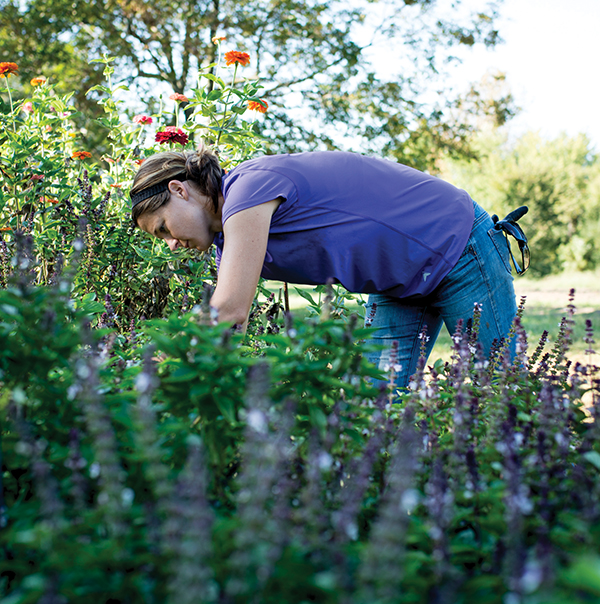 Cassie Pierce-Herringshaw of Peace of Prairie Farm in eastern Oklahoma. All images courtesy of the author.
Although wild blueberries grow in the woods right by our farm, our cultivated blueberries struggled with several years of record-breaking heat in 2011 and 2012, coupled with late freezes that reduced crop yields. Melons became too unreliable, with crops yielding delicious fruit in dry summers only to be followed by watery flesh during summers with excessive rainfall.
We used to grow over-wintered field crops like spinach but now use the high tunnel instead for early spring production because it’s more reliable. Fluctuating temperatures throughout the fall, winter, and spring were hard on the spinach, and in the high tunnel we harvest higher quality crops with less rain and cold damage.
Although many decisions we made in response to weather also were influenced by other factors (such as the difficulty of keeping perennial weeds out of blueberries), changing climate conditions have become a real part of our planning and adapting as farmers. We spoke with five other farmers in our region — Kansas, Missouri, Arkansas, Oklahoma, and Texas — for their perspectives on if and how changing weather is impacting their farms. Even though these five states are in a similar geographic area, weather conditions can vary markedly during the same summer across each state and within states.
Dripping Springs Garden, Huntsville, Arkansas
Dripping Springs Garden in northwest Arkansas, along with co-owners Mark Cain and Michael Crane, have been an institution at the Fayetteville Farmers Market since they started farming vegetables and flowers in 1984. With over 35 years of experience, Mark says the primary weather change he’s observed is that the winters were previously colder with more snow, below freezing temperatures for weeks at a time, and plenty of 10-degree winter nights. Now, winters are noticeably milder, and severe cold tends to come in bursts. A fringe benefit of milder winters is that they spend less time getting snow off their greenhouses and it’s easier to grow winter crops profitably.
“I can’t say there is a consistent pattern of any kind,” Mark said. “Spring rains are more intense and inconsistent.” There are more frequent torrential rains, such as 5-inch rain events, in the last decade. “We have to expect we will have them.” Protected growing has become a very important part of the farm’s strategy. When it’s too wet to work outside, they always have the caterpillar and high tunnels.
Summer temperatures seem to increasingly vary between extremes. The past few summers have been milder than usual with temperatures in the 90’s. In 2012, the farm got up to 106°F, the hottest summer they had ever experienced. Ironically, in spring of that same year they had torrential rain. These extremes are hard to plan for.
Mark’s greatest fear is a dry spell and notes they were in one at the time of the interview. The creek that runs through their property indicates how dry things are, and has been low the last several years. Their response to unpredictable moisture is to increase efforts to drought-proof the garden by raising organic matter in the soil, mulching, and experimenting with no-till to prepare for future droughts.
Tecolote Farm, Manor, Texas
David Pitre and Katie Kraemer ran Tecolote Farm outside Austin, Texas, from 1994 to 2021, when they transitioned their land to the young farmers of Steelbow Farm. David cautions against assuming erratic weather is always a result of climate change.
“Texas weather has always been so variable that it’s really difficult to separate out trends,” he said. “We will have multiple years of wet or dry, hot or cold, but it’s very difficult to define something as a trend. Certainly, the last few summers have been hotter than average, and my general feeling is that we have had fewer very cold February lows than I remember of the more distant past. My intuition is that those could be part of a trend.”
As someone who farmed for 27 years, he says: “I hear farmers with less experience sometimes making generalizations about how weather is trending. I’m a scientist and very much believe in looking at the data.”
David is encouraged by technological advances that have made long-term weather forecasts more reliable and sees valuable on-farm applications. “I think one of the most important developments in terms of farmers and weather is the increased accuracy of long-term weather forecasts,” he said. “The ability to accurately predict La Niña or El Niño patterns can have a huge effect on the farmer’s ability to generally plan. Simply knowing that a coming season is more likely to be hotter than average, cooler than average, drier than average, or wetter than average can allow a farmer to hedge their bets better. I am super excited about future developments that will bring better long-term forecast accuracy.”
Peace of Prairie Farm, Muskogee, Oklahoma
Cassie Pierce-Herringshaw of Peace of Prairie Farm in eastern Oklahoma is starting her ninth season growing organic vegetables and flowers, so she feels her perspective is somewhat limited. That said, springs appear to be getting wetter with greater bursts of heavy downpours, making it harder to plant in the fields in spring.
“It’s probably the main reason I got my caterpillar tunnels,” she said. The tunnels provide a consistent environment where she can be certain she will be able to plant. “It seems that every spring there’s doubt as to whether I’m going to be able to plant anything. And maybe it’s always been that way, but I know that for our first few years it didn’t feel that way and for the past four or five years it seems like it has been that way every single spring.”
The caterpillars are a means of hedging her bets. “Anything that can’t be too wet in the spring or isn’t resistant to that, I just don’t plant very much of it.”
Mellowfields Farm, Lawrence, Kansas
Kevin Prather and Jessi Asmussen own Mellowfields Farm on the eastern edge of Lawrence, Kansas in the Kansas River Valley. Like the other growers in this region, Kevin and Jessi increasingly rely on tunnels.
“Due to a perceived increase in heavy rain events (5-plus inch downpours), we have moved towards more protected culture growing,” Kevin said. “We’ve made investments in strong, wind-resistant hoophouses that can protect our valuable tomatoes from wind and rain.”
Kevin added, “[We] also seem to have had milder late winters and late falls recently, so in addition to the season extension from hoophouses, we have had longer field seasons as well. Above all, erratic weather has required us to stay flexible, though I have always assumed that this was just a part of farming, meaning we can plant it, but we might not get to harvest it. We’ve had long stretches of wet where we aren’t able to cultivate and lose the crop, and we’ve had long stretches of dry where we can hardly keep up with irrigation.”
Happy Hollow Farm, Jamestown, Missouri
Liz Graznak of Happy Hollow Farm sells produce from her farm near Columbia, Missouri, year-round through CSA shares and farmers markets. “I can tell you that in my 11 years, the big thing that I’m doing is more plastic, more plastic, more plastic,” Liz said.
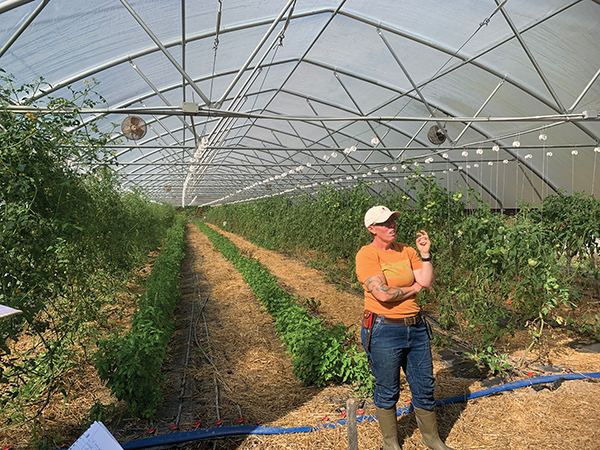 Liz Graznak of Happy Hollow Farm sells produce from her farm near Columbia, Missouri, year-round through CSA shares and farmers markets.
“It’s 100 percent weather-related, because as a farmer who is trying to make a living growing vegetables, I rely on 98 percent of the crops that I put in the ground to be harvested and sold. If I don’t have 500 of the 520 heads of lettuce I’ve planted come out beautiful, then that’s lost income. And I know my lettuce is going to be much more beautiful if it’s grown in a high tunnel than if it’s grown outside.”
Liz understands the irony of organic farmers becoming more reliant on plastic, but says it’s become essential. “If I can’t control the overhead water problem of crazy rains, then there goes my beautiful harvest of head lettuce and my income.” The high tunnels help increase harvest predictability.
She is close with several people in her area who farmed for decades and validate her observations that the climate is changing. Each of the 11 years she has been farming have had totally different weather patterns, making it impossible to depend on outdoor growing conditions. The stress led her to adopt plastic.
Liz has a number of large high and low tunnels and is putting up more caterpillar tunnels, taking advantage of NRCS EQIP [Natural Resources Conservation Service, Environmental Quality Incentives Program] multiple times to help offset some of the infrastructure costs. “There are only a few crops at this point that I grow outside,” she said. Weather is always the hardest part of farming, but when it becomes increasingly unpredictable, farming becomes that much harder.
Three Springs Farm, Oaks, Oklahoma
We’re in our 19th season of vegetable farming in northeastern Oklahoma. We have observed drier fall weather, which has made it harder to get our fall/winter cover crop in on time as we wait for rain to provide the right conditions to till and plant. Longer falls and milder winters have changed tornado patterns. Instead of tornado season being largely confined to spring, our region has seen tornados in December the past several years.
The milder winters also include drastic swings in temperature with, what feels like, greater frequency. A week in winter may include a day in the 70s early in the week followed by a high temperature in the 30s a few days later.
Spring has always been thorny, but more late freezes that go well beyond the average last frost date means we are planting later and later. We have learned to plant vulnerable spring crops like onions and potatoes a few weeks later to get closer to warmer weather.
Cooler temperatures accompanied by abundant rain translates into wet spring soil that prevents early field activities. In response, we are now consistently starting our spring field seeding a month later than we did earlier in our farming careers and relying on our high tunnel for our first spring greens.
For the first dozen years farming, we had success growing spring-planted fava beans for an early June harvest, but the past several years, late lingering cold soils and later freezes have made this crop all but impossible to grow.
Like Dripping Springs Garden, our farm is next to a creek that serves as a weather gauge. Our older neighbors who have lived in the area their whole lives have never seen the creek get as high as it has the past couple of years. With more heavy and frequent downpours, 100-year flood events are happening more frequently.
Frequent spring rains make succession planting, cultivation, and even harvesting difficult. Hail and pelting rain damage tender green leaves. On the back end of spring, we no longer try to push the envelope by growing crops such as lettuce and broccoli as late in the spring due to the likelihood of disease from rain and early summer heat.
Although all farmers in the south-central region are accustomed to weird weather, there are some common experiences of change: increased use of protected growing due to wetter springs, milder winters overall, and rain variability of heavy downpours to drought. How farms adapt depends on their location, the degree of change they experience, available resources, and approach to farming. Yet each farm has exercised flexibility. Accepting that there is no “normal” weather and making decisions about crop choices, planting calendars, infrastructure, and marketing based on that is key for long-term farm success and resilience.
Emily and Mike own Three Springs Farm, a diversified, certified-organic vegetable farm in eastern Oklahoma. They cultivate over 40 different crops and more than 150 individual varieties on three acres of land and sell primarily through their CSA.
Copyright Growing For Market Magazine.
All rights reserved. No portion of this article may be copied
in any manner for use other than by the subscriber without
permission from the publisher.