





Gather to learn, share, and grow in the off-season
Every January for the past six years, a group of 12 to 16 experienced farmers has gathered at Dripping Springs Garden, nestled in the Ozark hills, to reconnect, share knowledge, and support one another. What started as a modest gathering of growers seeking camaraderie has grown into a vital tradition that strengthens our businesses, deepens our friendships, and inspires us to push forward with gusto into the new growing season.
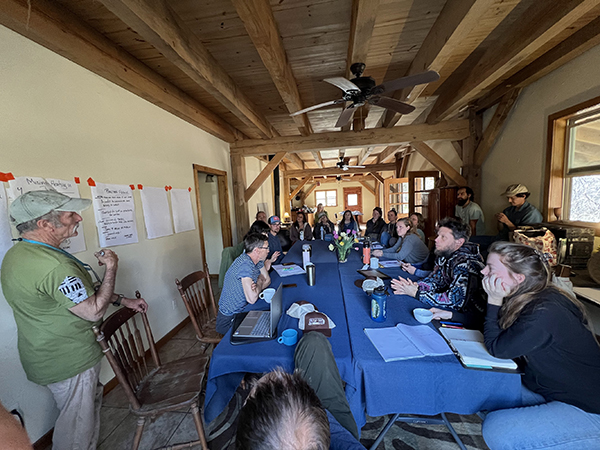
The group is casual but intent on sharing and learning. Everyone has a place at the table; this is not a conference, it’s a meeting of peers. All photos courtesy of the author.
Dripping Springs Garden, owned by Mark Cain and Michael Crane, is an ideal place for this annual event. Located in a small valley along Dry Fork Creek in Northwest Arkansas, the farm is a testament to what dedication, hard work, and sustainable practices can achieve. (For more on Dripping Springs, see the profile in the June 2020 GFM.)
Since 1984, Mark and Mike, informed by the pioneering work of the Alan Chadwick garden in Santa Cruz, where Mark apprenticed, have carved out a thriving organic farm from what was once an abandoned blueberry farm. They have transformed it into a terraced landscape of raised-bed gardens and tunnels that serve as both a model of production and a workshop for young growers eager to learn. With over 35 years of experience, they have welcomed scores of interns and fellow farmers, making their farm a hub of knowledge-sharing and growth. It’s only fitting that we gather here to exchange ideas and experiences.
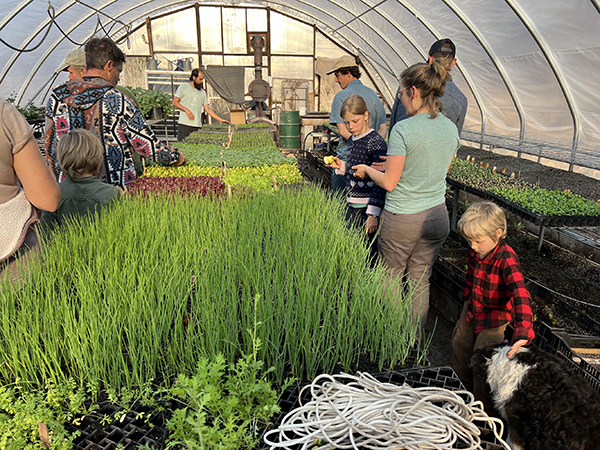
Having time to move through the farm and spend time soaking up the ambiance of the place encourages deeper connections, and offers a refreshing change from the meeting.
Our group first came together in 2018, sparked by Mark, who had previously participated in a similar gathering many years before, supported by a Southern Sustainable Agriculture Working Group (SSAWG) grant. Over time, the group has grown into a close-knit circle of farmers, eager to reconnect each year. As January approaches, the anticipation builds. Some of us start arriving the evening before the official meeting, sharing dinner and diving into long conversations about our lives as farmers. These late-night discussions—ranging from the joys and trials of market farming to personal hobbies and shared friendships—help set the tone for the next day’s exchanges.
As the early arrivers enjoy a communal breakfast, the rest of the group trickles in. Along with farm owners, there are often farm managers, experienced farmhands, and children tagging along, giving the gathering a multigenerational feel. The morning kicks off with a bit of ritual—some brave souls take a Polar Bear Plunge in the creek, while others enjoy yoga or a leisurely walk around Dripping Springs, soaking in the beauty of the land. We then prepare the intern house, a spacious timber-frame structure, for a day of concentrated dialogue and discussion.
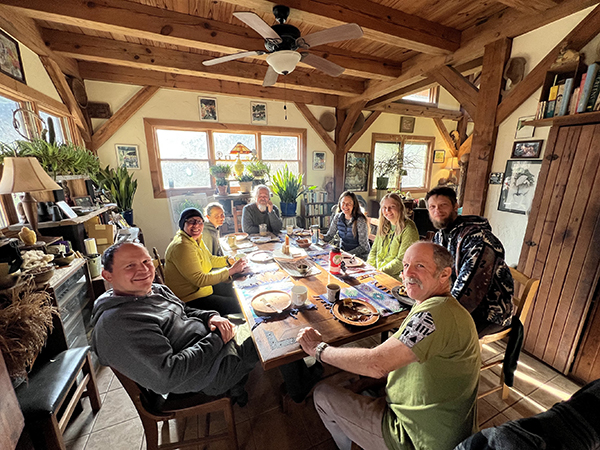
Food is central to any gathering of humans, and ours is no exception. Breaking bread together has a bonding element that is key.
Before the event, Mark encourages us to think of “hot topics” we’d like to discuss. With everyone gathered, we begin by writing those topics on large sheets of paper pinned to the walls. These lists guide us through the day, though the conversations often flow naturally and cover more ground than we initially expect. Around the table, farmers take turns moderating, ensuring the discussion stays productive and that everyone gets a chance to speak.
The subjects we cover are as wide-ranging as the farms represented. One moment we’re talking about staff management—how to train workers, how to balance personal time with farm responsibilities, and how to structure compensation—and the next, we’re diving into technical topics like new crop varieties, pricing strategies, or how to market effectively at farmers markets and through CSA programs. Farm succession and retirement planning are frequent topics, especially as some of us look ahead to transitioning our operations in the future.
No matter the subject, there’s a shared openness that defines our group. We’re all in different stages of our farming journeys, and we learn as much from each other’s failures as we do from our successes. Lunch is a highlight, as we break for an incredible potluck featuring the freshest ingredients from our farms. It’s a time to catch up more casually, dig into details that might not come up in larger group discussions, or simply enjoy the company of friends who understand the unique challenges we face.
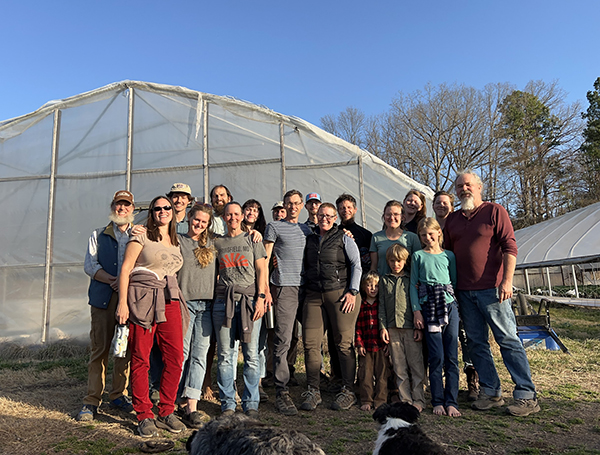
This group of farmers from the Ozarks has become more of a “farmily” than a group of casual friends over the years. We support each other in ways that only peers can.
After lunch, we reconvene to continue tackling the topics we didn’t get to in the morning. This is often when we share the best and worst ideas from the past season. It’s a cathartic time, full of laughter and sometimes a few groans, as we recount the ideas that flopped and the experiments that paid off. This year, for example, one farm’s gamble on a new variety of cucumber didn’t quite pan out, but another farmer’s innovation with low-tunnel season extension was a resounding success. We talk pricing strategies and swap tips on how to navigate the unpredictable nature of farmers markets.
Staffing challenges are a perennial hot topic. Some in our group work with H-2A laborers, others with interns and apprentices, and a few prefer to work alone or with minimal staff. We trade stories about training staff, creating a healthy farm culture, and how to manage work-life balance. There’s plenty of commiseration about the joys and frustrations of working with others, and every year we’re reminded of how differently each farm operates and how valuable it is to hear diverse perspectives.
By mid-afternoon, we typically wrap up the formal discussions and head outside for a farm tour. Walking through Dripping Springs with Mark and Mike is always a highlight. We admire their beautiful ranunculus, kale, and spinach crops, and marvel at the efficiency of their greenhouse systems and pack shed. Every year they have something new to show us, whether it’s a new piece of equipment or an innovative way they’ve organized their workspace. These moments reinforce the sense that farming is a continual learning process, no matter how experienced you are.
As the day draws to a close, we often take a few minutes to reflect on how rare and valuable it is to connect with other farmers in this way. It’s not often that we get to sit down and have in-depth conversations with people who share our struggles and triumphs. The advice we exchange is often simple but profound—sometimes it’s just the validation that you’re on the right track, or the reminder that it’s okay to make changes when something’s not working.
For those considering organizing a similar event, here are some steps that have helped us succeed:
Start with a Small, Committed Group: A core group of 8-15 experienced farmers is a good size to ensure meaningful dialogue. Everyone should be dedicated to contributing and learning from each other.
Choose a Gathering Location with a Strong Sense of Place: Meeting at an inspiring, well-established farm like Dripping Springs creates an atmosphere of learning and appreciation for the land, which fosters deeper discussions. The same gathering held at a hotel or a resort wouldn’t have the same spirit.
Set a Loose Agenda: While having a list of topics is helpful, allow conversations to evolve naturally. Flexibility ensures that important but unexpected ideas can emerge. On the other hand, having a moderator to rein in rabbit chases is also important; given the freedom to do so, some members will likely dominate the conversation.
Balance Formal and Informal Time: The structured discussions are important, but so are the shared meals, farm tours, and social time. These moments strengthen relationships and allow for more personal conversations.
Encourage Participation: Part of the moderator’s job is to encourage “passing the baton”, making sure everyone has a chance to weigh in on each topic. Some of us have a hard time listening as well as we should, but experience has taught us that sometimes the quiet, less extroverted participant has just the words we need to hear, if we’ll intentionally make space for them to speak.
Reflecting on the past six years, it’s clear that this annual winter gathering has been a catalyst for growth—both in our farms and our friendships. Our collective practices have improved, and we can all point to new varieties, strategies, or resources we’ve discovered through these gatherings. Whether it’s trying out a new variety of butterfly ranunculus or refining our staffing strategies based on shared experiences, the value of this event is immeasurable.
But perhaps most importantly, this gathering has created a community of support. Sometimes we don’t need information as much as an understanding ear, or a pat on the back; as market farmers, many of our successes and failures are not necessarily well understood by those around us, whether family or employees. This community of support is key to remembering the importance of the work we are doing, but also that we are first and foremost human beings who want to be understood and understand. We continue the conversations throughout the year—through emails, text messages, phone calls, and in-person meetups—and the sense of camaraderie that has emerged is priceless. We leave Dripping Springs each January refreshed, inspired, and ready to tackle another season.
Curtis Millsap, with his wife Sarah, and a large crew, raise 3 acres of organic vegetables and cut flowers on Millsap Farms, just north of Springfield, Missouri. They have been farming for 17 years, and sell through a large CSA, farmers markets, flower co-op, and restaurants. They love community and have built their farm into a caring and kind place.
Copyright Growing For Market Magazine.
All rights reserved. No portion of this article may be copied
in any manner for use other than by the subscriber without
permission from the publisher.