











“I could sell a lot more here, too, if I had all that free labor,” pronounced Leroy, our farmers market neighbor, many years ago. He was referring to the gaggle of young people who were working on the farm that summer and coming to market with us. I just smiled, because I was pretty sure Leroy had no idea of what housing, feeding, mentoring, and living with a different crew of new youngsters every year would be like — it wouldn’t be “free labor” even if we didn’t pay. “They should be paying us!” my farm partner Mike observes…
We’ve been here at Dripping Springs Garden in Arkansas for going on 27 seasons now, and can’t remember a single summer without the help of young people who have come to learn about organic market gardening. In the early years this was just a room and board exchange for labor; these days intern stipends are pushing 20% of total gross income. Why do we continue to choose to train new apprentices rather than simply have long-term employees (that no doubt could work faster, with less oversight)? The answer is a bit complex, a mix of personal background, temperament, and location.
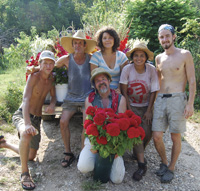
Having been an apprentice gardener myself (at UCSC’s Farm and Garden Project back in the late 70s) is certainly the biggest part of that answer. It was here that the basic forms of apprenticeship and working/living in the garden together took shape. We shared cooking and cleaning chores via posted schedules; took turns at irrigation and animal chores (good thing I didn’t feed the foxglove to the goats, even though it looked like comfrey!). We watched as Orin explained the intricacies of apple pruning, or tried to imitate Dennis’s smooth, sustained hand-digging of a sweet pea bed. Beyond the immediate horticultural skills, a lifestyle was being absorbed. Who would have known how many stories would come out, or songs, or laughter while weeding or harvesting, or doing any number of chores most people call “back-breaking labor”? We learned that even repetitive, strenuous tasks could be pretty enjoyable with good company and shared purpose and vision.
Fast-forward 32 years to our market garden in the Ozarks and much of that same spirit is alive during the summer production season here. This summer we’ll have three to five young people living at the farm, arriving in March or April and continuing through October to mid-November. Besides working together six days a week, we’ll also be eating two meals a day together (rotating cooking) and be each others’ main entertainment out here in the “boonies.” This is a very different relationship with workers than having people drive in each day and go home at night, and it’s not for everyone! It’s not perfect — but we seem to be getting better at scoping out who we choose to work and live with, and what architecture and ground rules make it easier.
Our main connections for interns are the ATTRA Sustainable Farming Internships and Apprenticeships listing (http://attra.ncat.org/attra-pub/internships/) and the MESA Program—the Multinational Exchange for Sustainable Agriculture (www.mesaprogram.org). We’ve seen a noticeable increase in the numbers of young people scanning the ATTRA listing in the past few years. When we get an inquiry, we send a descriptive document containing photos to help convey a sense of the landscape, scale of operations, daily schedule, markets, accommodations, and stipends. An intern application will also be attached, which asks for basic contact info, educational history and relevant practical experience, job history, and reference contacts. We ask them what they hope to learn, and for “three interesting things about themselves”.
These days we’re very careful to have a face-to-face interview or on-farm workday to see up-close who we’d be working with for seven months. Since we’re a small operation and spend so much time together, the chemistry needs to be not just neutral, but good. And since the interns will attend busy Saturday markets throughout the season, we need presentable, articulate, smiling faces (I hope I can fit into that category despite the fatigue). We can have all the high ideals we want about training the new generation of farmers, but realistically, who’s going to jive with us on a daily, up-close basis? We just have to go with our instincts on this, and we’ve gotten pretty picky.
Joining the MESA network as a host farm for international students in 2004 challenged us to become more professional about our intern training, infrastructure, and schedule. MESA requires a training plan, listing specific skills to be imparted, and training chronology. MESA stewards (interns) sign a contract for a 48 hour, six-day work week, which galvanized our work schedule (of course there is flexibility in this, depending on season and temperature, but we track hours nonetheless). We built a new timber frame barn, with two insulated and heated rooms for students upstairs and large shower/composting toilet bathroom downstairs. The old tree house was phased out (home to lyrical, wall-scrawled summer poetry and pithy Zen aphorisms—“Chiggers bore me”), but our two yurts are still in service for our close-to-nature lovers.
Having both international and U.S. interns here has been so rewarding, invigorating our field conversations and down-time socializing. Our thinking about the implications of sustainable and organic agriculture methods has been enlarged (do we really want our students to introduce black plastic techniques for organics in Cambodia, or can we afford to be out of the loop on our own country’s National Organic Program?). Having spent time abroad as both student and farm volunteer makes it possible to identify with the challenges these young people face as they are suddenly dropped into our market garden world. (I guess that’s why I have at times found myself in the women’s clothing section of Wal-Mart on a Saturday afternoon after market — dead tired— waiting for my Thai and Peruvian ladies to peruse the T-shirt selection.) But we’ve been lucky for the most part that the stewards came well-trained in horticulture; often they are only a few years out of university, with agronomy or forestry degrees, and are better trained in soil science and disease recognition than we are.
Setting appropriate boundaries up-front when our interns arrive has been very important. Like a rule book at a farmers market, these guidelines came out over years of lived experience — and some situations we want to avoid living through again. Now we have a letter, “Dear arriving summer intern”, that explains the intricacies of what they are provided with their room; the use and cleaning of bathroom/washer/common house; what food we will and will not provide; how our work and cooking schedules will operate; use of telephone/internet/computer (we provide these, but calls are at their own expense). At the end is a “privacy and respect” paragraph explaining that our house (next to the intern cabin) is our private dwelling, to knock before entering, and that evenings and weekends we need to recuperate and regroup, and so can’t be available 24/7 (emergencies excepted). At the end of the work day, we can come into the house, kick off shoes, and the 20-somethings and 50-somethings can go their separate ways — no doubt a relief in both directions.
Since we all live here on the property full-time, we are able to schedule working hours that make sense with the seasons — mid-summer, for instance, we work from 7 or 8 a.m. until 1 p.m., take off for a long 3-hr break and lunch, then return to the field 4-7 p.m. or later. This extended afternoon break is the time for ashtanga yoga (a personal passion), music, naps, or swimming, and allows us to start fresh for a second work period without trying to slug it out in the heat. The group yoga practice (entirely voluntary) has been an incredible team builder and stress reliever; what better way to get our crew in shape for all the bending over and lifting we do? Several times I’ve asked interns at the end of summer if they’ve learned anything especially important, and the response was “Yoga!” Not a bad skill set to take with you on the road to farming….
Bringing our crew en mass to the Saturday market is a high point of the week, since all our efforts in production come to fruition there in sales and compliments. We need everyone because our product volume, bouquet business and frenzy of the market require at least five folks on most Saturdays. Market is a huge crew motivator, where the feedback loop of sales/planting decisions/harvest preparations crystallizes for them, making all we do in the field more meaningful. Afterwards, we share our fondest and weirdest customer stories over lunch at a nearby restaurant, before scattering to our personal errands, parties, naps (me), or concerts…..and the eventual 50-mile trek back to the farm.
As we get older (we’re both pushing 60), this interaction with bright young people who want to learn what we’re doing has become ever more meaningful. How many summers do we have left to pass on a few tips to them, to inspire them with a real glimpse of life lived in the garden, complete with its headaches and backaches? Every summer they hold a mirror to us, showing us our value (or impatience and blind spots). We must still enjoy the lifestyle of it, having these kids come in every spring and leave in the fall, despite the challenges. We try to keep in mind my mom’s embroidery hanging in the kitchen, “As Ye Sow, So Shall Ye Reap” — but be advised to start with some good seeds.
Mark Cain sells cut flowers, berries, and vegetables at the Fayetteville, Arkansas, Farmers Market. He can be reached at drippingspringsgdn@gmail.com.
Copyright Growing For Market Magazine.
All rights reserved. No portion of this article may be copied
in any manner for use other than by the subscriber without
permission from the publisher.