











Farmers markets have blossomed across America; on any Saturday, it seems there is one on every street corner; so, why would anyone write about re-invention of something so successful? Because beneath the booming success of the farmers market there lurks another side, an uncertain, anxious feeling, perhaps in both farmer and customer: Are these markets really helping farmers? Is this concept just a fad? Have the farmers become an afterthought?
This note is written for the farmers who take their produce to a farmers market, and written from the perspective of someone who has been involved in the development and management of a good-sized farmers market from its inception—looking at dozens of market sellers and their farms, thinking about why the customers come to the market, and how today’s farmers can meet that need. No market, of any sort, is perfect, and farmers must continually work to make their farmers’ market and their own operation all it can be. Keep in mind that an outsider like me can only hope to trigger a way of thinking; you are the one who knows your own market.
A farmers market is just what it says: it is farmers, and it is a market — a farmers market is not a food court, nor is it a flea market. In reality, most markets these days don’t actually belong to farmers, but are sponsored by some entity that has created a farmers market for many reasons; that’s fine, but farmers markets exist because of farmers, and farmers must be the core of the market. Other things, like prepared foods made from the fruits of local farming are essential in bringing a market to the threshold that creates a joyful “public place”; they are necessary, but must be in balance—the place must truly be a farmers market. Think of the customers—they are critical, and if their experience is not truly authentic, that mirage will be the subject of their market talk.
Start by re-inventing your market presence: Are you doing a good job of meeting your customers’ interest in knowing about their food? Your customers can’t be out there at your farm from planting to picking, but your goal is take them on that food journey. Tell your story, and tell it again as it unfolds, and tell it anew as the next season dawns. Tell it with pictures, for one thing, using a board with notes that draw the customer into your farm. Add a periodic newsletter telling about what’s going on at your farm. Collect email addresses and send out periodic notes with even more pictures. If the market management gives you a web page, use it, change it, fill it, make it something valuable, and make sure it is current. Be a frequent contributor to your market’s weekly email. Make yourself available for local newspaper interviews. Communicate about the food your customers want to know about, and do it efficiently. I have watched farmers spend hours telling customers about their farm, and if they are a one-time purchaser, that’s not good; but if you get them on an email list, or get them to stop by to look at what’s new on your picture board, you make them a part of your farm — they become your farm’s friend, and they return.
Think about how you move from harvest to market table. Your vegetables will be the freshest thing the customer sees all day, and they should show it. You are growing things with a knock-out taste (that’s why business is booming), so every part of your process, from growing, to cutting, to packaging and refrigeration, to transport and market presentation should work to bring the freshest and tastiest fruits of your work to your customers. Think about each step in terms of the end game — all the things you’ve worked for, right there at the market table.
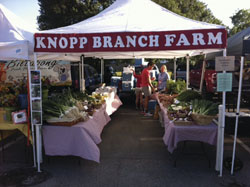
Re-invent your market booth from banner to tabletop. This should cost very little, but requires some self-criticism. The best banners I’ve seen are homemade, colorful and tell the story. The people with you at the booth must be part of the deal so they can speak with knowledge about a lot of the things that go on at the farm. In a practical sense, this may not be possible, that’s understandable, but get them out to the farm so they know what they’re talking about. Then, when you get good sellers, do what you can to keep them and maintain that customer comfort that such continuity brings. Make sure that the lead player in your booth is able to truly be “the face of the farm” and able to speak cheerfully about and answer questions about the farm — talk the walk. While we’re about the booth, re-invent all the ways it can help you. Do you do special orders? Want chef sales? Have a farm stand? Say so! Do the components of the booth operate comfortably? For example, can a regular customer buy what they want and be on their way while you are introducing the farm to a new visitor? Sketch a map of the booth and look at how everything flows. The booth itself has to say farm—tablecloths, for example, are an extra effort, but worth it, wood boxes are too. And all of this has to be oh so clean— before, during and at the end of the market. The way you run your booth tells the market customers how you run your farm, and invites them further into the space you have created for them.
Get back to re-inventing the market day — for you, the farmer. A farmers market has always been more than a farmer selling what he has that day: chefs talking about dedicated planting, buying starts from your neighbor, putting together a viable quantity for a large purchase, arranging for delivery, a food coop with an early morning pickup — think of ways to make their job easier and more efficient. Could you all meet after the market and learn about a new government program, a lender, a health insurance possibility or a new piece of equipment?
There’s more—think about your relationship with the market itself. Farmers’ markets today are a complex combination. The location, management and budget may have little to do with the farmers that populate the farmers market. Also, the market members are many independent businesses, in a sense competing with one another, albeit in a friendly way [play nice], and each will have different interests, different time frames and different allegiances. If all this can be kept humming along for the greater good, fine, but often it cannot and as that mood affects you, the individual farmer, something needs to change. Choose the forum for this part of the re-invention carefully; any negative vibrations at the market are picked up by the customers like a seismograph senses a distant earthquake, and a negative mood wastes all the hard work everyone has put into the collective market success. It’s in your best interest that the market continues and improves as a viable part of the community, so think about the root causes of general market problems. Examine your market structure and balance: has it taken in sellers to bring in more potential customers?—but sacrificed quality and diluted the food dollar as well as the purpose of the market? These new folks help to pay market expenses, perhaps more than you know, so a return to purity may have little appeal to decision makers. If asking vendors to leave in order to re-balance and return to basics is a goal, it could almost be impossible. But think about asking the market to look at itself as others might–from all angles: that is, ask some entity—the market governance, the sellers, or even the customers–to re-invent the market. Realize that the farmer-centric truth I’m talking about is not the only view; others involved in the equation may have different and valid perspectives: a value-added seller using your produce is advertising about your farm, the manager does lots of things for the farmer that go unnoticed, the governing group spends time that could be otherwise better employed. Think about it and don’t ask too much, nothing is perfect. Talk to your representatives on the governing body, often they forget that they are there to represent you rather than as an elected member of an elite club. A time honored, face saving mechanism for change is an outside force; for example, it helps to point out that a rule or regulation is on your side. For this approach, review not just the market’s rules, but also the sponsoring organization’s rules, the local ordinances about farmers’ markets and even the state rules chartering farmers’ markets—they’re for farmers. For example, Texas requires that the board of any farmers’ market include two farmers. What an opportunity for an instant impact if a Texas market has forgotten both its farmers and this rule.
Re-invention should return a market to its roots and reason for being — the farmers. But, in the end, you can only solve the problems that have solutions. All you can do is ask your market to be what it should be — and be positive about it. If an effort to re-invent your farmers market results in only your own, you have accomplished a lot. You have made your market much more than standing behind a table. The diversity, strength and options that come with the process of re-invention will leave you able to independently accomplish virtually all the functions of a market, even if the market itself fades away—all your eggs won’t be in the same basket.
H.C. Clark is a retired professor of environmental geology at Rice University and has been active in developing farmers markets in Houston. He raises cattle on a small farm.
Copyright Growing For Market Magazine.
All rights reserved. No portion of this article may be copied
in any manner for use other than by the subscriber without
permission from the publisher.