











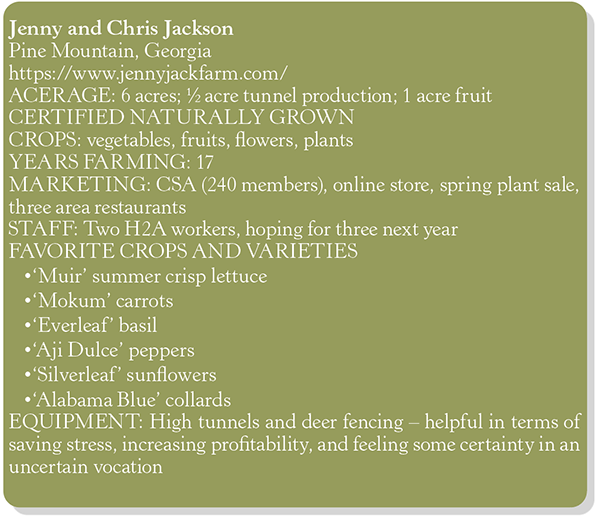
Jenny Jack Farm is located in the small community of Pine Mountain, Georgia. The day I visited, Chris Jackson met me in the driveway of their home across a quiet road from their farm. He invited me in and offered me a drink, but I declined, too excited to see their place and the work they have been doing there.
Before my visit, we emailed back and forth, realizing several similarities between our two farms: each with two young children and both parents working full-time on the farm, plus almost the same number of years farming. Whenever I connect with a fellow farmer it is refreshingly easy to talk and get into the specific details of this occupation.
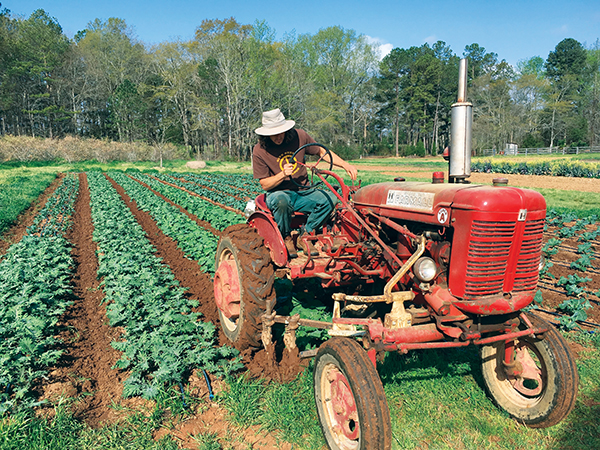 Chris Jackson on Jenny Jack Farm.
We walked over to the farm where a 5,000-square-foot barn sits along the road. The barn was there when they began farming. This space is used for everything from storage and packing to marketing. CSA boxes were neatly stacked, tools all in their place. On Wednesdays, they host a drive-thru pick up here for their CSA members and online store orders, plus an on-farm market set up.
They use Harvie to manage their CSA, explaining there is a big learning curve for both farmers and customers at the outset. The software company takes 7 percent of sales, which Chris and Jenny have built into the price of a share, adding $3 per week to each CSA. Some of the features of Harvie include customization, which Jenny says helps cut back on food waste. There is also the option of weekly or bi-weekly pick up and easy add-ons from the farm or from neighboring farms.
The feature they appreciate the most is the algorithm which allocates their inventory based on customers preferences. For example, Jenny will walk through the fields three to five days before the CSA pick-up and estimate the harvest, entering it into the system and emailing customers that it is available. Rarely do they have enough of everything for the entire CSA. When members join, they are encouraged to rate each crop grown on the farm. The algorithm matches the harvest with the distribution, so it all works out. She errs on the side of caution when estimating and can update the numbers after harvesting if necessary. High demand items can be added by customers during a weekly ‘customization window.’ The list is sent out at the same day and time each week. Jenny recommends members set an alarm each week as a reminder to customize. Harvie then generates the distribution list for them to pack.
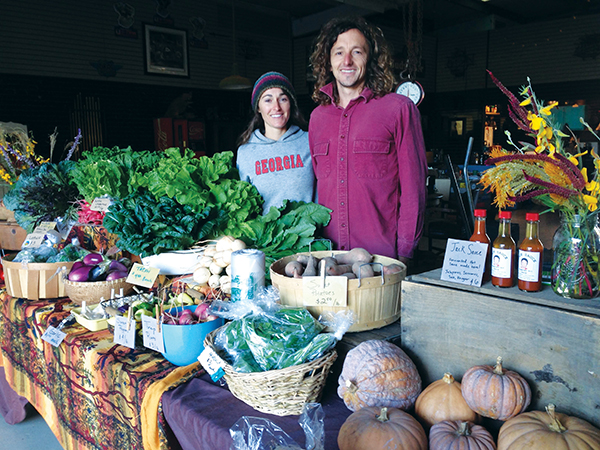 Jenny and Chris Jackson at their on-farm Market.
“If members choose to customize early and often, then everyone gets a fair shot at the product.”
There is also a kitchen and bathroom in that barn and a second big barn on the property used for storing equipment, tractors, a van, fertilizers, and row cover. They recognize they are fortunate to have these two structures.
After a quick walk through, we made our way to the fields, enclosed by an 8-foot deer fence. It looked relatively new. Friends who own a fencing company gave them a great deal on it ($10,000) though it required quite a lot of labor to install.
A section of the farm was being prepared for planting and others were covered in silage tarps. It was February, still early in the year. Jenny joined us shortly after we entered the fields. Her parents purchased this land in the 1980s for horses and recreation. She wanted to farm this land as far back as middle school, thinking of hay at that time, because that was what she saw being produced in the area.
In high school, she considered blueberries. At the University of Georgia she studied horticulture, but it was Chris’ and her time WWOOFing in Hawaii for six months and apprenticing for one year on Glover Family Farm which eventually led them to the diversified model they have now.
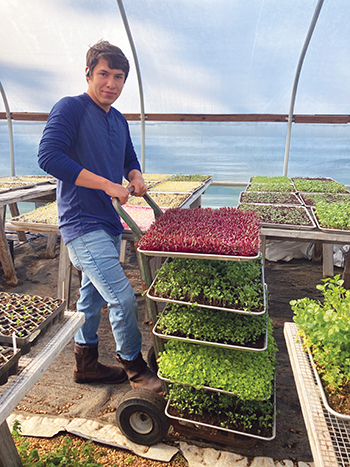 Jose with the microgreens.
The owners of Glover Family Farm, organic farming pioneers in Georgia, allowed them to work and learn on their farm even though they had recently retired from farming full-time then. They introduced Chris and Jenny to many other growers and organizations like Georgia Organics and Slow Food. In 2007, Jenny’s parents generously allowed them access to the land to start their farm.
Comparing farming notes, the three of us moved toward the greenhouse, already filling up with plants for their annual spring plant sale. They use Barn2Door for plant pre-orders. Inventory is entered and online ordering opens up around March 20th each year, with pick-up and in-person sales the second week of April.
A good variety of herbs, flowers, annual veggies, and some perennials are offered. Three-inch pots sell for $4 each. Some annual flowers, such as marigolds, sunflowers, and zinnias, are available in six packs. Flowers and tomatoes are the best sellers.
Another aspect of greenhouse production is microgreens, comprising around 10 percent of their sales. These go into CSA shares, are sold through the online store, as well as to restaurants. A mechanical greens harvester cuts the microgreens quickly and efficiently and is also used for arugula harvests.
Green onions, turnips, beets, and spinach were growing in the high tunnels, planted with the Paperpot Transplanter. The soil does need to be just about perfect in order to use this tool, but when it works, it works really well. They also use a tilther to prepare soil in the tunnels for planting, but a BSC for incorporating compost and other jobs the tilther can’t handle.
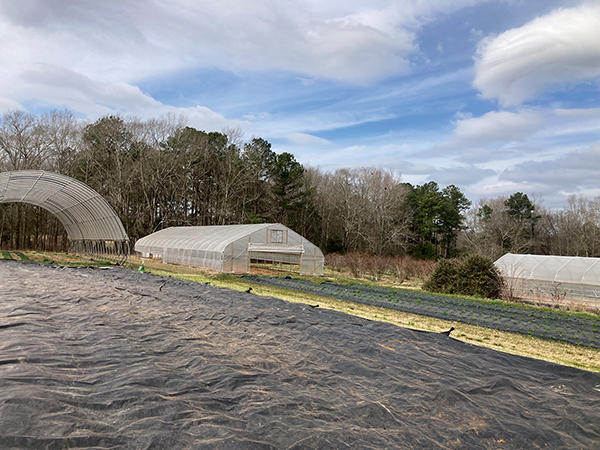 Silage tarps and tunnels.
Nematodes in the tunnels were a big concern. They have tried solarization and applied a nematicide through the driplines with good results so far. Insect barrier on the tunnel entrances and sides prevent leaf-footed bugs and stink bugs from damaging their tomatoes in the summer.
When talking about equipment, they used the term ‘hybrid-size farm,’ which immediately resonated with me. Not so small, but not too big either, somewhere in the middle. Those of us farming in that space often have to work hard in order to find the right equipment and systems to fit our farms. In addition to the high tunnel equipment, for the field they have a 30-HP tractor for tilling, discing, shaping beds, and laying irrigation and a Farmall Super A to cultivate paths on single row crops.
On our way back to their house, we passed 100 blueberry bushes, tea shrubs, and elderberry for juice and tinctures. They clearly like trying new things and experimenting. The land is 150 acres in total, so some of the experimenting is a quest to find ways to use more of that land. I later learned that they plan to take out the tea shrubs because the post-harvest labor was too much. The elderberries, however, are still in the running for expansion. Currently, they have 600 elderberry plants.
Their fields had the same complete order of the barn. “How do you keep everything so orderly,” I asked, wishing my own farm would look this way. “The last fifteen minutes of each day is spent cleaning up” Chris said.
Chris and Jenny invited me to stay for lunch. Their two young children (six and three) had been at Jenny’s parent’s house next door and came back over, both engaging and playful. Eggplant caponata prepared by a chef (and customer) from last summer’s harvest was warming on the stove.
I have always been envious of these seemingly perfect arrangements, a chef and a farmer working together to preserve the bounty in high times. As farmers, we don’t often have time to handle all of the excess produce during peak production. Finding someone who does, and the skill to do so, is a gift.
Over plates piled high with the warm, fragrant caponata, farro and a fresh salad, we had a difficult, yet constructive, conversation. Chris and Jenny told me they had strongly considered not farming anymore and starting a farm-adjacent business instead, installing and maintaining home gardens for people. As happens on many farms like both of ours, when the two farm owners become parents, it has an impact in multiple ways; some of the time formerly spent on the farm is now focused on family and expenses grow significantly. Some farms are able to operate without childcare, but for those that are not, childcare expenses, as well as travel to and from, can be a burden.
They decided to try the H2A program, completing the paperwork and paying for two workers to come work on their farm this year. “The decision to move to H2A labor was driven from a place of helplessness, a last-ditch effort to make parenting, profitability, and production farming converge into a somewhat workable way of life.”
On my own farm, we began participating in the H2A program just after the birth of our first child and have continued for the past nine years, working with the same family from Mexico. You can read more about our experience with the H2A program here.
After more recent conversations, they say the H2A program has been great for them and they are committing to a second year. “We increased prices, increased CSA numbers, and assumed greater labor efficiency would help our numbers and we think it is going to work out.”
At first, I thought Jenny Jack was a play on her first name and their last name, which it is somewhat, but on their website, I found further explanation. Jenny is the name for a female mule and Jack the name for a male. “Mules are known for being strong, stubborn animals. Those are two characteristics that we feel are imperative for farmers to possess as well!”
I could see this in their perseverance.
As we said goodbye that February morning, they asked me to say hello to the two farmers I would be visiting next. A tight farming community exists in Georgia, fostered by Georgia Organics. Chris and Jenny continue to be involved in the organization by serving on the programs committee and attending, often speaking at, their annual conference.
The morning on Jenny Jack Farm reinforced my belief that we help ourselves, as a farming community, when we come together and share our knowledge and experiences.
Margaret Ann Snow is co-owner and operator of Snow’s Bend Farm.
Copyright Growing For Market Magazine.
All rights reserved. No portion of this article may be copied
in any manner for use other than by the subscriber without
permission from the publisher.