











The first few years of any farm are chaotic. They’re filled with high-energy experimentation. Farmers are learning their land, trying out different tools and production methods, and planting everything under the sun to see what grows well and what sells. Tractors are bought, greenhouses and coolers are built, workdays are long, vacations short.
At some point, the chaos needs to settle down if new farms and their farmers are going to survive.
A few years ago, Steve Brenneman, one of our CSA customers who owns an aluminum trailer manufacturing company, sent me an email offering to come out to our farm, watch us work, and then help us design a plan to “lean up” our farm. Steve is a good businessman and he is also a lean practitioner and teacher.
I wasn’t so sure. Lean principles grew out of the Japanese automobile industry (Toyota in particular is often looked to as a model). The basic goal is to ruthlessly eliminate waste–anything the customer does not value–from your production system.
Did a farm really have something to learn from manufacturing? Running an assembly line is nothing like the messy, unpredictable work of a farmer. We decided to give it a try. We toured Steve’s factory and read up on the basic concepts. Steve came out and helped us develop a plan, and we got to work eliminating waste and reorganizing our farm.
We are by no means experts in “lean,” but our farm after two years of “leaning” is a very different place from what it was in the beginning, and some of what we learned might be helpful for other farms, too. Below is a sampling of principles from lean thinkers that we found most helpful for us. Put together, they can provide a powerful toolkit for your farm.If you are interested in learning more, you’ll find plenty of books and articles that teach the principles of lean at your local library or on the Internet.
1. Implement 5S
We started the lean journey by implementing the 5S system, a workplace organization method. Each practice corresponds to a list of five Japanese words which when translated all start with the letter s.
In a nutshell:
SORT. Get rid of anything that is not absolutely necessary for your production and keep only what you need. When in doubt, get rid of it. For us, this meant spending several weeks loading up wagonloads for the auction or landfill.
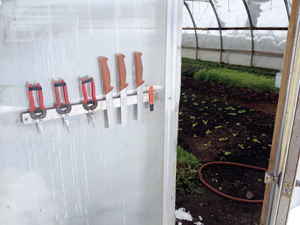
SET IN ORDER. Every tool should have a place. At any given time, it should either be in its place or in the hands of a worker. There is no third option! Our goal was to organize our spaces so that a 10-year-old could walk into a room and get us any tool we asked for. So tools are hung at as close to eye level as possible and they are not stacked on top of each other.
Another goal is to place tools as close as possible to where they are used. When Steve asked me to show him how I prune the tomatoes, I had to start by walking 200 or so steps to the storage barn for the pruners, then another 200 steps back to the greenhouse. “Why not keep pruners in the greenhouse next to the tomatoes?” Steve asked. The thought never occurred to us. Messes still happen, tools still get lost, sometimes for days at a time. But it helps to have organizing principles in mind.
SHINE. Clean your workspaces with a toothbrush. Then make sure they are well lit.
For us, we painted the cement floor of our processing room with epoxy paint so that we can mop up easily and we put in place stainless steel counters and sinks. Then we installed four T8 florescent light fixtures in our 12’ x 30’ processing room. It might seem like overkill, but we feel like the increased quality of our work was worth the expense.
We also bought and placed around the property several green-colored totes that are used exclusively for collecting weeds. The system is easy to follow and having totes close to where the weeds are encourages us to keep our growing beds clean.
STANDARDIZE. This refers to creating work stations that are identical for a particular job.
For us, we replaced our mix of 30 or so salvaged harvest containers of different colors and shapes with just one type of container. Another example: we supplied each greenhouse and each plot we farm with the exact same hose and irrigation set-up, so that a worker can water different areas without confusion.
SUSTAIN. Setting up organization systems is one thing, making sure you use them is another.
In some lean factories, a worker is assigned at the end of each week to go around the facility with a clipboard and give a numerical rating for the cleanliness of work spaces. The goal is get a better rating each week.
We haven’t gone that far, but we do set aside time each fall to deep clean our spaces. We call it “taking it to zero,” meaning we want each space to start the year with a cleanliness baseline of zero.
We also set aside a few hours of staff time on Friday afternoons to getting the farm back in order. Doesn’t always happen, but we’re getting better, and, once again, it helps to have a target.
2. Find metrics to measure your work
To lean up, a farm needs to find and use consistent metrics to track which crops and practices are making you moneyand which are a drain on your resources (i.e., targets for elimination).
Chris Blandchard’s article in GFM January 2013 provides a great overview of how to track your costs of production, and I suggest reading it. In addition to a careful income/expense analysis (your task as an owner), a “lean” practice is to pick one very simple metric that workers can use across all of your products that will allow your team to easily compare products and set goals.
For example, you could track the dollar value per harvest container for each of your different crops. Or the value per row foot. Or the value amount of each crop you can harvest in an hour. The actual metric you choose doesn’t matter as much as making sure you’re consistent across the board.
You can often do this measuring in your head in just a few seconds as you are working. Post a chart in your processing room to keep track, then set targets for improvement.
3. Spend time deciding what NOT to do
After you have information on the profit margins for your crops, begin eliminating crops that track low. This is surprisingly hard to do! “But we have to grow X!” you might say. You can grow X, but realize that X might be bogging down your farm.
It helps to set a bar. For example, on our farm, we try to eliminate crops that do not yield a harvest of a set dollar value per hour spent harvesting and processing–what I call “field to cooler” time. (We double the bar for “stake and prune” crops like heirloom tomatoes and greenhouse peppers that take a lot of upfront time to trellis and prune.)
Sometimes the metrics will help you decide on equipment purchases. For example, potatoes did not make the cut for us until we started using a simple tractor-mounted potato digger.
The list of crops that don’t succeed will look different on every farm because every farmer has unique competencies and all farms have different soil types, equipment and market access.
4. Work as hard to trim expenses as you do to increase sales
Say your goal is to increase net profits by 50% over 10 years. What business wouldn’t love to do that!
One way to get there would be to expand production and increase sales. That approach would take a lot of effort: you’d need new equipment, more land, more greenhouses, more staff, more customers, etc.
Another way would be to cut expenses. What if you managed to cut expenses by just 5% a year (who couldn’t do that?) over a 10 year period while keeping revenues the same? This is lean growth. Granted, the above example is simplistic. Revenue streams are important and there might be ways to efficiently increase those streams. Lean thinking simply encourages finding and eliminating waste as an equally legitimate way to grow your business.
Every year we examine a printout of our expense ledger and ask ourselves, “How can we trim another 5% off this year?” It’s a good discipline and it has helped to have a specific goal.
We love expense-cutting growth because the savings are perennial. For example, if you can save $500 per year on a cheaper compost sourced from another supplier, over 10 years you have saved $5,000. (Friends of ours who raise pigs have done these sorts of projections comparing different feed sources–whey, scraps, corn, etc.) Or if you can find a way to shave an average of just 20 minutes per day off your processing time because of a new method, over ten years (assuming a 5-day workweek) you will have freed up 52,000 minutes–or 36 days–to grow more food…or take a vacation!
5. Create a smooth work flow
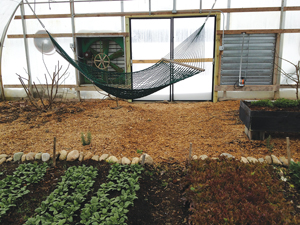
Steve asked us to imagine we were watching our farm from overhead and to trace a line on paper whenever people moved around. By the end of a typical harvest day, our farm would look like a plate of spaghetti (hence the term “spaghetti diagram”).
To smooth out our spaghetti noodles, Steve encouraged us to harvest as “market ready” as possible.
To get from your field into the hands of a customer, a vegetable will go through a lots of “moves.” If you can find a way to eliminate even one or two moves, your noodle gets straighter.
For us, we have started harvesting our crops into the same totes that we will take to market (unless the crop needs to be washed), and we bunch or pack in the field as we harvest. For example, if we need 50 bunches of kale, we’ll count out 50 rubber bands, stretch them around a couple of fingers, and band as we pick.
6. “Level the load”
This refers to spreading out your weekly and yearly workload so that you are not overwhelmed during your peak times/seasons (Fridays/mid-summer).
We do this in several ways. We do as much spring bed preparation in the late fall as possible because spring is always a rush. We harvest throughout the week rather than waiting for the last minute. And we keep a winter project list of tasks to complete in order to free up time in summer.
Perhaps most significantly, we extend our growing season year-round through the use of greenhouses, so that our sales and workload are spread more evenly throughout the year.
7. Remember who you are working for: the customer
This is key. According to lean thinking, what the customer wants is paramount. It should dictate your long-term decisions and your day-to-day tasks. If your immediate task is not in the service of giving your customer something they value, then you should stop doing it.
This sounds harsh, but it is not meant to strip the fun out of farming. Rather, it’s meant to give your farm focus so that it is profitable enough for you to pay yourself fairly and to give you time to do things that you enjoy.
Sometimes customer-focused farming means going out of your way. For example, we have started calling some of our chefs (at a time they choose) so they can place quick orders while flipping eggs or plating a dish. This is faster for them than email (which would be our preference); as such, the phone call becomes part of the service we provide.
In conclusion, if your farm, like ours, has seen its share of chaos, then applying “lean” principles could help it run more smoothly and profitably. You probably started growing for markets because you envisioned making a living outdoors around the green things that you love. “Leaning up” might help bring that goal closer to within your reach.
Ben Hartman and Rachel Hershberger own Clay Bottom Farm near Goshen, Indiana. They have a CSA and sell at the Goshen Farmers Market.
Copyright Growing For Market Magazine.
All rights reserved. No portion of this article may be copied
in any manner for use other than by the subscriber without
permission from the publisher.