











#toolsforgrowingformarket
The farm I apprenticed on in the 1990’s had two electric utility carts. They were two of the every-day drivers and material movers around the ranch. These were what most people would recognize as a golf cart, but with a small dump truck bed instead of holders for golf clubs. Carts like these versatile low speed vehicles (low speed vehicles being a class of vehicle maxing out under 25 miles per hour) have been the used by grounds keepers on golf courses, college campuses and in many parks for a long time, both in gas powered and electric versions. The electric versions tend to be a little more expensive up front, but they have a lot of advantages over the gas-powered versions. In my experience they also have advantages over larger trucks that I’ve driven on farms.
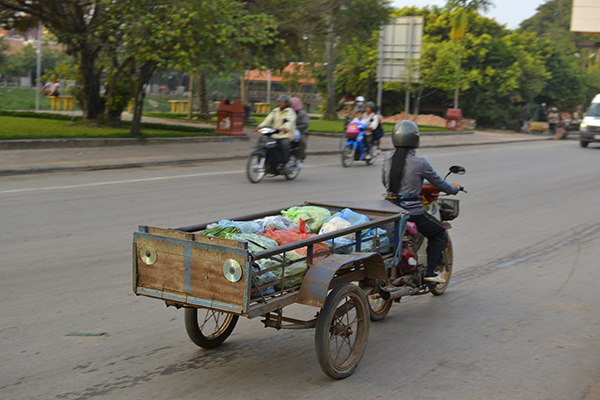
Motorcycles can be a good option for hauling trailers, especially with relatively lighter, bulkier loads at lower speeds.
When driving a vehicle on the farm we tend to do a lot of stopping and starting, drive at relatively low speeds, and to get in and out of the vehicle many times. Electric vehicles don’t require any warm up on cold mornings, just turn the key, press the pedal and they go. The utility carts are also really easy to slide in and out of, and there’s little worry about getting the interior all muddy or dusty. Getting in and out is easier partly because they’re closer to the ground, a feature that makes loading up the bed of the vehicle with whatever it is that you’re carrying easier, too. They’re completely silent when stopped, and much, much quieter when moving – a feature that’s hard to fully appreciate without experiencing it on a daily basis.
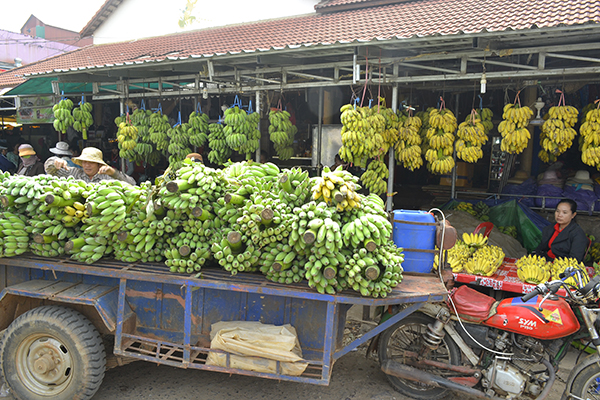
The size of trailers people haul with small motorcycles can be very impressive. This requires an experienced driver and would be unsafe at high speed or on steep hills, but on relatively flat farm roads with relatively low speeds two wheel vehicles with a trailer can haul big loads. All photos courtesy of the author.
The maintenance and regular upkeep is very different than internal combustion vehicles. If you have the older style lead-acid batteries the maintenance basically consists of checking the water levels in the batteries and keeping them trickle charged when not in use. With newer battery technologies there’s even less maintenance. There’s no fuel to buy and store, oil or filters to change, just plug them into a battery charger and they’re good to go.
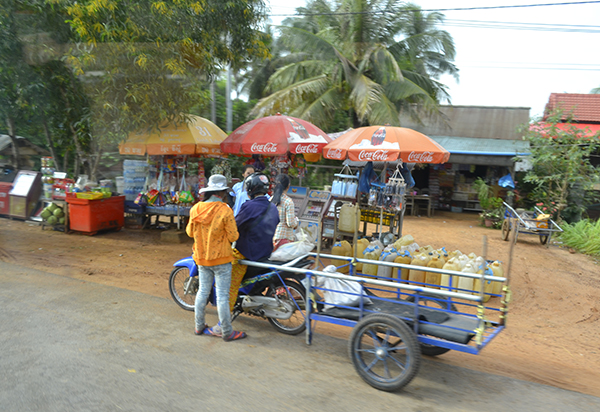
This small motorcycle is hauling a trailer that can also be used as a hand cart when decoupled.
For someone already familiar with internal combustion engine troubleshooting, there’s not a lot of overlap when things go wrong so where to start if things go wrong can feel pretty mysterious initially. In my years of dealing with problems on electric vehicles, if it fails to function normally it almost always ends up being a loose or corroded connection somewhere, often on one of the battery cables. Depending on the environment that’s a relatively infrequent problem, and the other parts are even more reliable and long lived.
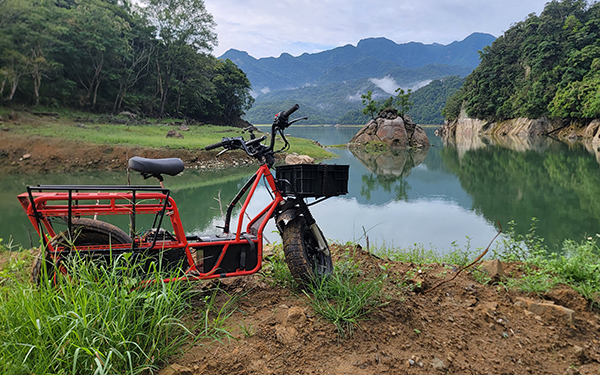
A prototype of the Packa Trusty Trucker out in the wild. If you can’t wait for the Trusty Trucker, a similar model, the Genie, is available at blixbike.com.
The other common problem I’ve seen with the smaller utility carts is flat tires. Small vehicles have smaller wheels, and smaller wheels wear more quickly (there’s less rubber) and they aren’t typically as heavy duty as a tire designed for a big heavy truck because they both don’t need to be, and because heavier wheels are less efficient. While flat tires can be a pain on any vehicle, they’re no more difficult to change than on a larger vehicle.
In the December 2012 Growing For Market I wrote an article about pedal power around the farm, another low speed vehicle. At the time I was using a cargo bike on my farm with electric assist. Even though that was relatively early days in the electric assist cargo bike development, it was another super reliable, low maintenance way to move loads around the farm and to do small deliveries off the farm.
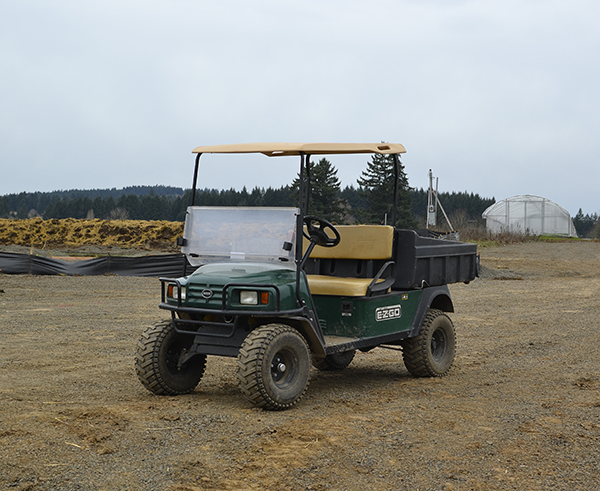
This electric utility cart has a dump bed, higher clearance and off road wheels for better traction in the field. Four wheel utility carts come in many configurations with different lengths and bed options, as well as different cab options from fully open, to partially covered like this one, to fully enclosed for more extreme weather. Having an open cab like this, but with a wind screen for chilly mornings driving down farm roads, is a great option which makes it easy to hop in and out, but with a little protection from the elements.
A few years later I had the opportunity to travel in Cambodia and to visit farms there. The number one most common transportation option, for pretty much everything, was small motorcycles or motor scooters, just as it is in many other parts of the world. As much as I love pedaling my own bicycle, I could see how these small motorcycles and motor scooters combined the ability of bicycles to travel on narrow paths, and to navigate tight spaces, but with the motors, larger wheels, and better brakes they were also capable of pulling large loads, often in very large trailers hooked to a hitch just behind the driver’s seat.
Ever since then I’ve wondered why these little motor scooters aren’t more common on farms here in the US and I suspect it has to do with price and availability of options, with cars dominating the market here unlike the market in Cambodia and many other countries. It probably also has to do with weather, as motor scooters seem to be more popular in parts of the world where it doesn’t snow. While internal combustion motor scooters will probably never become a popular option here in the US, I’m already seeing a lot more people riding fat tire electric bikes for recreation and transportation as if they are motor scooters. These have a lot of potential on the farm, and recently I’ve seen what I think might be an even better option, a purpose-built electric utility scooter.
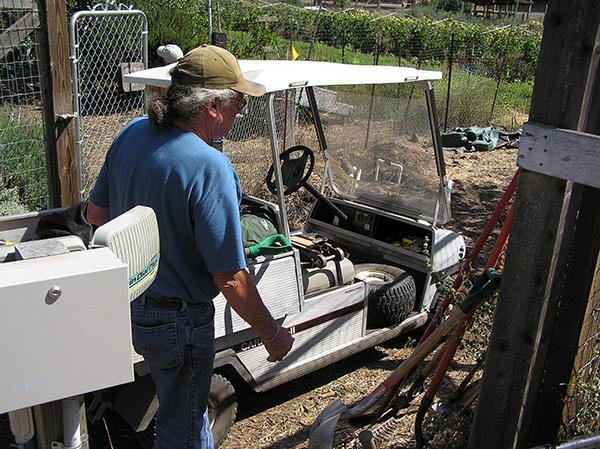
Andy Scott, the famer I apprenticed with standing next to one of the electric utility carts at Hidden Villa. The small size of these vehicles and low weight allows them to maneuver into tight spots on the farm.
The Trusty Trucker from Packa is still in pre-production so it’s not actually available for sale yet, but it represents what I hope will become a more commonly available vehicle here in the US and around the world. Additionally, their design incorporates some smart design features that I want to highlight. For these reasons the Trusty Trucker was the winner of CAFF’s (Community Alliance for Family Farmers) hardware category of their 2024 Innovation Challenge.
While the Trusty Trucker wasn’t designed just for farmers, in the same way that the electric utility vehicles I’ve used weren’t designed specifically for farms, all of the features are perfectly suited to what’s required of farm vehicles. First of all, it’s no frills, no fancy displays or plastic fairings which don’t really serve a function, but break too easily and need to be repaired or discarded. The vehicle is designed to be easy for riders to operate, to be easily repaired with all parts being replaceable, and to easily allow accessories to be attached to the frame as needed. In addition, those accessories don’t need to be proprietary, there’s lots of opportunity to easily customize, or to use off the shelf baskets or farm-built racks with lots of places to bolt directly to the frame.
The Trusty Trucker or any other two-wheel vehicle won’t haul big harvests out of the field by itself, but I think there’s a lot of potential when coupled with a trailer for it to haul small farm sized loads efficiently. If those trailers are designed to also act as hand carts when decoupled from the tow vehicle, they can often get much closer, or even inside a packing shed, unlike larger trucks. Vehicles like this are ideal for tasks like running out to the field for switching irrigation valves or making irrigation repairs, or even to just scout crops in distant fields. A small two-wheel vehicle with fat tires providing low ground pressure and an experienced rider can even drive straight down pathways in many cases, right into the field with minimal impact.
Even on my own current tiny urban farm, less than an acre, but with some of our supplies stored a city block away, I find a bicycle, often attached to a combination trailer/hand cart, saves significant time and energy over walking for many common trips. When I was working on larger 5–15-acre farms we’d often use a small truck, but the difference between how much time it took to get in and out of the cab, warm up the engine in the morning, and navigate tight spaces, relative to what it takes in a smaller vehicle was noticeable. I’d like to see more of these small, low speed electric vehicles, with lower emissions and noise, used on farms everywhere. They have the potential to add small but significant efficiencies saving time, energy and wear and tear on our bodies.
Josh Volk farms in Portland, Oregon, and does consulting and education under the name Slow Hand Farm. He is the author of the books Compact Farms: 15 Proven Plans for Market Farms on 5 Acres or Less, and Build Your Own Farm Tools, Equipment & Systems for the Small-Scale Farm & Market Garden, both available from Growing for Market. He can be found at SlowHandFarm.com.
Copyright Growing For Market Magazine.
All rights reserved. No portion of this article may be copied
in any manner for use other than by the subscriber without
permission from the publisher.