











Grow beneficial microbes with the least labor, water, equipment and fuel
I’ve made over 40,000 yards of compost over the past 28 years using a skid steer, bucket loader, and a compost turner. But the first compost piles that I built in 1978 were entirely hand-made endeavors. Beyond their careful construction, the fact that these piles were never turned, yet produced high-quality compost, continues to guide an approach to composting that I refer to as “low-input” or “slow” composting.
There’s no shortage of books, articles and courses providing instructions for making compost. Unfortunately, many of the instructions offered can be missing critical details, and/or be excessively time-consuming, impractical, unnecessary, and even counter-productive.
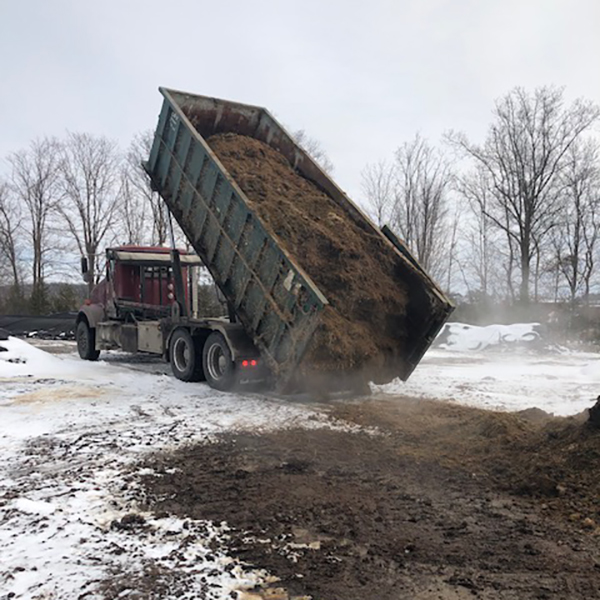
The author receiving a thirty cubic yard load of horse manure. After delivery, the manure is moved to into broad, short (in height) piles to maximize its exposure to rainfall and snowmelt. After four to eight months, it’s then mixed with wet dairy manure at a ratio of about two parts horse manure to one part dairy manure. All photos courtesy of the author.
Beyond explaining why these instructions are problematic, this article describes some alternative low-input composting methods that can be used to produce high-quality compost with a minimum amount of labor and costs.
Challenging the conventional wisdom
If you ask people who know something about composting to list the most important things required to make compost, they likely will say:
1. Start out with a mixture of raw materials containing a carbon to nitrogen (C:N) ratio of 30 to 1.
2. The pile needs to reach temperatures of 150°F to 155°F to kill pathogens and weed seeds.
3. The pile has to be turned as frequently as possible.
There are multiple problems with this list, including:
It often doesn’t include the critically important goal of ensuring there’s enough moisture to support a thriving and diverse microbial population, but not so much that the pile becomes saturated which leads to the growth of anaerobic bacteria while inhibiting beneficial aerobic microbes. This is important because anaerobic bacteria not only generate unpleasant odors, but they produce metabolic by-products (e.g. sulfides, volatile organic acids, etc.) that are toxic to plants.
While a C:N ratio of 30:1 may be ideal, if care is taken to ensure optimum conditions, any organic material or mixture of organic materials will decompose regardless of their C:N ratio.
While elevated temperatures are a useful indicator of microbial activity, temperatures above 140°F to 145°F are often an indication of not enough moisture. High temperatures can also inhibit beneficial micro-organisms, while favoring undesirable microbes. And while many weed seeds are killed by elevated temperatures, weed seeds are also destroyed by decomposition (rotting), and/or sprouting and then being killed by turning. Similarly, while most pathogens may be killed by high temperatures inside a pile, they’re also killed by predation and competition with other microbes.
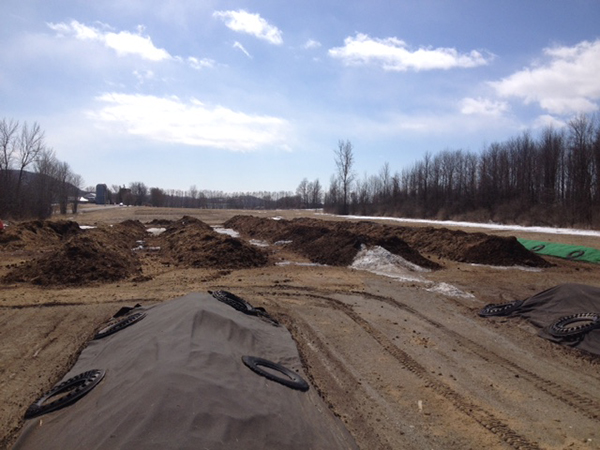
The author’s compost site with covered/protected finished compost in the foreground, and uncovered horse manure in the background that’s intentionally being exposed to rainfall and snowmelt.
Turning is important because it redistributes feedstocks throughout the pile, breaks apart clumps, and restores pore spaces reduced by settling and particle size reduction. However, great compost can be made with just a minimal number of turns, although the process will take a bit longer compared to a pile that’s turned more frequently.
Advocates of Controlled Microbial Composting (CMC), also called the “Luebke Composting Method” add some extra high-input practices, including: adding clay soil; monitoring frequently for oxygen and carbon dioxide concentrations; turning frequently (e.g., every day for at least two to three weeks) to ensure these gases remain above a specified O2, and below a specified CO2 concentration; and, keeping piles covered throughout the entire process, supposedly to reduce moisture loss from evaporation and to protect microbes from damaging UV-light.
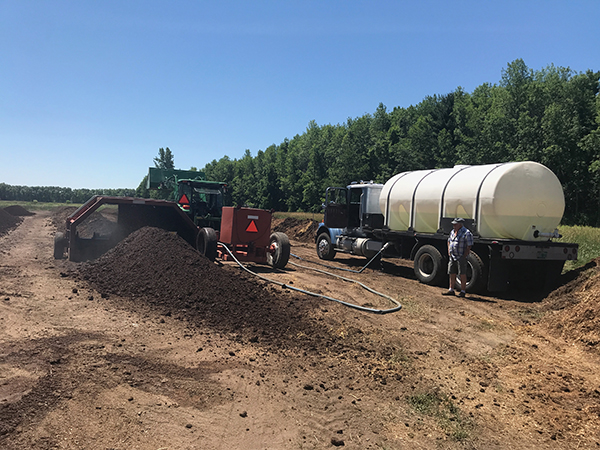
The author Increasing the moisture content of active compost windrows using a commercial water truck and a compost turner outfitted with a watering manifold.
Unfortunately, while frequent turning does speed up the compost process, there’s scant independent research quantifying any improvement in compost quality that can be attributed to these high-input practices. It’s also likely that some people are discouraged from even trying to make compost because they’ve been led to believe that these high-input practices are necessary. This is also unfortunate because many of these practices also have additional significant downsides, including:
Clay is expensive and difficult to source, especially in large quantities, and simply adding some native soil likely offers similar benefits.
Not only does frequent turning increase labor inputs, equipment wear, and fuel consumption, it also accelerates moisture loss. Low moisture levels in turn increase pile temperatures, which reduces microbial diversity by favoring thermophilic microbes and inhibiting beneficial mesophilic microbes which thrive in temperatures between 68°F and 113°F. One important group of mesophilic microbes are the Pseudomonas bacteria that metabolize complex synthetic organic compounds, including persistent broadleaf herbicides that are increasingly found in compost feedstocks.
Frequent turning also can reduce the nitrogen content in the finished compost due to the release of volatile forms of nitrogen include ammonia (NH3), nitric oxide (NO), nitrogen dioxide (NO2), nitrous oxide (N2O).
Keeping piles covered continuously with breathable compost covers doesn’t significantly reduce moisture loss, but it does cause the covers wearing out sooner due to increased UV-light exposure. The loss of such a tiny percentage of microbes on the surface a pile also doesn’t justify the extra labor and costs associated with covering piles continuously.
Low-input or Slow composting — Keeping it simple
Composting is essentially the management of organic materials to create an optimum environment for decomposing organisms to transform them into a soil amendment that contains beneficial soil microbes, and also improves tilth, aeration, and water-holding capacity, which all promote more vigorous plant growth.
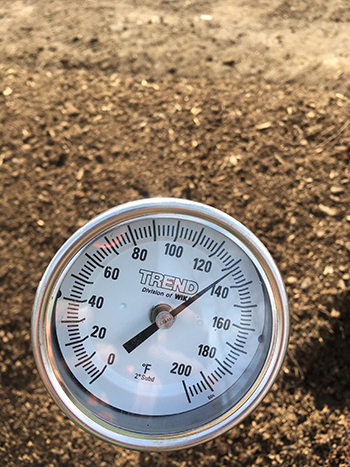
The author measuring the temperature of an active compost windrow. With an optimum moisture content of between 60 and 65%, the temperature will typically be between 131 and 140 degrees F for up to three months. Over an active compost period of four to five months, the windrows are turned at two, three or four week intervals.
The goal of a low-input, or slow composting system is simply to create the conditions that will support the growth of beneficial microbes with the least amount of labor, water, equipment and fuel use possible. However, this approach requires a thorough understanding of the specific conditions that will support the growth of these beneficial organisms, including:
Compost microbes need food in the form of fresh organic materials, either plant materials and/or animal manure that hasn’t already decomposed significantly.
Compost organisms require access to oxygen.
Compost microbes also require moisture to function, so the materials they’re consuming must be sufficiently moist. But there can’t be so much moisture that a pile becomes saturated, a situation in which pore spaces inside the pile are filled with water, limiting the amount of oxygen in the pile, and leading to anaerobic conditions. When a pile becomes saturated, the potential for “passive aeration” is also limited, which is the movement of O2 in and CO2 out of the pile via both diffusion and convection powered by the heat generated within a pile.
Ingredients
Contrary to the “conventional wisdom” of needing to start with a mixture of ingredients that have an ideal carbon to nitrogen (C:N) ratio of 30:1, it’s completely possible to make compost from a mixture of ingredients that have a significantly higher or lower combined C:N ratio, assuming optimal decomposition conditions are created.
For example, in addition to ensuring there’s optimal moisture, using multiple ingredients, including some native soil and/or finished compost will increase microbial diversity along with the types and concentration of macro- and micro-plant nutrients in the finished compost. Combining different ingredients will also introduce particles of different shapes and sizes that will increase the amount of pore spaces, which will in turn increase the potential for “passive aeration.”
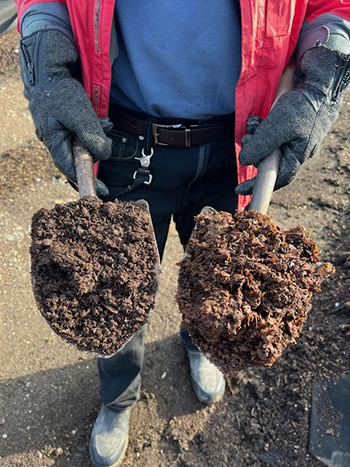
The author demonstrating that UNfinished compost (on the right) will contain lots of identifiable woody materials, while finished compost (on the left) will be dark in color and contain very little identifiable woody materials.
For example, wet, dense, high-nitrogen materials such as dairy cow manure, food scraps, poultry manure, meat processing offal, fish or food processing waste, etc., absolutely need to be mixed with drier, more carbon-rich ingredients to achieve a more balanced C:N ratio and to reduce the moisture content and the “bulk-density” of the pile to create more pore spaces. The most commonly used bulking agents are bedded horse manure and chopped yard/green waste.
While wood chips are also often used, they typically won’t absorb much water, and the majority of their carbon is inside the chips, and not readily accessible to the bacteria on the particles’ surfaces. And since wood chips take longer to decompose, the largest chips will also typically need to be screened out of the finished product.
While the compost process does inhibit and kill pathogens that cause plant disease, it’s safer to avoid using diseased plant materials as feedstocks due to the risk that some of these pathogens will end up in the finished compost.
Ingredients such as leaves and other types of green waste/yard debris may also contain the invasive and highly destructive adult Asian jumping worms or their cocoons. So, it’s essential that these piles are carefully managed to ensure the temperature stays above 130°F for long periods and are turned thoroughly at least three or four times so that all the ingredients are adequately exposed to those elevated temperatures.
Finally, adding amendments such as kelp meal, biochar, and/or rock dust will enhance the agricultural value of the finished compost.
Pile construction, size and shape
There are essentially four ways to build a compost pile or windrow: 1. Pre-mixing the ingredients and then putting them into a pile/windrow. 2. Placing the ingredients into a pile/windrow in alternating bucket loads, and then using a compost turner or a bucket loader to mix them together. 3. Loading ingredients into a manure spreader modified to create a narrow pile/windrow. 4. Placing ingredients manually in alternating layers, and watering each layer as needed.
If using a bucket loader or manure spreader to build a pile, an ideal pile width is around 12 feet to 13 feet (measured along the ground at the base), and because the pile will shrink in height by as much as 50 percent, it should be built as tall as possible. The surface-to-volume ratio (i.e., the amount of surface area compared to the interior volume) created by a pile of this size allows for a reasonable amount of passive aeration, while also providing a fair amount of insulation to limit heat loss.
This will also minimize the potential of the pile to become saturated during periods of heavy and/or prolonged rainfall as well as evaporative losses during periods of dry weather. However, if a pile is built manually, a 6-foot to 8-foot width is going to be more practical, and if using a 10-foot wide compost turner, the pile can only be around 9.75-foot wide, or 11.75-foot wide if using a 12-foot wide turner.
Ensuring optimum moisture
The optimal moisture content to support a diverse microbial population in an active composting system is between 60 percent and 65 percent. This is evidenced by the materials having a slight sheen and being able to stick together when squeezed with a few drops of water being easily squeezed out. The exact moisture content of a pile can also be quantified by weighing a representative sample taken from inside the pile, drying, reweighing it, and then dividing the wet weight by the difference between the dry and wet weight. The calculation looks like this: 1.0 lb (wet weight) – .35 lb (dry weight) = .65 lb/1.0 lb (wet weight) = .65 (or 65%) moisture.
Even in temperate climates that receive precipitation throughout the year, more moisture will typically be lost through evaporation than gained from rainfall during the active/hot composting phase. This means that the moisture content will steadily decrease depending on a variety of internal and external factors including: the amount of heat being generated within the pile; its surface-to-volume ratio; the bulk density; the amount of rainfall, sun and wind; ambient temperature and humidity; and, the frequency of turning.
Therefore, to avoid allowing a pile to become excessively hot due to insufficient moisture, which will also inhibit and/or completely stop the decomposition process, it’s critical to start the process with a moisture content of 65 percent and 70 percent, which is slightly higher than necessary during the active stage. Evaporative losses during the active stage can also be minimized by building the pile with the smallest surface-to-volume ratio as possible and minimizing the amount of turning being done.
If composting dry ingredients that aren’t going to be mixed with wet ingredients, water needs to be added either before or after the pile is built. In regions that typically receive substantial precipitation, dry ingredients can be spread out in flat, squat piles to get as much exposure to rain and snow melt as possible, and/or watered manually with a sprinkler.
Water can also be added to an existing pile using sprinklers that wet the entire pile surface, versus drip tubes /tape that typically result in the water simply “channeling” down through the pile and wetting only narrow vertical strips, and then running out the bottom of the pile as leachate. If using a compost turner or manure spreader to turn, these can be outfitted with a “watering manifold” to allow water to be added while turning, assuming there’s access to a high-volume water source.
Turning
Turning a compost pile provides some important functions, including:
- Homogenizing the ingredients.
- Breaking apart clumps.
- Helping to ensure that all the ingredients are exposed to the most biologically active areas within the pile.
- Moving dry materials from the surface to the wetter interior of the pile.
- Restoring porosity lost through settling.
- Killing weed seeds that have sprouted.
To reduce the risk of pathogen contamination of food crops, and to be approved for use on certified organic farms within 120 days of the harvest of vegetable crops, the USDA National Organic Program (NOP) certification standards also require that composted manure be managed to achieve temperatures above 131°F for a minimum of 15 days. Although compost from unturned and/or static-aerated composting systems can “technically” meet this standard, thoroughly turning a pile three or four times helps to ensure that all the ingredients will be exposed to zones within a pile that have the most microbial activity and highest temperatures.
Using a compost turner is the most effective way to turn a pile, but these machines are relatively expensive. A 10-or-12-foot wide tractor-pulled turner also requires a 100 or 120 hp tractor, and must have the ability to move less than .5 mph at full horsepower, which requires a “creeper gear,” or hydrostatic, IVT or CVT transmission. A manure spreader modified with deflectors to eject materials into a windrow is also effective, but requires one tractor to pull and provide power to the spreader (via a PTO), and a second tractor with a bucket loader to fill the spreader box. A bucket loader or an excavator can also be used to agitate/turn a pile, although these machines aren’t as effective for mixing materials and breaking apart clumps. Small piles can also be turned manually.
While there are great reasons to turn, there are also great reasons to minimize the frequency of turning, including: saving money on labor, fuel, and equipment maintenance and repair; conserving water; and, reducing of the loss of nitrogen and carbon (as CO2).
However, to produce high quality compost with just a few, thorough turns, the process must still be carefully managed to provide optimal aerobic conditions and kill weed seeds and plant and animal pathogens. Beyond the management strategies described above, some additional strategies include:
Either not starting the active composting process, and/or not turning during periods of freezing weather.
Regularly checking the interior of the pile to ensure there’s sufficient moisture and to check for changes in temperature, color, smell and particle size.
As needed, covering active or finished piles with “breathable,” macro-porous compost covers (e.g., ComposTex) to protect them from excess rainfall.
Increasing moisture content in active/hot compost
When moisture levels drop below 50-55 percent, the decomposition process slows down or stops. A negative feedback loop is created in which the amount of water available to evaporate and cool the pile is reduced, leading to even higher temperatures. When this occurs, the only way to increase the moisture level is to add water as described previously.
If needed, raising the moisture level of a dry pile requires a substantial amount of water. For example, to raise the moisture level of a pile containing 100 cubic yards of material from 50 percent to 65 percent requires about 3,000 gallons. Here’s the math:
1. 100 cu yd x 600 lbs/yd = 60,000 lbs (weight of ingredients) x 50% (H2O) = 30,000 lbs H2O
2. 30,000 lbs H2O + 25,000 lbs (additional) H2O = 55,000 lbs H2O (new weight)
3. 25,000 lbs (additional H2O) / 8.34 lb/gal = 2,997 gal (additional H2O)
4. 30,000 lbs (original weight of dry ingredients) + 55,000 lbs H2O (new total) = 85,000 lbs (new total pile weight)
5. 55,000 lb H2O (total water) / 85,000 lbs = 65% H2O
Avoiding and remedying excess moisture
As described above, excess moisture creates anaerobic conditions and generates leachate that removes valuable nutrients from the pile and can negatively impact surface and ground water resources. Excess moisture conditions are indicated by the interior of a pile being cool and wet, having a unpleasant odor, and by water seeping out the bottom of the pile.
 (Above) The author demonstrating the amount of water that can be squeezed out of a handful of “active” compost with a 66% moisture content. (Below) The author demonstrating that only a few drops of water can be squeezed from a handful of “finished” compost with a 56% moisture content.
There are three ways to prevent excess moisture conditions during the active or curing phase: mixing drier ingredients with excessively wet ingredients when building a pile; building the pile with the lowest surface-to-volume ratio area as possible to minimize the impact of excess rainfall; and, as needed, protecting the pile from excess rainfall with a breathable, water-shedding compost cover such as ComposTex.
However, to reduce the moisture level of a pile that is at an early decomposition stage and has become too wet from excess rainfall, dry ingredients can be mixed in. But if dry ingredients aren’t available, or the pile is approaching the curing stage, the moisture level can be reduced by letting the surface dry out over multiple days, and then turning to bring wet material from inside the pile to the surface where it can dry out. It’s also important to use a compost cover to protect piles during heavy and/or prolonged rainfall events.
To conclude, I hope this article has been a useful introduction to the art and science of low-input composting, and will inspire you to try making some compost using these methods.
Steven Wisbaum is the founder of Champlain Valley Compost Co. based in NW Vermont, and CV Compost, distributor of ComposTex compost covers. Due to space limitations, references have not been included in this article, but these will be provided on requests sent to steven@cvcompost.com. Comments and questions are also welcome.
Copyright Growing For Market Magazine.
All rights reserved. No portion of this article may be copied
in any manner for use other than by the subscriber without
permission from the publisher.