





Customer satisfaction is always important for Community Supported Agriculture (CSA) farms. Part of what makes the CSA such a desirable marketing model is the stable customer base that ideally sticks with the farm year after year. Happy CSA customers are more likely to return and share positive words with their friends, who may become new customers.
Here on our farm, Oakhill Organics, these basic satisfaction goals have become even more crucial as many of our customers have found their budgets tightening because of the recession. We want to ensure that our CSA shares remain a high (and affordable) priority for our customers, even during financial challenges.
In 2011, we have 170 CSA members for our 45-week-long season, and we are actively expanding. As we seek new members, we’ve found that the market has changed since we started our CSA in 2006. Back then, we were the only CSA in our town and it felt easy to find customers. Now there are several CSA farms operating here, and we have to be more strategic with our offerings to gain new members.
From what I’ve heard here in Oregon and across the nation, many farms are experiencing similar dual phenomena: customers have more CSA purchasing options and fewer dollars to spend, thus increasing the competition and making customer satisfaction as important as ever.
We’ve experienced positive results with our improved “hard times” strategies, and I wanted to share some tips here for the benefit of other farmers who want to increase customer retention, gain new members, or start a brand-new CSA in a challenging economic moment.
Consider waiting to start a CSA
First of all, if you are just starting your farm, I would encourage you to consider other marketing venues for your first few seasons.
The CSA farming model is very alluring to new growers — in some ways it is almost a trick in how it seems like an easy way to make a farm income! If you have the skills to throw together an appealing brochure and/or website, you can receive checks in the mail without having done any actual farm work!
But to maintain a CSA, you will need to work very hard to fill all those boxes you’ve pre-sold. This is where I have seen many new farmers stumble. Projecting how much produce you can grow is extremely difficult to do without having the experience of a season or two behind you.
You will learn a great deal as you make many mistakes in your first years of farming, and the CSA program can make it difficult to navigate those inevitable failures without hurting your long-term reputation. Dissatisfied CSA customers might not want to return in future years, especially when there may be other programs for them to try instead.
So give your farm some breathing room and consider other options: Start your farm by attending one or more markets, where you can simply bring the vegetables you have each week. Or try selling to chefs. You will learn a great deal about quality and what types of veggies people love by seeing what market customers or chefs choose to buy.
These outlets certainly don’t offer all the same stable benefits of the CSA model, but they can also be a lot less challenging mid-season. Plus, if you bring great stuff to market, you can establish a reputation for quality and start attracting future CSA customers.
While I would urge you to not start a CSA in a first season, when to actually start a CSA will depend on you and your farm. Obviously, just one or two seasons under your belt certainly won’t create vegetable growing expertise, and you might want to wait even longer before starting a CSA.
But a season or two will give you a much more realistic understanding of your farm’s unique limits (how much produce can be grown on the land with labor available, etc.). Knowing these limits (and recognizing that each season is unique) can be a good starting point for planning a CSA, especially if you take into account the inevitability of surprises and mistakes along the way.
Be vigilant about quality
There are of course many intangible reasons for joining a CSA, but, ultimately, people are buying vegetables from you. Those vegetables had better be good tasting and good looking.
After five years of trial and error, this is our strict rule: if a veggie isn’t awesome, we don’t give it out.
Culling produce and being picky when harvesting are such hard things to do in the early years of a farm, when every single bean or carrot feels so hard-earned. It can also feel wasteful in a recession, especially if, say, 80% of the carrot is fine … why waste it?
We used to give less than perfect produce, especially in winter shares. Often we would bump up the value of a week’s share and consider the blemished produce “extra.” Unfortunately, we found that our members didn’t understand that those holey potatoes were “extra,” and they were often just frustrated with having to do more work in their kitchen to peel things down.
Again, this is a hard lesson to implement, especially on an organic farm. But if you are serious about member retention, quality is crucial.
If you are just starting your farm, it might take a few seasons even just to recognize quality (and then to learn how to communicate those values to your employees), but it needs to be a goal even if you’re not there yet.
Now that we are in our sixth year of growing, our farm’s produce is not perfect, but it is reliably very good. We’ve found that high-quality produce is key to our most valuable marketing tool ever: word of mouth recommendations. We want our CSA members to be jazzed each week they pick up their vegetables so that they use superlatives when talking about our farm with their friends and neighbors.
Provide consistent volume
Since our CSA runs through the winter months, we have to plan carefully for harvests at almost every time of the year. There are natural fluctuations in abundance — even storage crops have limitations. We find that May and June are the toughest months for providing enough produce. It’s tempting to use the CSA philosophy to justify dwindling shares those months with a promise to make it up in August.
However, in practice, we have learned that people are most satisfied when they receive approximately the same volume of produce every week. That weekly volume of produce should make sense to them based on share price. In our experience, CSA customers can’t easily perceive value spread out over an entire season and are less happy with fluctuating share sizes, even if it adds up in the end.
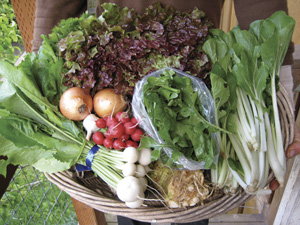
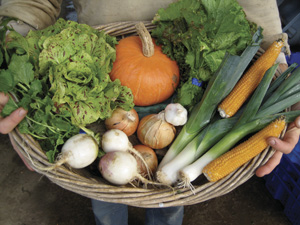
On our farm, we harvest seven to nine different kinds of vegetables every week for our “Large” size share. Each veggie is provided in abundant but not overwhelming amounts: one big bunch of carrots, two pounds of potatoes, three onions, etc. When we select the items, we consider how they balance each other for culinary roles (onions, roots, fresh eating greens, cooking greens, etc.).
In order to have that consistent, well-balanced volume of produce for 45 weeks, we have to plan very carefully. Our fields are disproportionately planted to the off season crops, since there are more of those weeks in the year and our winter harvests have an increased cull rate.
Certainly, there is still an arc to the year, and August always feels more abundant than May, but the actual difference in weekly produce volume is quite subtle.
Each farm’s planning needs to be unique, but simple steps can be taken to meet this goal, such as planting a lot of early season crops to help fill out those famously challenging spring shares: radishes, Asian greens, salad mix, turnips, kale, etc.
Remember that your customers’ perception of the season is often more important for satisfaction than the actual number of veggies given out from start to finish. So, if you just can’t make those first weeks feel full, try starting your CSA later in the year.
Also, if customers are consistently complaining about not receiving enough produce throughout the season, then you either have too many CSA members for your current scale, or you have charged too much money for your share.
Offer smaller shares
Up until this year, we offered only one share size. This was convenient for us, but it never seemed to fit all of our members’ needs. We found ourselves hearing similar refrains from multiple members: “I love the veggies, but our budget is getting tight, and we find ourselves not using all of it by the end of the week.”
In order to retain those customers, this year we decided to offer a smaller share size. We call it a “Medium share,” and folks who buy this option choose the five items they want each week from the seven to nine we’ve harvested (the Large share folks just take it all). The Medium has been very popular and made up half of our total shares in its first year.
Our Medium-Large system is uniquely suited to our “farmers market” style pick-up (read more about our distribution method in the February 2009 issue of GFM), but other CSA farms have offered variations on a “half” or “small” share with good results. These less expensive options can keep people invested in the CSA, even if they are experiencing financial challenges.
For us, having the Medium share has also proven a great marketing tool for new CSA customers, many of whom appreciate “trying” our CSA without spending as much money.
Offer payment options
On a similar note, allowing our customers to make four payments over the year has attracted members from across our community’s income range. New members aren’t daunted by having to write a really big check to farmers they’ve just met. Again, it makes things slightly more complicated from a management standpoint, but we have gained and retained many customers because of these flexible price and payment options.
Watch your back door
Inevitably, some people don’t return. Rather than just saying “oh well,” I strive to make personal contact with each and every CSA member who has not yet signed up for the subsequent season. I avoid putting these folks on the defensive; instead I mention that they haven’t signed up, and then I gently ask if they have any feedback for us.
In about half the cases, simply talking to them leads to them signing up again. Sometimes people just forget and need a reminder! I have learned time and time again to never give up on someone. I even send cards to former members from many years back and they sometimes return.
Even if the person really does not want to sign up again, I at least get valuable feedback to consider for future seasons of our farm’s CSA.
Offer rolling sign-ups
This is a profoundly powerful yet simple strategy: if you want to grow your CSA, allow people to sign up at any point in your season. Catch them while they’re excited about the idea, and you are much more likely to gain them as a customer than if you simply put them on a mailing list to receive info next year.
We started doing this in 2011, and we’ve been gaining one to two new customers every week. If we keep this rate up, we can easily add 50-60 new members over a year, with very little work or active marketing! I just have to keep track of pro-rated prices and stay on top of our numbers for harvest from week to week.
Ask for feedback
Another simple tactic is to give out a survey toward the end of every CSA season. We’ve done this every year, and it’s been a great opportunity for us to get feedback. We always ask some generic questions regarding perception of quality and volume, but we also use the survey to check in about specific things, such as: How can we make the CSA experience more convenient? What sorts of programming would you enjoy at a future farm open house?
Simply being asked about their experience will go a long way toward soothing any minor frustrations with a season. Also, we ask people if they plan to return, and if not, why not? Again, this information can help us tweak our program to attract and retain new members in future years, and it’s an invaluable annual process.
Develop a unique angle
There are multiple CSA farms selling shares in most regions today. With all the options, why would a potential customer specifically want to join your CSA?
We’ve found that as more CSA farms start up in our area, we continue to offer the longest season (45 weeks in 2011), which has given us a valuable niche and selling point when people are weighing their choices. Our CSA members are generally folks who want to eat locally grown food year-round. In addition, we are working to add more types of food options to our CSA in future years: fruit, berries, dry beans, and grains.
What’s your unique option? If your farm looks like all the rest and you’re struggling to get new members, perhaps adding an “angle” would help recruit more people: add a fruit share, offer to sell add-ons from other kinds of producers, extend your season (carefully at first!), add eggs, add flowers, add work share options, host the best seasonal parties ever, etc.
Reach out
This final suggestion comes less from our farm’s actual experience and more from our future goals as we expand our CSA over the next few years. While it’s true that there are now several CSA farms marketing in our immediate community, there are literally tens of thousands of people living here who are not in any CSA. My husband and I are constantly pondering the question of how to reach these populations, some of whom fit into very different demographics than our already diverse CSA.
At this point, we are still gaining new members at a steady rate thanks to our rolling sign-ups and word of mouth advertising. But, in future years we wonder if we will need to market in new ways to reach our eventual goal of 250+ shares. It’s a question that I imagine is on other CSA farmers’ minds as well.
I’d love to hear more from other farmers about this topic or any others related to maintaining and growing a high quality, thriving CSA!
Katie Kulla and her husband Casey operate Oakhill Organics in Dayton, Oregon. You can find more of Katie’s writings at their farm’s website: www.oakhillorganics.org. Email Katie: farm@oakhillorganics.org
Copyright Growing For Market Magazine.
All rights reserved. No portion of this article may be copied
in any manner for use other than by the subscriber without
permission from the publisher.