











As the snow falls here in Maine and I look back through my records for last year, I realize that somehow or another, I ended up having a good hoophouse year in 2012. In fact, I doubled my tomato yield from the previous year in the same size house. In 2011, I grew just over 2,000 pounds of tomatoes in my 30 x 48 foot hoophouse. In 2012, I grew just over 4,000 pounds. I’d like to share some of my hoophouse successes and failures from 2012 in the hope that I can pass on something useful for 2013. This is the first in a series of articles about hoophouse improvements, and will cover planting density and trellising methods.
Planting density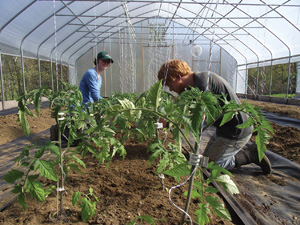
One of the most important tools that you can use to improve your hoophouse production is a pencil and paper. When confronted with a new idea of how to do things, it’s important to “pencil it out,” look at it on paper and see if it makes as much sense there as it does in your head. Such a change is what I give most of the credit for doubling my tomato yield. I have two 30 x 48 foot unheated hoophouses. At 1,440 square feet each, that’s not much protected cropping space, and very valuable real estate to me. I grow tomatoes in one and cucumbers in the other, and switch back and forth every year. It’s not the greatest rotation, but I figure it’s better than tomatoes every year.
In 2011, I used the kind of spacing that I see a lot of people with hoophouses using — a single row of tomatoes with a head (the growing tip of the plant) every foot or so. I think of row spacing in the number of heads per foot rather than plants, because this expresses the correct spacing regardless of how many heads are on the plants. For example, if you wanted to have one head per foot over 50 feet, that would be 50 single leader plants, or 25 double leader plants, both producing the same head spacing. So for the purposes of this article, I’m going to talk in terms of number of heads to figure out plant spacing.
Previously in my 30 x 48 hoophouses, I was planting five rows of tomatoes, one head every foot, with rows 40 feet long. I am planting indeterminate, grafted, double leader tomato plants, so in my case those 40 heads were from 20 plants with two heads each. So at five rows with 40 heads each, that gave me 200 heads in the house.
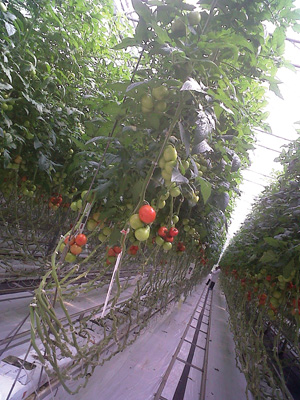
In my job doing tomato variety research and development for Johnny’s Selected Seeds, I get to visit a lot of greenhouses. I noticed that many of the larger greenhouses I was visiting use a double row of tomatoes, rather than a single, with the two rows 2 feet apart, and a 3-4 foot walkway between double rows.
I began thinking about the implications this spacing change could have on my own little hoophouse, so I got out my pencil, and after a little scribbling realized that I could accommodate four double rows of tomatoes two feet apart, with four feet between double rows in my 30 x 48 house. This raised the number of tomatoes I could squeeze in from 200 heads (1.25 plants per square meter) to 320 heads (2 plants per square meter), a 60 percent increase.
This increase in number of plants also results in a decrease in the amount of airflow. Although I did see a little bit more botrytis, in particular in the middle of the double rows, it wasn’t that much worse than my old, lower density spacing. I just kept an eye out for disease outbreaks and removed infected leaves when I saw them. Though disease was a little higher I don’t think it ever reached an economically damaging threshold and it never killed any plants.
I am pretty scrupulous about disease prevention, as far as scouting, removing old leaves below the developing fruit cluster, removing diseased foliage, sanitizing pruning and harvest tools regularly, and using rollup sides, peak vents, and HAF fans to improve ventilation. It’s also worth noting that my hoophouses are relatively new and haven’t had decades of use to build up a thriving population of diseases. Plus, our long, cold winters up here in Maine help the disease equation by killing off some pathogens that might overwinter in sunnier climes. So if there is a downfall of the high-density planting option, it’s the potential for higher disease.

Two heads per square meter is still a low density by commercial greenhouse standards. But since I am growing in a hoophouse, not a greenhouse where I could control humidity, I am worried about foliar disease outbreaks if I get the spacing too dense.
I still think there is some under-utilized space in the house that I plan on taking advantage of next year. There is almost 5 feet from the outer crop rows to the edge of the hoophouse. The very edge of the hoophouse does not have the full height of the body of the house, because the slant of the roof is very close to meeting the sidewalls by that point. But, there is still a good six feet or more of height there. So I plan on running a purlin down each side of the house, a foot and a half from the sidewall, and trellising a single row of cherry tomatoes, or a short heirloom like Cosmonaut Volkov for example, down each edge of the hoophouse.
If I’m really feeling rowdy, I might plant a row of tomatoes along the south wall of the house, perpendicular to the other rows in the house. I have always been searching for a way to make better use of the space we use for walking at the ends of the house. Now the north end is no good, because it is shady from all the plants south of it. But the south wall is pure sun. I might have to set up a trellis structure inside the house, more like a field setup such as T-posts with a wire along the top, since there is nothing to trellis to a foot and a half from the south end wall. But I think that setup would officially maximize the holding capacity of my hoophouses.
But who knows? Maybe you can think of some way to sneak a few more plants in here or there? If you do, let me know. People have long used other creative strategies to get the most out of their houses. Hanging baskets of flowers or even cucumbers over a low-growing crop like seedlings or bedding plants is another strategy to use more vertical growing space. It’s just not an option for me with 9-foot tall tomatoes or cukes in my houses.
Lowering and leaning
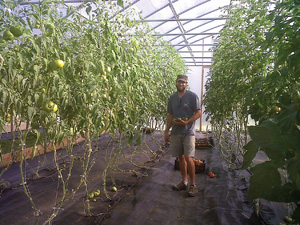
One reason beside plant density that double rows are standard in the greenhouse industry is because they use the two rows for lowering and leaning the plants as the vines grow. Lowering and leaning is a technique that enables growing a plant that is longer than the height of the structure that it is being grown in. The plant is grown up a piece of twine, with extra twine spooled and clipped securely to an overhead cable. There are several different devices available to attach the spool of twine to the overhead cable until it needs to be played out. The most common of these is called the Tomahook but there are others that work well, too. I use this system in my house because otherwise the plants would grow up to the top cable and run out of room sometime in late July or August, with some of the best growing yet to come.
When the plant has climbed the length of the twine, reaches the overhead cable and runs out of room to grow up any more, some of the twine is spooled out and the plant is lowered, giving it room to continue to grow up. The plant also needs to be leaned after lowering, or the stem would build up and possibly kink and break after repeated lowerings. So lowering is always accompanied by leaning, or pushing the plant down the wire to keep the stem from piling up at the base. The effect by the end of the season is that the head of the plant is many feet away from the roots, with the stem trailing along the ground where the plant has been leaned.
Since there is nowhere for the plants on the end to slide, they have to be looped around to the other row in the double-row pair. In this manner, the tomato plants are unlimited in the height they can achieve. Of course they are limited by the season and how far the roots can pump water to the head. But the vines can get very, very long using this method in a heated, long-season greenhouse.
The top wire in my hoophouse is 9 feet above the ground. We paid a little more for the extra high sides on our hoophouse, which is not that much more expensive and I think well worth the investment for anyone wanting to grow tall, trellised vining crops. I have never measured my plants at the end of the season, but I would guess they are approaching 20 feet long even in our short season and without heat. For the record, we plant our hoophouse tomatoes the first or second week of May and they usually get killed by frost in the first week of October or so.
I’d like to pause here and put in a plug for grafting. My plants are not much less vigorous the day they die than the day they get transplanted. The only way I know of to achieve this level of vigor is through grafting. I have seen hoophouses even in our short season area that lose vigor and stop pushing fruit before they reach the top wire and before the end of the season. If you have problems with low vigor in your tomatoes, it’s well worth it to try some grafted plants.
I realize that in some parts of the country, the best time of year for hoophouse tomatoes may not be the summer, as it is here in Maine. Even with climate change here in the far northeast, our field tomato season is so short that sometimes I wonder how people even grow tomatoes outdoors here. By the time they are ripening, it is cooling off again. Which is why I love my hoophouse. It gives me a nice long season worth investing some labor in to establish the plants for a decent yield. But those of you farther south can still apply these techniques for a spring or fall or even winter crop of tomatoes depending on your location.
In the next issue, I’ll report on a new trellising system from Holland that I loved for cucumbers and hated for tomatoes. In subsequent issues, I’ll write about how to recognize whether your vining crops are vegetative or generative and what to do about it; analyzing yield data to boost yield; and other ways you can get more production from your valuable hoophouse space.
Andrew and Ann Mefferd own One Drop Farm in Cornville, Maine. Andrew also works as a trial technician for tomatoes at Johnny’s Selected Seeds Research Farm.
Copyright Growing For Market Magazine.
All rights reserved. No portion of this article may be copied
in any manner for use other than by the subscriber without
permission from the publisher.