











Winter is often a quieter time for farmers, but wildlife are still around and active, making the most of food and habitat sources — including overwintered crops and season extension structures. In addition to the frustration of seeing your hard work disappear overnight, and the surprisingly high fire risk caused by mouse nests in greenhouse heaters, rodent pests on the farm present a food safety concern: You never want to see unplanned manure showing up.
Rodent management approaches are going to be similar, whether thinking about a high tunnel full of winter-grown spinach, bags of seed in a shed, or a minimally heated barn full of stored squash. In the vein of the truism that an ounce of prevention is worth a pound of cure, your first steps are prevention through both sanitation and exclusion. Effective exclusion paired with good sanitation can eliminate, or at least greatly reduce, the need for lethal means of population control.
Sanitation
Practicing general farm sanitation is one of those recommendations that I lump into the category of “simple but not necessarily easy.” We likely all know that you don’t want to have piles of wood, messy forgotten corners, or heaps of vegetable scraps waiting to be composted someday, and especially not in close proximity to food production, processing, or storage areas. Establishing routines that prevent those problem spots is often harder to maintain long term, especially in the autumn when it can feel like everything needs to be harvested, processed, stored or sold all at the same time as days are getting shorter.
While rodents move about very effectively, it takes energy to move longer distances on their little legs, especially in colder months when they need that energy to stay warm, so they prefer to take up residence near food sources. Reducing suitable habitat is effectively reducing the population you have to manage, and cleaning up building perimeters may act as “soft exclusion.” Being prey animals, rodents do not like to travel across exposed distances, and prefer running under cover and alongside walls.
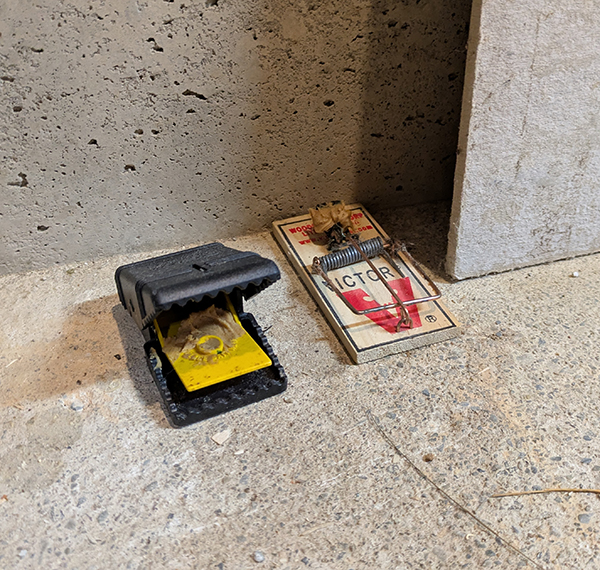
Wooden snap trap set perpendicular to a concrete wall by the outlet of a sheltered run resulting from haphazard storage of scrap materials. Quick-set style plastic trap for comparison. All photos courtesy of the author.
Whenever possible, avoid debris piles and leaning things up against buildings. Gravel borders, or at least grassy perimeters maintained at a low trimmed height, can help to make a structure less appealing. Similarly, pay attention to the area at the base of interior walls. If you’ve got space to store pallets and storage bins away from the wall, do so. It can be helpful to paint a white monitoring strip on the floor at the bottom of walls, to more easily notice any signs of rodent activity.
Exclusion
Similar to sanitation, exclusion is another task that is, of course, easier said than done. Effective exclusion is most reliable when done thoroughly, but that becomes more difficult as animal size decreases. Norway rats can get through openings larger than a half-inch, while mice can squeeze through openings that are just larger than a quarter-inch! Rodents have very impressive abilities to gnaw through things, so very durable materials are best for exclusion efforts: concrete, sheet metal, and heavier gauges of hardware cloth. Fill and cover gaps, holes, and screen vent/exhaust openings that are low to the ground — but only if you can do that safely.
Screening will potentially lower air flow and could allow for clogging over time, stopping air flow completely. It’s best to relocate necessary vent/exhaust openings higher up or to use manufacturer-approved exclusion. When insulating greenhouse baseboards, or the foundation of a new building, consider wrapping the outside of foam board in galvanized hardware cloth before burying it, and continue that coverage at least a foot above the soil line. Be sure to overlap ends of hardware cloth or sheet metal to prevent any gap that rodents could get through.
What about repellence?
Effective repellence would also fall under prevention. However, I’m unfortunately not aware of any rodent repellent effective enough for me to feel comfortable recommending it! Ultrasonic devices and similar gadgets have not been shown to be reliably effective in driving rodents from buildings. Trials generally show only short-term reductions in movement, followed by rapid habituation within days.
I’ve heard folks recommend applying peppermint oil to building perimeters, or planting peppermint around the outside of buildings, to act as a repellent. Because a moat of peppermint plants around your high tunnel might also provide voles or other rodents with a shielded runway to travel without fear, I would probably experiment first with applying peppermint oil. Any material you purchase and apply with the intent of controlling a pest needs to have been registered as a pesticide, even peppermint oil.
Though peppermint oil as an active ingredient is considered FIFRA 25(b) minimum-risk, you would still likely need to have your certifier add it to your list of materials if you’re certified organic. You would then also list your use of it in your pesticide application logs. I would caution that any repellent that gets applied needs to be reapplied regularly to remain effective (if it even is in the first place — let me know!).
Repellents are better viewed as accessories, not stand-alone solutions, and should not substitute for the foundational work of sanitation, exclusion, monitoring, and ultimately controlling any populations that are discovered near produce that must be kept safe.
Management through trapping
Because prevention and repellence can only do so much, many organic farmers rely on trapping for some degree of control. Live traps do exist, and they can certainly trap rodents if you feel like you have an ethical and legal way to deal with them afterward. The rest of this article will be describing lethal traps, though most everything said applies to live traps as well.
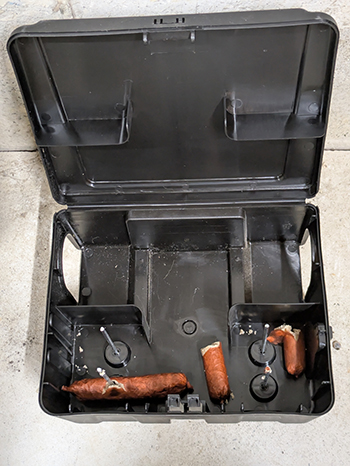
Evolve rodent fertility management baits in a securable box with openings positioned to be set against a vertical surface where rodents prefer to travel.
The difference between “we lost a corner of the spinach to voles” and “we lost all of the spinach this winter” comes down to population pressure. Because rodents can reproduce quickly, the critical window for population management usually begins in the late summer or early autumn — before they’ve started to nest inside the areas you don’t want them in.
Identify the areas that you want to protect, the species of rodents that you think you’re contending with, and the traps that you are most likely to successfully use repeatedly. Newer plastic traps may help with the “ick factor” while old fashioned wooden snap traps with metal bait clips may allow for the most fine-tuning of trigger sensitivity. Newer electronic or CO2-powered multi-kill traps may allow for more time between monitoring. When rodent population pressure is high, you may need to “walk the trap line” more than once a day to reset traps and to reduce the likelihood that more cunning species, like Norway rats, begin to associate a trap’s bait with danger.
Trap placement and bait choice depend upon the rodent species you’re targeting. Pine voles can be a very difficult pest to deal with but are less common in vegetable farm settings and won’t be discussed here. Mice, rats, and sometimes chipmunks are the rodents that we are most concerned about in wash/pack and storage buildings. Rats can sometimes tunnel underneath planted greenhouses in the summer months as well.
Mice, rats, or chipmunks can cause havoc by getting into seeds (before or after planting) or building nests where you don’t want them to — and a mouse nest in a greenhouse heater could lead to a dangerous and costly fire. Voles, however, are the rodents which most often cause the greatest economic damage, eating greens or seedlings in a planted greenhouse or high tunnel. While you must still take care to prevent contamination from their feces, shrews are not a pest species and may be beneficial to you because they actually feed almost exclusively on insects and other small animals.
Voles love to run in “tunnels” through vegetation just above, or barely below, the surface of the soil. Vole damage can look similar to cutworm damage, with seedlings chomped off just above the soil line, and may also be noticed as leaves that have been dragged into the entrance of a tunnel. Because voles are vegetarian, they will go for a small slice of apple as bait — I’ve even had success with a slice of beet!
Mice and rats are almost always successfully lured in by protein-rich peanut butter. When I don’t know whether I’m dealing with a vole or a mouse, I will sometimes use a small slice of apple with peanut butter on it. Because of their strong drive to run against vertical surfaces, and under the cover of their “tunnels,” vole trapping will often be successful even without bait, if attention is given to proper trap placement.
Realistically, it may be hard to find a bait that is more attractive to a vole than your frost-sweetened spinach! Place open traps directly in known runs, perpendicular to vertical surfaces, or in pairs lengthwise in the run, with triggers facing outwards. Surround any identified entry points with as many traps as you can get your hands on, and consider developing a system to identify trapping areas with a specific color of flagging that is known to all farmworkers to avoid accidental encounters.
Many have reported consistent success with placing traps in something that creates a sheltered tunnel — that could be a commercially available secured enclosure, a purpose-built box (many designs exist), or a short length of gutter turned upside down (my preference). Though these simulated tunnels may be attractive to voles, they also come with a downside for anyone like me who easily falls victim to “out of sight, out of mind.”
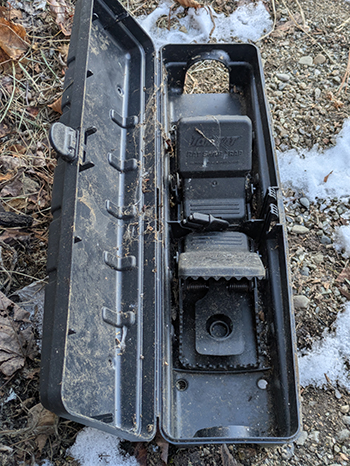
Quick-set style plastic rat traps in a securable box, which reduces non-target risks and can be placed alongside a vertical surface. The tunnel design is attractive to rodents, as it allows them to feel more sheltered, and can be replicated with an upside-down length of gutter placed over two traps set facing outwards.
Trapping mice and rats shares similar approaches, benefitting from placement near vertical surfaces or other sheltered enclosures. Bait is typically much more important for these omnivores, but thankfully they tend to be real fans of cheap peanut butter. Norway rats may be cautious around traps, so it can be beneficial to first leave rat traps baited but unarmed for a night or two to allow for some acclimation.
Similarly, if you are successful with a rat trap but not very quick to deal with it, other rats may associate the trap and its bait with death and avoid them for a while in the future, so it is best to rotate through different baits, and possibly traps as well, so that each rat is encountering a new temptation without “bait-shyness.” Other baits attractive to rats include chocolate, which can be easily utilized as a spread like Nutella; meats like bacon, pepperoni, etc.; and the cartoon classic, cheese — but only if you can adequately secure it to the trap’s trigger.
If, when checking your traps, you find them set off with the bait missing and no rodent, you may need to 1) better secure the bait to the trigger; 2) bend the catch on a traditional style metal trigger to make it trip more easily; or 3) place bait further towards the back of a plastic trigger paddle (in the case of quick-set black plastic style traps) as that forces a mouse to go further into the trap to get the bait. Rat traps are less likely to spring when a lighter-weight mouse goes after the bait, and you may find yourself needing to set mouse traps where you thought you were only targeting a rat.
In the other direction, mousetraps that have sprung with bait removed and no catch may have been triggered by a rat that was large enough to avoid incapacitation, and you may need to begin setting rat traps as well. You can generally tell whether you’re dealing with mice or rats by the size of the droppings they leave behind. Multi-kill traps may be particularly useful in storage areas that don’t get walked through regularly.
Population management with bait
If prevention methods and physical methods such as trapping are still insufficient for achieving satisfactory population management, certified organic producers may use baits formulated with the one synthetic rodenticide approved by the National Organic Program (NOP) — vitamin D3 (cholecalciferol). As with all certified organic management, farmers must communicate with their certifier to demonstrate that they utilize all of the non-synthetic management options before adding an approved synthetic to their management plan, as well as to verify that any specific product — and not just its active ingredient — is approved for use. An important consideration with cholecalciferol baits is that most rodents will need more than one or two days of exposure before they succumb to them.
Cholecalciferol baits carry a much lower risk of secondary poisoning for non-target species than conventional anti-coagulant rodenticide baits (i.e., scavenging predators, dogs, or birds like vultures receiving a toxic dose from eating the corpse of a rodent that died from it), however, they are not entirely without risk. It is critical that the manufacturers’ instructions be followed to reduce the risk of primary poisoning of non-target species from unsecured baits.
Another, much newer set of bait products has emerged recently. They are non-lethal but may still help to keep rodent populations in check. ContraPest and Evolve are two fertility-control materials produced by Senestech that are designed to act as rodent birth control and may improve population management when used in addition to (not in lieu of!) the approaches already discussed. Evolve lists cottonseed oil as its active ingredient, allowing it to be regulated as a FIFRA 25(b) minimum-risk pesticide.
While that suggests it is non-synthetic, and likely to be allowed in organic systems, it would still need approval from your certifier before you use it, as all ingredients must be allowable. ContraPest has synthetic active ingredients that are not currently approved by the NOP, so despite its non-lethal mode of action certified growers would need to seek their certifier’s approval of a strict separation plan that adequately documented how these baits would be kept away from organic crops and soil.
Wild predators and domestic animals
Many wild predators happily feed on rodents, including snakes, birds of prey, and carnivorous mammals like foxes and coyotes. While it is likely beneficial to ensure habitat for these providers of free rodent population control outside of your growing area, similar food-safety concerns apply to their droppings as much as to rodent droppings, and in the case of wild or domestic cat species, even more so.
Cat feces are the only source of a long-lived infective form (oocyst) of the parasite Toxoplasma gondii, which can cause serious harm to fetuses if ingested by a pregnant person or animal. While keeping a farm cat may have a very useful impact controlling rodent populations, care needs to be taken to minimize risks of them spreading T. gondii. Very young cats that have only recently been exposed through hunting or eating raw meat are the most common avenue through which T. gondii oocysts are produced and spread (typically within the first two weeks of initial infection), as previously infected cats essentially do not spread the oocysts a second time.
While the oocysts can remain infective for more than 100 days after entering soil or water, they are not infective for the first 24 hours after exiting a cat. In a nutshell, this means the most important steps to reduce risks from keeping a farm cat around for rodent control are: 1) take the most care with young cats that are not expected to have hunted previously, as they are the most common vector of T. gondii oocysts by a large margin; 2) exclude cats from food production areas and also areas where animal feed is kept; 3) provide food to farm cats — fed cats hunt essentially as much as unfed cats but are much less likely to eat what they catch, reducing infection risk; and 4) provide at least one litterbox that is maintained daily to ensure that it’s the more attractive location for a cat to do its business (daily removal ensures disposal of oocysts before they become infective).
Dogs are also used to control rodents on occasion, with some “ratter” breeds being especially well suited to the task. You may even have owners of ratter dogs around you that would be happy to use your farm as a training area for their dogs to exercise their strong hunting instincts.
In all cases, domestic and wild rodent predators should be kept safe from non-target effects of your other rodent management efforts. Think twice about trap locations if you have a dog that can’t resist peanut butter, or invest in secured trap boxes, many of which are designed in a tunnel-like fashion to be more enticing to rodents. All baits that I’m aware of have label requirements to only be used in secured bait boxes, or possibly in underground burrows, and for good reason. While cholecalciferol poses low risk from secondary exposure, primary exposure (i.e., eating full bait blocks) can be very toxic to mammals and can cause long-lasting and unnecessary harm even if ingested below a lethal dose.
Please note: This information is for educational purposes. Any reference to commercial products or trade/brand names is for information only, and no endorsement or approval is intended. Pesticide registration status, approval for use in organic production, and other aspects of labeling may change after the date of this writing. It is always best practice to check on a pesticide’s registration status with your state’s board of pesticide control, and for certified organic commercial producers to update their certification specialist if they are planning to use a material that is not already listed on their organic system plan. The use of any pesticide material, even those approved for use in organic production, carries risk — be sure to read and follow all label instructions. The label is the law. Pesticides labeled for home garden use are often not allowed for use in commercial production unless stated as such on the label.
Caleb Goossen is the organic crop specialist of the Maine Organic Farmers and Gardeners Association (MOFGA) and the author of MOFGA’s Pest Report newsletter (sign up at mofga.org/newletter-sign-up-pest-report). Formed in 1971, MOFGA is the oldest and largest state organic organization in the country. MOFGA’s mission is to transform the food system by supporting farmers, empowering people to feed their communities, and advocating for an organic future. Learn more at mofga.org.
Copyright Growing For Market Magazine.
All rights reserved. No portion of this article may be copied
in any manner for use other than by the subscriber without
permission from the publisher.