

We’ve heard it many times. You didn’t get into farming to do marketing, bookkeeping, and all the other tasks of running a business. Yet, here you are knee deep in spreadsheets, Quickbooks reports, social media videos, and a host of other things you didn’t think you signed up for when starting a farm. It’s true, running a successful farm business requires that we wear many other hats.
The reality is that it is absolutely necessary to not just grow beautiful and delicious produce and flowers, but we small-scale farm owners are also responsible for selling and marketing these products.
This is a compilation of what I have discovered to work for my farm in terms of marketing on a small budget and limited time to invest. What I propose here are simple tasks that can be incorporated into your busy schedule with bigger tasks (such as website redesigns) happening in the winter months when we have the mental energy to be creative and the time to be proactive in laying the foundation for a successful season ahead.
While my farm is a small operation located in rural western Colorado, these tactics and concepts can be adapted to fit your needs and interests wherever you are located and whoever is your demographic. No longer is it necessary to invest hundreds of dollars in print ads or to pay graphic design firms large sums of money to create and update websites or graphics. Lucky for us in these modern times, there are many new apps, platforms, and other affordable tools available to farmers that make marketing approachable, fun, and easy.
Website
To start, I would argue that the most critical piece to our marketing plan is our website. This was the first marketing tool that my farm invested in with our very limited start-up budget. Websites do not have to be elaborate- maybe it’s just a landing page to start with- but having a presence on the web is crucial.
There is lots of great information out there on what to include on your website. However, more than anything, this is a place to collect names and email addresses for a newsletter, to let folks know how to get in touch with you and to list where to find your product. Make sure these items are kept up-to-date and include events and other current offerings if so inclined and time allows.
I set a reminder on my Google work calendar on the 15th of each month to give the website a quick look over and make basic edits including the addition of new events, changing the announcement bar (if necessary), and, maybe, updating the online store. I have used Wix and WordPress in the past, but currently use Squarespace as our web host and find it to be the most user-friendly for someone like me with little previous graphic design experience.
In the off-season, I make any big updates to the website. Fresh photos are always good and a review of content to make sure everything is still accurate are good winter tasks. What in the past would have cost several thousand dollars to hire graphic designers to build out and maintain is now available to small businesses for just a few hundred dollars each calendar year.
Email list
Going hand in hand with a website and the second big piece of the marketing pie is establishing an email list and identifying a platform from which to build and send email campaigns. For us, this platform is Mailchimp. There are many options out there (Brevo, Constant Contact, etc.), but Mailchimp is what I have always used and have had success with.
Again, for a reasonable price, $13 and up (or free if you are just getting started), you can build out and schedule professional looking emails with all sorts of reporting and analytics that can help you refine your messaging and identify who your most engaged customers are. When getting started, find the plan that is right for you depending on your email list size and how frequently you plan to send out newsletters for an estimated total quantity of emails sent each month.
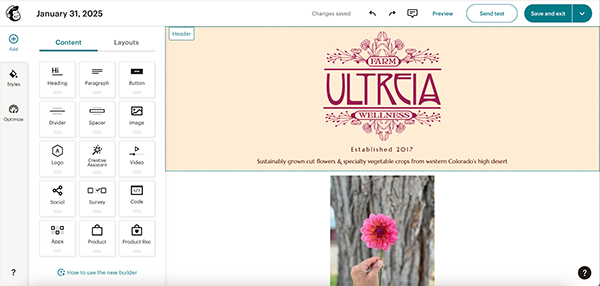 We use MailChimp as our email communication platform. As you can see here, it is user-friendly for even the novice and allows you to create a customized, professional newsletter that your customers will love. There are many tutorials available to help you learn and refine your skills on this platform. All images courtesy of the author.
This can always be changed later. The general opinion amongst farmers in the current climate is that newsletters are the most consistent, reliable source of communication and advertising. Unlike social media, you know this message is going to land in the inbox of your targeted customers. It is easy to set up an email template that can be used each week or however frequently you send a newsletter.
Again, I like to update ours occasionally to keep it fresh and interesting. Another feature that I especially like in Mailchimp is “tags.” By creating tags, I can isolate certain segments of our customer base and communicate with them specifically. This has been especially useful for CSA purposes.
At our farm, I send out a weekly email during the growing season and then my goal is an email every three weeks or so in the “off-season.” As our farm continues to evolve with late winter and spring flower sales, this email campaign schedule is becoming more gray. Yet, really, it is whatever fits your business’ needs and your time availability best.
One important tip to remember is to not just send emails when you are trying to sell something. Believe it or not, our customers want to learn about our lives, what and how we do things on our farm, and create rapport with us. The newsletter is a great way to do this. There are many effective ways to write a successful newsletter depending on your intention, and again, how much time you have to cater to subsets of your audience, but I tend to stick to a format that is tried and true for my clientele.
This includes:
Farm Narrative: This is usually a 300-500 word creative writing piece that creates an emotional tie and connection with the reader. Based upon feedback, it is a great conversation starter at market and a community-building tool.
List of “What’s At Market”: This list includes everything that we’ll have at market so that if someone is unable to make it, they can send their list with a friend.
List of “What’s Coming Soon”: This list includes everything that is going to be coming within the next month. We’ve found that it has the effect of creating desire and a “fear of missing out,” especially for items that will only be available for a brief time.
Bullet point list of “What’s Happening On The Farm”: This list provides a brief snapshot of what tasks and events are happening on the farm in any given week. Maybe we had a dump truck full of compost arrive, maybe it was the week for seeding brassicas or transplanting hoophouse crops. There are so many things that we might take for granted as normal operations but that help to paint a fuller picture of what you’re doing at your farm and help your customers get to know you and your operation.
Events Graphics: At the bottom of newsletters, I include graphics and links to any upcoming special events such as a one-time festival or workshop that we might be offering.
Social media
And, the third biggest piece of the marketing on a small budget pie is social media. As much as most of us love to hate it, various platforms are used by almost all of our customers. Like it or not, it can be helpful to get our brands out there. At our farm we use Facebook and Instagram. We have found that they both serve different purposes and both tend to be used by different demographics. Facebook tends to be more conversational and receives the most engagement from our late middle age and up clientele. Instagram has more visual appeal and speaks the language of beauty through photos, an important means by which to share imagery of beautiful vegetables and flowers. For us, we have found that our younger audience is more responsive to this platform.
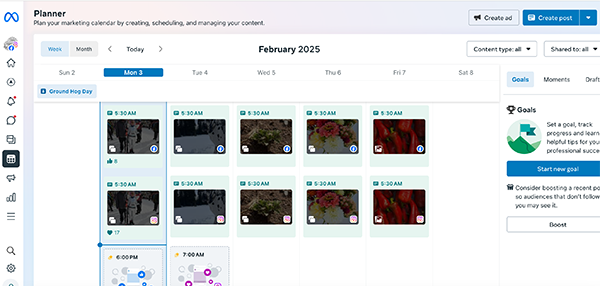
This photo shows my farm’s Meta Business Suite “Planner” page. Here I schedule all my posts to go out on Facebook and Instagram for one week at a time so that I can try and minimize my time on social media. Of course there is still the option to do an impromptu post, story, or reel if something strikes me during my day on the farm, but having these scheduled posts in place frees up mental energy knowing that this part of our marketing is complete for the week.
My advice would be to get to know who your ideal customer is and use the platforms that are most appealing to them. There is no sense in dabbling in every platform out there because, one, we have more important things to do like grow food and flowers, and, two, if a particular platform caters to a demographic that is not necessarily your target, why waste your time there? If Facebook is one of the platforms you decide to use, we have found some success with attracting new customers by using our town’s and county’s message boards.
A couple of tips that I have found helpful to consider when using social media are that, one, it’s not about how frequently you post, but about your consistency. For example, I like to set a goal for myself such as making two posts per week during the off-season and five during the growing season. Although the algorithms of these platforms continually change, this goal helps me to get in a rhythm and always be thinking about what might be an interesting (or necessary) post.
As for inspiration for posts, be creative. I like to mix it up to include some sales pitches (i.e., our CSA is now open); some educational posts (i.e., here’s how we soak our ranunculus corms); some “what’s happening on the farm” posts (i.e., check out these gorgeous new head lettuces); and some marketing posts (i.e., we just scheduled our next fermentation workshop).
To manage my posts I use Meta Business Suite. As we all probably know by now, social media can be a total time suck. By designating a time each week to schedule all my posts for the week, I stay focused and on task. I use my Google calendar with a recurring Monday “task” where I keep a running list for each week of what I’d like my scheduled posts to be. This way, I can just open that on Monday morning and post according to what I’ve been brainstorming throughout the previous week without taking much time to noodle on content.
This probably goes without saying, but post photos of people whenever you can. Don’t be afraid to become the face of your business. People want to support people. It can feel vulnerable putting your photo out there, but it is one of the many ways that we strive to create connection and community through my farm’s marketing.
Other notable tools
These are the three biggies of our marketing plan, but there are some other notable tools and techniques that I have come to adopt over the years. First of these is Canva. For anyone not familiar with Canva, it is a graphic design platform that provides tools for creating social media graphics, website content, and flyers. I have also designed our business cards, gift certificates, workshop materials, educational materials (example: how to care for dahlia tubers), and labels there. It is extremely user friendly and affordable. The basic plan is free. We use the Canva Pro option for $15 each month. It is advertising dollars well spent.
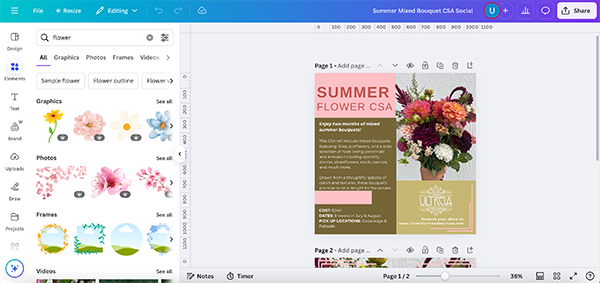
I regularly use the Canva platform for all my farm’s graphic design needs. I now use the Canva Pro plan so that I have access to all the premium content; however, for years I used the basic free plan. The free plan allows you to get comfortable with the features and see how you like it, all at no cost. Pictured here is a social media graphic that I made to advertise our Summer Flower CSA.
Another tool is a calendar of events. This is a road map for what, how, and when you’d like to get the word out on certain events and offerings. I map out this calendar that lists all of our events for the year, and it also includes miscellaneous tasks and any ordering that needs to happen that month. I include this in our marketing discussion because I also lay out when I would like to do things like roll out our CSAs, the dates for our dahlia tuber and plant start sales, workshop dates, all special events and festivals that we have committed to, and one-off pop up markets such as Small Business Saturday.
It helps me feel and stay organized in my marketing approach. This way I can proactively plan to stagger events like my dahlia tuber sale and the roll out of my summer CSA. I also can work around major holidays that might have an impact, negative or positive, on an event or product that I would like to promote. This tool allows me to be methodic in my planning rather than chasing my tail or bombarding our customers with too much information. I create this calendar in our off-season so that I do not have to expend the mental energy during the season to plan this out.
I would be remiss if I did not mention word-of-mouth and community-activism advertising. Word of mouth advertising is what testimonials and reviews aim to do — create the social proof that your brand is not only legit, but loved. While it seems obvious, here’s your reminder to get involved in your community. I have made a point of becoming involved in local business organizations and Business After Hours sponsored by our town.
I am on the board of local nonprofits and volunteer when I am able (in the off-season). Our farm is a member of the local growers association. We try to donate to several silent auctions each year. We create opportunities to partner with other local businesses so that we can cross market and be introduced to potential new clientele.
These are all great ways to spread the word on your business, have casual conversations with potential customers, to garner feedback and hear those brand testimonials, and to create goodwill and let everyone know that you are invested in your community. We are always looking for ways to cultivate these connections, and we have found that there is no shortage of them if you are willing to give back to the community that supports you.
Finally, I encourage you to get creative. Look for marketing opportunities that may be unique to your community. For instance, in our town there is a locally owned boutique motel that has a marquee where they advertise events for local businesses. Our town sends out a calendar of events each month with the utility bills and all I have to do is email them by the 20th of each month with any details I would like included (this is another set Google calendar “task” reminder). Our community radio station has a calendar on its website where events can be submitted and available through their website on the listening-area-wide calendar of events, and sometimes are read on the air.
Before wrapping up, it is critical to include a bit of information on messaging. If you’re going to the trouble of marketing your business, think about what are the best ways to communicate who you are and what you do. I’ve come to terms with the fact that we are not for everyone and everyone out there is not for us. What’s that phrase? If you’re talking to everyone, then you’re talking to no one.
For our farm, this means that I write our newsletters and I use language in our social media just as I would if I were talking to a friend. I speak in my voice and have become an ambassador storyteller for us. I am honest, letting my personality (and occasionally opinions) shine through. I check once, twice, and then a third time for grammatical and typing errors. Although it can sometimes be in a straightforward, friend-to-friend tone, I want it to be professional and clear.
I like to use language that evokes emotion or appeals to one’s emotions. The reality is that no one wants to read a vanilla newsletter or boring post that could have been shared by any farm in your area. Use language that makes it your own. And, finally, it is not always about selling in all of our messaging. Sure, that’s an important part of the marketing dynamic, but so is building relationships and asserting your authority on a topic by educating. There is a wealth of information that each of you holds as a farmer for how exactly you do things that your customers would love to hear.
I am by no means the expert (in fact, I have never taken a business course in my life), and I’m constantly learning new tricks of the trade. Fortunately, there is an abundance of useful podcasts, informative books, YouTube videos, and free or low-cost workshops available to keep growing my marketing tool box.
If this is all new to you, I invite you to pick one or two things to focus on and set specific, measurable goals for yourself now that can be tracked throughout the season. If it’s all old hat, hopefully there’s a kernel of wisdom in here that can sharpen or refine what it is you’re already doing. Regardless, I hope that you, too, can find enjoyment in becoming the voice, face, and ambassador of your farm through budget-friendly marketing that fits into your busy schedule.
Melissa Newell is co-owner of Ultreia Farm & Wellness located in the rural town of Cedaredge located on Colorado’s Western Slope. Growing in a high altitude, desert climate, she farms about an acre of specialty vegetable crops and cut flowers together with her husband. You can learn more about Melissa and her farm at www.ultreiafarmandwellness.com, or follow her on IG or FB at @ultreia.farm.wellness.
Copyright Growing For Market Magazine.
All rights reserved. No portion of this article may be copied
in any manner for use other than by the subscriber without
permission from the publisher.