











August has come and gone, and here at 3 Bug Farm our crops (and weeds) have reached a frenetic crescendo of photosynthesis. Somewhere in their DNA, the plants know that Maine summers are brief, and they have only a few months to grow, make seed, and die or go dormant before the long winter settles in.
This means we’re busy, along with most growers at this time of year. This year, we’ve managed to work most of the kinks out of our production systems (so far least) – and so, the crops are looking pretty healthy, and yields are coming in more or less where we expected them to be.
At this time of year, the greatest risk to our bottom line (and our largest nighttime preoccupation) has to do with how well we’ve matched our production to our impending sales. Will our customers buy what we thought they would buy when we made our planting plan, at the volume and price we predicted? Or will our hard work and money decompose before our eyes as sales come in lower than we’d hoped?
We’re not alone in thinking about this. Fortunately, there are some simple business planning and recordkeeping practices we (and many of the farms I consult with) engage in to help prevent the heavy crop and financial losses that stem from lower than expected sales.
Inventory turnover
The rate at which you convert saleable product into sales is called, “inventory turnover.” Your inventory turnover rate is a great way to measure how closely your production matched your sales. I believe that inventory turnover is the first and most important aspect of business management a farm owner should focus on. This is because, in agriculture, so much of your money (and thus risk) is invested in a crop long before you see a dime of revenue. By August, most of your expense budget is used up for the year, and most of your inventory is sitting in the fields in live, perishable form. If you can’t convert it into cash before pests, disease, or plain overmaturity renders it unsalable, then the money you’ve invested evaporates, leaving nothing but red ink on your books at the end of the year.
When I start working with a new farm client, the first thing I do is take a look at their inventory turnover, and estimate the financial damages they incurred last year. I usually ask them to add up (sometimes estimate) the total saleable product their farm produced in one year, for each of their major crops; and then their total sales (using the same unit they measure yields with) for those crops. Divide the total sales by the total inventory, and you will get a percentage figure – that’s your inventory turnover in one year.
Now subtract this % turnover from 100%. You will get another percentage figure – this is your crop loss rate from market mismatch, what someone in another industry might refer to as “shrinkage”.
Next, multiply your loss % by your variable costs associated with growing that crop (for more information on crop losses and variable costs, see my March 2016 article in Growing for Market). That’s roughly the amount of money you spent on the crop, but did not recoup – it disappeared.
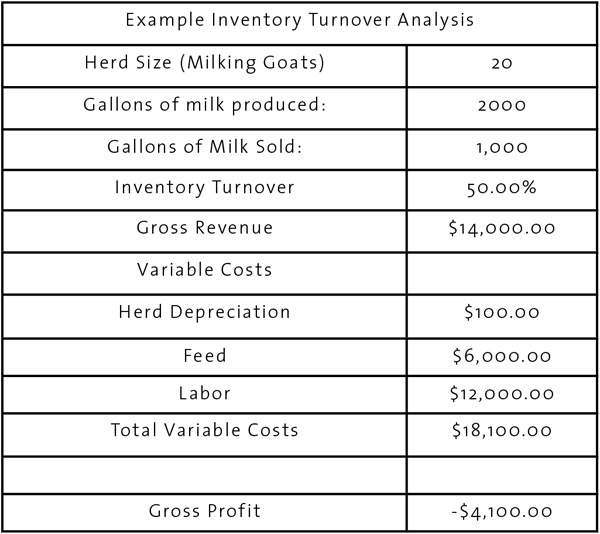
Take, for example, a small goat dairy, milking 20 goats. Say each goat produces 100 gallons of milk per year, and the dairy sells the milk for $14 per gallon. That would mean 2,000 gallons of milk per year. If the dairy sells its milk for $14 per gallon, that means it might theoretically gross $28,000 per year. If the dairy has variable costs of $18,100 per year in feed, vet, and labor, it might make a gross profit of a little under $10k. Sounds pretty good, right?
But say the dairy only sells 1,000 gallons of milk. Its inventory turnover (1,000/2,000) is 50%, its gross revenues only $14,000, and it posts a loss of -$4.1k. It wasted over $9k in variable costs ($18.1k variable costs times 50% loss rate). Ouch!
I am often asked what an acceptable inventory turnover rate is. The answer will vary farm by farm, but in general, if you’re 80% or higher, you’re probably in good shape.
Improving turnover
If your bottom line is suffering due to low inventory turnover, then you need to match your production more closely to your sales. There are two basic ways you can do this: increase sales, or lower production. The rest of this article focuses on ways to ensure that your production and sales are as close to matched as possible.
Creating sales forecasts
The first place to start is the sales forecast, sometimes called a marketing chart. This is simply a chart showing all your major crops, along with the potential sales, in both quantity and $ revenue, that you expect to make for each major customer in the course of one year. Sales forecasts are best made in the winter. For wholesale customers, list individual customer names; for direct markets, list the market (e.g., “Hilldale Farmers’ Market” or “Farmstand).
It’s important that this chart projects the potential total sales you might make if you had unlimited product – not necessarily what you made the previous year. Depending on whether or not each customer is a wholesale account or a direct market, there are different methods for estimating the data you need for a sales forecast.
Negotiating commitments
The foundation of just about every successful wholesale relationship I’ve seen involved a commitment letter. This is a written agreement stating that a farm will attempt to grow and sell a specific set of crops, for a specific time frame during the season; and the wholesale buyer will make an effort to purchase those crops, at stated volumes and prices. Sometimes, commitments include details like pack sizes and quality standards. Commitments are usually non-binding, “good faith agreements” – they are usually not legally enforceable contracts. They work best when undergirded by a foundation of personal trust between grower and buyer.
In my experience, it is usually the responsibility of the grower to produce a commitment. I advise farms to meet with their customers at least once in the winter. If you can compile a report of sales by item for the previous year with that customer, do so – it will make the conversation easier. Review what worked and what didn’t from last year, and identify potential areas for growth – either new crops, or expansions of existing crops.
Soon after the meeting, draft a note (usually an email) to the buyer, saying something along the lines of, “Thank you for meeting with me yesterday. Based on our conversation, here is what we intend to grow for you: X crop, at a volume of X cases per week, packed X bunches per case, at $X per bunch/case, from June 1st to October 15th . . . “ etc. Always end the email with a question: “Does this sound acceptable to you?” If they don’t respond, politely nudge them again until they do.
In the past, I have used commitments to negotiate or defend prices. For example, once my wife and I were engaged to sell kale to a supermarket chain. In the winter, we tendered a price that they accepted. One week before the kale was ready to harvest, their buyer called us, trying to get us to lower our price by 40%. When I furnished the commitment letter to both the buyer and his department head, they stuck to the original price. We grossed an additional $20,000 that year as a result. Sometimes words are worth a lot of money!
Sales Velocity
Direct market sales can be trickier to estimate. It may be tough to collect commitment letters from every patron of your farmstand! This is where good recordkeeping of sales can really pay off.
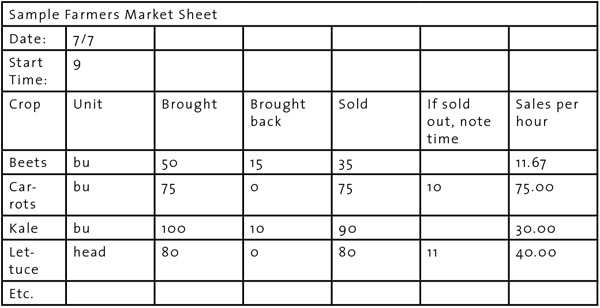
There are many computerized sales recordkeeping apps now available, but for many farms, hardcopy is the most viable option. The easiest way to measure sales at farmers’ markets may still be the “inventory brought & brought back” method that many farms I work with use. Simply track the quantity of product you are bringing to a given market on a given day, then what you bring back – the difference is a decent approximation of your sales. Many farms pack their inventory in easy to measure, standardized bulk quantities – bushel baskets, or 1 1/9 bushel wax boxes, for example. They might record that they brought 2 bushels of peppers to market, and brought ¾ bushel back. Thus, they sold 1.25 bushels. This makes it super simple and fast to take inventory before and after.
However, this method doesn’t necessarily provide an accurate projection of your potential sales. What if, for instance, you continually sold out of peppers? For every minute you sit at your stand without peppers, you are missing potential sales. How do you know what those might be, and thus how many more peppers you should plant next year?
In order to accurately measure this, you can begin measuring the sales velocity of your products. Sales velocity (or sell-through rate) is the rate of speed at which you sell a product. In the case of farmers markets, sales velocity is best measured in sales per hour; sales per day might be more appropriate for a farmstand.
To track sales velocity at a farmers market, add a column to your sheet for you to record when you sold out of a given product. That way, you can calculate your sales velocity by dividing your total sales for the day by the number of hours the product was available.
Multiply the sales per hour by the total number of hours you do that market, and you will produce a reasonable estimate of your total potential sales for that crop.
Adjusting production
Once you’ve created a marketing chart, it’s time to make sure your production is reasonably matched to your sales. Add up all the potential sales for each crop; divide this by your expected yield per bed or animal; and now you know how many beds you need to plan or animals you need to stock.
Balancing production to demand is tricky business. Plant too much, and you’ve wasted space and money. Plant too little, and you’ve missed sales and created unhappy customers. In general, I advise farms to plant 15-20% more than their marketing charts call for.
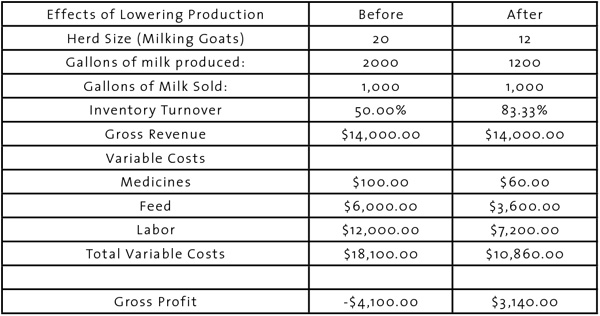
Sometimes, your marketing chart may tell you that you are overplanted or overstocked. This may seem like bad news at first; but lowering production tends to be easier, and may provide you with the financial effects you need. For example, if the goat dairy mentioned above cut its milking herd to 12, but maintained the same level of sales, its inventory turnover would improve to 83%, and its gross profit would jump over $7k to $3,140 – all without having to add a single customer, employee, or piece of equipment.
Tracking sales
It’s important to create marketing charts and matching production plans, but they don’t guarantee anything. In fact, I’ve never seen a plan that happened exactly as intended – there are just too many variables, from the field to the taste bud, to create that level of predictability. A sale isn’t a sale until the product changes hands.
This means that it’s not enough to create a great marketing and production plan, then shove it into a corner of your desk and forget about it for nine months. In order to improve your inventory turnover, you have to have a mechanism for tracking your actual sales, by crop and by customer, against your forecasted sales; and quickly addressing problems as they arise. I recommend that you compile and review this report weekly during the season (and, being cognizant of how busy you are, I swear this is the only report I would say that about).
Compiling the sales actual vs. budget report is one place where Quickbooks can make your life much easier. If you use Quickbooks for only one thing, use it to track sales and make invoices; you can also set up a budget and quickly pull a report that automatically compares your actuals vs. budget to date for the year.
If you identify any significant gaps between your budget and your actuals, address them immediately. For example, there may be a quality issue that is not significant enough for a buyer to mention, but is inhibiting sales. In northerly locations, the growing season is just too short to miss even a few weeks of potential sales.
If necessary, contact your customers and politely investigate. Don’t be antagonistic; you can use phrases like, “We noticed that sales were lower than expected, and we wanted to know if there’s anything we can do to help you sell more of our product.”
In one example, my wife and I were wholesaling salad mix to a co-op we had been selling to for years. Sales suddenly dropped in half one July; foolishly, we let this continue for 5 weeks, thinking this was an aberration. When we finally contacted the co-op, we learned that another farm had provided the co-op with farm specific packaging for their mix; customers were buying this instead. By providing labels, we were able to regain our market share.
The importance of communication
One of the games I sometimes like to play with participants in marketing workshops I call, “The Head Lettuce Game.” It’s modeled after an activity called the Beer Game (http://www.beergame.org), which was developed at MIT. It’s meant to simulate a local foods supply chain for head lettuce. There are four players: a retailer, a processor, a distributor, and a farmer. In each round, each player receives and fulfills an order for lettuce from the person “upstream”; then decides how much lettuce they want to order the next round. The farmer decides how much he or she wants to plant; lettuce takes four rounds to be ready to ship. Also, each player must place any lettuce they did not ship that’s more than two rounds old in the “compost.”
Most importantly, the players are not allowed to speak with each other during the 25 round game; only to place and receive orders.
Almost inevitably, a phenomenon called the “Bullwhip effect” begins to manifest. Small changes in demand for the Retailer get multiplied as they move down the chain, creating large and seemingly unpredictable spikes and drops in orders by the time they get to the farmer. I’ve seen farmers receive orders for 50 cases, plant 60, then receive orders for 0 by the time the lettuce is “ready.” That’s a lot of compost!
This effect gets produced no matter how well-meaning and thoughtful the players are. They are each trying to manage their own inventories as rationally as possible; but they are not able to do so without knowledge of the inventories of their counterparts in the game.
Sadly, this bullwhip effect is well known to almost anyone who’s tried to engage in the wholesale produce supply chain at any level. Too often, the response, whether it be from the farmer or the buyer, is to feel jilted or frustrated. “This guy promised he would buy stuff from me; when I had it ready, he abandoned me!” “Yeah, well where were you when I needed it three weeks later?” Etc.
There is an antidote to the bullwhip effect: strong communication up and down the supply chain. When players (or real farmers and buyers) are more aware of each other’s inventory and sales velocity up and down the supply chain, they can work together to adjust plantings and find new markets before having to send too much to the compost pile. If a buyer knows that a farmer will have a product three weeks ahead of it being ready, they will work to clear their existing inventory ahead of the product’s arrival. If they don’t have that lead time, they may have to tell the farmer to wait three weeks instead – and the farmer may not have three weeks to wait.
From the farmer’s point of view, this means you shouldn’t expect to completely fall out of touch with your customers between the crafting of that commitment and the time the first product gets shipped. Keep in touch – when you start plants in the greenhouse, when you plant them in the field, as the crop grows. Send updates, with pictures. Especially, notify buyers when something’s gone wrong as soon as possible. Nine times out of ten, the buyer will really appreciate being given the lead time to find another source if you have a crop failure, and they will keep working with you.
This kind of communication requires a level of trust that can be harder to find the larger and less personal the supply chain gets – but when managed properly, it can reduce market mismatches, increase inventory turnover, and make the overall system more efficient and more profitable for all. It’s one of the advantages the more local, small-scale food system has over its larger competitors.
Jed Beach is a farm business consultant and organic vegetable farmer in Lincolnville, Maine. He and his wife operate 3 Bug Farm, where they wholesale greens, herbs and other crops to stores and restaurants. Jed provides business planning services and crop profitability assessments to farmers through his practice, FarmSmart. More information can be found at www.farmsmartmaine.com.
Copyright Growing For Market Magazine.
All rights reserved. No portion of this article may be copied
in any manner for use other than by the subscriber without
permission from the publisher.