











Gardens of Eagan got its start in 1973, when Martin Diffley began growing organic vegetable on his cousins’ land in Eagan, Minnesota, and selling them at a roadside stand. Over the next several years, the operation grew, and Martin began delivering to natural foods co-ops in the Twin Cities. Joined in 1985 by Atina Diffley, the operation moved south to Farmington, still just 37 minutes from the Twin Cities natural foods market, in 1994.
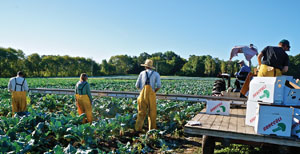 Workers harvest and pack broccoli in the field at Gardens of Eagan.
In 2008, the business was purchased by Minneapolis’ Wedge Food Co-op, one of the nation’s largest consumer-owned food cooperatives. Linda Halley, an experienced organic farmer, was hired on as farm manager, and under the name Gardens of Eagan, the Wedge began farming on land rented from the Diffleys. Gardens of Eagan continued in this location until 2012, when the Wedge purchased 127 acres of land, including a 2-acre greenhouse range, a few miles south, in Northfield. The 36-month transition of the land to organic production will be completed in August 2014.
The Wedge’s purchase came as much more than a simple desire to own a vegetable farm. Rather, the Wedge saw in Gardens of Eagan an opportunity to expand its involvement in the local and organic foods community in ways that supported the growth of a diverse array of local producers.
Incubator program
Before the Wedge purchased the business, the Diffleys had made land available to a beginning farmer to help them get started. The Wedge used this start as an inspiration to establish a full-fledged incubator program for beginning farmers.
“It’s about business development, not farmer training,” Linda noted. Participating farmers bring farming experience and a business plan to the application process. While Gardens of Eagan provides training on the use of Gardens of Eagan equipment and facilities, the farm doesn’t provide a formal farmer-training program, although staff do serve as an informal resource. Instead, the Gardens of Eagan incubator functions as an economic development hub for farmers, allowing them less-than-market-rate access to land, facilities, and equipment in the context of a like-minded community. Being at the farm provides additional connections to resources that small farmers need, such as spot labor from Gardens of Eagan crew members.
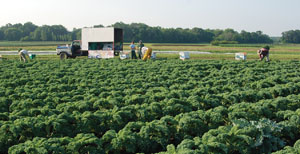 The kale planting gives some sense of the scale of the farm.
Incubating at Gardens of Eagan means that farmers don’t have to come up with greenhouse space, tractors, and packing facilities in year one. Gardens of Eagan works with incubator farmers to develop schedules for equipment operation and the use of facilities that allows everyone to get their work done. The Gardens of Eagan packing house was designed with a large, open plan so that multiple operations can function at the same time, and configurations can be adjusted to meet current needs. Access to a loading dock allows farmers to take advantage of bulk deliveries without arranging for separate transportation.
Incubator farms cultivate a designated plot of ground during their tenure at Gardens of Eagan, and are expected to maintain fertility and weed control. First-year rents for land and equipment are set at very low rates, and gradually increase as the farmers gain experience and markets, providing a gradual transition as revenues and profits increase.
Besides growing new farmers, the incubator program provides real value back to the Gardens of Eagan operation. Two of the last four incubator farms have had one partner who worked at Gardens of Eagan, in addition to their work on their start-up operation. “The incubator program has allowed us to attract and retain great employees who might not have been with us otherwise,” said Linda. For the beginning farmers, the arrangement makes possible an “off-farm” income during the start-up phase, without having to travel far from their farming operation.
Transplant sales
With more than 80 percent of its cropland planted to transplants, Gardens of Eagan has a huge demand for well-grown plugs. To provide a consistent supply of top-quality produce, they need top-quality transplants throughout the season, and plug trays are seeded from late February into July. Linda had long been aware of the need on the part of area growers for quality, certified-organic plants, so when the new location provided excess greenhouse space, Linda decided to expand Gardens of Eagan’s transplant production.
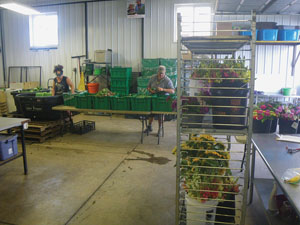 The packing shed is used by the incubator farms as well as Gardens of Eagan.
In addition to its own plants, Gardens of Eagan sells custom-grown plug trays to farmers, and potted garden plants to natural foods retailers and at its own farmers market stand.
“Transplant sales allow us to leverage our excess greenhouse space,” said Linda, “and making them a major focus of our operation lets us dedicate a staff position to greenhouse production, meaning we’ve got somebody who is always focused on the greenhouse operation, even when things are crazy in the field.”
Sales of potted garden plants to retail stores and at their farmers market helps Gardens of Eagan bring staff on earlier in the season, which makes it easier to recruit and retain a great crew. Garden plant sales begin in mid-April and continue to early June.
Custom-grown, certified organic vegetable plugs fill an important need for local and regional growers, while diversifyingGardens of Eagan’s market for greenhouse-grown transplants. Most of Gardens of Eagan’s farmer-customers grow most of their own plants, but use Gardens of Eagan to fill specific needs, such as not turning their greenhouses on early, or to increase their capacity for certain large plantings.
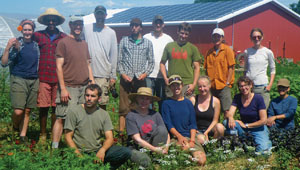 Above: Most of the 2014 crew. Farm manager Linda Halley is second from right in the front row. All photos courtesy of Gardens of Eagan.
Gardens of Eagan has made significant investments in order to sell their transplant products, including customized plant stakes and UPC codes. “Customized tags allow us to identify our plants as certified organic,” according to Linda, “and helps our customers track sales of each item.”
To transport plug trays, Gardens of Eagan developed a customized corrugated cardboard container to hold three 1020 plug trays, allowing plugs to be shipped via courier or by the pallet. Gardens of Eagan has worked with the Wedge’s subsidiary, Co-op Partners Warehouse, to provide transport of pallet quantities to farmers throughout the region at a reasonable cost.
Potted plants and plugs both fit in well with the greenhouse equipment and supplies Gardens of Eagan already uses, such as potting soil, a flat filler, and an automatic seeder. Producing large quantities of transplants allows them to bring per-unit costs down.
Wedge Community Co-op
The Wedge Community Co-op, with over 15,000 members, has been a cornerstone of local and organic foods in the Twin Cities since the early seventies, so when it purchased a major supplier of local, organic produce, there was plenty of concern in the local grower community. Fortunately, the Wedge’s mission – and Gardens of Eagan’s – goes far beyond vertical integration, so Linda goes out of her way to make accommodations as she expands Gardens of Eagan’s size and diversity. “We work hard not to be in the marketplace when other growers have historically counted on those sales,” Linda said. “That hasn’t always been easy, but it’s important because many farmers depend on the Wedge’s role as a major buyer of local products.”
Being on the same team with a produce department has made an important difference for Gardens of Eagan, especially when it comes to pricing discussions. “Pricing isn’t a win-lose proposition when you’re part of the same organization,” Linda noted.
Being on the same team has also been important as Gardens of Eagan goes through the process of transitioning its new land and production to organic. Quality farmland isn’t easy to find, especially within a limited geography that would allow Gardens of Eagan to retain its farm crew. The Wedge supported the farm’s transition by agreeing to carry Gardens of Eagan’s transitional-organic product where it normally would have opted for organic. “Unless you have a market that will support you without question, you can’t go whole-hog into transitioning new ground,” Linda said. The Wedge took the risk of purchasing transitional land with the knowledge that they would have to take on the extra work of educating its staff and its customers about why supporting the Gardens of Eagan transition matters.
That’s not to say that being a farm owned by a grocery store is always easy. Market farming has some significant differences from the grocery business – including such basics as a fiscal year that ends on June 30, requiring inventory and reporting that don’t match the farm’s own seasons. And even though it’s at the core of what makes local produce special, the Wedge’s management hasn’t always understood the seasonal nature of the farming business, where you spend money for months without creating any revenue, and where availability is occasionally a boom-and-bust affair, even under the best management. “Let’s face it,” Linda said. “Crop failures don’t happen in a grocery store. It’s not a business event that people outside of farming have experience with.”
Co-op Partners Warehouse
The Wedge also owns a produce warehouse and distribution company, Co-op Partners Warehouse. Like the Wedge, Co-op Partners has been a staunch supporter of both the local and organic food system since its inception in 1999, with a strong commitment to sourcing from smaller farms as well as name-brand organic labels.
Most of Garden of Eagans’ sales are distributed through Co-op Partners Warehouse, even though the majority of the transactions are direct sales between Gardens of Eagan and the stores. Gardens of Eagan has scheduled its order fulfillment to align with Co-op Partners’ trucking schedule so that most Gardens of Eagan shipments are picked up at the farm by Co-op Partners trucks returning from deliveries, and transported to the warehouse. At Co-op Partners Warehouse, Gardens of Eagan product is combined with other shipments for distribution.
“We only put a driver on the road one day a week,” according to Linda. “And even that’s only for a couple of hours, since we simply drive to the warehouse and drop our product off for further delivery.” By contracting deliveries with Co-op Partners, Linda is able to drastically reduce her transportation costs – not to mention the headache of trying to run the equivalent of a small distribution company. In addition, combining loads reducing Gardens of Eagan’s environmental impact.
Gardens of Eagan isn’t the only farm that benefits from this cooperation with Co-op Partners. The warehouse also provides order consolidation services for a variety of other farms and food businesses.
Satellite farms
Gardens of Eagan is a major producer of organic broccoli for the Twin Cities marketplace, but with nearly half of its acreage devoted to brassicas, it can’t sustainably grow more broccoli than it already does, and demand continues to go unfulfilled. So Gardens of Eagan used its relationship with Co-op Partners Warehouse to provide a guaranteed market at a set minimum price for three other farmers to scale up their organic broccoli production. “While it wasn’t really an incubator setup,” Linda said, “we looked at our resources and said, ‘how can we use this situation to grow more farmers?’”
Linda worked with her crew to document best practices, provide production schedules, and train growers to grow and harvest large quantities of wholesale-quality broccoli. One grower relied on Gardens of Eagan to provide transplants for his operation, since he lived far from his land and greenhouse management presented insurmountable challenges for him.
“We also provided some intense mid-season troubleshooting,” said Linda. “We couldn’t predict the challenges in advance, and our existing relationship with Co-op Partners Warehouse allowed us to get honest feedback about the product quality from these ‘satellite farms.’ We were able to overcome challenges with our growers that might have otherwise ended their relationship with the warehouse.”
All three of the project farms were in transitions of one sort or another during this effort, and two of them are no longer producing wholesale. But one has gone on to become a major supplier to Co-op Partners Warehouse, and broccoli occupies an important role in that farm’s economics. “That feels like success to me,” Linda said.
“I think there’s still a lot of potential to develop here,” Linda said. “It’s not like we’re fully settled in yet, either to our new farmland or to Gardens of Eagan’s new relationship with the Wedge or Co-op Partners. We’re still looking for potentials and possibilities for doing more, for the store, the Wedge’s members, the warehouse, and our farming community.”
Chris Blanchard provides consulting and education for farming, food, and business through Flying Rutabaga Works. He has worked in farming for the past 24 years, managing farms and operations around the country. As the owner and operator of Rock Spring Farm since 1999, Chris raised twenty acres of vegetables, herbs, and greenhouse crops, marketed through a 200-member, year-round CSA, food stores, and farmers markets. Contact him at www.flyingrutabagaworks.com.
Copyright Growing For Market Magazine.
All rights reserved. No portion of this article may be copied
in any manner for use other than by the subscriber without
permission from the publisher.