










Post your favorite farm-made tool on social media using #toolsforgrowingformarket or email it to us at admin@growingformarket.com. If Josh picks your tool, you win a $50 tool gift certificate and a Full Access sub to GFM!
Hand carts are a great tool on the farm, saving time moving all sorts of things, and saving wear and tear on our bodies. I’m a big fan of hand carts as many of you probably already know. This series of articles kicked off with a really unique one back in the March 2020 GFM and I’ve been writing about carts for longer than that. In the October 2010 GFM I wrote about the hand carts I was building at the time. The evolution of that design is one of the chapters in my book, Build Your Own Farm Tools. Three posts on Instagram with the #ToolsForGrowingForMarket hashtag caught my eye this past spring, all hand carts, and all very different and I’ll explain why below.
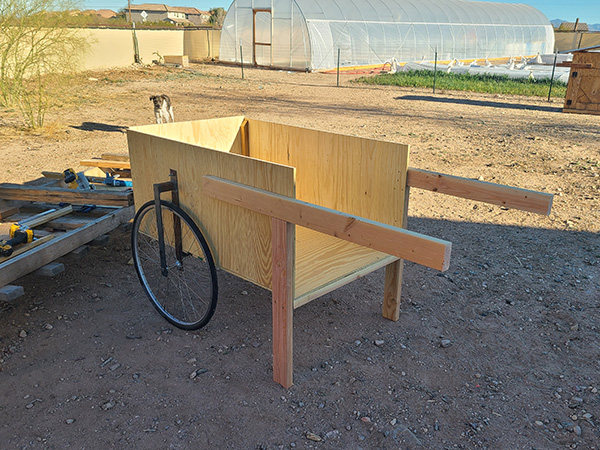 Monlighter’s cart is built from wood and steel. The farm built steel forks for the wheels are also tied together with a steel tube under the wooden frame and a steel pipe is used for the handle.
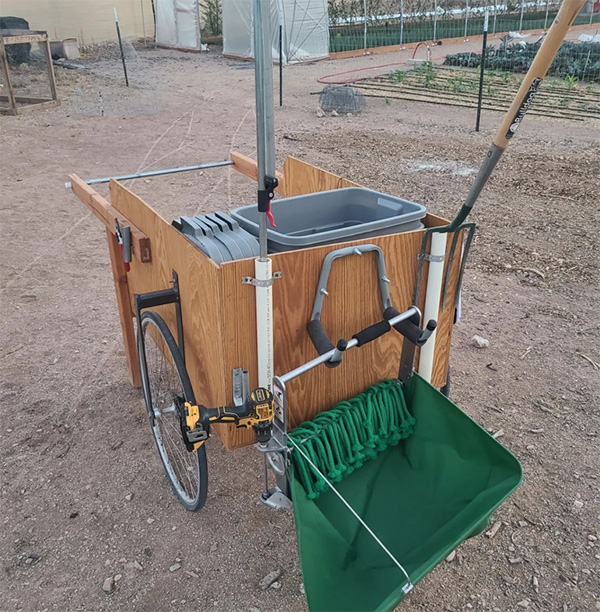
Tommie from Moonlighter Farm in Tucson, Arizona, posted a photo of the cart he built from scrap wood and metal. Moonlighter is a new farm, tiny sub-acre, one-man operation specializing in leafy greens and baby roots. Though the farm is new, Tommie spent a couple of years working on other operations and networking with growers in his area. The design of his cart is very similar in form to a typical garden cart with a low deck with tall sides and back. For Tommie the sides help to keep harvested greens in the shade while the desert sun is still low in the morning. The main difference between his cart design and a regular garden cart has to do with the width, and the wheel mounting method. The cart is designed to straddle his beds and to fit two Rubbermaid totes side by side. Instead of cart wheels that slide onto an axle he welded forks to hold used bicycle wheels and bolted those to the sides of the cart. He also attached mounts on the outside of the cart for carrying tools. The tubes for holding tool handles are made from 1 ¼” PVC pipe and a long carriage bolt through the bottom of the pipe prevents the handle from falling through, while leaving the pipe open enough to not collect dirt or water.
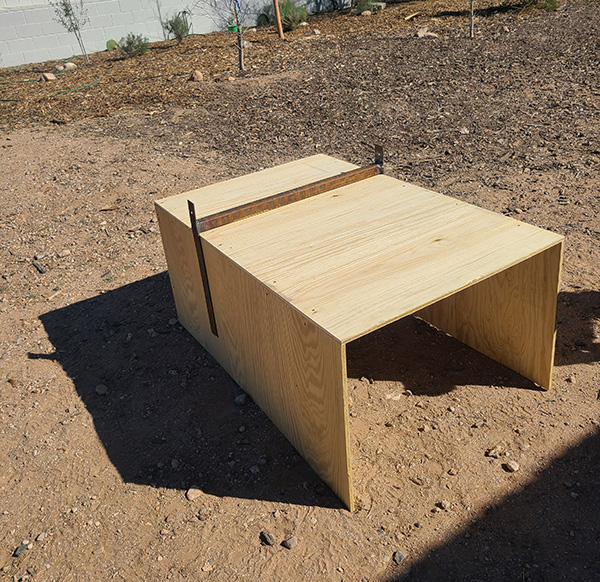 Moonlighter farm cart construction.
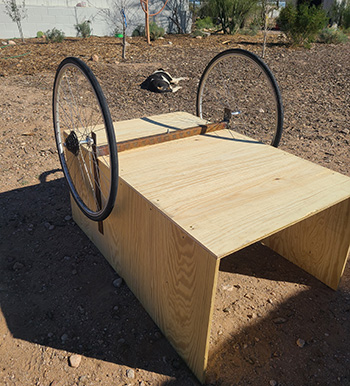
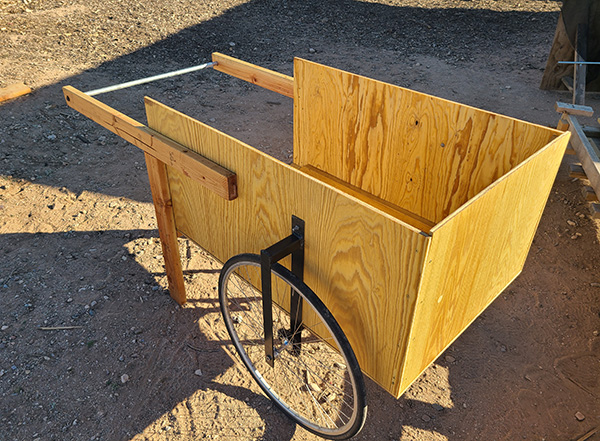
At the time I talked to Tommie about his cart he had only been using it for a few months but was already appreciating its utility around the farm: for moving harvests out of the field, and for moving seedling trays into the field. He did have a few notes for other folks who might build one. He bought a set of used bicycle wheels, a front and rear, but the hub spacing on those is different so the brackets need to be different and it would have been better to get two front wheels. The tool mounts are useful but being mounted behind the wheels requires something to be in the cart to prevent the cart from tipping over. Even though the cart is capable of straddling the beds he doesn’t often pull it over the beds. My carts also straddle my beds and we both agree that even though we don’t always use them to roll over the beds we still appreciate the ability to do it when needed.
Jonathan from Taybank Growers Collective in the heart of Scotland posted photos of a very different cart they use on their farm, a bicycle trailer he converted into a hand cart. Again, this one has a low deck, but unlike Tommie’s cart there are no sides, just little cleats on the ends to keep bins from sliding off the frame. Simple aluminum frame bicycle trailers for hauling kids and groceries have become more common which means there are more of them out there on the used market, prime for making modifications, especially as the fabric enclosures wear before the aluminum. With only the addition of a wooden dowel for the handle and some extra screws Jonathan was able to repurpose the parts of the frame that had been for hooking the trailer to the bike to create the handle and feet. By his reporting ideally the handle would be stiffer, but it’s functional enough that they hadn’t felt the need to reinforce it immediately.
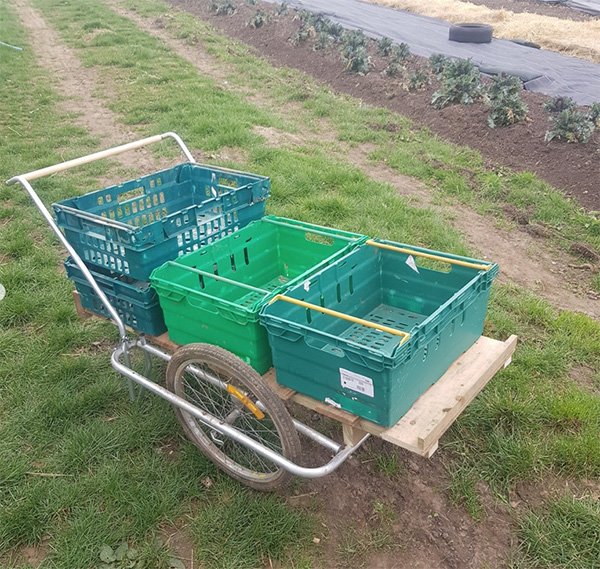 Taybank’s cart is a modified bicycle trailer with an added wooden deck. The handle is made from repurposed parts of the cart and a wooden dowel.
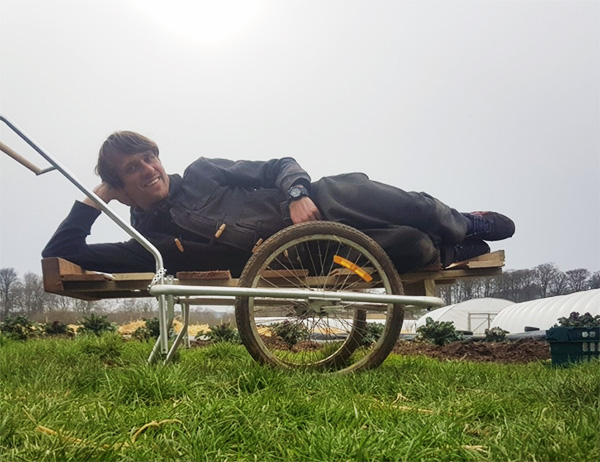
The Taybank cart proving how burly it is.
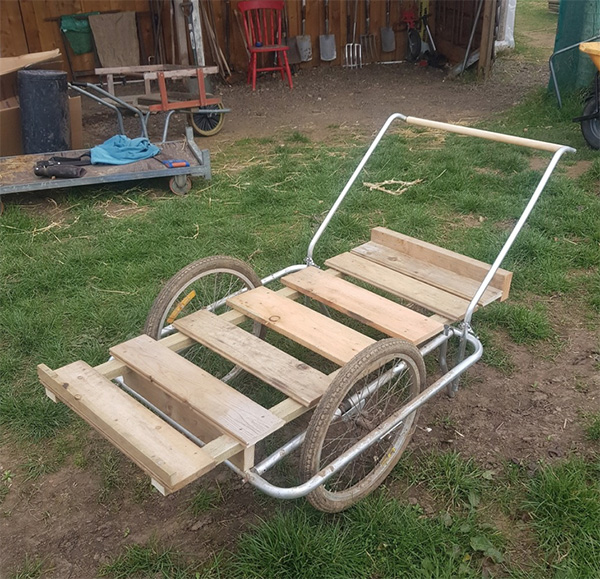
The Taybank cart unloaded.
Thomas and Sarah Judd from Meadow Lynn farm in southwestern Ontario, Canada, posted a photo of a cart that is very similar in form to the modified cart that Jonathan made seven years ago. Theirs was welded together from aluminum square tube and is much longer. Because the cart is purpose built it snuggly fits the bulb crates they use for harvest, allowing five to be lined up on the bottom and for extras to be stacked on top of those. Sarah reports that with heavy crops like summer squash a single layer of bins is a comfortable load, but with bulkier crops like lettuce they can easily stack three high. The light weight of the aluminum tubing makes the cart very easy to handle.
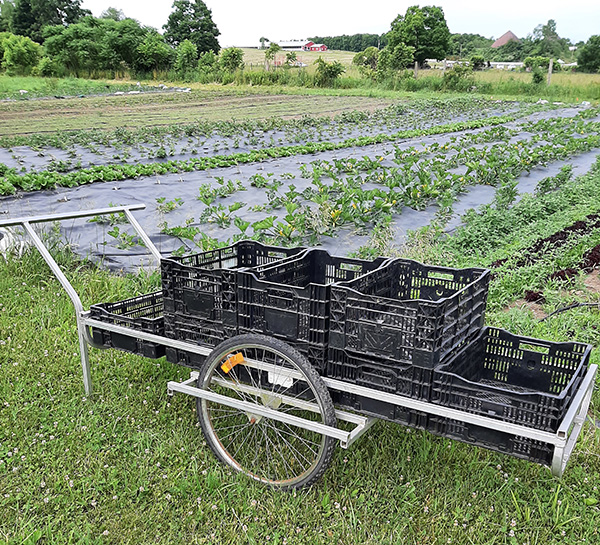 Meadow Lynn’s cart fits five bulb crates all lined up and centers the weight over the wheels.
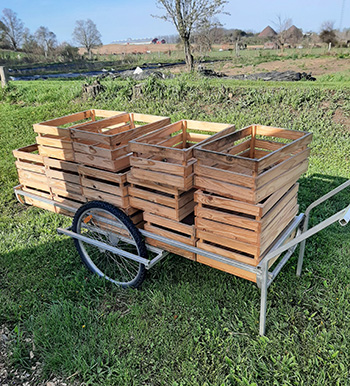
Another view of Meadow Lynn’s cart.
Josh Volk farms in Portland, Oregon, and does consulting and education under the name Slow Hand Farm. He is the author of the books Compact Farms: 15 Proven Plans for Market Farms on 5 Acres or Less, and Build Your Own Farm Tools, Equipment & Systems for the Small-Scale Farm & Market Garden, both available from Growing for Market. He can be found at SlowHandFarm.com.
Copyright Growing For Market Magazine.
All rights reserved. No portion of this article may be copied
in any manner for use other than by the subscriber without
permission from the publisher.