











Growing from mushroom production to a large CSA farm
I met Brian and Liz Simpson in 2017 at a farmers market in Birmingham, Alabama, where we were both vendors. They sold the most delicious shiitake mushrooms. Our CSA had requested add-on options from other farms, and it was important to me that they be local, organic, and farmers we admire. They checked all those boxes. Brian and Liz are remarkable in their intelligence, attention to detail, foresight, and planning, as well as confidence and strong ideals. Their dream had been to have an organic vegetable farm. Even though Liz studied Horticulture at Auburn University and worked on three different farms, they had little to no experience in the business aspects of vegetable farming. They didn’t feel they could make accurate projections in order to plan for and take on starting a vegetable farming enterprise.
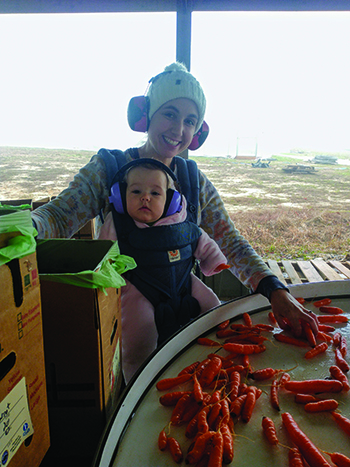 Learning how to use the rotary sorting table on Mountain Sun Farm.
Brian studied Environmental Science at the same college and worked on a farm which had both vegetable and mushroom operations — his labor focused on the mushroom aspects. He participated in some of the business side of the mushroom production. Because of this and the fact that mushroom production is more straightforward than field grown vegetables, they felt comfortable making projections and plans for growing mushrooms.
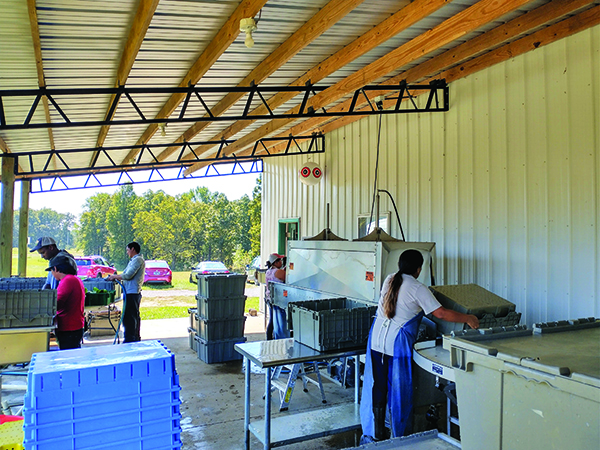 Packing shed with the AZS rinse conveyor. “It helps to set and maintain a pace. No one can loiter or slow things down on the line when it is in use,” says Liz.
“For a long time I wished that we had just skipped the mushrooms and jumped right into vegetables,” Brian said. “But the Buddhist raft parable helped me realize that we did need it after all to learn the business side on a steadier foundation.” In the parable, a person comes to a river that is impassable on foot. However, they must get to the other side. They work for a while, gathering sticks and twigs and fashioning a raft, then safely paddle across. Once on the other side, they consider what to with the raft- carry or drag it along on the journey? In the end, the raft must be left on the river bank, its purpose having been served. For Brian and Liz, mushroom production provided financial stability while they practiced growing vegetables, adding more each year, gathering production numbers on crops, and building a customer base.
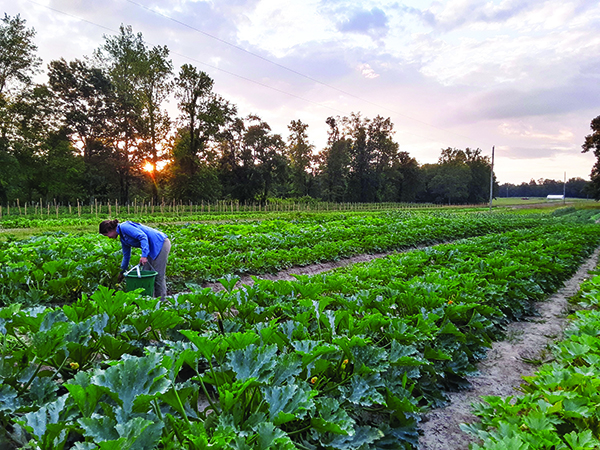 Summer squash harvest.
This was all to get them over to the side of full-time vegetable production, where they wanted to go, leaving the mushrooms behind in the end. For three years, they leased land, grew mushrooms and saved money, all the while looking for farmland to buy. Eventually, they found 34 acres in Mentone, Alabama, for $5,000 an acre. After being told by the local bank they could not finance the purchase without a house on the land, and becoming disenchanted with the Farm Service Agency’s antiquated style of communication, they found First South Farm Credit. The pairing sounds perfect.
Two separate loans were financed, one for the land and later one for the infrastructure. Liz and Brian speak highly of the organization, leading me to believe the lender truly wants to see farmers succeed. The first equipment they purchased was a waterwheel transplanter and a bed shaper. “We knew we wouldn’t have much money for labor and that labor would also be hard to find in our area, so we wanted to invest in equipment that would help with speed and efficiency as well as body fatigue,” Liz tells me. No water, no power, and no buildings were present on the property when they bought it. For the first five years they lived in a camper on the property while they began the vegetable operation.
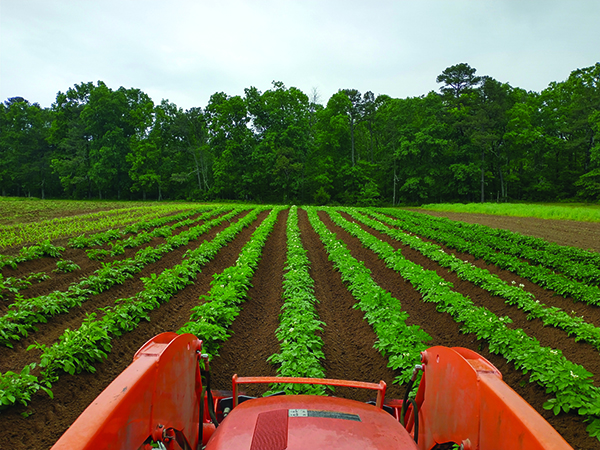 Clean cultivation of potatoes.
March through November each year they focused on growing vegetables, and December through February they switched to constructing a barn with a home connected to it. In April of 2022, their daughter was born. Due in May, she arrived a few weeks early. Their home was still being finished. They converted the sweet potato storage room into a ‘studio,’ living in there together as a new family of three for a few weeks. Do all farmers have stories like this one? Tales of the lengths gone to. Liz tells me, laughing, how both of the new grandmothers came to the hospital to meet the new baby. Brian, somewhat hesitantly, said it was the perfect window for planting potatoes. She understood, so he left for the farm to do just that, returning later to spend the night with his family in the hospital. Mountain Sun Farm has about 10 acres in vegetable production per season with 1/3 acre recently planted in blueberries. A five-strand electric fence surrounds the entire property to keep deer away. Smaller, one or two strand fences are put up around the most vulnerable crops, such as beets and strawberries. They are Certified Organic through QCS and also participate in the Real Organic Project. The Real Organic Project is free to participate in and there is a quick and easy one-page application. Farms must be certified organic to participate.
Liz describes it as a further step and conversation starter with customers, leading to meaningful discussions around food production. Both hydroponics and animal confinement are not allowed under the Real Organic Project. Someone inspected their farm initially when they applied and does so again every few years. They look at factors such as employee treatment, along with aspects of production. Mountain Sun Farm also participates in 1% For the Planet, giving 1 percent of total sales to an environmentally focused non-profit of their choice, which is typically a group of Alabama Riverkeepers. They have three part-time and three full-time workers from the area — two have been with them for two and a half years. One person does all of these deliveries two days a week, working on the farm two other days. She has worked at Mountain Sun Farm for almost four years and is a huge help. For the first time, they plan to have a winter CSA in an attempt to provide year-round work for their crew. Another aspect of their farm I’ve always admired is their beautiful, mechanically cultivated beds. The walkways are cultivated with spider gangs, five in each. Within the beds, rows are marked when shaped, and Brian stresses to everyone working on the farm the importance of keeping plants within the line when transplanting because cultivators are pulled behind, not belly-mounted. Guidance cones, or roller cones, do most of the steering from behind. The sway bars are free to swing and adjust to where the guidance cones steer. The first pass happens seven to ten days after transplanting. Finger weeders are used this first time, and Brian goes relatively slowly. The second pass is another seven to ten days later with A-blades and side knives on a single toolbar. He drives faster this time to move soil and bury weeds, as opposed to the uprooting the finger weeders do. If the height of the plants doesn’t prevent it, a third pass is great, driving as fast as possible.
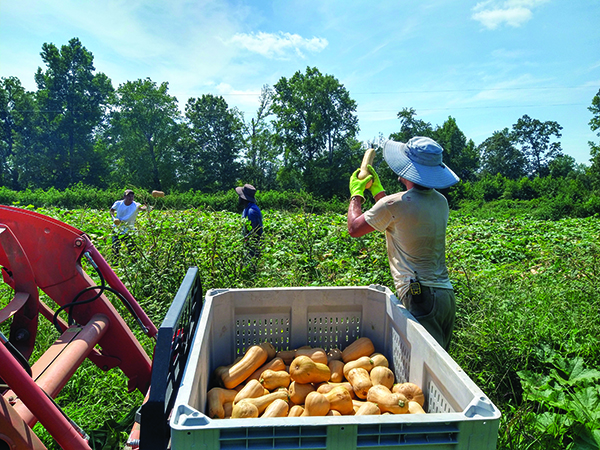 Bucket brigade/human chain-style butternut squash harvest on Mountain Sun Farm. All photos courtesy of Mountain Sun Farm.
Mechanization follows into the packing shed, where Liz once told me the AZS Rinse conveyor is one of her favorite pieces of equipment because it helps to set and maintain a pace. No one can loiter or slow things down on the line when it is in use. When they were producing mushrooms, they began selling to large natural food store chains, and eventually also sold vegetables to them. Even though they were able to name their prices, they set them too low at the beginning, trying to compete with larger farms. They never had a contract, instead working with individual buyers at stores. They would have an enthusiastic, consistent buyer replaced by one who bought nothing. “In the winter of 2021-2022, we had amazing buyers and sold tons of sweet potatoes so we based our next season’s numbers off of that,” they said. “The following winter we couldn’t even get orders placed and we were sitting on 11,000 pounds of sweet potatoes that didn’t have a buyer.” Ever the persistent farmers, Brian and Liz heard about Local Food Purchase Assistance grants that pay farmers for donated crops. These thousands of pounds of sweet potatoes made their way to two food banks, and the farm was compensated.
Over the years, they attended farmers markets. In early summer of 2020, they helped form a grassroots, farmer-owned market with me and another farmer when we needed a direct connection to our customers, ensuring safety and comfort for everyone during those tumultuous pandemic days. Currently, they are a CSA-only farm serving 447 members, distributing about 380 shares per week (some biweekly) with 24 pick-up locations in eight cities. This is the “sanest rendition yet” they tell me, when talking about their past marketing strategies.
They use Farmigo software to manage the CSA members and distribution. Liz looked into several options, finding Harvie cost-prohibitive, but recommends farmers also look into Local Line. I quickly did so myself and found fixed, monthly rates listed starting at $23/month as well as flexible options (Starter being the basic plan, then Core, Platinum, and Ultimate). Brian left me with advice for aspiring organic vegetable farmers. “…reject the common view that being a farmer requires being the business owner — that you can’t have a farming career as an employee. It makes the career path impossible.” He goes on to argue that most careers (doctors, lawyers, engineers, accountants, mechanics, veterinarians, etc.) do not open their own practices right away. “Move to a region with organic farms that are large enough to have career positions and learn as an employee, clock out at the end of the day and still get paid for all of your work even in cases of crop failure,” he added.
He stresses that working on a time-tested, for-profit farm, rather than a non-profit or retiree project farm will prepare you better for the reality of making the financial side of a for-profit farm work. I completely agree.
Margaret Ann Snow is co-owner and operator of Snow’s Bend Farm.
Copyright Growing For Market Magazine.
All rights reserved. No portion of this article may be copied
in any manner for use other than by the subscriber without
permission from the publisher.