











This second of three articles featuring a native plant nursery business focuses on propagation and growing techniques. My neighbors, mentors, and dear friends, Sandy Roth and Dick Kenton, started Plant Works native plant nursery in 1996 in rural La Grande, Oregon. We hope these articles encourage others to grow native plants and work in restoration. The January 2023 GFM article focused on the origins, business-side and overview of the operations.
At Plant Works, native plant propagation breaks down into three classes: wild seed, cuttings, and roots. For Dick and Sandy, wild seed propagation is the preferred method for most native plants. “Wild-collected seed gives the greatest genetic diversity,” said Sandy.
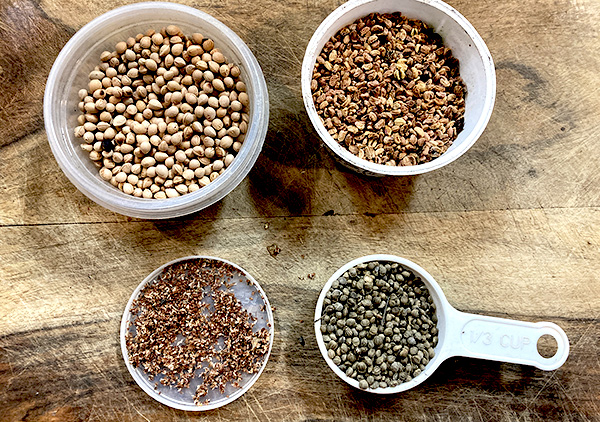 Clockwise from top left- Chokecherry, Hawthorn, Dogwood and Ocean Spray seed.
They use seed from the same elevation and collect as close to the restoration project location as possible to improve plant survival. Wild seed collection starts in mid-summer with employees collecting in approved areas with nippers and long hooks for tall species.
To prepare the seed, they first let the fruit rot in Ziplock bags so the pulp gets soft. The mush is then run through Cuisinart food processors using the plastic “bread dough” blades or metal blades taped with duct tape. The point is to remove as much fruit pulp as possible to decrease the risk of mold and disease while seed is stored.
The pulp mixture is then floated in water. Generally, the pulp and bad seed floats and good seed sinks. “We never know how wild-collected seed will germ,” said Sandy. “So just in case, we throw the fruit pulp and floating seeds in a seed flat and see if it will germ outside the greenhouse. Sometimes we get germination and it can help if we’re short on plants.”
The rest of the seed is dried on screens and newspaper. Dried seed is stored in plastic bags in dedicated fridges and marked carefully.
Sandy said that she plans to plant and grow 30 to 50 percent more plants than are ordered due to the variability of wild-collected seed and plant loss. But I wondered, how do you know how much seed to collect? “We use reference books to estimate seeds per pound by species,” she said. Particularly, they use Woody Plants in North America, an interactive textbook from Virginia Tech, and the Native Plants Journal, an online forum about natives across North America, from the University of Wisconsin.
Seed collection and preparation is fundamental for Sandy. “Seed is the beginning of it all. Seed is life. Seed has to be handled the most respectfully of anything we do.”
Cuttings
While she prefers the genetic diversity and vigor of seeds, for some species, Sandy uses wild-collected cuttings. “We do stick propagation for willows, cottonwood, and snowberry,” she said. “We cut whips in dormancy in early spring.”
Harvesting cuttings is particular — not just any whip will put on roots and shoots. “Cottonwood sticks, for example, must have terminal buds,” she said. Not so for willows and snowberry — any bud will do. Without terminal buds, a cottonwood stick will root but will not produce leaves. They harvest the youngest whips at the diameter needed for the contract order. For orders with tubes or pots, they harvest larger diameter whips.
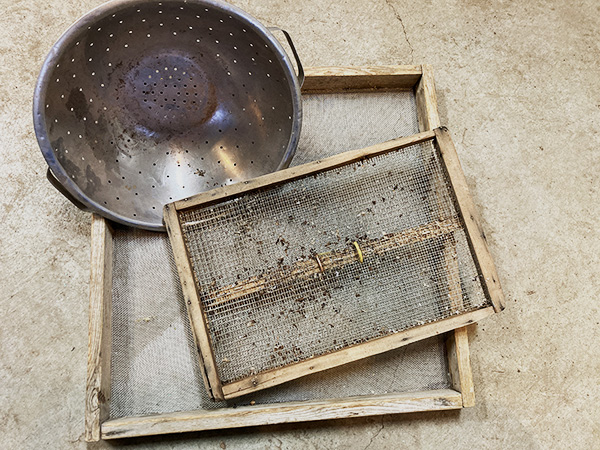 Seed screens for cleaning wild collected seed.
Whips are bundled into groups of 25 and chop-sawed into shorter sections, each with a terminal bud. The sticks are then soaked in rooting hormone or willow water. Willow itself creates a natural rooting hormone, so Sandy also uses the water from soaking willow sticks to start other cuttings.
“Cuttings must be soaked and as hydrated as possible before planting,” said Sandy. In order to keep the sticks from drying out, they dip the top of the stick in a latex-based paint. Then the bundles of sticks are put in the walk-in cooler to soak up rooting hormone or willow water and hydrate before planting. Soaked cuttings are then stuck in tubes of soil, latex end up, and put in the greenhouses to grow.
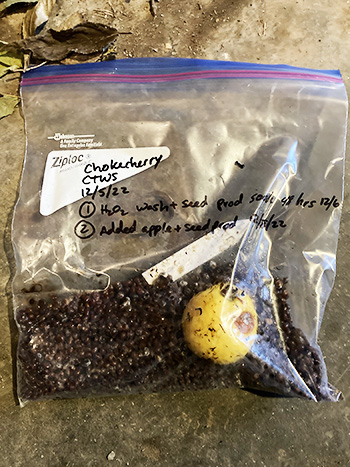 Seed stratifying with apples in the cooler.
“Hopefully there is rooting before dormancy is broken,” said Sandy. The aim is to have roots before leaves and before it gets hot. “Everything gets trickier with warmer weather.” Generally, they start planting cuttings in February here in northeast Oregon, latitude 45 degrees. The goal at Plant Works is to have everything propagated and growing before the summer solstice.
Root Propagation
Root propagation at Plant Works is used only for aspen and chokecherry or in bad seed years. “If there is no seed one year,” Sandy says, “then we have to rely on cuttings and roots.”
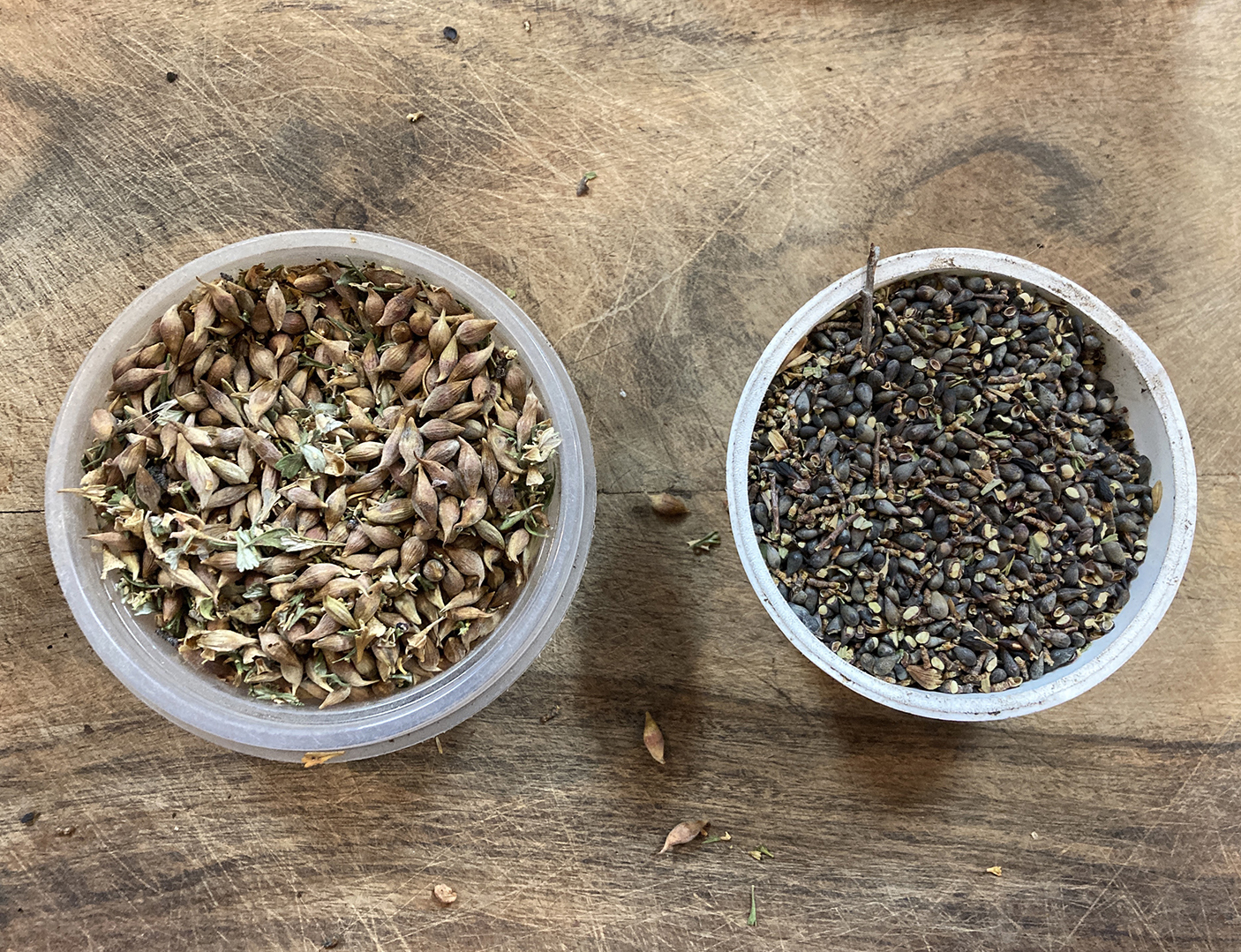 Uncleaned and cleaned bitterbrush seed.
Root propagation is the hardest method because root collection is laborious. “For example, you have to collect aspen roots in dormancy in the fall or spring when the ground is soft enough to dig,” Sandy explained. Roots are cut into two-inch chunks and laid in seed flats and covered with soil. Once they sprout, the sprout and a little root are cut out, dipped in rooting hormone, and transferred to tubes. “At this point, we keep them moist and just hope they grow,” she said.
Soil
Plant Works orders custom soil mixes from a soil company in the Willamette Valley, about five hours away. Huge totes are delivered to the nursery on a semi and unloaded with a forklift. Totes of soil then are loaded into a soil mixer, wetted, and spiked with endo and ecto mycorrhizals, actino iron, and composted chicken manure, also from the Willamette Valley.
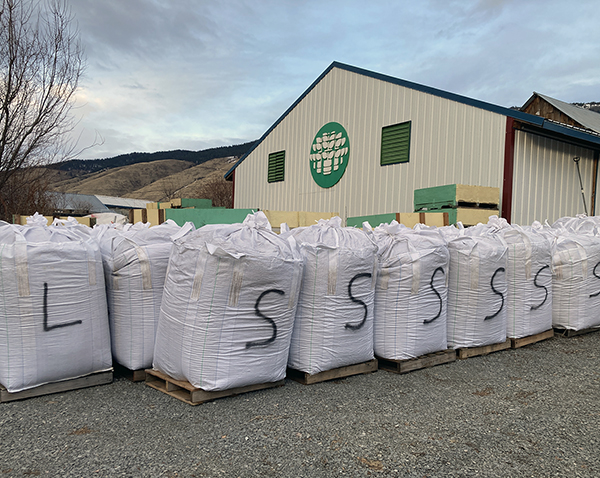 Soil totes at Plant Works. They get a finer mix for starting seeds in small cells than for larger containers.
Plant Works uses “small cell” and “large cell” soil. Small cell is finer and used for seed starting and smaller 10- and 16-cubic-inch tubes. Large cell is used for 40-cubic-inch tubes and gallon pots.
Once plants are planted in tubes or pots, hazelnut shells are added to the top of the soil. In the Northwest, these shells are cheap and abundant to buy from orchards. The top-dressing cuts down on moss growth and water loss, the same reasons why many growers top flats with vermiculite. In the past they tried a ground corn meal product, perlite and chicken grit, but have found that shells are the least expensive and work best.
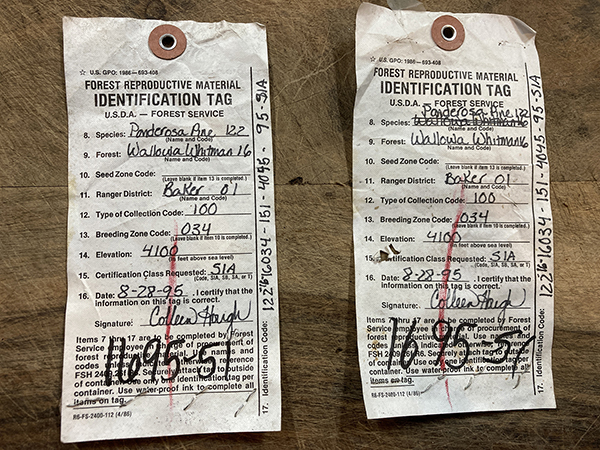 Seed collection tags.
Fertilizer
Plant Works fertilizes through the addition of professionally composted chicken manure mixed in the soil mix and foliar fertilizer administered through the overhead watering systems. Sandy never adds foliar fertilizer unless seeds have sprouted. “But that’s just me!” she said. “I don’t know if there is scientific proof for waiting.”
Plant Works generally is growing native plants for restoration in one season — a growth timeline that wouldn’t happen in the wild. Therefore, fertilization timing is extremely important. Sandy watches plant growth very closely through the season and increases or decreases foliar fertilizer based on size progress. “I don’t want plants getting too big,” Sandy explained. “If they do, we have to cut them back.” She doesn’t like wasting fertilizer or labor hedge trimming greenhouses full of plants. She uses foliar shoot fertilizer up until the summer solstice and then switches to root and bud fertilizer until one to two months before shipping plants in October and November.
Pest and disease management
“I use all organic products because I don’t think anyone should be exposed to toxics,” Sandy said. “It is a matter of worker safety and precautions.” She uses a two-step biocontrol program and Safer’s Insecticidal Soap runs through the greenhouse fertigation system. She is also always experimenting with what I call her “witch’s brew” to disrupt and discourage pests. While my background and her husband’s background are more science-based, Sandy does a lot by feel, observation, and intuition based in plant medicine.
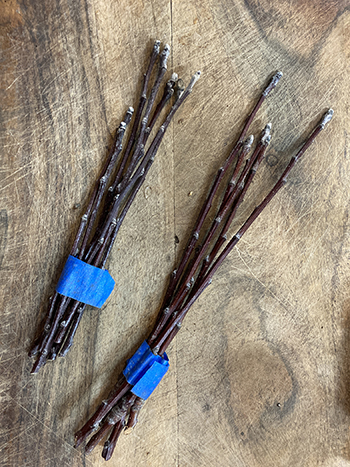 Cuttings for stick propagation are used for willows, cottonwood, and snowberry. Whips are cut in dormancy in early spring.
She uses what she calls “pheromone therapy” to mask the plants from pests. “This year I tried oregano water for bug control and red cedar oil. It seemed to work especially for weevils.” I sometimes laugh at her concoctions and advice, but her 35 years of experience and uncanny intuition and skill for growing plants always have me eating crow.
Here in the high desert, we must strictly manage water loss, so we use shade cloth after the solstice. Sandy ordered extra-long shade cloth that touches the ground on both sides. This creates extra shade and a barrier for birds, deer, and insect pests.
She also gets creative when pests find their way into the greenhouse. Last year she found aphids on a batch of plants, but instead of spraying, she had her crew move them outside the greenhouse. “Every predator insect in the book showed up,” she said. “Bald-faced hornets, yellow jackets, wasps, and ladybugs cleaned the plants. Sometimes we would just stand and watch them eat the aphids.”
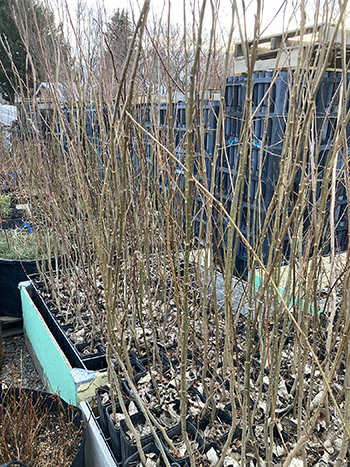 Overwintering gallon plants outside.
While pests must be managed, disease in a native plant greenhouse is the worst killer. Damping off, fungus, and molds can wipe out plants quickly because high desert species are especially intolerant to wet leaves. Sandy is strict about only watering on sunny days in the morning so that the leaves have time to dry out before nightfall. This is the most important disease management strategy at Plant Works, especially in the spring.
In tandem with water management, ventilation and heat management help with disease control. They have two 30-by-85-foot greenhouses and two 20-by-85-foot greenhouses. All have fans, automatic louvers and are heated by a natural gas boiler. The greenhouses are double-walled for heat conservation and the sides roll up and down manually during the season for both heat and ventilation. Each of these features must be managed with water and weather to reduce plant loss to disease.
Sorting
To me, it seems that the Plant Works crew is constantly moving racks of tubes out of the greenhouses on carts into the warehouse and sorting out dead plants. Due to the low and unpredictable germination of wild-harvested seed and high loss of native plants due to disease, plants are sorted three times during the short growing season and more if sold as two-year-old plants.
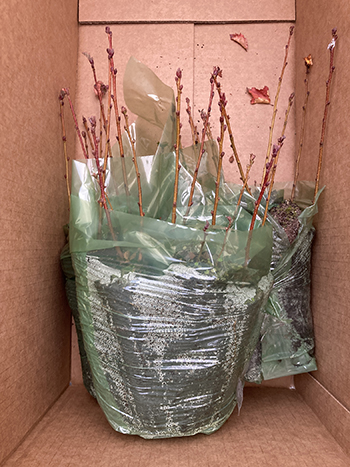 Plants wrapped to overwinter or ship.
After germination, plants are sorted to see what survived and if re-seeding is needed. Then in the mid-summer dead plants are culled to make a second count and to make space for more plants. The frequent sorting also gives Sandy a chance to touch base with customers in case plant loss will affect the contract. Over the years she has had to manage expectations and teach customers about native plants; from seed to plant, they just aren’t as predictable or as manageable as bred seed.
The last sort is when plants are de-tubed and packaged for shipping. I have pitched in during shipping time for years because it is a busy, all-hands-on-deck time of year. The first year I helped, Sandy explained her philosophy on people and plants when I wanted to give every wimpy plant a chance to ship and be planted out in the wild. “There are two kinds of people in this world,” she said. “Believers and pitchers. You are a believer, but you should pitch that plant.”
Even so, her plant-loving employees and friends like me take home way too many plants to save or salvage. It is hard not too when you know the time, effort, trial and error — not to mention Sandy’s intuitive care and experimental witchcraft — that have made these plants grow.
Nella Mae Parks farms on her family place in Cove, Oregon, growing vegetables for her on-farm farmstand, the farmers market, and wholesale outlets in the region.
Copyright Growing For Market Magazine.
All rights reserved. No portion of this article may be copied
in any manner for use other than by the subscriber without
permission from the publisher.