









The Brown Marmorated Stink Bug (BMSB) is an invasive species that is emerging as a serious problem. It is thought to have arrived on the East Coast from Asia and has been officially documented in 33 states. It has over 300 host species, causes tremendous damage, and so far, has no reliable methods of control, organic or otherwise.
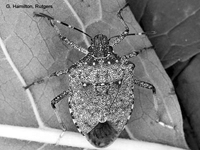
BMSB feeds on almost any fruit or podded crop: tree fruit, berries, tomatoes, peppers, okra, cucurbits and all legumes. It has also been found feeding on cut flowers including sunflowers and zinnias. Mid-Atlantic apple growers lost an estimated $37 million to the bug last year.
Gary Mount of Terhune Orchards in New Jersey described damage to his apple crop: “At the very end of harvest, on our last two varieties, stink bugs came in great numbers. They may have been moving off corn or soybeans that might have been harvested in the area. The IPM agents tell us it might have been as late as two or three days before harvest. The bug punctures the skin and later a brown pithy spot develops. We put some of our apples in storage thinking everything was fine, only to find damage now when we take them out. IPM agents rated our damage at 54% when sampling the late apples.”
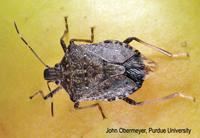
This true bug releases an aggregation pheromone (especially in the fall) which causes adults to gather together in buildings and other protected places to overwinter. The aggregation pheromone of this particular stink bug is being isolated in a USDA laboratory now and may be comercially available for use in the 2012 growing season. Until that is ready, some success can be achieved using other stink bug aggregation pheromones, especially in the fall. Pheromones are relatively expensive.
Low-cost tactics to try this year include parthenocarpic varieties, row covers when that is feasible, caterpillar tunnels or hoophouses with screen doors and enclosed bee colonies. Possibly there is a netting with holes small enough to keep BMSB out, but large enough to let pollinators in. It would need to be on hoops or structures to keep BMSB from reaching the crop for eating or egg-laying. Surround kaolin clay sprayed early and often has shown some success in the pome fruits. The company is offering samples for on-farm trials.
Russ Mizell (FL) has published a paper on trap cropping for native stink bugs in the south: He recommended buckwheat, triticale, sunflower, millet, field pea, and sorghum for native stink bugs. A succession of trap crops including these and others such as pumpkins, cowpeas, and other small grains (which are most attractive in the milk or soft dough stage) could help. Flaming the trap crops is likely to work well. Trap crops only work if they are more attractive than the crop.
Predatory stink bugs, assassin bugs, spined soldier bugs and two native egg parasitoids will reduce the BMSB numbers, but do not give adequate control. Several egg parasitoids from China may be released from quarantine in the U.S. in 2013 at the earliest, to tackle the pest. BMSB are attracted to yellow and to corrugated cardboard. Chickens and preying mantis seem to lose interest after a few bites. Hogs will eat them. There are concerns that the flavor of the stink bugs may carry through to milk, meat, eggs, wine and soy products, either from ingested bugs or insect parts mixed in with the crop. Soapy water will kill the nymphs. One spraying killed about two thirds of the adult bugs in one study. Other studies found soaps ineffective.”
Tracy Leskey at the Agricultural Research Station of USDA at Kearneysville, WV, has done a lot of work over the last two years. See http://anr.ext.wvu.edu/r/download/74527. Rutgers also has a 2-page fact sheet at their website: http://njaes.rutgers.edu/stinkbug/.
An Organic Task Force is collecting information on potential organic approaches to management of this bug, and planning formal research. Contact Ted Rogers Ted.Rogers@ARS.USDA.GOV to join the task force; please give email and phone numbers. An interactive website has been set up as part of the future research. The website was set up by Matt Grieshop who runs the organic pest management program at Michigan State. Also working with Matt as a postdoctoral researcher is Anne Nielsen whose Doctorate was written on BMSB at Rutgers. Go to http://www.bmsb.opm.msu.edu/ and click on the Grower Forum where farmers are posting thoughts on various threads for dealing with this problem. Researchers are asking growers for specimens, locations, and information on crops damaged and crops unaffected. Sample monitoring plans are being designed and posted on the website, for growers wanting to help with the research.
Pam Dawling, Ted Rogers, and Lynn Byczynski contributed to this article.
Copyright Growing For Market Magazine.
All rights reserved. No portion of this article may be copied
in any manner for use other than by the subscriber without
permission from the publisher.