






Last summer I joined four other farms in Oregon’s high desert to do field research on irrigation management in no/low-till vegetable production. The project lead, Katie Swanson of Sweet Union Farm in Klamath Falls, Oregon, invited farms to measure plant-available water differences over one growing season between beds with no- or low-till preparation and beds prepared with tillage.
Through USDA Sustainable Agriculture Research and Education (SARE) grant funding each farm received tensiometers, weather stations, and technical assistance from folks at Oregon State University (OSU). SARE grants are an opportunity for farmers and ranchers to get funding for research and education on sustainable agriculture topics such as on-farm renewable energy, rotational grazing, pollinators, no/low-till, and other topics.
Our SARE grant focused on understanding and improving our water conservation practices and decision-making through low/no till and soil water monitoring. We wanted to test whether no/low till improves water holding capacity and to identify changes we could make to improve water conservation in our dry climate.
Growing in the high desert
While Oregon is known for its dense forests and rain, this “westside” environment only covers about a third of the state. The region east of the Cascade mountain range looks more like neighboring Nevada or Idaho rather than rainy coastal Oregon.
High desert weather is defined by extreme daily temperature swings (40° F to 100° F), daily afternoon wind, late frost (in June), early frost (in August), a short spring (two to three weeks) and very little precipitation (10 to 16 inches per year.)
As SARE study participant Caleb Thompson of Sungrounded Farm put it: “We receive 11 inches of precipitation annually, which predominantly comes in the form of snowfall in the winter.” High desert farmers rely on snow as our reservoir and snowmelt as our summer irrigation water.
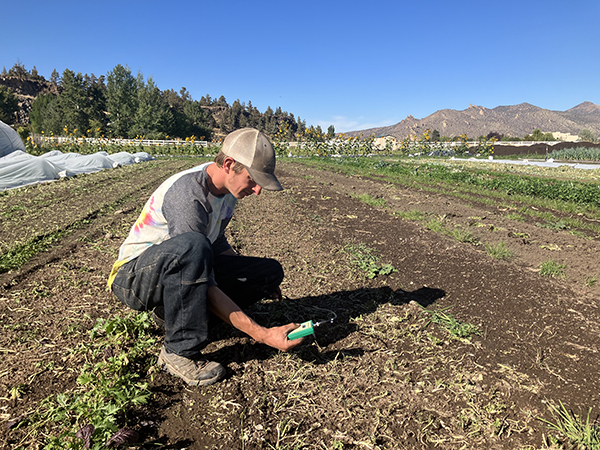 Caleb from Sungrounded Farm checking a tensiometer. All photos courtesy of the author.
If there is little snow in the winter or it melts too fast, we can face water shortages. Several of the participant farms are facing a chance of no water allotment from their ditch system this summer (literally zero!), which makes last year’s water conservation research even more important.
Soil moisture is affected by a matrix of factors: soil physical properties (texture and organic matter); precipitation and irrigation; surface evaporation; temperature, humidity, and wind; tillage and mulching; plant type and maturity; and evapotranspiration from plants. Some of these we live with, others we try to influence.
With tunnels and shade cloth we can modify a few of these soil moisture factors such as temperature, humidity, and the drying influence of wind. By increasing organic matter, mulching, and tillage practices, we can increase (or decrease) the water holding capacity. While the farms in the cohort have tried to maximize soil moisture in these ways, what we were missing was monitoring the resulting soil moisture. We didn’t have the data to show the impact of these practices or know how much water the soil and plants really needed and when.
SARE case study
Each farm buried three Watermark tensiometers in each of three test beds at three different depths. Tensiometers measure soil moisture based on negative pressure to show how easy it is for a plant to suck water from the surrounding soil. A lower centibar reading means water is easily available; a higher reading means the soil is drier; zero means the soil is saturated.
We monitored soil water tension weekly throughout the season and kept track of irrigation events. OSU staff monitored temperature, humidity, precipitation, and wind through our on-farm weather stations.
Each of the five farms chose a crop to test with no-till, low-till, and tillage practices. We each wanted to understand tillage and water needs of specific crops. Sweet Union Farm in Klamath Falls tested paste tomatoes. Fibonacci Farm in Bend tested zinnias. Sungrounded Farm in Terrebonne tested onions. Sakari Farms in Tumalo tested golden beets. Nella Mae’s Farm in Cove tested lettuce mix.
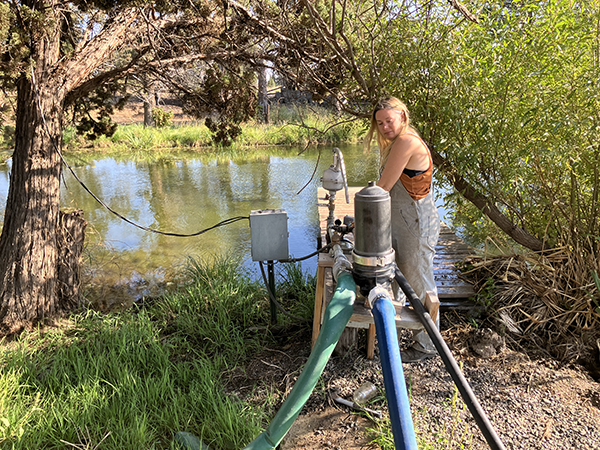 Laura Rassmusen turning on the pump at Fibonacci Farm.
Katie at Sweet Union wanted to know how far she could push paste tomatoes in each test bed without watering. I wanted to understand if the tillage methods influenced soil moisture, and therefore, direct-seeded lettuce germination and production in July and August. While we were testing different crops and had different questions, the commonality was how well the soil held water given different tillage regimes.
Water-holding capacity
Less tillage did improve soil water holding capacity and crop performance on several farms. This was a small case study, so conclusions we can draw are limited. However, two farms in the cohort saw that beds with less tillage saw better soil moisture and required less irrigation.
For the rest of us, the results were mixed. However, our observations of the no/low till beds, germination, and production results anecdotally encouraged us to keep monitoring soil water moisture between tillage treatments. For example, my low-till lettuce beds out-performed my tilled lettuce beds in terms of germination and fewer weeds. My broadforked lettuce bed outperformed my tilthed and tilled beds so much that I was motivated to broadfork all beds this year.
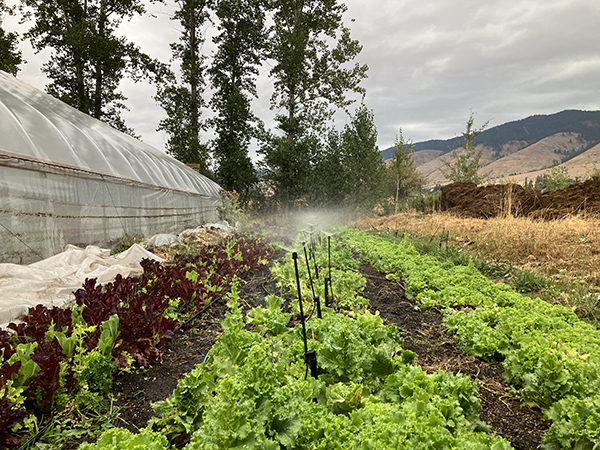 The tilled lettuce test plot on the author’s farm.
For others, crop performance seemed similar between tillage treatments, which is a good argument for not tilling. If tillage doesn’t improve crop performance, why waste time and gasoline on it?
Tensiometers improved irrigation
Perhaps the most impactful thing we learned from the SARE project was the value of monitoring soil moisture and using tensiometers. Both Katie and I feel silly saying it, but sometimes it was kind of a pain to spend five minutes checking soil moisture. It isn’t hard, but there are just so many demands on the farm that this simple monitoring practice sometimes fell to the bottom of the list.
However, being a part of a cohort of farms in a study project motivated us. At the end of the season, we really were able to see the results. During the season, the data gave us a sense of what was going on below the soil surface and allowed us to more confidently wait to irrigate or cut back on water. If you know there is water available in the rooting zone of your tomatoes, you can sleep at night without adding more.
Sam Schreiner at Sakari Farms also said the tensiometers will help him give better instructions to employees. The “stick your finger in the soil test” is subjective and you can’t stick your finger down two feet. But you can tell employees, “check the tensiometer and water when you get to 30 centibars.”
Caleb Thompson at Sungrounded Farm said soil moisture data will help to prioritize watering. In the high desert when you may only get water for one day per week, tensiometers help farmers understand which fields or crops need water rather than just broadcasting an inch over the whole farm.
Better data, more conscientious farmers
SARE grants can help with farmer behavior changes. Without monitoring, it is easy to irrigate on a schedule or based on assumptions rather than the in-the-soil reality. It is easier to water every crop on the same schedule and repeat the watering regime year after year.
All the farmers said that the practice of monitoring made us more conscientious and observant through the season. Farms with limited water were able to waste less where it wasn’t needed.
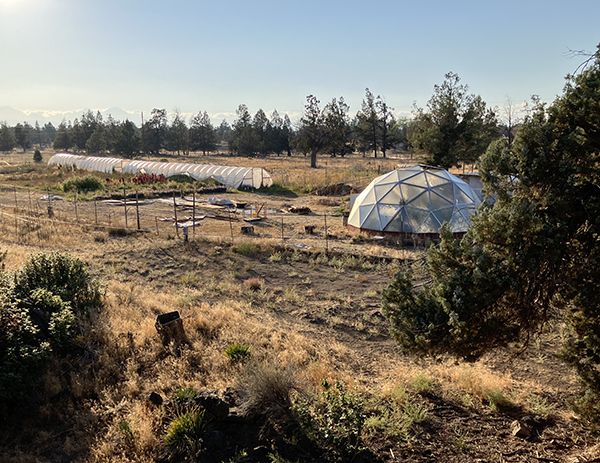 You can see how dry the high desert landscape is around Fibonacci Farm in Oregon.
I felt more accountable for water conservation. Unlike the others in the cohort, I use well water and have pretty good access to water. Checking the tensiometer and finding I had overwatered made me dial back the amount and duration of irrigation, which is better for the soil, the crop, and for our aquifer.
SARE study takeaways
The design of this SARE study by Swanson and OSU Small Farms agent Maud Powell made it easy for farmers to participate. Each farmer was paid for time and compost, about $1,700. The case study approach was adaptable to each farm and each farmer was able to customize the no-till, low-till and tilled treatments.
As mentioned earlier, the water tension sensors and weather stations were provided and so was set up help. Paying and supporting farmers through this grant encouraged us to adopt new tools and technology and to spend time monitoring. The grant, cohort, and OSU staff gave us accountability to collect data and support in analyzing it.
Working with an agricultural technical service provider (extension agent) made our grant application and project more successful. Powell helped us narrow down ideas for the grant proposal and create a cohesive project. Creating a cohort of farms made our project more impactful and more likely to get funding.
The results of the case study reached a larger audience through connections to other organizations that were excited about our ideas, such as the Oregon Climate Action Network.
What makes the high desert country tough to grow in is a combination of extreme weather, changing climate, and the bad water policy and systems we’ve inherited. However, this cohort of farmers used the SARE grant opportunity to tune into water conservation and tune up our irrigation management skills.
“Farmers like us in extreme climates are constantly adapting,” Swanson said. “With climate change, other places will face what we face every day, and I think we have a lot to share.”
Nella Mae Parks farms on her family place in Cove, Oregon, growing vegetables for her on-farm farmstand, the farmers market, and wholesale outlets in the region.
Copyright Growing For Market Magazine.
All rights reserved. No portion of this article may be copied
in any manner for use other than by the subscriber without
permission from the publisher.