











For nearly 20 years, Carolyn Faught has operated Omena Cut Flowers, a U-pick and subscription flower farm in northern Michigan. She loves growing flowers, and the way she has constructed her flower business has allowed her to keep another job that she also loves.
“The U-pick is my gift to me and my gift to the world,” Carolyn said. “For me, it’s a spiritual thing. I love everything about it, and my customers love it.”
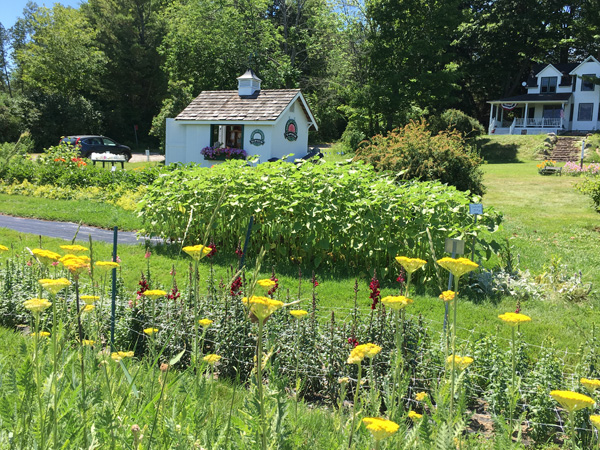
Below: The flower beds are the front yard of the Faughts’ century-old farmhouse. They built the 8 x 10 foot shed a few years after starting the business and consider it a great investment.
But she also values the job that takes her away from the farm four days a week, as communications director for the Leelanau Conservancy, a nonprofit organization that has conserved more than 12,000 acres of land on the Leelanau Peninsula in northern Michigan.
“I feel fortunate to be involved in two things that are very important to me, that are making the world a better place,” she said.
That her flower business is well-loved is evident. She keeps a guest book in the shed where customers get their scissors and containers and leave payment. Page after page is filled with heartfelt thanks and compliments. “I left more than I owed because I want you to keep doing this!” one customer wrote.
At this point, there is no risk that Carolyn won’t keep doing it. Not only does she love the flower business, she also has developed it into an important revenue stream. Last year, she grossed $23,000 and netted $17,000 from six months of sales. U-pick accounted for 50 percent of her revenue, bouquet subscriptions for 40 percent, and the on-farm sale of perennials for 10 percent. This year, after a small price increase and a minor adjustment in her business model, she is on track to a larger profit.
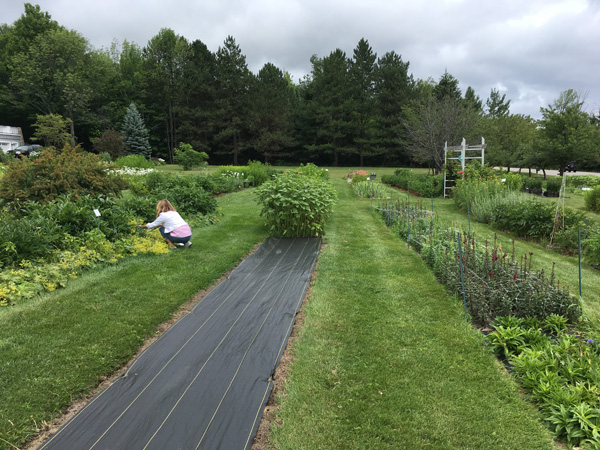
Below: A customer picks her own bouquet at Omena Cut Flowers. Landscape fabric covers a bed that will soon be planted with another succession of sunflowers.
Before this year, she offered bouquet deliveries as far away as Traverse City, which is 22 miles from her farm. Now her strategy is to bring customers out to the farm to either pick up subscription bouquets or pick their own flowers. Most of her customers are happy to take the scenic drive up Route M-22 to her farm that overlooks the bay. There, they can stroll the mowed grass paths between beds of flowers that are noticeably well-kept.
“I absolutely love to weed,” Carolyn admits. “If my body could take it, I’d be out there 24/7 pulling weeds.” She gives credit for the farm’s neatness to her husband, Dave Faught, a Certified Public Accountant who works from the farm. Dave likes to get away from his desk to mow and till.
About 60 percent of her flowers are perennials, including many varieties she got as starts from her mother, a once-avid gardener who is now 89 years old. Dividing her perennials also provides many of the container plants she sells at the honor-pay stand. She succession plants annuals including sunflowers and zinnias, scheduling for the heaviest production in June through August, when northern Michigan fills up with vacationers, most of whom either have their own houses or rent houses so have a use for cut flowers.
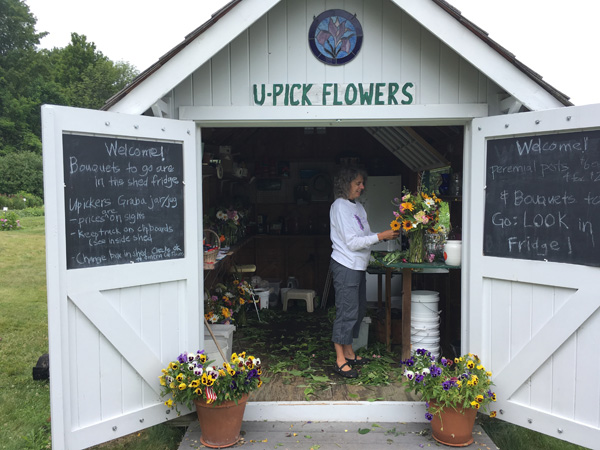
Below: Nadine Elmgren makes bouquets for subscription customers. Nadine was Carolyn’s sons’ preschool teacher and she has worked on the farm as the bouquet maker for five summers. The farm is rarely staffed, so communication with customers happens on chalkboards and index cards. A locked box is a fairly recent introduction after several farms in the area lost money from their honor-pay containers. All images courtesy of Lynn Byczynski.
She markets primarily through her own email list and through her Omena Cut Flowers page on Facebook, which now has more than 3,500 people following. Carolyn has found that purchasing Facebook ads has been good for business.
Plenty of year-round residents support her flower business, too. She is active in Suttons Bay Schools, where her and Dave’s younger son, Will, is now a high school senior. Their older son, Sam, is in medical school.
“I donate a lot of flowers to different organizations,” she said. “After 9-11 especially, I thought ‘What can I do to help this world?” I came up with the idea that I would donate flowers if people would leave a check made out to the Red Cross and we raised over $1,700. We have raised money for AIDS projects in Africa, the local food pantry, Flint water. I love the fact that the garden can be a place for good.”
Lynn Byczynski is the founder of Growing for Market and the author of The Flower Farmer: An Organic Grower’s Guide to Raising and Selling Cut Flowers, available from www.growingformarket.com.
Copyright Growing For Market Magazine.
All rights reserved. No portion of this article may be copied
in any manner for use other than by the subscriber without
permission from the publisher.