





A small-scale, community-based farm store
We can’t all live near Manhattan, Boston, Montreal, San Francisco, Ann Arbor, Madison, or any number of other awesome markets for organic produce. In my experience as a farm manager on farms in the Hudson Valley, Finger Lakes, and Sacramento Valley, you can sell it all, all the time, in those markets. Not so in the myriad small markets many of us find ourselves in.
For my own permanent farm, I landed in a small, but growing and enthusiastic market near Utica, New York. We are in the relatively low-income Mohawk Valley — a beautiful place to live and farm that also happens to lack big cities, clientele with large disposable incomes, or a hot restaurant scene. We do have some outstanding, nationally ranked restaurants, and they work hard for every dollar they earn.
Many of us live and farm in similar smaller markets. Maybe yours, like ours, is solidly middle class, lacks the bright-lights-big-city, lacks the sprawling suburbs, but does have a strong core of people interested in and highly supportive of healthful, local foods. Maybe that core group acts as ambassadors for local farms, helping spread the local food scene little-by-little in your area.
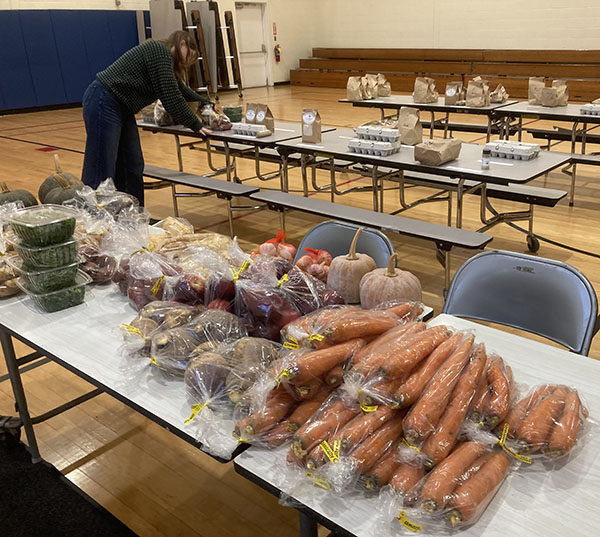
As produce, baked goods, and meats arrive from farmers, they are arranged on tables by customer name for the 5-6:30 pick up window.
Maybe a big part of your job as a retailing farmer is educating people about the differences between grocery store produce and local produce, industrial organic and local organic. You pull in customers one-by-one, not in huge hauls. Maybe you, like us, read about the successes of food hubs and farm stops with a bit of envy — if only we could pull that together here.
What I describe in this article is a low-budget, low-risk food-hub-adjacent initiative that has been working for us in our small market, and that we think could also work for many of you. It is a local, farmer-driven, full-plate sales outlet. It has a lot of flex to it and does not require a major investor or a grant to get it going, just someone looking for a side hustle and a group of willing farmers.
In 2022, JB Riffle, then a local teacher, now the Executive Director of the Farmers Market Federation of New York, and one of those all-important local food ambassadors, started Local Foods Mohawk Valley (LFMV). It’s a simplified online sales platform that acts as a scaled-down (which for us at this time, is the appropriate scale) food hub/farm stop. Importantly, each farmer involved has full access to the backend of the website and full control over inventory and price points.
JB decided on and maintains a 90-10 split, which is both a generous give to the farmers (more akin to retail than wholesale) and a solid keep-the-system-well-in-the-black-with-a-bit-of-side-hustle for JB. I’ll break down the process of getting LFMV going into the following sections: Initiation Phase, Weekly Logistics, and Future Hopes.
Initiation phase
Choose an online platform. All of us growers know there are many options out there. For a price, you can get a lot of flash from some of those options, which again, might be an awesome business move in a hopping market. JB chose the admittedly unflashy EatFromFarms platform. (And please note: The intent of this article is not to support or criticize any specific online platform, but rather to breakdown our experiences.) EatFromFarms (EFF) is inexpensive and its developer George Duggan is highly responsive to emails and phone calls. It might not look like a polished web interface (my opinion, and, ok, there’s a critique) but it gets the job done. The price point is also exceptionally affordable.
Recruit farmers. Just like a farmer’s market manager or a store produce manager, JB reached out to a cross-section of the local farming community: a few veg growers, a few dairy folks, a few pastured meat people, a honey guy, a maple syrup farm, a couple bakers … you get it. A nice selection, but one that avoids overly similar farms stepping on each others’ toes.
Give those farmers full access to the website. With EFF, each farmer can create his or her own password-protected account, and there is unlimited space to add new vendors. Each farmer then has full access to the backend of the website for farm products. Farmers, therefore, control their own inventory, item descriptions, item photos, and pricing. JB is completely hands-off in this department, allowing the farmers and makers themselves to determine what gets listed on a week-to-week basis and how much it should sell for. I think this is a key determinant of the success of this system: we farmers remain as “price makers” not “price takers.”
Develop a customer base: JB started with an email list that has grown steadily. Participating farmers have contributed contacts to this email list, but are not required to. LFMV has done what all of us in the local foods business are pretty familiar with: find creative ways to get the word out — email, social media, word of mouth, paper brochures, time spent interfacing at farmers markets, etc. Recently, JB sent out over 4,000 postcards to local addresses. We’ll see how this impacts sales over the coming season.
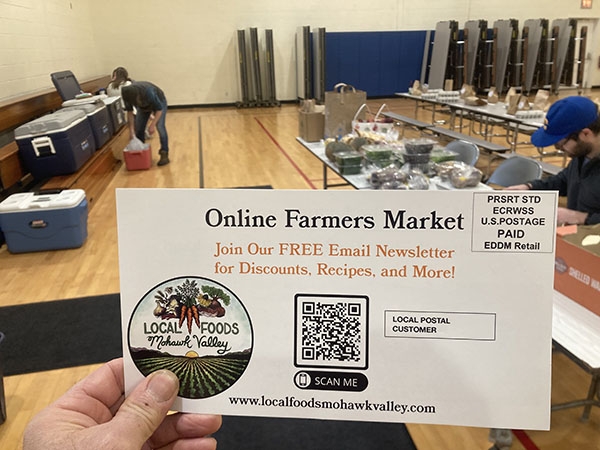
Local Foods Mohawk Valley recently send out 4,000 postcards to local addresses to drum up business.
Pick a distribution site. LFMV distributes once per week (more on this in “Weekly logistics” below). Finding the right site for distribution is probably the trickiest part of this system. For LFMV, the original distribution site was in a church with a large open entrance space and ample parking. JB paid a monthly fee to use the space. This worked well for several months, but then another even more convenient opportunity opened up to move distribution to a local private pre-school gymnasium where JB taught.
JB is able to use this space for free, but as you’ll see from the following information, the space is only needed about four hours a week. You can imagine any number of other potential arrangements for a distribution site: churches, schools, municipal buildings, a well-located and clean garage, a barn, etc. The important thing is to land on one that works well for everyone and is consistently easy to access. JB also carries a liability insurance policy that covers this distribution set-up — an important step for anyone developing a similar program.
Infrastructure needed. Portable coolers are the big one. As eggs, dairy and frozen meat arrive for distribution, they need to be kept cool. JB invested in a number of large coolers (which, importantly, he is able to stack and store on-site). Tables are the other big need. Fortunately, at the current site, a large number of folding tables are already available. JB is able to set these up, clean them down, and put them away with minimal effort. You’ll also need a good, reliable printer to print out the weekly “Product Pick Lists” and “Customer Assembly Lists.”
Weekly logistics:
Develop the schedule. In our case, it works like this: Tuesday is delivery and pickup day. Online customer ordering is open from Wednesday 6 a.m. to Sunday midnight. Newsletters and reminders go out to the customer base on Thursdays and Sundays. There is no ordering on Mondays, giving farmers a chance to download their “Product Pick List” and gather product together. Product is delivered to the local gymnasium on Tuesdays between 3:30 p.m. and 4:30 p.m. Customers pick up almost immediately afterwards, with a pickup window from 5:00 p.m. to 6:30 p.m. So far, this once-a-week schedule has worked very well for us. Depending on your situation, you might want to have multiple days, or might find that weekends are preferable.
Delivery and distribution: Each individual farmer can download their individual “Product Pick List” from the EFF website anytime after midnight on Sunday. For my farm, Monday is always one of our three harvest days of the week, so Tuesday works well for us as a delivery day. That said, on the Tuesday of distribution, farmers must drop off their product within a narrow one hour window, 3:30 p.m. to 4:30 p.m. This can seem tight, and for us on a busy produce farm, it is. As it happens, we also do a large CSA distribution on Tuesdays, and frequently find ourselves wishing the drop off timing for LFMV was later in the day. Generally, one of my workers is able to get the timing right so that the day ends with a delivery to LFMV right at 4:30 p.m.
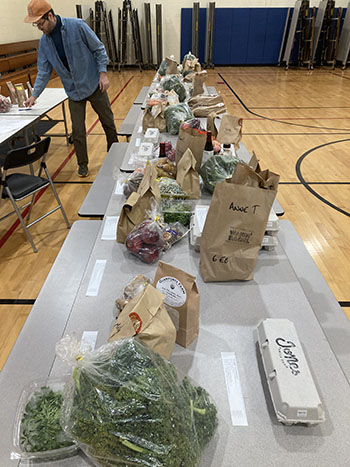
Pre-ordered produce is grouped by customer name.
But you can imagine the occasional logistical challenges of this during the heart of the season. We have no problem making our winter distributions on time. JB and some volunteers (family members and local college students) inventory the produce and distribute it on large tables with a printout of each customer’s order. It is important to thoroughly check-in each vendor’s product to make sure there are no mistakes. The time window between farmer drop off and customer pick up is tight. The customers filter in from 5 p.m. to 6:30 p.m., logical after-work timing to swing in and pick up a bounty of local goods.
The money: JB collects a $3-per-order service charge to help cover the costs of the online site, space rental, and basic liability insurance. This service charge could be adjusted in either direction to suit an individual’s needs. So far, this service charge does not appear to be an issue for the LFMV customer base. In turn, each grower receives 90 percent of whatever price they have set for the items they sell on the site. EFF has an accounting page that neatly summarizes each vendor’s monthly sales, making this an easy calculation. JB writes checks to vendors on a monthly basis.
And that’s the gist of it. How do the farmers and makers feel about the system? When I ask other vendors, everyone is, well, happy. It is an expanded sales outlet with minimal effort on the part of each individual vendor, and it works to combine some of the best aspects of direct marketing and wholesaling.
For our produce farm, it’s been a great way to move products that we have in super-abundance during the heart of the season, and we find it is an especially lucrative outlet for winter sales. We put tons of storage crops in walk-in coolers each fall and also grow microgreens. I feel confident selling a large portion of this through LFMV, and rarely have to resort to taking a true wholesale price from other outlets.
Other farmers coming in from greater distances (some drive up to an hour) have mentioned that they really appreciate the chance to have concentrated sales in one place and in one short time period and no long day at the market tending a stand for these sales. Farmers are also receiving a solid, very-close-to-retail return on their efforts with LFMV. Monthly pay-out can sometimes be an issue for farmers who have a lot of their product pending at this one outlet, but again this is an aspect that can be adjusted.
When I ask customers how they feel, they’re thrilled. LFMV very much meets that standard of locavore “full plate” shopping. We have some extremely talented farmers in our area, but they are pretty widely scattered: LFMV draws everyone into one place.
Future hopes
Where could this go in the future? We don’t know. Our area is certainly in an economic upswing and the core of serious local food boosters keeps growing, so we all keep dreaming and scheming, that’s for sure. We bat around new ideas, such as perhaps adding a chefs’ pickup day, where orders are exclusively for restaurant owners; maybe expand to separate distribution days in separate local regions; the potential to add deliveries for customers and delivery conglomeration for farmers. Lots of possibilities.
One thing we do know for sure is that this system has expandability and flexibility to it, with low risk on all fronts. We especially think it is an appropriate vehicle to test the viability of a food hub/farm stop/co-op in your area. Who in your area might run a version of this? Maybe, like us, a local food booster looking for a meaningful project. Maybe a farmer parent or spouse looking to support local markets. Perhaps a farm worker/intern looking for more involvement and some side-hustle income. A retiree looking to invest time? Local chamber of commerce or cooperative extension?
However it might work out, if you’re like us — a bit envious of farmers who have really booming sales outlets in their areas — we are certain this can be a low-risk, low-stress pilot for testing the waters of your smaller market.
Jason Townsend is the owner of Kingfisher Farm, a certified organic vegetable and fruit farm near Utica, NY. Kingfisher Farm is 12 acres of vegetables, orchard, small fruit, and a tree nursery marketing through CSA, farmer’s markets, and online sales.
Copyright Growing For Market Magazine.
All rights reserved. No portion of this article may be copied
in any manner for use other than by the subscriber without
permission from the publisher.