











An experiment with a radical marketing model
In 2013 and 2014 our farm, Oakhill Organics, operated a Full Diet style CSA in Yamhill County, Oregon. My husband Casey and I tried this unique and challenging CSA model after the acres under our management expanded from 17.5 to 100. We’d been looking to diversify our offerings for years, and the new land base provided the room to experiment. But in 2011 we weren’t sure exactly how we would approach diversification and growth.
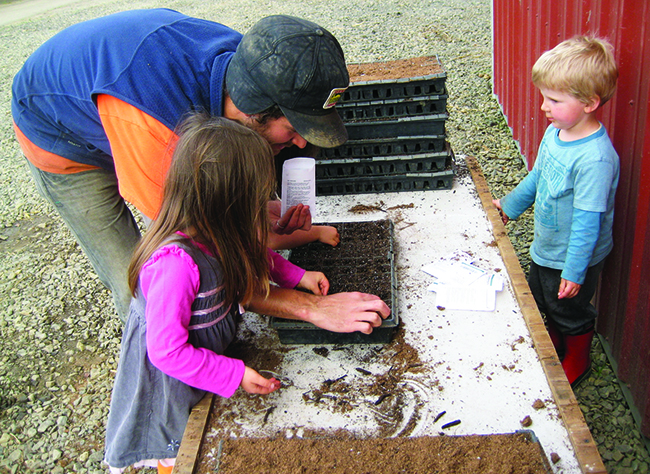 Full-diet CSA members engaged with the farm in many ways while they were at pick-up, including the children sowing the season’s sunflower crop in trays.
We already had been operating a vegetable CSA program since 2006 and had 200 members. It made sense to start layering new enterprises on top of that existing marketing structure, hopefully increasing the amount of farm goods we could sell to the community we’d already built. Rather than going broader by expanding our customer base, we wanted to go deeper by selling more goods to our current community.
Full Diet CSA concept
As we were brainstorming ways to do this, we read Kristin Kimball’s memoir The Dirty Life, which describes the Full Diet CSA model she and her husband pioneered at Essex Farm in New York. We met Kimball at a conference in early 2012 and talked more about Full Diet details, and we were sold. This would be the model we would use to expand our farm’s acreage and offerings.
Here’s our understanding of the Full Diet model and how we applied it. As a farm, we would aim to produce as many different staple foods for our customers as possible — that included vegetables, fruit and also eggs, meat, milk, nuts, and grains. Our customers would pay a flat fee for the year and then come to the farm weekly to pick up food. There wouldn’t be set amounts of anything, but instead they’d choose what they enjoyed and in volumes they thought they’d use. At Essex they call this open-ended distribution model, “free choice.” We’d also offer some u-pick crops throughout the season.
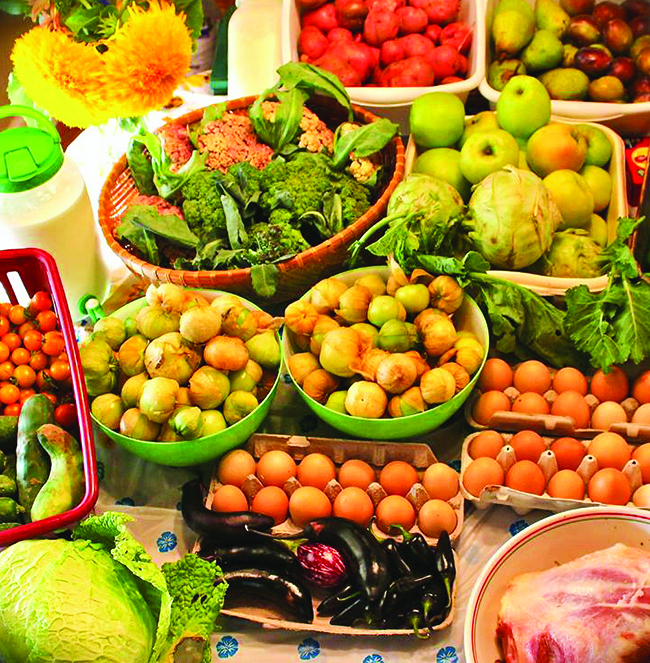 An Oakhill Organics Full Diet CSA member took this photo of one of their household’s weekly August shares. They selected based on the “free choice” model, so it represents their particular taste preferences and appetites.
We appreciated how this model would give us room to explore new enterprises within a streamlined marketing concept. We anticipated that we’d save an enormous amount of time and labor by having one place where we distributed all of our offerings. We wouldn’t have to sell each new enterprise separately. Instead, we would sell the one CSA (a product and a lifestyle opportunity) and share what we had each week with the “Food Adventurers” who were ready to join us in the experiment.
Preparing for the Full Diet
We spent all of 2012 preparing to launch our new concept. While we knew the preparation would involve massively complicating our farm’s enterprises, we were eager to launch. So, we decided to dive head first into the new projects with the goal of starting our Full Diet the first week of 2013.
Because we were a produce farm, the most significant preparation was expanding our farm to include livestock. We’d had limited experiences with livestock, but we hired two employees who brought experience exceeding ours, and we learned what we could through reading and informal mentor relationships with nearby dairy and livestock farmers.
Animals require very different infrastructure, and we did not have any animal-oriented shelters or structures on our farm. So, because we had a large land base and mild year-round weather, we decided to shape an animal operation that would be based on year-round pasturing, with high tunnels as temporary shelters for the most inclement weather.
It took us many months to buy the necessary supplies, locate the right stock, and begin the slow learning and training process needed to launch a pasture-based system, including milking on pasture. To have a diversity of meat, egg, and dairy options, our new livestock operation included: laying hens, Jersey dairy cows, a flock of hair sheep, sows, and eventually meat chickens and turkeys.
In 2012, we also planted grains and purchased a hammer mill to allow us to process as many grains and vegetables as possible for animal feed. We already had two fruit orchards planted, but we planted blueberries, raspberries, and strawberries at larger scales as well early that year.
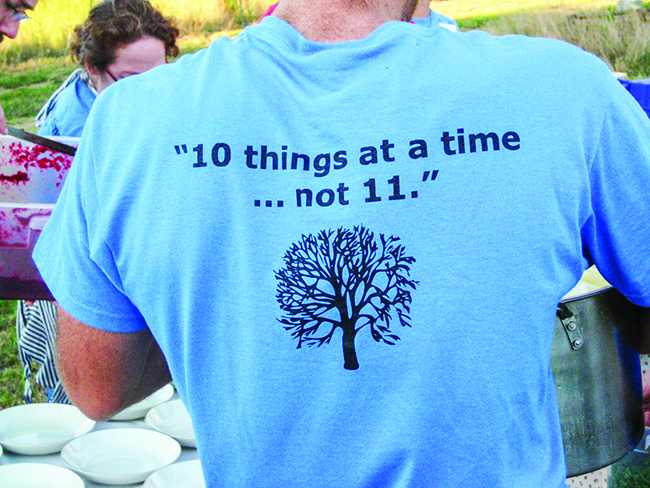
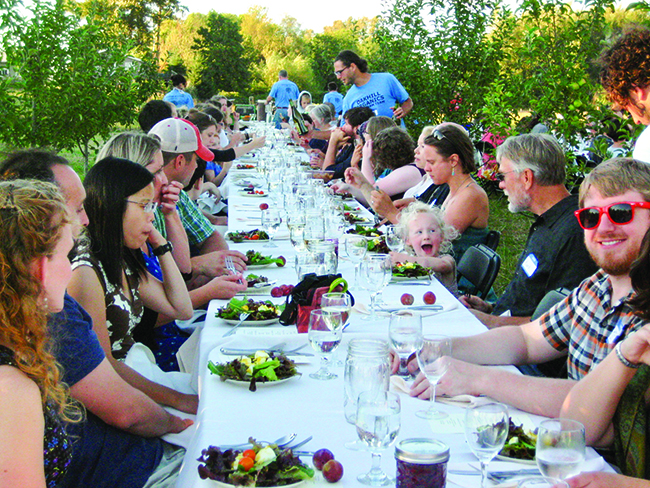 In 2013, the author’s farm hosted a free multi-course sit-down dinner for CSA members. All of the food served came from the farm itself. (Below) The farm printed its Full Diet farm motto on special shirts that volunteers wore at the sit-down dinner. All photos courtesy of the author.
In addition to preparing the farm for the upcoming shift to the Full Diet, we also spent 2012 preparing our CSA members. After some back and forth, we decided to continue offering our vegetable and fruit CSA to members who weren’t ready for the big Full Diet adventure, but we wanted as many people to switch over as possible. We knew the Full Diet experience would be a significantly bigger commitment in cost and time for our eaters, so we used our CSA newsletters to share details on how we expected it to work. We also held two in-person information sessions.
Final details
Apparently, many of our community members were ready for the adventure; we started our first week of 2013 with 30 households signed on. We asked them to sign our usual CSA commitment form along with another document based on the raw milk herd share agreements many Oregon raw dairies use to operate legally. Essentially, the document said that all of our members “co-owned” the animals, and we were simply processing and distributing their products each week.
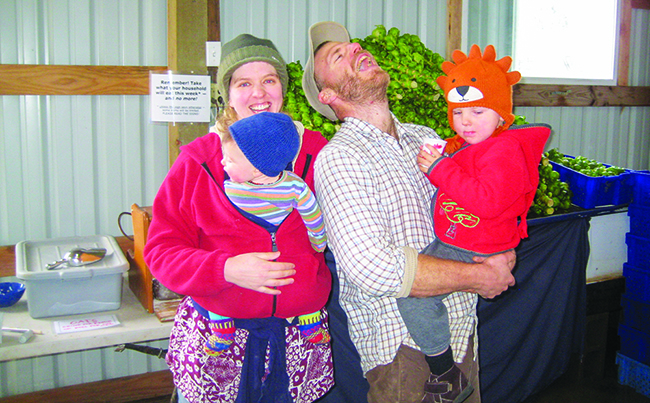 The author and her family celebrated the inaugural day of Oakhill Organics’ Full Diet CSA in front of a giant pile of Brussels sprouts in their pole barn pick-up space (January 2013).
Direct marketing animal products in this way is a legal gray area. Laws vary state-by-state, and to sell meat by the pound or cut requires a load of licenses along the way. However, selling meat “on the hoof” often falls into different categories. We steered our program into those gray areas, while also doing what we could to ensure that we were operating in the cleanest, most humane way possible, learning and adjusting as needed. Our herd-share-style agreement helped us when the Oregon Department of Agriculture made a surprise visit several months into our first year.
The final step was setting up a pick-up site in our pole barn. We are located about 20 to 30 minutes from the two small cities where the majority of our members live. By hosting the pick-up on our farm we greatly simplified our work and were able to give them easier access to the seasonal u-pick items. We set up several long tables in our pole barn for distributing vegetables. We already had two walk-in coolers, where we were able to store milk, eggs, and meat. One of our employees would pour milk, each family bringing its own clean jars for transport. Along another wall, we set up a butcher station, where Casey was on site butchering meat.
By the first week of 2013, we were ready to start.
The early snags
The first few weeks were tumultuous as farmers and eaters alike navigated the new evolving systems. We had a handful of families drop out within the first two months because they realized their lifestyles weren’t compatible with the work required; however, we picked up several more families over the course of the year to more than make up for the loss.
We also realized that it took a lot of forethought to balance the food needs of 30 or so different families all being fed from one farm. While we embraced the concept of the free choice selection model, in practice the food wasn’t unlimited in supply. So, we learned to put reasonable upper limits on foods we knew would be popular enough to risk running out. Those limits still provided plenty of abundance and represented vegetable quantities far exceeding those of most CSA programs.
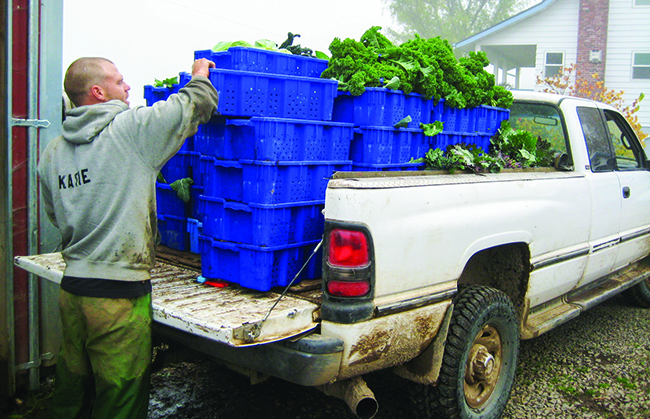 The author’s husband unloading just some of the bins of greens that would be distributed at a weekly Full Diet pick-up for 30 households.
Limits became critically important in finding fair ways to distribute the animal products, especially milk and eggs, which have natural seasonal fluctuations. We aimed to communicate regularly about what our supply level was and help people find an amount that made sense. In addition to continuing to offer a weekly farm newsletter, I wrote a Full Diet newsletter that shared behind-the-scenes specifics about the upcoming week, including availability and limits.
After a few months of tinkering and fine-tuning, we found a comfortable routine that seemed to work for everyone.
The successes
We offered the Full Diet program for two years, and in that time we met our goal of supplying diverse offerings in abundant quantity every single week. To that end, our Full Diet was a success.
Without a doubt, the best part of operating our Full Diet CSA was the food itself. Our family, along with our employees and members, enjoyed fresh raw milk, rich farm eggs, succulent cuts of pasture-raised meat, tree fruit, dry beans, oats, seemingly endless vegetables, abundant berries, and more.
We also relished the extra time we got to spend with our community of eaters during our weekly pick-up on the farm. Every Thursday afternoon, cars pulled up to our pole barn, and we’d be there to help pour milk, restock vegetables, answer questions, and chat. In the summers when we had u-pick opportunities, some members enjoyed even packing a dinner and leisurely enjoying their time on the farm.
Our first summer, we combined the best of the food and the community in one celebratory farm event by hosting a free sit-down dinner for our CSA members, catered by chef friends. Not charging for the meal allowed us to serve meat and dairy from the farm. That one memorable night probably encapsulates our entire Full Diet experience — delicious food, beautiful setting, good company and community — but very expensive and stressful for us to produce.
High complexity and risk
Our motto during the Full Diet CSA was “Ten things at a time, not 11.” We even printed this on T-shirts for our volunteer servers to wear at the dinner. At first, we were exhilarated by learning all the new things needed to operate such a diverse farm.
A few enterprises (such as beehives for honey) ended up total failures, but we did meet most of our idealistic goals. Even with our many successes, however, we found producing so many different farm products on one farm to be incredibly complicated — no surprise there. Obviously farming of any kind is never straight-forward, and in our previous seven years we’d dealt with plenty of stress, but the number of daily emergencies skyrocketed to a level that didn’t feel emotionally sustainable or safe for us or our employees.
We had the added challenge of the usual employee turn-over. It became critical for Casey and me to have a deep understanding of how every single enterprise operated and then be able to transfer that knowledge relatively quickly to other people. As we added more heavy equipment and animals into the daily work mix, we became increasingly uneasy about how much could go wrong, especially with newer employees on the job.
We were also producing foods that carried higher health risks, for example raw cow milk. During our steep learning curve, we learned quite a lot about how to mitigate those risks and keep our product clean and safe. That meant we had very critical sanitation and safety protocols on many different parts of our farm.
But even with these stresses, we did enjoy some aspects of the increased diversity and kept much of that for several more years.
The deal-breaker: money
The ultimate reason we eventually discontinued our farm’s Full Diet CSA was because of money. Looking back, it’s clear now that we profoundly undercharged our customers for what we were offering.
Choosing the correct pricing scheme for this particular distribution model was trickier than we anticipated. It is inherently difficult to plan without a clear sense of volume of food needed, and we learned that people are capable of eating a lot of farm foods when given the opportunity and encouragement. Because we had marketed the idea of free choice food, we felt it necessary to meet the expectation of abundance. That meant that we never wanted to run out of food nor cut people off unless very real limits were necessary, such as discussed.
To ensure that every member had equal access to this level of abundance, we found ourselves over-producing every item. The extra food certainly fed our family and our employees well, but it meant a big disconnect between our production level and what we were being paid for.
And, beyond the extra production issue, we weren’t sure we even were being compensated appropriately for the food that did go home with our members each week. In the free choice distribution model, we didn’t keep track of exact quantities or volume of food distributed, but occasional calculations told us that the market value of the food moving through our CSA pick-up vastly exceeded even the large payments coming in from our members.
Yes, we saved some money by streamlining our marketing into the one channel, but only on costs related to marketing and distribution — for example the labor and input costs of a pound of grass-fed beef were just the same for us to produce as for someone selling it at full price at market.
We did raise our price in our second year (from $2,000 to $2,300 per adult per year), but we found that as we raised the price, people who were lighter eaters stopped seeing the value of participating in an expensive program. So, our price increase ended up unintentionally selecting for the eaters who took greater advantage of the free choice model and were likely taking home much more food in terms of financial value than what they were paying. Of course, they did not know this because we had purposefully disconnected our costs from their costs. And yet, for many of our families, even the new higher price was a budget stretch, so we didn’t want to keep raising the price.
Due to all these pricing challenges, we watched our farm’s profits disappear during those two years. In the seven years we’d farmed before the Full Diet, we hadn’t had any off-farm income, and the farm itself had always comfortably paid its own expenses plus ours — including financing infrastructure building and new projects. We were now just barely squeezing by, and we were finding ourselves unable to make ongoing improvements in the many enterprises we now operated on our farm.
It was also challenging not being able to calculate which of our many enterprises were profitable or not. In theory it didn’t matter in the Full Diet concept, but at the same time if we weren’t feeling financially stable, we needed to be able to see the relationship between what each product was costing us to produce and what it was bringing in. One thing that was clear was that our ongoing traditional vegetable CSA was bringing in more than its share of money and keeping us afloat.
Ultimately, we didn’t see a reasonable way for us to work through this fundamental pricing versus cost of production challenge of the free choice Full Diet system in our particular circumstances. Perhaps in a more affluent community, the program price could be set high enough that the farm always made enough money. Or perhaps a farm that started out with more infrastructure and equipment could worry less about having as much cash flow for capital expenses. Obviously every farm has its own unique circumstances that determine what kind of marketing models work or don’t.
Shifting gears
In the fall of 2014 we announced our decision to discontinue our Full Diet CSA at the end of that year. Not only were we burnt out, we perceived that many of our members were feeling similarly after two years of spending a big chunk of every week driving out to the farm and then processing their fresh farm foods.
We wanted to regain some of our farm’s profitability and sustainability. We also wanted to hold on to many of our favorite elements from the Full Diet experience, especially the wider diversity of delicious farm products and the increased community feeling we experienced by hosting our members on the farm.
Thankfully, we came up with a solution that blended these elements into our ongoing vegetable CSA. I’ll describe that hybrid model and our Storefront Success in the next issue of Growing For Market.
Katie Kulla lives and farms with her family in Yamhill County, Oregon. You can find Katie at www.OakhillOrganics.com and on Instagram: @katiekulla.
Copyright Growing For Market Magazine.
All rights reserved. No portion of this article may be copied
in any manner for use other than by the subscriber without
permission from the publisher.