











There is a new crop on the scene and the Wiedigers just HAD to get on the bandwagon! The new crop is ginger. That’s not new, you might think. But wait, this is not the same as that fresh ginger you bought at your favorite produce counter — ginger with a tough outer skin and lots of fiber inside, making skinning and grating it a challenge. Oh no, this is something entirely different. This is a tender, skinless, almost fiber-free ginger, and, wait for it, beautifully pink and white!
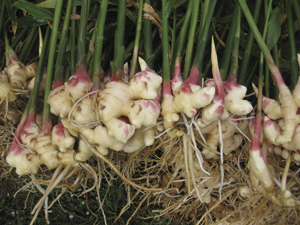
Baby ginger. Or, young ginger, spring ginger, pink ginger … well, you get the point. Like many of the crops we love and grow, the baby ginger is almost a totally different food from the more mature root.
So, how new is it? Well, here in the continental U.S., pretty new. Missy Bahret and Casey Steinberg of Old Friends Farm in Amherst, Massachusetts, decided to try it a few years ago and wrote about it in the August 2008 issue of Growing for Market. You can read their article at https://growingformarket.com/articles/baby-ginger.
Several universities are researching growing it, primarily in high tunnels. They include Virginia State, Penn State and Cornell as well as others. Googling baby ginger production will net you a lot of research information. And, last year, we participated in a trial with Johnny’s Selected Seeds, growing it in one of our high tunnels. Actually, we failed terribly at it, but learned a lot. And, in January, when we had the opportunity to purchase planting stock and try again, like the eternally optimistic farmers we are, we decided to go for it.
We purchased enough stock to plant 100 row feet – 30 pounds. Now, buying 30 pounds of seed ginger is not like buying 30 pounds of seed potatoes. It is a considerably larger investment. At the 30-pound quantity, we paid $5.50 per pound plus $30 shipping. But this seed ginger is tissue cultured, and grown to be disease free, shipped 2 day air from Hawaii and comes with lots cultural information, newletters and advice from the distributor. It also has a much higher selling price, so we dived in.
In early March, we got a phone call from the grower in Hawaii, making sure we would be home when it was delivered as a few hours sitting on a porch in March temperatures would not be good for the tender rhizomes. Two days later, we received a box of stock, carefully cut to the correct planting size, ready to plant. We were so excited! As you all know, for a grower, a new crop is so much fun! We couldn’t wait to get started. So we planted it into our standard potting media in bulb crates, put it into our heated – but cool – greenhouse and waited to see the first sprouts. And waited. And waited. Was it okay under there? Dug around and looked. Well, no rotting, just need more patience. And waited some more. Finally, with the warming days of early April, we started seeing shoots. Those first few were so exciting! Once it started growing, it grew fast, especially as the temperatures continued to climb.
By the end of May, soil temperatures in our high tunnel where we planned to transplant the ginger were perfect. We got a little sidetracked by other farm business, but by the middle of June, we were ready. Paul prepared the planting area by tilling our normal amount of 3-4-3 Replenish into a bed, a pound or a little more per row foot. Ginger rhizomes grow up and out, so we knew it needed to be hilled several times during the growing season. Mindful of that, we started by placing the 12” tall plants into an 8” deep furrow. We placed the plants, covered them with a couple inches of soil and laid drip tape, a row on each side.
Ginger is a hungry crop, and, in a high tunnel, a rather thirsty crop. We were running the drip irrigation two to three times a week for three to four hours. Keep in mind this was for plants already over a foot tall. Seed pieces or small plants would not need this much water this early. Once it got established in the bed, it really started growing. Mid-July, we were seeing cracks in the soil above the crowns, and gave it the first top-dressing of Replenish, maybe .5 to .75 pound per foot, and hilled it from the loose soil at the edge of the trench. We weeded the bed at the same time. Already, we could tell that this was a really fast growing, gorgeous crop. There were at least twice as many stems coming from the crowns as when we planted it, maybe three times as many.
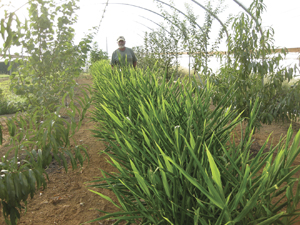
By the middle of August, the ginger was at least three feet tall, and the stems from the crown had doubled again. This was really exciting, because each stem means a rhizome of ginger under the soil — hopefully, a fat and heavy one. We did another light hand weeding. The ginger foliage seemed to be shading the soil enough to discourage heavy weed growth. We also noticed a little damage to the foliage from a small black caterpillar, and talked about spraying with some Bt, but the damage was relatively light, and we decided to just watch and see. Grasshoppers also made some holes in the leaves, but the ginger just kept outgrowing the damage.
In early September, I came home from work one afternoon, and Paul just insisted we needed to go up and look at the ginger. So I changed clothes, and up to the high tunnel we went, carrying our camera with us. I was amazed! It had grown so much since the last time I had seen it. It was close to chest high on me, and the crowns were almost touching in the row. We decided to top dress and hill one more time to get the most growth to those rhizomes before we started harvesting. It was so satisfying to look at a crop we were growing essentially for the first time, and have it be so successful.
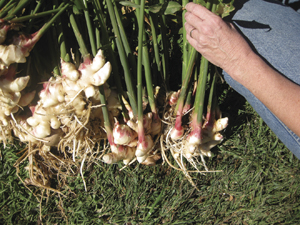
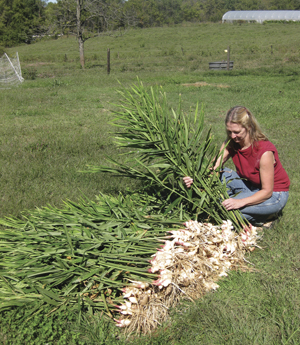
Finally, at the end of September, we could wait no longer and Paul dug our first harvest. Since this is a NEW crop, and we market in farmers market in a smallish city and our customers are often hesitant to try new things, he dug just 8 row feet. He hauled it down to the house and hosed the soil from the clumps — so gorgeous! He piled it up so we could take some pictures. We got some good ones, but pictures just do not do it justice! It is white and pink, almost a neon pink. Once we got pictures, he trimmed off the tops and roots and did a little more hosing to get the rest of the soil off. Then, we weighed it: 28 pounds. Wow! That’s about 3.5 pounds per row foot. Later in the season, we were getting almost 4 pounds per row foot. Not too shabby for a first try at a new crop.
Okay, we now knew we could grow it. We could see it was absolutely gorgeous. We priced it at $9 a pound, above mature ginger in the supermarket but below the pricing we had heard for larger metro areas, set it out on the table at market, and waited. It was a slowish market day, as they often are once school starts here. But the ginger got a fair amount of attention.
As in “is that ginger? It can’t be. Ginger is a tropical crop.” “It’s pink!” “Did you grow it?” “How’d you do that?” “You all always have weird stuff.” Well, at least they didn’t say “You all are the weirdest farmers!” But, they bought. Most didn’t buy large amounts. They bought some to try. My prediction is that they will be back for more. It is so fabulous they won’t be able to help themselves. We sold almost everything we took. And we really do like having new, “weird,” wonderful items at our farmers market. It helps us stand out from all the other vegetable vendors.
As with any new crop, be prepared with recipes. Know that you will be doing a lot of educating of how to use it. Take lots of pictures and put some on the table with the ginger so folks can see it being grown. We actually took an intact plant, tops and roots, to show how it grows and that got a lot of interest. You might want to pile it into a large basket, or just heaped on the table in the most prominent spot you have and watch the customers gather!
Lastly, lest you think we are out here on the “new crop limb” by ourselves, we want to give you some additional information. Susan Anderson, of East Branch Ginger (http://www.eastbranchginger.com), the distributor from whom we purchased our planting stock, says there were about 155 baby ginger growers this season. Some of those just bought small amounts to experiment with. The majority were in the mid-Atlantic, with a few in the Midwest, far west and New England. So if you want to grow it, and especially if you have a high tunnel, chances are you CAN grow it. It is amazingly beautiful, and for us, at least this year, not very demanding. It wants warmth, nutrition and sufficient moisture. With those needs supplied, it returns possibly the most beautiful harvest you have ever seen. If you are looking for something new and exciting to grow, we would like to suggest baby ginger. You won’t be disappointed!
If you would like to see what the ginger looked like during the growing season, we have a set of pictures from greenhouse to harvest on our website: http://www.aunaturelfarm.com/High-Tunnel-Ginger.html
Copyright Growing For Market Magazine.
All rights reserved. No portion of this article may be copied
in any manner for use other than by the subscriber without
permission from the publisher.