
Mother’s Day is the only major floral holiday that most local flower farmers can supply, whether they grow in the field or under cover. We put a lot of focus on having as many flowers as possible. When I worked at a florist’s, they said that it was their busiest holiday. The owner of the shop said, “Not everybody has a valentine, but everybody has a mother.”
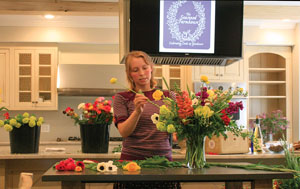 Gretel Adams teaches a Mother’s Day bouquet-making class where particpants brought their mothers to work on an arrangement together.
Mixed bouquets are our top-selling item for Mother’s Day, but we couldn’t do it without the supporting cast of blooms. Our top 10 sellers for Mother’s Day in order were: bouquets, ranunculus, tulips, stock, anemones, snapdragons, plants, dusty miller, LA lilies, and ornithogalum. Below are some details about some of these crops and the conditions in which we grow them here in zone 5b/6a. There are additional options if you have a heated greenhouse, but let me start with the outdoor crops.
.png)
Tulips
In our zone, the latest blooming tulips available are ready close enough to Mother’s Day that they can be stored for sale during that week. We extend the season by pulling the bulbs during harvest, and making sure to get them while they are still a little green. We store them upright, dry in Procona boxes for a maximum of two weeks. The varieties we like the best for late blooms are Spring Green (a lily flowering tulip), Black Parrot (which is a dark purple), and Blue Parrot (actually a pinky, lavender color, so don’t let the name fool you). Tulips are a flower that florists can use a lot of for moms, and they do like having some that are cheery colored. If I were a mom, I would love black tulips, but apparently not everybody sees it that way.
Biennials and perennials
Dianthus that can be planted in fall for the following spring bloom can handle pretty cold temperatures, with or without snow cover over the winter. You just have to make sure you get it planted so it has enough time to get established before the dead of winter. Last year we planted it way too late and had only a few tiny blooms, but the year before it was perfect timing for Mother’s Day. The other nice thing about biennial dianthus is that you get an assortment of colors. It makes it harder for bunching to florists since the seed is sold as a mix, but it is nice to be able to offer something besides the standard Amazon colors we grow as annuals throughout the rest of the year. The varieties we choose to overwinter are the Sweet, Messenger, and Electron series. The seed gets started week 25, and then field planted in August.
For us, herbaceous perennials aren’t blooming yet in May. We are just warming up enough for them to start putting on good growth, as our typical frost-free date is Mother’s Day. We are still building up our repertoire of woody cuts, but Viburnum Roseum is one that blooms in time for Mother’s Day sales, as well as Spirea ‘Bridal Veil’. We used to have black pussy willows that we didn’t harvest for the catkins, but we would let leaf out to fill in bouquets. Just be sure the foliage doesn’t have new growth tips on them, otherwise they will wilt. (We have since dug them out to put in drainage next to the greenhouse.) There are growers who use unheated, covered space to speed up peonies for bloom on Mother’s Day, which we have dreams of doing some day, but haven’t experimented with yet.
Now on to those that require unheated, covered space. Ours are high tunnels, but there are other growers that use low tunnels or caterpillar tunnels.
Ranunculus & anemones
Our second succession of ranunculus and anemones, which we plant around December 1, are the blooms that hit Mother’s Day. For the coldest nights, they may need a floating row cover, depending on your zone and weather.
Bells of Ireland
Last year we tested bells in the heated versus unheated space and noticed only a few days difference bloom time. The bells in the unheated space actually seemed happier, so we figured why waste the heated space on something that didn’t benefit that much from it. The bells that bloomed for Mother’s Day were seeded in early October. I personally think they smell like musty basement, and they take a lot of work post harvest to get all of those leaves off, and beware of the thorns. But they work great in bouquets, especially if you can leave those top few sets of leaves on the stem, so are still worth the effort.
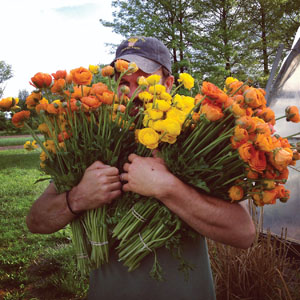 Photo at right: Steve Adams with armloads of ranunculus coming out of the unheated greenhouse. All photos courtesy of Sunny Meadows Flower Farm.
Sweet peas
We use a hand crank food processor to scar the sweet pea seeds, and then soak them overnight to soften the shell, all to help with germination. We used to direct seed them in February, but would end up with uneven germination and gaps in the bed, so now we start the seeds in the greenhouse and then plant out established plants. Our sweet peas typically start blooming around Mother’s Day and go through 4th of July.
Dutch iris
When you buy pre-chilled iris, you can plant them to bloom on your timing, because the bulbs come to you from the supplier conditioned to think they have gone through winter. We get these beginning in November and then every two weeks through the winter. They aren’t a very high-dollar crop, but you can really cram them into greenhouse space, they work well in bouquets, and are another thing we can have on the truck for florists. We plant them four per square using Hortonova as a planting grid; they could be planted tighter, but that is as close as we can get them without having to dig out the bed. The blooms for Mother’s Day are grown unheated and planted week 7. Iris also work in the heated space, but heat isn’t necessary here to get them by mid May.
And now for what can be grown in heated space. We keep our heat very minimal, at 40°F most of the winter, and then we raise it to 50-55 degrees in March when the night temperatures get warmer. Everything grows really slowly, but it keeps it alive and works for our timing.
Dusty miller
We overwinter one patch of dusty miller in the heated house so we can cut it for Mother’s Day (and for early spring weddings). This year instead of leaving an old bed in there, we started seeds so it will be a new patch to cut for spring. Those seeds were started week 15, allowing enough time for the plants to get large before winter.
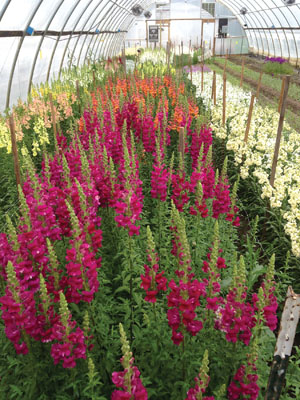 Snapdragons in the heated greenhouse ready to be cut, with Overture Magenta in front.
Stock
This is our number one request from florists for Mother’s Day, and each year we increase, but it is still not enough.They tend to use it in most arrangements, no matter their floral design style. I know I love it! Locally grown stock stays fluffy and smells amazing, characteristics that the boxed blooms may not have. White is nice to have, but the colorful stock sells best. Our Mother’s Day crop is seeded week 48, and we plant a whole bed in the greenhouse. More about specific planting dates and our favorite varieties in my next article.
Snapdragons
Snapdragons are another florist staple, but it seems like every florist has the colors that they like or dislike. I have a hard time picking colors to grow, but we decided it was better to have more of just a few colors than to have only a bunch or two of lots of different colors. For Mother’s Day production, the 1-2 group of snaps are blooming in our zone: Overture, Chantilly, and Maryland are the varieties we choose. Next year we will narrow it down and grow: Overture White, Chantilly Salmon, Overture Magenta, Maryland Red, and a still undetermined pink one. For our timing, we start these seeds week 51 for Mother’s Day blooms.
Ornithogalum
These get planted in October when the tulips come, and they grow very slowly. Last year ours were grown in crates, but for next year we have dedicated half a bed in the greenhouse for them. I will be sure to keep you updated on those trials.
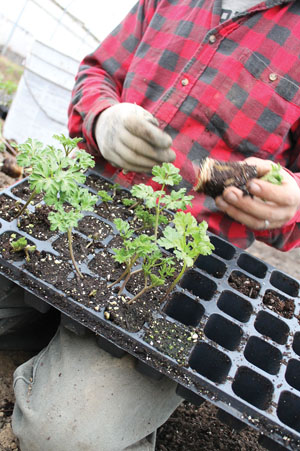 Steve transplanting the pre-sprouted anemones into the unheated greenhouse.
Lilies
These are grown in crates in our propagation house which is a little warmer, set to 50°F through the winter, 58 once it warms up a bit. We pretty much use all our LA lilies in bouquets. The Orientals are for sale for florists and are the first ones of the season. Not all Orientals take the same amount of time to bloom, so be sure to consider that in your timing. The Crystalblancas that we grow, for example, take longer than the Roselily.
Also know that the cooler greenhouse temperatures will delay blooming a little longer than in the standard days to maturity that are tested in optimal conditions for lilies. We have found that growing them at cooler temperatures has reduced the need for supplemental lighting in the greenhouse. Before we would keep our greenhouse warmer, around 65°F, and the lilies would grow faster, meaning longer, thinner stems before budding. Now we keep the greenhouse cooler, so they grow slower (and we just use heat mats for germinating seeds in the prop house), which also helps keep heating costs down.
Other flowers worth mentioning, but that don’t work for our timing: December planted freesia in a minimally heated greenhouse always gets too short in the warmer weather leading up to Mother’s Day, although sometimes you will get lucky with a cooler spring and one last flush just in time. For those a little colder than us, your last succession of freesia may be right on target. Larkspur in our unheated space always starts blooming the week after Mother’s Day. This year I got hopeful and even added it to our availability list, but it didn’t make it in time.
For those a little warmer, you may be able to have it soon enough. Digitalis could be grown unheated for Mother’s Day, but that trial was a few years ago, and I am not sure of exact timing. And lastly, hybrid delphinium, but we haven’t figured out the timing on those. Fall planted delphinium would be a good choice for spring bloom. Growing them under cover or in the field just depends on your weather conditions.
I also want to mention our herb plants. They were another great suggestion from Dave Dowling, the former ASCFG president who now works for Ball. Herb plants help make spring our most profitable season at the farmers market. They require covered space, but it can be unheated for later plugs. Ours are grown in the minimally heated house, and we buy in plugs in mid March, potting them up to trays of 16.
Since our frost free date is Mother’s Day, it is also our biggest plant sale day. We sell them wholesale as well as retail at farmers markets. We always seem to run out of flowers for Mother’s Day, but plants give us something else to offer for gift giving. For next year, we are planning to put up another greenhouse to expand our stock and ranunculus production, and we plan on planting about 12,000 tulips, with ¼ of those being the late ones. Mother’s Day, here we come!
Gretel and Steve Adams own Sunny Meadows Flower Farm in Columbus, Ohio. They can be reached at sunnymeadowsflowerfarm@gmail.com.
Copyright Growing For Market Magazine.
All rights reserved. No portion of this article may be copied
in any manner for use other than by the subscriber without
permission from the publisher.