

Community building CSA balances fair prices and fair wages
Pluk! was conceived one summer evening in 2017 by a couple of wannabe farmers. They were fresh out of agriculture school in the polder (low lying land reclaimed from the sea) and living in the heart of Amsterdam. That night, over a bottle of organic wine, we considered what Amsterdam had to offer — a progressive and diverse population with a growing appreciation for local food — as well as the city’s challenges, a lack of agricultural land around the city the most daunting.
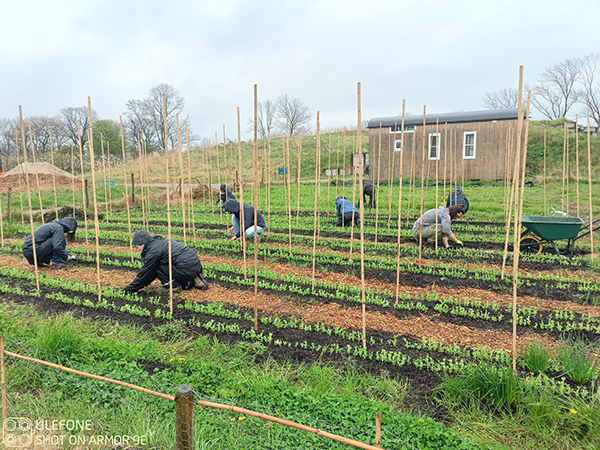 Planting out pea seedlings with a group of volunteers in the rain. All photos by the author unless otherwise noted.
We also compared the various small-scale and local models of food production that we had discovered as part of our training at Warmonderhof, the Dutch school for biodynamic agriculture. We knew for sure that our project would be a self-harvest Community Supported Agriculture farm.
As startup farmers, we appreciated the CSA principle of sharing in the risks as well as in the bounty and the security of a guaranteed income from membership fees at the beginning of the season. And even more importantly, we relished the idea of facilitating the most direct connection possible between ourselves and our urban-dwelling harvesters.
We hoped to create an educational project in which members would play an active role: helping in the fields and learning about our growing techniques and how to harvest crops. We were excited about the chance to talk to people of all ages about the wonders of plants, insects and the soil ecosystem.
We planned to showcase a mixture of organic, agro-ecological, regenerative and permaculture techniques to demonstrate how much food could be produced by many hands on a relatively small plot. In our mind, Pluk! would feature colorful polycultures of diverse vegetables, herbs and flowers where families from various backgrounds would gather for their weekly harvest.
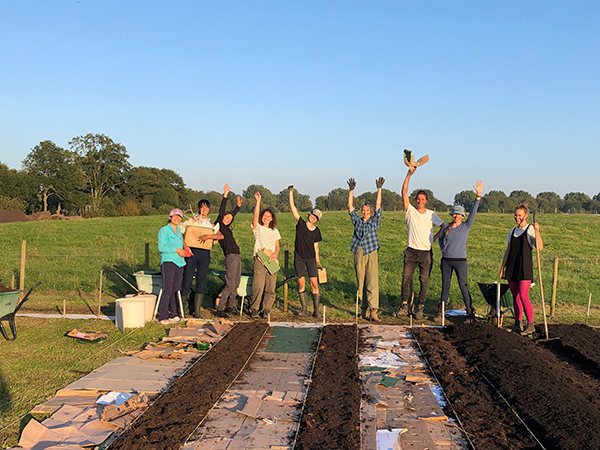 Converting a grassy area into beds using ‘no dig’ techniques.
Our goal was also to use Pluk! as a platform for highlighting the repercussions of the global industrialized model of food production on climate, biodiversity, and the resulting inability of farmers in many parts of the world to grow food for their own communities due to pressure to export. By offering fresh, nutritious vegetables within biking distance from home, we wanted to allow people to escape from the monotony and monoculture provided by the supermarket. We envisioned our farm offering a small but powerful contribution to the overturning of today’s destructive global food system.
After a few months of searching, we were invited by biodynamic fruit farmers Wil and Lisan Sturkenboom to launch our CSA between their rows of apple and pear trees at their self-harvest orchard on the outskirts of Amsterdam. Due to our proximity to the city and our connection with the urban farming collective Cityplot, we had an enthusiastic group of members and volunteers from the very beginning. After a few months of hard work, our beds were full of people learning to distinguish kohlrabi from radishes, and how to harvest salads so they would grow back again.
We didn’t make much money that first year. Most of our profits were reinvested into regenerating the soil, building fences to keep the curious chickens out, and buying quality hand tools. It was hard work, but we were living our dream. Our members were enthusiastic; they wanted to come back the following season together with their friends and neighbors. One of our few disappointments was that our project was attracting mainly white, well-resourced people, even though it is located in a multicultural, lower-income neighborhood.
Community and solidarity
Today, six years later, Pluk! feeds more than 200 families at two locations outside of the city. Over time we have gradually acquired more land, and in parallel have grown our number of farmers, harvesters, interns and volunteers. Our vision has truly taken root and we are more convinced than ever about the power of CSA to bring about societal transformation through a focus on education and community-building.
When our harvesters are asked to say in one word what Pluk! means to them, their responses include “tasty,” “peaceful,” “healthy,” “abundant,” “nourishing,” “joyful,” “educational,” “eye-opening,” “community-building,” “invaluable,” “magical,” and “hope- providing.”
A self-harvest CSA is not for everyone. Trudging through fields, often in extreme weather conditions, and heading home afterwards with a heavy bag of dirty, sometimes unfamiliar and less-than-perfect vegetables takes time, perseverance and flexibility. But what we have learned over the past years is that Pluk! is about much more than vegetables. It’s about the random chats in the fields about how to make kimchi, how to save flower seeds, or how people are holding up during lockdown.
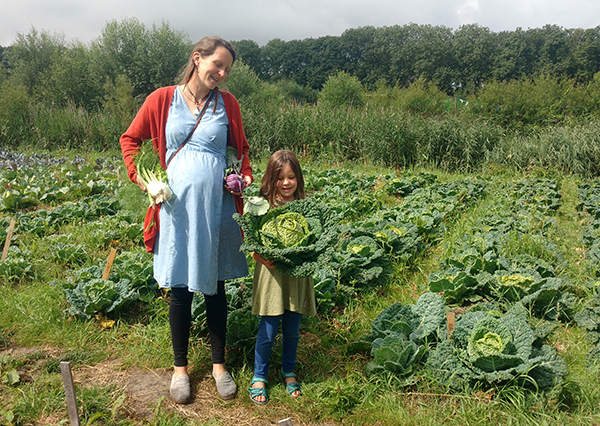 Happy harvesters with savoy cabbage
It’s about the young boy who is proudly using his first Opinel knife to harvest fennel all by himself. It’s about the harvesters who deliver shares to other community members who are in quarantine or to a neighboring refugee family just arrived from Ukraine. It’s about the children who gather around the worm bin and dare each other to hold one of its squirmy inhabitants. Harvesting and all that it entails is a joyful and social act. The interactions within our community weave a resilient web of commitment and engagement.
All Pluk! farmers, past and present, are environmentally, politically and socially engaged beings and this is embodied in how we organize our CSA. We communicate with our community about topics that we feel passionate about: from deforestation in the Amazon to the land struggles faced by Indian farmers and Shell’s activities in the Niger Delta and beyond.
For us, these diverse campaigns and struggles around the world are directly related to the values we are trying to support with our CSA: solidarity, diversity, inclusivity, biodiversity, land rights and food sovereignty. For us, small-scale farming — and particularly community supported agriculture — is a concrete way to create a viable alternative to consumerism and individualism.
Ultimately, our harvesters choose the level of political engagement they feel comfortable with. Although some prefer to quietly harvest their carrots and chives in deep communion with nature, many of the people who find their way to our farm are eager to engage. In pre-COVID times, our harvesters and volunteers organized monthly dinners at a local community kitchen and donated the profits to struggles including the Kurdish Freedom Movement, anti-racism groups and migrant collectives.
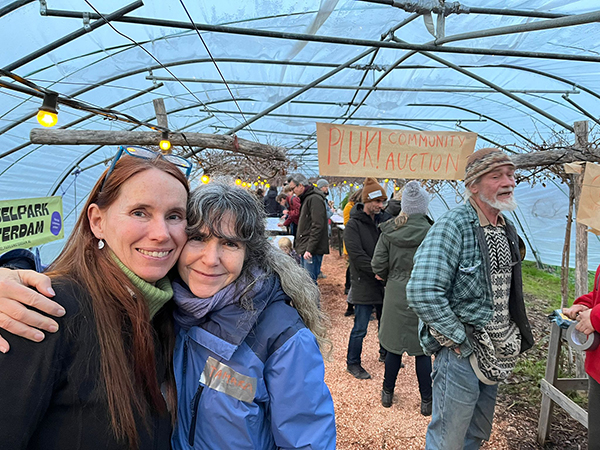 The author (left) and harvester Tamara at their community auction at the end of the harvest season.
There was celebration in our community when the European Union petition — widely circulated by our members — to save bees and farmers from pesticides reached more than one million signatures. In 2021, we were delighted when a group of beaming harvesters joined the agro-ecological block at the climate demonstration in Amsterdam.
Our community has also sprung into action to defend the fertile agriculture soil in the polder behind our fields from the city council’s plans to build mega distribution centers. They have helped to promote the alternative vision for local food production in this polder provided by Voedselpark Amsterdam (www.voedselparkamsterdam.nl). We have calculated that 10,000 local families could be fed from this fertile clay soil, an alternative to senseless destruction to facilitate the on-demand economy that is gobbling up huge amounts of green space in cities around the world.
A living wage for the farmers
We are proud of what we have built together with our community. Every day that we are on the field we feel richly rewarded in the emotional, spiritual and social realms. Securing sufficient financial reward, however, has been a challenge since the outset. Although our wages have slowly crept up since our early years, we consider ourselves lucky if we manage to gross €16 per hour (around $17), the amount that the government has established as a ‘livable wage’ for freelancers.
A great deal of credit for the fact that we have managed to reach the minimum wage can be given to the work of Elske Hageraats, a CSA grower who advocates for just financial rewards for small-scale farmers in her book Eerlijk Loon! (Fair Wages!). Over the past years, her compelling logic and tactics have spread through the Dutch CSA community like wildfire. In her book, Hageraats urges farmers to communicate some of the less visible benefits of their work to their members:
“Agriculture is not just about food production. It is also about supporting a biodiverse ecosystem, continuing to build up the soil and soil life, combating climate change by storing carbon in the soil, preserving the many varieties and thus genetic biodiversity, keeping knowledge alive and continuing to pass it on to future generations, creating beautiful places where people can come together and relax, where children can see where their food comes from, and above all: giving people who want to become farmers the opportunity to follow their dream.”
Hageraats stresses that it is our task as regenerative farmers to claim our contribution to these practices and processes that go beyond the growing of vegetables. If we are to inspire the radical change that is needed, we must educate people about the true cost of food, and communicate about the global food production system that leads to the destruction of nature and the exploitation of small-scale farmers and farm workers to keep prices low.
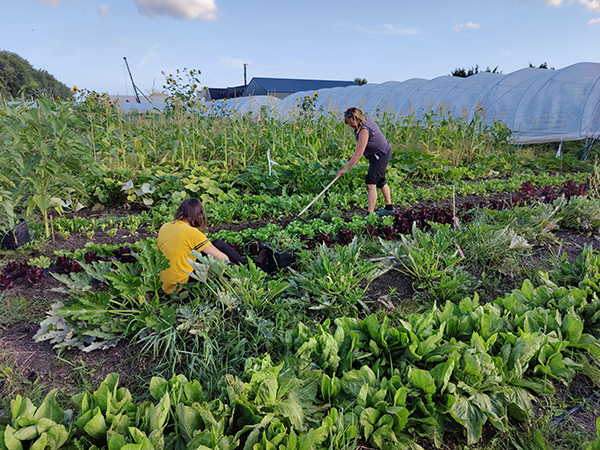 Enjoying the lushness of summer.
We have had a steep learning curve in our quest for fair wages. During the first three years of Pluk! we worked with a fixed cost for our shares. If paying in one go was not possible, we allowed members to pay in installments. Each year, as we noticed how hard we worked and how little we earned, we raised the share price bit by bit. And yet we were still not achieving a financially sustainable situation for the farmers.
When we told our community about the low number of euros we were earning per hour from the CSA — not to mention the side jobs we were working outside of our long farming hours to make ends meet — many were shocked. Some found it uncomfortable to be part of a project that was not managing to pay its farmers a living wage, and proactively asked to pay more. This was welcome, although we also knew that other members were struggling to pay the current share price and did not want to exclude them by raising prices across the board.
The solution, which many farmers around the Netherlands were adopting after reading Hageraats’ book, was the implementation of a sliding scale that allowed harvesters to pay what they could afford for a share. A carrot icon in the middle of the scale indicated the amount that we would need most people to pay in order to secure a living wage for the farmers.
This strategy was quite successful in securing a minimum wage, with most people paying the carrot indication, and those paying less or more balancing each other. Yet, in 2022 we noticed that more of our harvesters were paying below the carrot recommendation, and we were not able to reach the minimum wage using our sliding scale. We are still not sure why: increasing energy, rent and bulk food costs perhaps, coupled with a general feeling of insecurity in a society recovering from COVID and experiencing the impacts of the nearby Ukraine invasion, and feeling the heat of climate change?
At any rate, in 2023 we will take this idea a step further by adopting an income-based pricing system, which will ask people to base their contributions on their own hourly wage. This model was pioneered in 2022 by De Stadsgroenteboer, our buddy CSA in Amsterdam. They had excellent results with many people paying above and beyond what their previous sliding scale had allowed.
This slightly different approach encourages members to think carefully not only about the value of the food they buy from their CSA but about their own economic privilege (or lack thereof). With this system we hope to add a few extra euros to the farmers’ hourly salaries, allowing us to build up pensions, for example, and cover the costs of insurance and taxes.
If this tactic fails at the beginning of the season to bring in a fair wage for the farmers, we will consider the option to hold a ‘bieterrunde’ or ‘bidding round,’ a process popularized by German CSAs. In this scheme, the farmers communicate to their members that they will not start production until they have attained the level of income needed for a fair wage. For the ‘bieterrunde,’ the members are convened prior to the start of the season, either live on online, and the farmers present their costs, the income from shares received to date, and the amount still needed to reach minimum wage. The members then proceed to bid anonymously until the amount required has been raised.
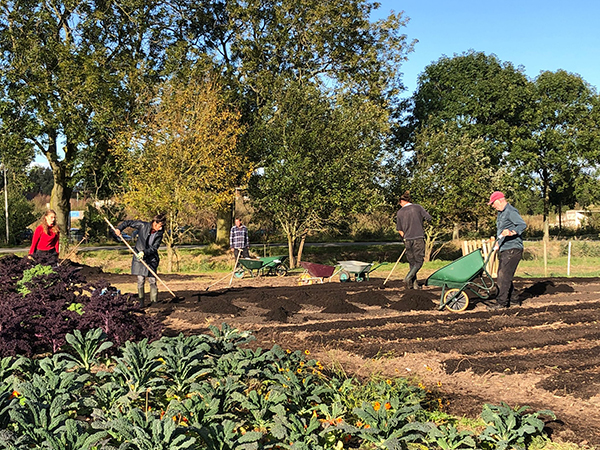 Building beds using ‘no dig’ methods.
In general, the transformation of the food system from large-scale, industrial and polluting to small-scale, local and agro-ecological means that people will need to start paying more for food. In the Netherlands — as well as in other industrialized countries including the United States — the general trend is that food has become increasingly cheaper over the past decades. People have become accustomed to paying increasingly smaller proportions of their income for food. In 1960, for example, the average Dutch household spent 30 percent of its total budget on food. By 1980, that amount had fallen to 16 percent. Today, even with rising food costs, food purchases make up just 11 percent of the average Dutch consumer’s total spending.
This is an important context for the protests and blockades by Dutch farmers that have been on the news over the past years. For decades, the Dutch government has failed to act on data indicating a serious environmental crisis related to the excessive release of nitrogen connected to cattle and artificial fertilizer. The drastic measures now being implemented pose extreme challenges for conventional farmers needing to adapt their practices. Many of these farmers, with the exception of the biggest producers, also have been duped by the hyper-competitive global agriculture system and subject to the downward spiral of income and the squeezing of the market price for their products.
Their environmentally unsustainable practices have been encouraged and supported by the neoliberal Dutch government as well as by the EU’s Common Agricultural Policy (CAP), which has the main goal of increasing productivity. Eighty percent of the CAP’s total subsidies go to 20 percent, the largest farmers, which further stresses smaller farmers and those attempting to produce more sustainably.
Solidarity and inclusivity
Over the past few years, we have become better at explaining the deeper and more lasting importance of our work and asking our community to support us financially as far as they can. However, we are still faced with the thorny challenge that as we move towards fair wages for the farmers, our project becomes increasingly inaccessible for some of the local population. Even at the lower end of our sliding scale, and even with flexibility in spreading out payments, our prices are out of reach for many Amsterdammers. Visitors to the farm from the direct neighborhood regularly admire our fava beans or pumpkins and express interest in taking part in the CSA, yet their faces fall when they hear the costs.
This presents us with a dilemma: how can we pay ourselves a living wage yet at the same time include a crucial segment of the population, perhaps those who could most benefit from our nutritious vegetables and community experience? How can we extend the solidarity aspect of our project further to include everyone who wants — and has the right to — fresh, local food? Could there be other barriers to inclusion in our CSA beyond the price, such as cultural barriers that lurk in our largely white middle-upper class community?
Now that we have made important headway in securing a stable income for the farmers, we will turn our attention to tackling these challenges. With our thoughtful and engaged community and using our core vision of solidarity as a framework, we are hopeful that we will find a more inclusive way forward.
Ann Doherty is a co-founder of Pluk! and farmer at Pluk!’s Boterbloem location. Pluk! is a self-harvest CSA with two locations just outside of Amsterdam. For more information go to plukcsa.nl. For more information about fair wages for farmers: https://www.youtube.com/watch?v=5mKjggqKBdg or contact Elske Hageraats, elske.hageraats@gmail.com.
Copyright Growing For Market Magazine.
All rights reserved. No portion of this article may be copied
in any manner for use other than by the subscriber without
permission from the publisher.