











In this article I cover aspects of growing potatoes that I did not review in previous GFM articles. To come up to speed, take a look at the January 2022 article on planting and green sprouting potatoes (including stages of growth); October 2021 covered harvest and storage; November 2008, root cellars; and in February 2008 we covered succession planting.
Crop rotation and cover crops
Crop rotation is very important for potatoes, which are nightshades like tomatoes, peppers and eggplants. Colorado potato beetles emerge from the soil in spring and walk (they don’t fly at this stage) toward the nearest nightshades they can detect. Give them a long hike. A distance of 750 feet (230m) or more from last year’s nightshade plots should keep them away. A three-or four-year rotation out of nightshades is ideal.
Suitable cover crops before potatoes include brassicas (which can help reduce root knot nematodes and Verticillium), Japanese millet (which can reduce Rhizoctonia) and cereals in general. Beware beets, buckwheat and legumes such as clovers and some peas and beans, as these can host Rhizoctonia and scab.
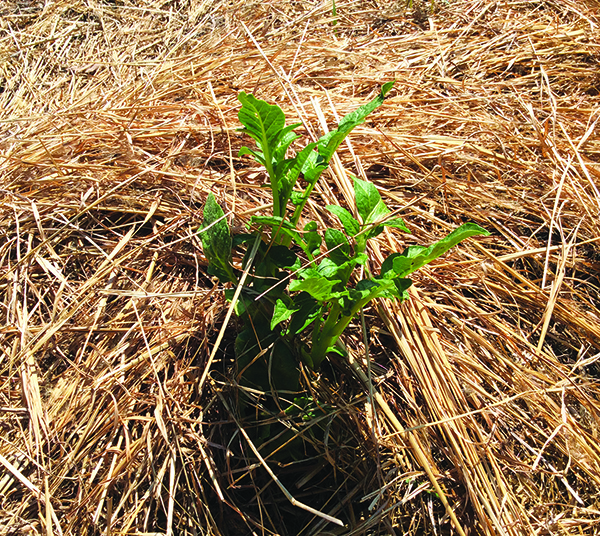
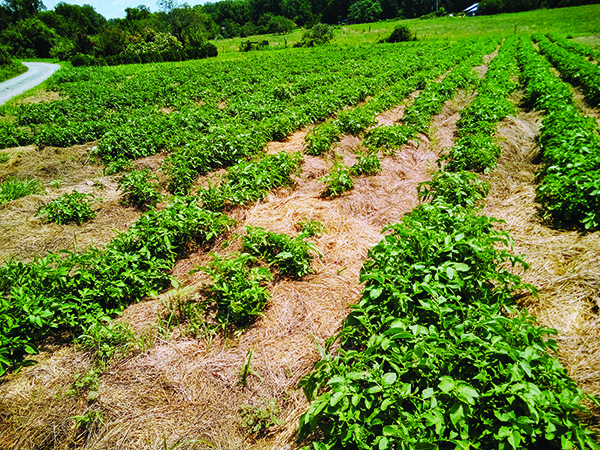 Potato patch mulched with hay in the summer. Photo by Pam Dawling.
Our March-planted potatoes follow a winter cover crop mix of oats and soy (which winter-kill in our zone 7a climate). This cover crop is undersown in our late sweet corn 30 days after sowing the corn. Our June-planted potatoes follow a winter cover crop mix of winter wheat or winter rye and crimson clover. (Yes, we risk the clover.) This mix is sown in early-to mid-October after our middle planting of sweet corn. We read potatoes do well after corn, so we set up our crop rotation that way. Perhaps because corn is a grass it helps reduce Rhizoctonia.
After harvesting our March-planted potatoes in mid-July, we regularly did a fast-turnaround and transplanted our fall broccoli and cabbage there in late July. We under sowed that with a clover mix four weeks after planting the brassicas. We kept the clover mix for an all-year green fallow, until February a year and a half later.
This fast turnaround was nerve-racking, so we no longer do that. We simply follow the potatoes with the clover mix and transplant the brassicas elsewhere. After harvesting our June-planted potatoes in October, we sow winter wheat with crimson clover if by October 15, or winter rye and Austrian winter peas, if later.
Lifecycle
When the leaves start to turn pale, potatoes have finished their leaf-growing stage and will put energy into sizing up the tubers. Avoid irrigating at the end of the growing period or the potatoes may develop hollow heart, make knobby secondary growths or even crack. For maximum yield, wait until the tops are completely dead.
Whether the vines die naturally at the end of their lifespan, or die of disease, or frost, or by mowing or flaming, it helps storability to wait two to three weeks before harvesting to let the skins toughen up. However, if potatoes are going to succumb to late blight, harvest them before the blight makes its way from the leaves down into the tubers; late blight will rot the potatoes if the infection reaches the tubers.
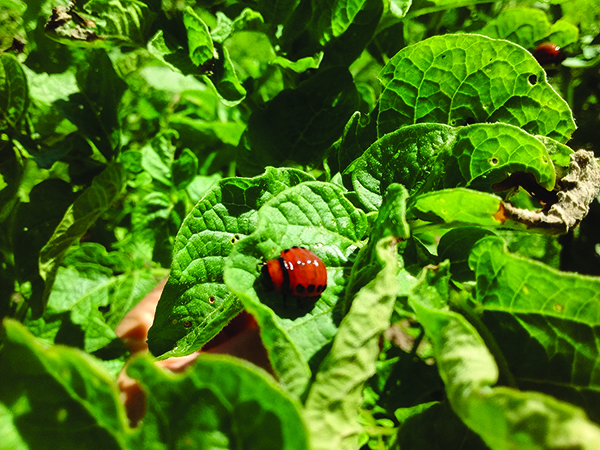 Closeup of a Colorado potato beetle larva. Photo by Pam Dawling.
Skins become more resistant to scrapes and bruises, and the potatoes become higher in dry matter if you can leave them in the ground for a couple weeks after the tops die. Test by digging up a sample and rubbing the skins. When the skins don’t break, the potatoes are storable. Harvesting is also easier if the vines are well dead.
Potatoes have a natural dormancy of 60 to 130 days (depending on the variety and storage temperature). After that period, they will start to sprout.
Weed management
Potatoes are said to be a “cleaning” crop, as if they did the weeding themselves. Not so. Any cleaning that takes place is a result of cultivation. As with many plants, the initial growth stage is the most critical for weed control. Hilling in sunny weather once the plants are six inches (15 cm) tall (piling soil over most of the leaves) can deal with lots of weeds in a timely way, especially if the machine work is followed by the crew passing through the field hoeing. Organic mulches also reduce weeds.
Later in life potato plants produce a closed canopy that discourages weeds until the tops start to die. Mary Peet in her 1996 book, Sustainable Practices for Vegetable Production in the South, reports that potato yields were decreased 19 percent by one red root pigweed per meter of row left growing for the entire season.
In wet weather it can be impossible to hill when you want to, and flaming can save the day. Flaming is not an alternative to hilling, but it can buy time and deal with rampant weeds if the soil is too wet. Potatoes may be flamed at 6 inches to 12 inches (15–30 cm) tall. Beyond that, flaming is not recommended. See ATTRA Flame Weeding for Vegetable Crops.
Flaming when the potatoes are less than 8 inches (20 cm) tall is also an effective control measure for Colorado potato beetles. Choose a warm sunny day when the pests are at the top of the plants. Flaming can kill 90 percent of the adults and 30 percent of the egg masses, according to ATTRA.
Biological IPM disease and pest reduction
Biological Integrated Pest Management [IPM] tackles problems one step at a time with ecologically based practices, starting with actions to reduce chances of pests getting a grip on your crops. Because nightshades have a lot of fungal, bacterial and viral diseases, it pays to minimize the chance of diseases attacking your plants.
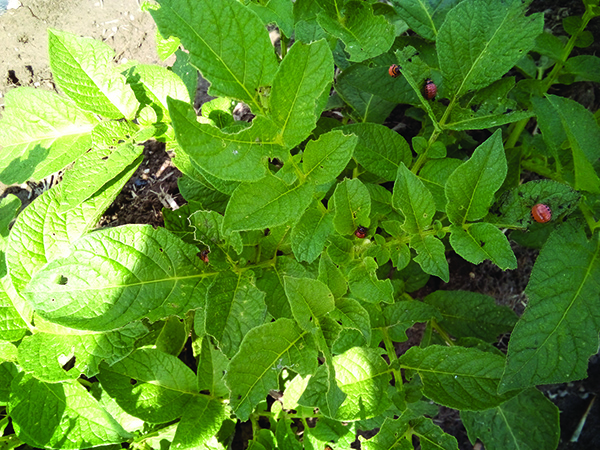 A light infestation of Colorado potato beetle larvae, and the damage they cause. Pam Dawling.
I recommend the ATTRA online publication Organic Integrated Pest Management. Each page is a poster, complete with photos and clear concise information. Another good resource is the Integrated Pest Management in Organic Field Crops Webinar from eOrganic on YouTube. To use IPM practices to head off pest and disease problems before they occur, cultivate strong crops and provide healthy soil, sufficient space, nutrients and water, suitable soil pH and temperature. Choose varieties that resist the most likely pests and diseases.
Improve the soil tilth, drainage and aeration. Chisel plow or broadfork to break hardpan, or grow deep-rooting cover crops ahead of your potatoes. Maximize air circulation. Choose a bright, breezy location (avoid frost pockets that collect dew), orient the rows parallel to prevailing winds and give the plants plenty of space.
Add compost and cover crops to build fertile soil to support strong plant growth and help increase the diversity of soil microorganisms, building naturally disease-suppressing soil. Use foliar sprays of seaweed extract, microbial inoculants or compost tea to boost general disease resistance. Consult ATTRA (The National Sustainable Agriculture Information Service) for compost tea information.
Rotate crops to reduce the chances of pests and diseases carrying over from one crop to the next. Practice good sanitation. Clear old crops promptly, so they don’t act as a breeding ground for pests or diseases. Avoid smoking tobacco, especially near nightshades, and have smokers wash their hands with soap or milk before working with potatoes. Tobacco can spread tobacco mosaic virus (TMV) to nightshade crops. Avoid working potato plants while the leaves are wet. Remove and destroy diseased plants. Clean tools in between use in one field and another. When the harvest is finished, till the tops into the soil to speed decomposition, or remove and compost them.
Remove nightshade weeds (e.g., horsenettle, jimsonweed and black nightshade), which can be alternate hosts for pests and diseases. Prevent soil splash-back onto leaves, to reduce outbreaks of soil-borne diseases. Use drip irrigation rather than overhead sprinklers.
Cover or protect the plants physically from pests. Mulch to stop soil-dwelling pests (CPB) moving up into your crops. Net or row cover to protect from airborne pests (leaf hoppers, blister beetles).
Provide habitat for natural enemies and other beneficial insects. Farmscaping with sunflowers, peas, vetch, buckwheat or small grains, to encourage ladybugs and lacewings, can make insect control unnecessary in a good year. Ground beetles and bats can consume surface and air attackers.
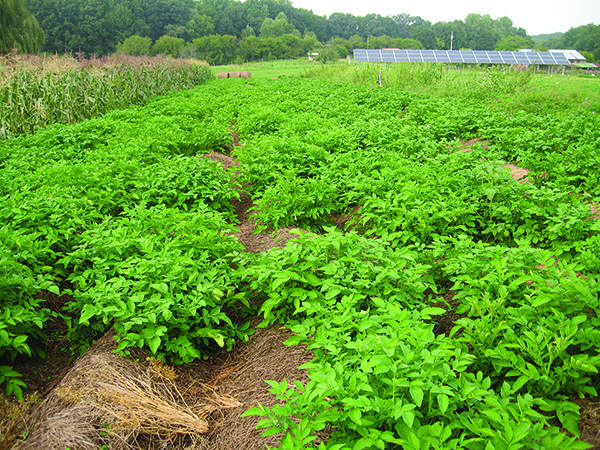
Monitor your crops regularly once a week and identify any pests you see. Introduce natural enemies of the pest (bacteria, fungi, insect predators or parasites). Try biofungicides against some diseases. F-Stop, T-22G Biological Plant Protectant Granules or other forms of Trichoderma can control Rhizoctonia, Fusarium and Sclerotinia. Soil-Gard (Gliocladium virens) can work against Rhizoctonia. Bacillus subtilis works against Rhizoctonia, and Sclerotonia. Mycostop (Streptomyces griseoviridis) can be used against Phytophthora, Alternaria, 35% hydrogen peroxide diluted to a 0.5–1% foliar spray solution may help control early blight. 1% solution = 3.7 oz in 124.3 oz water to make one gallon (1 ml:33 ml).
If the pest population is above the action threshold, hand pick (or trap) and kill the pests. After trying the earlier steps in the process, if the damage is still economically significant, use organically-approved biological controls including Spinosad or Bacillus thuringiensis [Bt].
Pests
Potatoes can be attacked by more than 150 insect pests. Don’t despair. In each region only a few species cause unacceptable losses of yield or quality, resulting either directly from insects or indirectly by disease transmission.
Colorado potato beetles, which lay eggs in clusters of 20 or more, are the most common. They look like ladybug eggs with a stronger orange color — don’t kill the wrong ones. The beetle can go from egg to adults in as few as 21 days. The pink blob-like larvae has four instar stages, and 75 percent of the total foliage destruction is caused by the final, biggest instar. Left alone they can kill a planting.
Acceptable amounts of defoliation that don’t cause loss of yield are surprisingly high: 50 percent to 75 percent of the top leaves on a young 6 to 8 inch (15–20 cm) plant; 25 percent on a 12 inches to 16 inches (30-40 cm) plant; a mere 10 percent at the critical full bloom stage (when the tubers are sizing up); and up to 25 percent once full grown. As with many pests, having a few of them is not a big problem — it’s all about the numbers.
I scout once a week, counting adults and larvae on a hundred randomly selected plants. As soon as I see more than 50 adults or 150 large larvae or 400 small larvae, or egg masses on more than 10 plants, per 100 plants, I spray. I use Spinosad, a fermentation product of a soil bacterium. It kills insects by over-stimulating their nervous systems.
Spinosad kills a wide range of helpful and harmful insects, so spray in the early morning or late evening when bees are not flying. It’s the most effective when pest insects eat it, but keep it off beneficials as much as possible. Shake the bottle well, and follow the instructions. Clean and triple rinse the sprayer. Do not flush in the creek or pond. Repeat in six days, but only if needed. Usually one spraying is enough, although I continue weekly checks.
Crop rotation is effective, as mentioned. Mulching with hay or straw can prevent the beetles from finding your potato plants. We never have them on our mulched summer planting. CPB can produce one to three generations a year (three in the South). A significant portion of the summer generation adults go directly into the soil and become dormant.
Prior to using Spinosad, we used Bt. The version of Bt for CPB is Bacillus thuringiensis var. tenebrionis. It works for small larvae only. Neem and Beauvaria bassiana can also kill CPB larvae. Flaming was mentioned above.
Insects with piercing-sucking mouthparts damage potato leaves, sucking out phloem, injecting their toxic saliva and possibly transmitting diseases. While potatoes can grow new leaves, there is still damage to plant health. Sap-feeding insects can directly kill the plant.
Aphid-transmitted viruses cause greater losses than all other insect-related damage together. There are at least nine aphid-transmitted potato viruses. Aphids can be reduced by farmscaping, planting flowers to attract ladybugs, lacewings and other aphid-eating insects.
Potato leafhoppers are a bad problem in central and eastern North America. They overwinter on the Gulf Coast. In spring, flying adults are transported north on upper-level airstreams. Yield loss can occur before damage (“hopperburn”) is visible. The initial effects are reversible if leafhoppers are controlled before leaves shrivel and die.
By reducing the green leaf area, hopperburn affects photosynthesis and growth. The most vulnerable stage is when the tubers are bulking up. Leafhoppers can also transmit diseases. Trichogramma wasps parasitize leafhopper eggs. Garlic with insecticidal soap, sprayed early in the morning, especially on the undersides of the leaves, can control hoppers.
Potato psyllid occurs in the western U.S. Damage to the roots and tubers is caused by feeding nymphs, which can cause psyllid yellows. The first symptoms include stunting, loss of green color, leaflet distortion, reddish discoloring of new leaves, and the appearance of aerial tubers. Early action can stop and even reverse the damage. Adults cause little to no damage underground.
Wireworms (click beetle larvae) can tunnel through the tubers. Wireworms can live for one to three years, so crop rotation is important. Avoid planting potatoes the first year after turning under pasture or lawn. If you expect to have wireworms, plant small whole seed potatoes rather than cut pieces.
Cutworms can eat the leaves from the bottom of the plant up (the opposite approach from CPB larvae). Once the plants are fully grown, up to 75 percent loss of lower leaves is unimportant. At earlier stages if any cutworm damage is seen, dig around the stem, find and kill the cutworms.
Blister beetles can cause trouble later in the season, skeletonizing leaves and spreading a wilt. They contain cantharidin, which can cause skin blisters on unwary workers. Blister beetles can be trapped in chard or beet crops next to the potatoes. The beetles are easier to see and catch in the trap crops than in potato foliage. If there aren’t too many, it may be worth putting up with them, as their larvae eat grasshopper eggs.
The potato tuber moth damages growing foliage and tubers, but the biggest losses occur in storage. Larvae inside the potatoes can continue their development, filling the tubers with frass and letting in decay organisms.
Nematodes can be deterred by choosing appropriate preceding cover crops, or by applying to the soil 1 to 2 tons per acre (2240-4480 kg/ha) of crushed mustard seed meal before planting. This will also reduce early weeds and act as a fertilizer.
Diseases
Three conditions must exist before a plant can become diseased: a susceptible host, a disease organism, and a suitable environment for the pathogen. The choice of the disease control method should be based on an accurate identification of the pathogen and the disease.
Late blight (Phytophthora infestans) is by far the worst disease to afflict potatoes. This is the disease that contributed to the famine in Ireland. (Profiteering English land-owners sold the barley and left the tenant-farmers to subsist almost entirely on potatoes.) The disease is caused by a fungus-like oomycete or water mold (previously considered a fungus, now reclassified as protozoa) that blows in on the wind.
It is worse in warm wet weather with cool nights. Late blight starts as “water-soaked” spots on the leaves. These expand into gray-black “scorched” areas, sometimes with a dotted white mold growth on the underside of the leaves. Cut stems reveal a dark circle of infected tissue. The disease spreads rapidly, turning plants black, as if badly frosted, and can kill an entire planting in 10 days unless stopped by hot dry weather. Heat stress can mimic the symptoms of late blight, apart from the white dots.
The best defense is to always remove volunteer nightshades from your fields and compost or incorporate all crop debris. The disease spreads via cull piles, and other nightshade plants — it needs live plant material to survive. If you find volunteer potato plants popping up in early spring, pull them up. Spores survive winter in warmer climates and then blow north. Preventive action may be taken with sprays every five days of (toxic) copper products, hydrogen peroxide, Bacillus pumilus or Bacillus subtilis.
If late blight occurs late enough in the season, you can save your crop by mowing off the foliage, raking it off and disposing of it. Then, leave the field untouched for two weeks before harvesting whatever potatoes have grown. Disposing of large amounts of blighted foliage is no easy task. When I dealt with late blight back in the 70s, we made a fire and gradually added more tops as the previous ones burned. This was a very smoky fire, polluting, and no doubt contributing to global warming. Digging a big hole and burying it all is probably better.
Early blight (Alternaria solani) is a common fungal disease, which mostly affects stressed or older plants. It starts as small brown spots on the lower leaves, which conglomerate into brown blotches that are restricted by the leaf veins. The lesions have a bullseye appearance — concentric circles with a yellow halo around the outside.
During warm humid conditions, the fungus steadily defoliates the plants, reducing yields. The disease is seed-borne, soil-borne and airborne, surviving on plant debris and nightshade weeds. Early blight can appear late in the season, not just early, despite the name. The disease symptoms can be minimized by growing strong healthy plants, supplying sufficient water, and spraying with compost teas. The beneficial fungus Trichoderma harzianum can give good results.
Black Scurf or Stem Canker fungus (Rhizoctonia solani) is worst in cold wet soils. Early in the season it can cause sprout death. On older plants, red-brown stem lesions develop into cankers, and the infection can spread to the tubers, which then become cracked and misshapen, and may have dead tissue at the stem end. There may be firm black sclerotia (small dried reproductive bodies) on the tuber. In the future, get disease-free seed potatoes and wait for the soil to warm a bit before planting.
White Mold (Sclerotinia sclerotiorum) on the vines can be prevented by dusting the seed pieces with the fungal antagonists Trichoderma viride and Trichoderma virens. For a chart with about 30 potato diseases, see The Potato Association of America’s guide, Commercial Potato Production in North America.
Pam Dawling works in the 3.5 acres of vegetable gardens at Twin Oaks Community in central Virginia. Her books, “Sustainable Market Farming: Intensive Vegetable Production on a Few Acres,” and “The Year-Round Hoophouse,” are available from Growing for Market. Her weekly blog is on her website and on facebook.com/SustainableMarketFarming.
Copyright Growing For Market Magazine.
All rights reserved. No portion of this article may be copied
in any manner for use other than by the subscriber without
permission from the publisher.